

Software development is one of the most critical choices that businesses will make in 2026, whether in-house or outsourced. With technological projects being increasingly complex and competitive, companies need to select the appropriate model of development with great caution on the basis of cost, speed, quality, and scalability. In-house software development involves the creation and maintenance of an internal development team in the company. Such an approach will provide a good control mechanism to the development process, facilitate communication, and coincide with the business goals. It is primarily desirable when long-term products are involved where ownership and in-depth internal knowledge are paramount. Nevertheless, it is also accompanied by the challenges of being expensive to hire and run, extended recruitment times, and lacking scalability.
Outsourced software development, in contrast, is the collaboration with independent professionals or companies to develop projects. This model can provide easy access to a talented and skilled workforce, reduce the costs, and expedite the project implementation. Outsourcing nowadays is more mature and incorporates such options as a dedicated development team, staff augmentation, and long-term engagements and hence is more dependable and adaptable in comparison to traditional outsourcing. Due to the obvious benefits and drawbacks of both models, nowadays, hybrid solutions have found their place in many enterprises according to their objectives.
This blog will thoroughly compare in-house and outsourced software development, including all advantages, disadvantages, and the expenses involved with the purchase and development of software so that you can decide on the appropriate model to pursue for the business.
Understanding In-House vs Outsourced Software Development
The businesses of 2026 usually decide between in-house software development and outsourced software development using factors such as cost, speed, quality, and scalability. The two models are commonly employed according to the demands of projects and business objectives.
What is In-House Software Development?
In-house software development is a scenario whereby a firm develops an in-house software development team to design, develop and maintain software. This team typically consists of developers, designers, QA engineers, and project managers working within the organization. With this kind of a model, businesses have complete control of the development process, improved communication, and high alignment to the long-term objectives. It is mostly applied to projects that require a high level of security, ownership, and development. It can, however, be expensive because of recruitment, salaries, training, and infrastructure, and it needs a long time to expand the team.
What is Outsourced Software Development?
Outsourced software development refers to the process of outsourcing software development activities to another company or a development team. It allows firms access to highly skilled developers and saves money and does it in less time without hiring an entire internal development team. Other varieties of modern outsourcing include dedicated development teams and staff augmentation that are more flexible and interactive. Nonetheless, it needs effective communication, adequate planning, and effective control in order to sustain quality and business objectives.
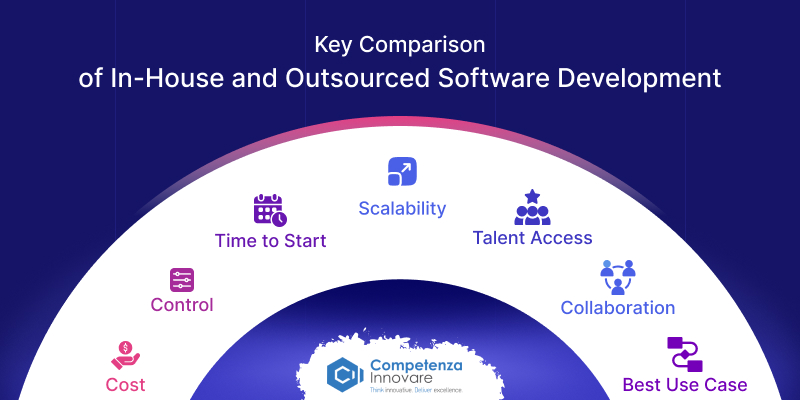
Key Comparison of In-House and Outsourced Software Development
The decision between in-house and outsourced software development is based on the balance of price, speed, control, and scalability of the business. Both models are commonplace but address different needs of businesses.
| Factor | In-House Software Development | Outsourced Software Development |
| Cost | Increased due to recruitment, wages, and facilities. | Outsourced and thus more flexible and cost-effective. |
| Control | Complete autonomy in team and product building. | Shared control with external development partner. |
| Time to Start | Reduced in speed by recruitment and boarding. | Quick and on-site skilled teams. |
| Scalability | Restricted by in-house recruitment. | Easy to scale teams based on project needs |
| Talent Access | Relies on local recruiting. | International access to developers and expertise. |
| Collaboration | Face-to-face communication in team. | Needs to be organized and managed. |
| Best Use Case | Long-term, core business products. | Quick deployment, MVPs, and agile projects. |
Cost Comparison: In-House vs Outsourced Development
Cost is one of the critical aspects that should be looked at when determining the choice of in-house software development or/and outsourced software development. Businesses tend to have a comparison of costs borne in total software development and not only salary, hiring, and infrastructural and long-term maintenance costs.
| Cost Factor | In-House Software Development | Outsourced Software Development |
| Hiring Cost | High (recruitment, interviews, onboarding) | Low (handled by outsourcing partner) |
| Developer Salary | Monthly fixed salaries + benefits | Included in project or hourly cost |
| Infrastructure | Office space, equipment, tools required | Not required (handled by vendor) |
| Training Cost | Continuous investment needed | Minimal or none |
| Scalability Cost | It’s expensive to scale team quickly | Easy to scale up/down on demand |
| Project Cost Model | Fixed long-term operational cost | Flexible (hourly / fixed / dedicated team) |
| Total Cost Impact | High long-term investment | More cost-efficient and flexible |
Key Takeaway:
In-house = More expensive fixed cost, total control.
Outsourcing = Reduced flexible cost, scaled-up faster.
Costs of software development hiring in comparison with outsourcing costs are what most companies consider before making a decision of which model to use to harness their business growth.
Also Read: How to Reduce Software Development Costs Without Cutting Quality
Pros and Cons of In-House Software Development
One of these models is in-house software development, in which businesses create their own internal technology team and operate it. Companies often prefer it when they desire high levels of control, enhanced communication, and a lasting development of their product. Nonetheless, it is also associated with a large investment and management.
Pros of In-House Development
- Full Control of Development: The company has full control of the development process, the team, and the product roadmap that helps in a good product direction.
- Greater Emphasis of the business Vision: In-house teams ensure that maintenance of communication between them and the business stakeholders is more efficient and that more companies adhere to the vision set by the company.
- Enhanced Security: The best business data, codes, and intellectual information are stored in the organization, and the risks of outside security are also reduced.
- Long-Term Product Knowledge: The in-house staff acquires full product knowledge over time, contributing to the decision-making and further development.
Cons of In-House Development
- High Cost of Software Development: This firm will be forced to pay wages, recruitment, training, equipment, hardware, and payroll benefits, and it is a costly model.
- Slow Hiring: It is also possible to take time to find good developers and compile a strong team that reduces the speed of the project completion.
- Poor Scalability: It is able to scale up with much difficulty when new skills or increased development capacity are needed by the team.
- More Intensive Management Intervention: This entails constant HR, training, and internal coordination, which injects operational workload.
In-house development suits well the company requiring complete control, high security, and long-term stability of products. But when it comes to businesses that need to scale faster, at a lower price, and have the flexibility to grow, outsourcing can be a more efficient choice.
Also Read: How to Rescue a Failing Software Development Project
Pros and Cons of Outsourced Software Development
Outsourced software development is a type of model where companies pay third-party teams or agencies to create or maintain software projects. Businesses and startups favor it due to its faster delivery and access to skilled people and less stringent development costs. But as with any other model, it has its shortcomings, as well.
Pros of Outsourced Software Development
- Lower software development expenses: Outsourcing is less costly in staff, salary, equipment, and training. The amount of money businesses will spend on services or resources they only need.
- Rapid Project Implementation: Any external team is already at work and is also already qualified to support rapid development and reduce time-to-market.
- Access to International Skills: Companies can hire skilled programmers and professional labor forces at any place anywhere in the world without any restriction of space.
- Scalability with Ease: The teams are easily able to be expanded or reduced depending on projects’ needs; hence, it is extremely adaptable in relation to expanding businesses.
- Contemporary Collaboration Models: Staff augmentation and full-fledged development teams surge augmentation models and intensified collaboration within a timeframe, advanced control, and communication.
Cons of Outsourced Software Development
- Reduced Level of Direct Control: Business does not have overall control of the day-to-day development decisions as it does with in-house teams.
- Communication Issues: In the case of collaboration, there are times when time zone differences, language distribution, or needs can be an issue.
- Dependence on External Team: Over time internal technical knowledge may be worn out by employing an external vendor.
- Risks of quality management: Project quality and consistency might be compromised unless it is managed and properly documented.
Outsourced programming is more suitable for the firms that want to cut the cost, have faster implementation, and have scalability. With effective communication and an appropriate partner, it could yield good results while cutting down operations.
Dedicated Team vs Staff Augmentation vs In-House Model
Businesses consider in-house teams, dedicated development teams, and staff augmentation models when they are deciding on a development strategy. All the models provide varying degrees of control, flexibility, and cost effectiveness based on project requirements.
In-House Development Model
In-house development implies forming a complete internal team to manage software development. It provides complete control and enhanced communication and is well integrated with business objectives but is also expensive, slower to staff, and less scalable.
Dedicated Development Team
An external team that solely works on your projects is known as a dedicated team. It provides a level of control and flexibility, as it has a faster setup and access to skilled developers. It is most suitable to long-term projects that require continuous development.
Staff Augmentation
Staff augmentation refers to incorporating outside developers in your team. It can be used to bridge skill gaps and ramp very quickly without losing control in-house. It is suitable for short-term needs or emergency scaling of projects.
Also Read: How to Evaluate a Software Development Partner
When to Choose Outsourcing vs In-House Software Development
Whether to outsource or develop an in-house software will depend on your business goals, budget, and your time to scale and develop your product. The two types can be effective in different situations, and the applicability of the two depends on the intensity of the project and its long-term strategy.
Not sure which development model fits your business? Let our experts help you choose the right approach.
When Should You Outsource Software Development?
A strong alternative to outsourcing is one where the businesses require speed of delivery, cost reduction, and flexibility without building the entire in-job team. Startups and expanding businesses have broadly exploited it in the need to experience rapid growth and get access to a pool of talent available.
- Small startups with small budgets that require low-cost development.
- The MVP development, where wholeness and market testing are prioritized over structure in the long term.
- Quickly scaling businesses that require additional developers.
- Work in the short term on projects or jobs without any long hiring agreement.
- The availability of world talent by outsourcing software development.
Outsourcing software development to startups is also tried by many companies when they need to start in a hurry and spend less upfront. Also, it often occurs when corporations cross the question, Should I outsource software development? to compensate between expense and speed.
When Should You Build an In-House Team?
An in-house team is most appropriate when a business requires longer-term control and ownership of the product and consistent development. It is appropriate to use in companies where software is an essential aspect of operations and needs internal understanding.
- Continuous updates and development of the product in the long run.
- Standard business systems and internal platforms.
- Extremely secure projects that need a high level of data control.
- Complex requirements of enterprise-level applications.
- Firms that emphasize the creation of good internal technical expertise.
When an organization thinks about building an in-house development team, it is based on its long-term in-house software development plan.
Risks & Challenges in Both Models
In-house and outsourced software development have some risks that may affect the cost, quality, communication, and deliveries of the project. This knowledge of these challenges enables companies to select the correct model and minimize the possible development challenges.
Outsourcing Risks & Challenges
Outsourced software development is popular with its flexibility and cost savings, yet it also needs good coordination. Quality control is one such issue where the external teams might not have clarity on the vision of the product or the business objectives in the beginning. The other problem is the existence of communication gaps, particularly in the situation of work in various fields and times, which may influence the speed of feedback and the project. In others, failure to have proper documentation and project management may result in delays or mismatched expectations of the project.
In-House Risks & Challenges
In-house software development carries solid control and superior compatibility, but it postulates more challenges towards its running. High costs, such as salaries, hiring, infrastructure, and long-term employee maintenance, are the biggest problem and raise the total software development costs. Another challenge is slow hiring and onboarding. It is time-consuming to find qualified developers, and it may slow down the project. Also, quick team scaling is challenging when new skills are required, potentially decreasing the flexibility of fast-changing project requirements.
Outsourcing risks are primarily associated with communication, quality, and coordination, whereas in-house risks concern primarily cost, delays during hiring, and scalability. As a way of handling these risks, many companies select well-experienced development partners or even resort to a hybrid development model.
Conclusion
Both in-house and outsourced software development are powerful models, but they serve various business requirements. In-house development suits best business ventures that are interested in complete control, great security, and long-term ownership, although it is costly and time-consuming to develop and maintain a team. Outsourced software development can work with businesses that require a quicker delivery and saving of costs as well as having access to high-level talent in the world; however, it requires effective communication and proper project management. Most of the companies are now utilizing a hybrid model by both methods in order to achieve higher output. Ultimately it is up to you and your objectives, budget, and time frame. The selection of an appropriate development strategy with a preferred partner such as The Competenza can assist in creating trustworthy, scalable, and high-quality software systems.
FAQs
What is the in-house software development?
In in-house software development, an organization forms an internal staff to design, develop, and maintain software products. The team is directly engaged in the organization and adheres to internal processes and objectives. It has complete control of the project, good collaboration, and more alignment with business needs. Nevertheless, it involves increased investment in staffing, wages, training, and infrastructure and thus a long-term commitment.
What is the outsourced software development?
Outsourced software development can be defined as the act of hiring a third-party firm or even team of software developers to undertake software projects. This helps the companies to access a pool of talent in terms of developers without necessarily developing an in-house team. It helps to reduce the costs, speed up the development cycle, and increase scalability. It, however, involves effective communication, planning, and coordination in order to achieve quality findings.
What is the main difference between in-house and outsourcing?
The primary disparity is control and flexibility. In-house development offers full control, ownership, and in-house communication. Outsourcing rescues additional time and minimizes cost and also offers access to international talents. The two models are usually used depending on the business goals and the magnitude and time of the projects.
which is better in-house or outsourcing?
Outsourcing tends to be a cheaper option since it eliminates costs such as hiring, wages, training, and IT. Internal development necessitates long-term funding to carry a full-time staff. Localized costs of software development are what businesses typically match the two models up on, rather than demanding only initial costs.
When is outsourcing appropriate to a firm?
The companies need to select outsourcing in cases where they require delivery within a shorter time frame, MVP development, or attainment of cost-effective solutions. It can also come in handy whenever they desire to climb the ladder at a fast pace without developing a complete in-house team. New companies and expanding businesses are more likely to outsource in case of less time-to-market and more core business.
When does a company develop an in-house team?
A permanent staff would be suitable when the company has long-term projects and business central systems and when the project is of high security. It is appropriate when the firms require total control, ongoing growth, and profound knowledge of products. This model is appropriate in an environment of stable large-scale businesses.
What are the outsourcing software development risks?
Examples of outsourcing risks can be as follows. There will be a lack of communication, quality control problems, time zone disparities, and reliance on outside teams. Unless addressed effectively, these obstacles will have an impact on project delivery. The risks may be minimized by selecting a long-time development partner.
What are the cons of in-house development?
In-house development is an expensive process, time-consuming in hiring, and also not very scalable. Firms should also invest in ongoing training, infrastructure, and team management. It can be hard to scale the team within a short period of time when it is high urgency.
What is a committed development team?
An external team is a dedicated development team that is assigned to work on a single project of a company. It is a virtual addition of the internal staff and provides scalability and flexibility. This model is best in long-term projects that require steady developmental support.
What is a hybrid development model?
The hybrid model would be a combination of both the in-house and outsourced teams. Organizations engage internal personnel in core activities and jobs and outsource work requiring specialization or large-scale work. This strategy is conducive to balancing cost, control, and flexibility and therefore is a popular modern development strategy.