

The cost of software product development is diverse depending on the complexity of the product, features, and the method of development of the product. The cost of developing a software product can range between 10,000 to create a simple MVP and 500,000 and above to develop complex enterprise systems. This variance is such that each product needs different things. Simple MVPs are those applications with only core features, and the cost of the MVP development is low, whereas the SaaS platform and enterprise apps demand a scalable architecture, integrations, security layers, and cloud infrastructure, which raises the total cost of the application development. These differences are necessary to be analyzed in order to estimate software cost and properly plan software development costs by considering the different traits of software development prior to launching any project.
The overall cost of custom software development depends on various factors, including complexity of the features, UI/UX, technology stack, location of the development team, and timing of the project. Moreover, hourly rates worldwide and outsourcing models may have significant influence on the overall software cost estimation, so budgeting planning is a very important step before the commencement of development.
This guide will also take down the actual software product development estimate, discuss the important cost of pricing, explain the differences between MVP and full product investment, and get you to gain insight into how to plan your software budget with a clear approach to software pricing guidance.
Quick Answer—Software Product Development Cost in 2026
The software product development cost in 2026 will be subject to the complexity, features, technology stack, and scalability needs of the product. In most instances, however, most software products fall in defined pricing ranges, which are used in cost estimation of software development and in early application development cost planning.
Software Development Cost Breakdown:
| Product Type | Cost Range | What It Includes | Example Use Case |
| MVP (Minimum Viable Product) | $10,000 – $40,000 | Core features only, basic UI/UX, simple backend, and limited functionality to validate the idea | Startup MVP, idea validation, early product launch |
| Mid-Level Software Product | $40,000 – $150,000 | Advanced features, third-party API integrations, user dashboards, improved UI/UX, and scalable architecture | SaaS platforms, business tools, customer management systems |
| Enterprise Software | $150,000 – $500,000+ | Complex architecture, high security, cloud infrastructure, automation, and enterprise-grade integrations | Large-scale enterprise systems, fintech, healthcare, logistics platforms |
What Factors Affect Software Product Development Cost?
Some important technical and business factors affect the cost of the software product development. These factors define whether the development process is going to be simple or multi-faceted and directly influence the total software cost estimation and application development cost planning.
1. Product Complexity
The largest cost driver is the complexity of a software product. Simple functionality is the easiest to implement using any amount of resources, yet more complex systems are built that process real-time information, are automated, or use AI over time.
- Basic MVP = cheaper and faster delivery.
- Complex enterprise system = more expensive because of scalability and architecture.
The more complex it is, the more expensive it is to develop the custom software.
2. Feature Set
The choice of technology stack to use (front-end and back-end code, database, and cloud) also affects cost and scalability.
- The new generation stacks are cost-effective in long-term costs and performance.
- Developments can be more lengthy and expensive with niche or complex technologies.
The tech stack is also dependent on the future maintenance cost of software.
3. Tech Stack
The development technology stack employed (front-end and back-end code, database, and cloud) also influences cost and scalability.
- New generation stacks save on long-term expenses and enhance performance.
- Niche or complex technologies make developments more time-consuming and costly.
The cost of software maintenance in the future also depends on the tech stack.
4. Design Complexity
UI/UX design is influential in terms of user experience and cost.
- Simple design = less expensive and less time-consuming development.
- More user interface, more animation, and a fancier interface = more money.
Better design can, however, be more usable, but design development is more costly.
5. Development Team Location
The hourly rates and overall budget strongly depend on where your development team is.
- Offshore teams (India, Asia) = cost-effective.
- US/Europe teams = higher hourly rates.
- Medium models = mid-price models with mid-quality.
This is an important aspect of software budgeting.
6. Project Timeline
The time taken to carry out the project also influences cost.
- Flexible schedule = cost savings.
- Strict deadlines = additional developers and higher expenses.
Quick delivery tends to raise the total cost of software product development owing to the scaling of resources.
A combination of all these factors is used to tell the total cost of creating a software product. Early knowledge of them can assist enterprises to better estimate software costs, minimize contingent costs, and create a realistic development budget.
Software Product Development Cost Breakdown
The software product development cost breakdown assists the businesses as to how the overall budget will be allocated to various phases of developing a software product. This is relevant to proper estimation of software cost and efficient application development cost planning to start the development. The overall cost of a project in most projects is segregated on the basis of effort, technical complexities, and time in every phase of the development life cycle.
UI/UX Design (10–15%)
UI/UX design consists of user research, wireframing, prototyping, and final interface design. This phase concentrates on designing an easy and streamlined experience. The right design leads to increased usability and engagement with the user as well as full adoption of the product, which has a direct impact on the success of the software.
Frontend Development (20–30%)
Frontend development is concerned with the appearance or face of the software, e.g., the web or mobile applications developed based on a modern framework. This step ensures the product is responsive, bidirectional, and graphically convenient. It is significant in determining the overall user experience and performance.
Backend Development (25–35%)
Development of the software is centered on its back-end. It encompasses server-side code, databases, APIs, authentication, and system architecture. Because it involves processing of data, security, and scalability, it tends to occupy the highest part of the software product development cost.
QA Testing (10–15%)
Quality assurance is a combination of manual and automated testing to find bugs, test performance, and test security. This is to keep the product stable and consistent and to be able to use it by the actual consumers of the product before the product is released.
Project Management (10–20%)
Project management involves planning, coordinating, sprint management, communication, and monitoring deliveries. It ensures the ability to adhere to deadlines, budgets, and business objectives during the development process.
Their complexity has led to most of the software product development cost being devoted to backend and frontend development. But the product quality and successfulness also require UI/UX design, testing, and project management. Knowledge of this breakdown enhances estimating software costs as well as assists in planning a better development budget of MVPs, SaaS, and enterprise systems.
Software Product Cost by Complexity Level
The software product development cost also rises with the level of complexity, features, and scalability requirements of the product. Different technical effort is needed to be employed at each level, and this directly affects the overall software cost estimation and application development cost planning. Knowledge of these levels can guide the business into selecting the appropriate strategy when creating MVPs, SaaS products, or enterprise systems.
Simple MVP Software
Cost: $10,000 – $40,000
A basic MVP (minimal viable product) is created to test a business concept by having the bare minimum of features. It is likely to involve basic functionality such as user registration, login, simple dashboards, and no backend applications.
It’s validation- and speed-oriented and not perfection. Developing an MVP is very inexpensive, as it’s a small project and there are fewer integrations. It is best with startups or other early-stage companies that seek to understand product-market fit first before committing to large-scale investment.
Medium Complexity Software
Cost: $40,000 – $150,000
Software of medium complexity will have higher capabilities like third-party API interconnections, identity-based dashboards, payment systems, and enhanced user interface/user experience design. These systems need to be better structured with architected databases and scalable back-end systems.
This type is typical with SaaS services, business automation software, and customer relationship management software. Because it becomes more functional and developed with higher integration needs, the cost of development and time and resources needed to develop the software increase dramatically.
Enterprise-Level Software
Cost: $150,000 – $500,000+
It is very sophisticated, enterprise-level software. It includes the capabilities of AI, cloud platforms, microservices architecture, high security, automation, and multi-user scalability.
These systems are characterized by strong engineering design, continuous optimization, and future maintenance. This leads to a significantly higher cost of software product development since there is higher development effort, more advanced technologies, and continuous operation requirements.
The complexity of software costs goes directly up with complexity. Basic products plan on core validation, and complex systems are dependent on scalable architecture and long-term planning. Understanding well these levels is useful in enhancing software cost estimation, in planning better application development costs, and in assisting businesses to decide on appropriate development strategies to meet their product objectives.
MVP vs Full Software Product Development Cost
The difference between an MVP and a full software product is a crucial idea in planning the cost of software product development accurately. MVPs are frequently seen with businesses to help them date the idea and to minimize risk before investing in a full product.
What is an MVP?
A Minimum Viable Product (MVP) is a barebones type of software product that is developed to include the bare minimum features required to solve a particular problem. It also is not higher design or scalability but towards functionality.
An MVP typically includes:
- Basic user functions (log in, basic dashboard, simple work flows)
- Minimal UI/UX design
- Limited integrations
- Basic backend functionality
The main idea of an MVP is to investigate the idea in the actual market and user feedback before the full-scale development.
Why MVP Reduces Cost
MVP allows reducing the cost of crafting custom software significantly because it is not filled with many unnecessary features and focuses on the necessities.
Key reasons MVP reduces cost:
- Fewer features to develop and test
- Shorter development timeline
- Smaller development team required
- Reduced UI/UX and backend complexity
- Early validation reduces rework costs
This method enhances the cost estimation of software since businesses can only invest in the necessary ones at an initial level.
MVP vs Full Software Product Cost Comparison
| Factor | MVP (Minimum Viable Product) | Full Software Product |
| Purpose | Validate idea quickly | Build complete scalable solution |
| Features | Core/basic features only | Advanced, full-feature system |
| Development Time | Short (weeks to a few months) | Long (several months to years) |
| Cost Range | $10,000 – $40,000 | $40,000 – $500,000+ |
| Complexity | Low | Medium to High |
| Risk Level | Low investment risk | Higher financial commitment |
| Scalability | Limited | Fully scalable architecture |
Software Product Development Cost by Region
The cost of software product development also differs greatly based on the area in which there is your developing team. Hourly rate differences, talent differentiation, and operational cost variations directly affect the general software cost estimation and cost planning of application development. Selection of the appropriate area is one of the most important elements of software budget planning for startups and companies that target a trade-off between cost and quality.
Cost by Region Comparison:
| Region | Hourly Rate (Approx.) | Cost Level | Key Characteristics |
| 🇺🇸 USA & Canada | $100 – $200/hour | Very High | Premium quality, strong communication, high development standards, but expensive overall custom software development cost |
| 🇪🇺 Western Europe | $70 – $150/hour | High | Good technical expertise, strong regulations, balanced quality and cost for enterprise systems |
| 🇬🇧 UK | $80 – $160/hour | High | Reliable development teams, strong product engineering, slightly lower than US pricing |
| Eastern Europe | $40 – $90/hour | Medium | Skilled developers, cost-effective for SaaS and enterprise projects, popular outsourcing region |
| 🇮🇳 India & South Asia | $20 – $50/hour | Low | Highly cost-effective, large talent pool, widely used for startups and MVP development |
| Southeast Asia | $25 – $60/hour | Low–Medium | Growing tech talent, affordable pricing, good for scalable product development |
Hidden Costs in Software Product Development
Software product development cost encompasses more than design and coding costs. Numerous unseen costs add to the overall cost of developing the application following and during the development process. This is worth bearing in mind to estimate software costs and enhance budget planning.
- Maintenance and Updates: Once the software is released they have to be updated, bugs fixed, and also upgraded. This usually offers 15-25 percent on the overall cost of developing software custom software each year.
- Hosting and Cloud Services: Both apps will need servers, databases, and cloud storage. These costs which are affected by the number of users, affect long term development costs of software products.
- Third-Party Tools & APIs: Monthly fees or usage fees can be paid on Payments, SMS systems and analytics tools among other APIs and add to the overall budget.
- Testing & Fixes: Bugs and issues arise even post-launch and require fixes and updates, which increases the software development cost estimation in the long run.
- Scalability Costs: With an increased user base, one has to add more servers and infrastructure; hence, the resulting cost of running servers also goes up.
Unplanned hidden costs may raise the overall cost of software product development considerably. Their incorporation at the beginning will enable a more realistic software budget plan.
Also Read: What Is the Product Discovery Phase
How to Reduce Software Product Development Cost
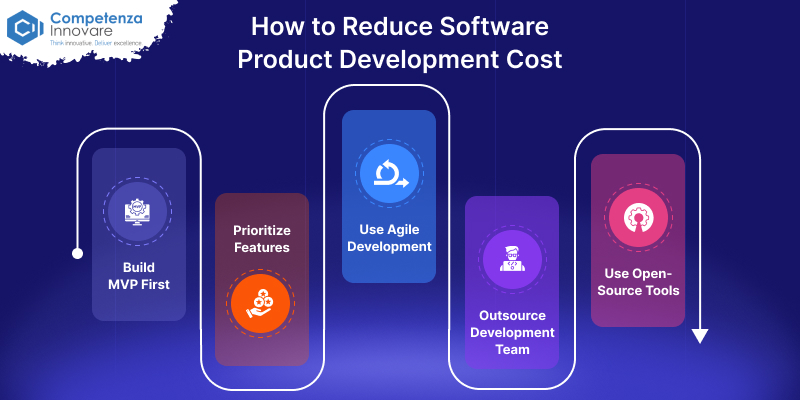
The appropriate planning, scope, and smart development strategies can help in reducing the cost of the software product development significantly. Businesses should not aim at creating everything at once but consider efficient ways of creating it in the most effective way, minimizing waste, and ensuring quality. This also enhances cost estimation of software and assists in better planning of cost application development.
Build MVP First
One of the best methods of saving on cost is to start with a minimum viable product (MVP). An MVP only contains the minimum necessary features necessary to test the idea in the market, which could be basic user functionality and key workflows. This approach eliminates wastage of time and resources on unnecessary developmental activities, shortens time to deployment, and reduces the cost of creating custom software in the initial phases since only the real needs are addressed.
Prioritize Features
Prioritization of features is useful in managing scope and avoids overspending. Businesses need to prioritize the more basic features before implementing more advanced functions but postpone more sophisticated features to subsequent upgrades. This also makes development simple, enhances the accuracy of planning, and ensures that the overall cost of software development is controlled.
Use Agile Development
Agile development saves money through the small, manageable stages with which it divides the project. All the phases are checked and enhanced according to the feedback that supports the detection of the problem at its initial steps and prevents the occurrence of costly reworking at the end. The application development cost and its overall efficiency will be enhanced because of this approach of continuous improvement that is aimed at better utilization of the resources.
Outsource Development Team
Outsourcing is an economical measure of decreasing development costs. Outsourcing or offshore development teams make available high-quality talent at a much lower hourly wage relative to in-house development teams. It also provides the benefits of being able to scale based on the requirements of the projects to help minimize the overall cost of developing a software product without compromising quality.
Use Open-Source Tools
Open-source applications and frameworks can be used to save time and money through the removal of licensing costs and ready-made development elements. By making development faster, more efficient, and less reliant on reinsourcing, these will save time and money in the overall estimation of software.
Final Answer – How Much Does It Cost to Build a Software Product?
The development cost of the software product would be normally between 10,000 at a minimum development scale of a simple MVP to more than 150,000 to 500,000 at complex levels of enterprise development. The final cost is based on the complexity of the product, features, design, stack technology, and scalability needs. Estimating software costs appropriately is also significant since additional costs such as cloud hosting, maintenance, and scaling are concealed, and thus they also can add up to the overall cost of developing the application in the long run.
Software building is not only a question of receiving a price quote; it is about managing risk and making sure that the execution process is efficient. An effective strategy ensures that the budget does not get out of control and lowers the custom software development expenses in the long term. The Competenza and other development partners assist in bringing businesses out of rough estimates into the circle of structured execution, leading to improved planning, control of costs, and scalable product delivery.
FAQs
How much will it cost to develop a software product in 2026?
The industry average cost of developing software products in 2026 is 10,000 to 500,000 plus. The price is based on features, locations of the need, complexity, and design. A simple MVP is less expensive, with enterprise systems being more expensive. Software cost estimation It is important to estimate the costs of software properly before development.
What makes software development so expensive?
Prices differ as each software product is unique in terms of scope and complexity. Price is affected by features, UI/UX design, technology stack, and location of the team of developers. Further developed systems are costlier and time-consuming in terms of application development.
What is covered by software development costs?
It involves UI/UX design, front-end and back-end development, QA testing, project management, hosting, and third-party integration. The number of updates and maintenance is also part of the total cost of the custom software development after launch.
What would a typical MVP software product cost?
An MVP usually costs between $10,000 and $40,000. It contains only necessary qualities that are required to prove the concept in the industry. This methodology removes risk and aids in the containment of cost at the lower stages of software development.
How much does it cost to develop enterprise software?
Enterprise software is priced between $150,000 and $500,000+. Its features are advanced, like artificial intelligence, cloud computing, security, and scalability. Such systems have greater development needs and durability.
What are the biggest cost factors in software development?
The primary ones are product complexity, set features, design complexity, technology stack, physical location of the team, and schedule. All these factors have a direct influence on the eventual cost of development of a software product and general budget planning.
What do software development hidden costs entail?
Maintenance costs as well as cloud hosting, third-party APIs, scaling infrastructure, and post-launch fixes are hidden costs. Such recurring costs may be quite large in the overall cost of the application development.
What is the cost reduction in software development?
All these can be done to minimize the costs through constructing an MVP initially, focusing on features, an agile development team, an outsourcing team, and open-source tools. Such strategies are successful in maximizing cost estimation of the software and minimizing waste.
What is the impact of outsourcing on software development cost?
The cost tends to be less as offshore teams cost less per hour. It also provides access to world talent and scale flexibility. This will reduce the overall custom software development price without compromising on quality.
How do you estimate software cost?
The best way to do this is to stake out the features, decomposition of a project, choosing the right tech stack, and future scaling needs. This ensures more accuracy in software cost estimation and software budget control.