

Software development outsourcing has since been a common practice by firms wishing to lower their expenses, expand rapidly, and tap into talent internationally. The three most popular models are offshore software development, nearshore software development, and onshore software development, which are differentiated primarily in terms of cost, effectiveness of communication, and flexibility of delivery.
In contrasting offshore vs. nearshore vs. onshore software development, the companies compare the rates of development, time zone disparities, ease of collaboration, and project control. Its most cost-efficient is usually the offshore development, as with the nearshore, there is an intermediate between cost and communication, whereas onshore is the most coordinated development with much higher pricing.
This blog describes a step-by-step cost analysis of offshore, nearshore, and onshore software development services to make you aware of pricing models, advantages, and which outsourcing model is most appropriate to your business needs in 2026.
What are offshore, nearshore, and onshore software development?
Software development outsourcing enables organizations to create products in digital form by engaging external teams rather than employing all the people internally. The three most typical models of offshore, nearshore, and onshore software development are largely characterized by location, collaboration, and cost structure.
The choice is significant simply because all models present a different trade-off of cost efficiency, ease of communication, and project control to startups, enterprises, and growing tech companies.
Offshore Software Development
Definition: Offshore software development is the process of collaborating with a development team in a remote area, typically with a time zone difference. The objective of this model is to develop at a reduced cost and access a vast source of tech expertise around the world.
This is a common strategy adopted by organizations that desire to grow fast without raising the staffing expenses.
Key insights:
- Provides the most cost-effective development solution.
- Offers access to highly skilled and specialized developers.
- Real-time communication is likely to be sluggish due to time zone disparities.
- Needs good project management and documentation.
- Barrier product development and long-term projects are best suited to optimize budget, as well as startups.
Nearshore Software Development
Definition: Nearshore software development is outsourcing to software development teams that are based in regions within the same or in-range working hours. It is a model that will enhance collaboration and keep development costs lower as compared to hiring locals.
The companies with the requirement to balance affordability and ease of communication choose it.
Key insights:
- Provides competitive prices between offshore and onshore models.
- Makes interaction easier because the working hours are aligned.
- Enhances the speed of teamwork and rapid development processes.
- Minimizes the time zone differences.
- Best suited teams that require a lot of contact and cyclic development.
Onshore Software Development
Definition: Onshore software development translates to recruiting a development team in the same location with the business. This paradigm is obsessed with the power of communication, compliance with the principles and painless collaboration.
It is usually applied in cases where the complexity of the project or security or compliance requirements are high.
Key insights:
- Most expensive of all the outsourcing models.
- Best communication and real-time collaboration.
- Less challenging to conform to the local regulations and standards.
- Improved cultural and business convergence.
- Ideal in enterprise-level, sensitive, or highly regulated projects.
Quick Comparison: Offshore vs Nearshore vs Onshore Software Development
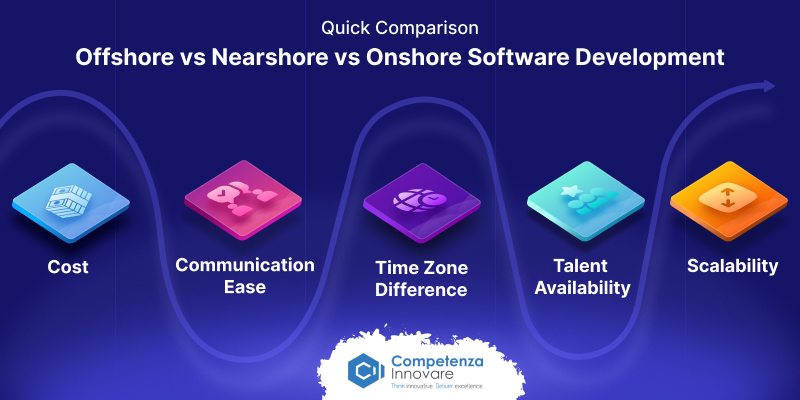
When comparing offshore and nearshore to onshore software development, firms weigh several significant factors, which include cost, the effectiveness of communication, time zone, access to talent, and scale. The table below provides an appropriate list that may help you determine the right outsourcing model of software development:
| Factor | Offshore Software Development | Nearshore Software Development | Onshore Software Development |
| Cost | Lowest cost option with significant savings on development budgets | Moderate cost, balanced between affordability and quality | Highest cost due to local hiring and operational expenses |
| Communication Ease | Can be challenging due to time zone gaps and cultural differences | Easier communication with overlapping working hours | Seamless communication with real-time collaboration |
| Time Zone Difference | A high difference may cause delayed feedback cycles | Minimal to moderate difference, supports smoother workflow | No time difference, ideal for instant coordination |
| Talent Availability | Very large global talent pool with diverse skill sets | Good access to regional talent with relevant expertise | Limited to local talent pool but often highly qualified |
| Scalability | Highly scalable and cost-efficient for large teams | Moderately scalable with balanced management effort | Less scalable due to higher costs and resource constraints |
Pros and Cons of Each Software Development Model
Comparing offshore, nearshore, and onshore software development, companies should critically learn about the advantages and constraints of both outsourcing models. In software development outsourcing, the correct decision is made regarding criteria such as cost, communication, scalability, and complexity of the project.
Offshore Software Development – Advantages & Disadvantages
Offshore software development is common among the businesses that seek cost-effectiveness and global sourcing of technical expertise. Nonetheless, it also brings about some business difficulties.
Advantages
- Lowest development cost: Major low-cost solution to the outsourcing of software development.
- Access to world talent: High talent pool of developers in various technologies.
- High scalability: Expands and contracts team size easily depending on project requirements.
- Flexible employment: Three-day work teams, hourly salary, or subcontracting a project.
- Low-cost leader: Leader in long-term development projects and start-ups.
Disadvantages
- Time zone challenges: Reduced feedback and communication (offshore development problems)
- Communication barriers: any possible misunderstanding because of both the distance and the differences in workflow.
- Management overhead: This will consist of good project management and documentation.
- Little coordination: least overlap of working time..
Best suited for: MVP development, start-up, and cost-conscious product scaling.
Nearshore Software Development – Advantages & Disadvantages
Nearshore development lies in a middle ground of the outsourcing strategy, low price, and high effectiveness of collaboration.
Advantages
- Average price development: Cheaper than onshore, not more competitive than offshore.
- Improved communication: There is more coordination in shared working hours.
- Fast development and feedback: Rapid cycles of development and feedback.
- Enhanced teamwork: The projects become easier to monitor and communicate.
- Efficient workflow: lessens delay as a result of time zone differences.
Disadvantages
- Small talent pool: Smaller availability than in the offshore markets.
- More expensive than offshore: Not the cheapest solution for outsourcing.
- Dependent on a region: Niche skills dependency can vary by region.
Better applicable to agile groups, mid-size organizations, and fast digital products.
Onshore Software Development – Advantages & Disadvantages
Onshore software development is aimed at optimal control, communication, and conformity, which is more expensive.
Advantages
- Most ideal communication: real-time collaboration with no problem of time zone.
- Powerful project management: The administration and supervision become simpler.
- Enhanced regulations and capital safety: In line with local regulations and the business industry.
- Good Quality Production: Good adaptation to the business expectations.
- Cultural fit: Simpler interpretation of project requirements.
Disadvantages
- Highest cost model: The most expensive in the onshore vs offshore development scenario.
- Cross scalability: Money scarcity discourages expansion of teams.
- Weaker access to talent: Localized to local hiring market.
- Increased operational cost: Makes the project budget very big.
Best suited for: Enterprise systems, high-security applications, and mission-critical projects.
Summary Insight
- Offshore software development → The cheapest with high scalability; however, there exists a communication problem.
- Close-shore outsourcing → Moderate price and partnering efficiency.
- Onshore software development → Maximum control and communication, still costly.
The right model in software development outsourcing is determined by your budget, the complexity of your project, and the level of collaboration that you need.
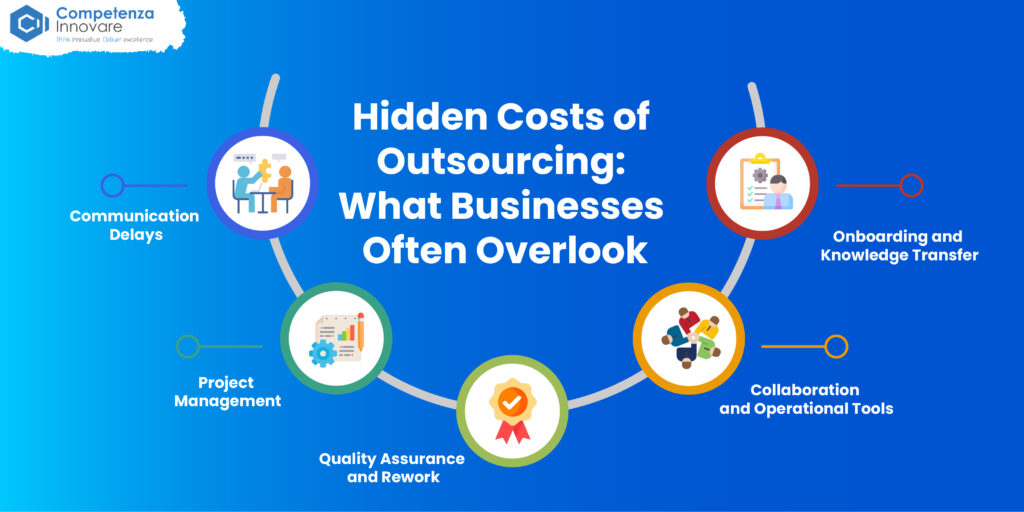
Hidden Costs of Outsourcing: What Businesses Often Overlook
Although outsourcing software development may have the benefit of lowering the cost of development, hourly rates should not be the main factor used to compare offshore vs nearshore vs onshore software development. The invisible costs can affect the budget of the project and the time schedule of the project.
Communication Delays
Misinterpretations, feedback failure and lapses in information could cause addition of time in the development and further revisions.
Project Management
The outsourced teams need a well-coordinated and monitored routine to ensure projects are on schedule and within the business interim striking
Onboarding and Knowledge Transfer
Developing teams must take time to internalize project needs, project processes, and business objectives and become maximally productive.
Quality Assurance and Rework
Unplanned bug fixes, testing, and any change of feature may add to the overall cost of outsourcing software.
Collaboration and Operational Tools
Security solutions, project management systems, and communication tools may add additional expenses into the project life cycle.
Offshore vs Nearshore vs Onshore: Decision Framework
The selection of an offshore, nearshore, or onshore software development model is determined by your budget, communication needs, project complexity, and business objectives. Although any of the outsourcing models would provide special benefits, you should choose the one that corresponds to your development strategy and anticipated results.
When to Choose Offshore Software Development
Select offshore software development in cases where your main objective is to minimize the cost of development while having a vast pool of professional programmers. This model fits start-ups most effectively, as well as growing companies and long-term projects, which require scalability and efficiency in terms of costs.
When to Choose Nearshore Software Development
Choose nearshore software development in case you prefer to balance cost and collaboration. Nearshore teams as well favor instant feedback, frequent workflow, and efficient production of projects with enhanced time zone coordination and easier communications.
When to Choose Onshore Software Development
Select onshore software development when top priority is given to direct communication, project visibility, compliance, and quality control. It is a model that is highly appropriate in complex projects where there is close working and effective oversight.
Startup vs Enterprise Breakdown
To startups, offshore software development is mostly the most viable solution due to lower costs and scaling of teams. The companies that are expanding at a good rate tend to rely on nearshore development of software since it is affordable and advertises well. Onshore software development is normally, by choice, selected by enterprises based on the need to comply, ensure software security during development, and control operations in order to assure a successful project.
AI Impact on Software Development Outsourcing
AI software development outsourcing in 2026 is changing the business by enabling development teams to work at faster speeds, enhance code quality, and shorten project durations. The use of AI-based software development solutions helping in coding, testing, debugging, and project management is also increasingly benefiting restaurants that are implementing offshore, nearshore, or onshore software development.
- Faster Development: AI will help developers to code repetitive tasks, create code quicker, and launch software quicker.
- Higher Quality: It will be enabled through the use of artificial intelligence testing software and bug detection software that will facilitate the identification of bugs and performance issues at an earlier stage, resulting in robust software.
- Greater Productivity: Developers are allowed to engage in more complex problem-solving and innovation, and AI is assigned the tedious tasks such as documentation and code reviews.
- Reduce Software Development Costs: AI allows businesses to better optimize the cost of software outsourcing and leverage projects through improved efficiency and less manual work.
Choose the right development model and build smarter with The Competenza.
Hybrid Outsourcing Models
Contemporary companies are shifting towards hybrid forms of outsourcing so as to eliminate the drawbacks of using one outsourcing strategy. Integrating the development models, the companies can balance the software development expenditure, communication performance, scalability, and project management. This will enable organizations to create flexible teams that fit their particular business and project needs.
Offshore + Nearshore Mix
This model takes the cost efficiencies of offshore software development and the nearshore development in terms of communication and collaboration and assists businesses to strike the right balance between affordability and effectiveness.
Distributed Agile Teams
The distributed agile teams operate in different locations but have the same developmental process. This method promotes the ongoing cooperation, flexibility, and speed of software delivery.
Follow-the-Sun Model
The follow-the-sun model involves teams across time zones to allow the development to commence outside conventional work hours and duration to expedite project deliveries and enhance productivity.
Vendor Selection Checklist
Software development outsourcing requires choosing the appropriate software development partner. The Competenza is a trusted company that can assist businesses in eliminating risks, developing efficiently, and attaining better project results.
Technical Skills Evaluation
Evaluate the technical skills, the experience in technology, and the capacity of the vendor in managing projects like yours. The development team needs to be comprised of a competent and committed group that has been shown to produce quality software.
Communication Testing
Evaluate the effectiveness and uniformity of vendor communication. Effective communication helps with the seamless collaboration and faster project development.
Portfolio Review
Check previous projects and case studies to know the experience of the vendor and its capacity and ability to deliver software solutions.
Trial Sprint Approach
Consider a small trial project to evaluate the performance, technical expertise, and fitness of the team in general before tying up in a permanent relationship.
Conclusion
When considering offshore vs. nearshore vs. onshore software development, there is no universal answer. Offshore development has the lowest costs and highest scalability; nearshore development has a balance between the cost and collaboration; and onshore development has the highest level of communication and project control. The correct option would be based on your finances, project demands, and objectives of your business. Analyzing the costs, communication requirements, scalability, and experience levels of the vendor, companies can choose the outsourcing model that provides the most advantageous option and effective success over the long term.
FAQs
What is the cost of offshore software development?
The cheapest type of outsourcing is generally offshore software development. Prices depend on the complexity of the given project, the size of the team, and the expertise needed, yet terms of offshore development enables a business to reduce the costs of software development and reach the global talent of talented experts at the same time.
Offshore vs. Nearshore vs. Onshore: Which is better?
No best option exists. The best offshore development is cost-saving; nearshore development is balanced in terms of affordability and collaboration; and onshore development has the highest degree of communication and project control.
Which is the lowest-cost outsourcing model?
Offshore software development is generally the cheapest form of outsourcing model, as it offers greater access to a talent pool and cheap operation expenses as opposed to nearshore and onshore development.
Is it a safe offshore development?
Yes, even when dealing with a reputable software development vendor that adheres to stringent security measures, confidentiality policies, and quality assurance measures, offshore development is safe.
What is the most communicative outsourcing model?
Onshore software development normally offers the most effective communication due to teams working under the same region and time of day. There is also good cooperation with minimal time zone differences in nearshore development.
What is nearshore software development?
In nearshore software development, the development team works with other teams in neighboring areas that have more or less similar working hours. It assists companies to enhance cooperation by keeping it cheaper than onshore recruitment.
When is offshore software development necessary in a business?
The offshore software development should be adopted by the businesses where the main objective is to optimize the costs, expandability, and access a wide range of talents. Hybrid cars are particularly well received by startups and emerging corporations.
What are the key advantages of onshore software development?
Onshore software development offers real-time communication, enhanced visibility of a project, increased regulatory compliance, and facilitation in the ease of collaboration and is more appropriate for complex or sensitive projects.
What is a hybrid outsourcing model?
A hybrid outsourcing model involves offshore, nearshore, or onshore teams in the same project. This practice assists companies to create a balance between the expenses of their development, their ability to communicate effectively, and their control of the project.
How do I select the appropriate software development partner?
When selecting a software development partner, look at the technical skills, customer reviews, project background, estimates on technical communication skills, and ability to provide a constant, dedicated development team that suits your business needs.