
Artificial intelligence is revolutionizing how organizations develop automated applications, improve their efficiency, and streamline business-related activities. The use of the terms “AI agents,” “agentic AI,” and “agentic workflow” is being increasingly used as AI technology advances. The terms are, however, misused by a great number of people whose roles and descriptions are based on referring to different variants of AI-based automation.
A typical AI agent is created to accomplish a particular task, like responding to customer queries, book appointments, or locate data. To go further in autonomy, agentic AI will enable AI to plan, reason, decide, and act upon multi-step objectives. Conversely, agentic workflow also focuses on the implementation of AI capabilities with business operations to execute end-to-end processes and optimize business operations.
It is significant to distinguish between AI agents vs. agentic AI and agentic workflows to find the correct approach in business investment in automation. All methods have their own advantages based on the complexity of the work, the level at which decisions have to be made, and the business objectives.
This guide will cover the concept of agentic AI, compare agentic AI and AI agents, overview agentic workflow, and discuss the ways agentic AI solutions can help organizations to automate processes, enhance decision-making, and boost business growth.
Why AI Terminology Is Creating Confusion for Businesses
Businesses are being presented with the concept of new technologies and automation at an alarming rate as artificial intelligence keeps developing. The terms “AI agents,” “agentic AI,” and “agentic workflows” are used more frequently, yet there are diverse organizations that cannot grasp the variations of the concepts.
The Rapid Rise of AI Automation
Generative AI also has led to the growth in the number of AI tools and automation solutions. Firms are shifting to the domain of AI in order to automate their activities, boost their productivity, ease their operation, and improve customer experiences. The number of automation programs that are entering enterprises is on an upward trend as the smart and self-governing systems are gaining ground.
Similar Terms, Different Capabilities
These terms are used interchangeably, but there are differences in applications of AI agents, agentic AI, and agentic workflows. AI agents are meant to accomplish definite tasks. AI has the capacity to perform agentic planning and reasoning and even make agentic decisions to achieve larger objectives, and end-to-end business processes can be automated by agentic workflows. When considering automation solutions, it is essential to comprehend that AI agents and agentic AI are different concepts in computer science.
Why Understanding the Difference Matters
Knowledge about these technologies can help companies to make smarter investments in technologies and develop viable automation plans. It helps also in planning of workflow, scaling of the enterprise, and efficiency in operations. Since the ability of AI solutions in agent form is only getting more and more popular in enterprise applications, a clear understanding of the concepts can be used to help optimize ROI and enable businesses to expand over time.
What Are AI Agents?
AI agents are intelligent computer programs designed to perform some tasks based on set objectives, available data, and associated tools. They are able to process information, make decisions within a set action scope, and take action without needing human intervention all the time. As more business people embrace the use of AI-based technologies, AI Agents Explained has been a discussion plaguing many organizations with the aim of optimizing efficiency and automating manual operations.
AI Agents Explained
The AI agents are able to engage with users, applications, and business systems to accomplish certain tasks. They are useful in business automation as opposed to the traditional software since they are able to analyze the inputs, comprehend the surroundings, and reply dynamically.
How AI Agents Work
All AI agents usually perform four major steps:
- Receive input
- Analyze context
- Take action
- Return output
This process helps them to accomplish tasks in a very short time and to do them correctly.
Common AI Agent Use Cases
Examples of some of these are:
- Customer support assistants
- Meeting schedulers
- Lead qualification bots
- Knowledge retrieval systems
- Sales assistants
These are applications that can assist businesses in streamlining and enhancing productivity.
Benefits of AI Agents
Enterprise automation AI agents will assist in lessening manual labor, accelerating tasks, enhancing productivity, and increasing customer experiences. It is due to this that intelligent AI agents for enterprise are gaining a lot of significance to organizations interested in automating their workflows to facilitate business development.
What Is Agentic AI?
“Agentic AI” refers to mature artificial intelligence systems that can plan, reason, decide, and act in more than two steps on their own and accomplish an assigned task. Unlike AI agents who focus on a single act, agentic AI can tackle more complex tasks with minimum human involvement.
Understanding Agentic AI
When you are considering what is Agentic AI, imagine a more refined version of AI that is capable of thought and can make decisions regarding what action is the best course of action and modify its behavior to new circumstances. This contributes its usefulness to more complicated business tasks and automation.
How Agentic AI Works
The operation of agentic AI follows a number of major steps:
- Goal setting
- Task decomposition
- Planning
- Tool usage
- Learning from outcomes
- Adaptive execution
These functions enable Agentic AI to perform tasks and enhance wider business objectives better.
Key Characteristics of Agentic AI
The following are some of the key characteristics of agentic AI:
- Autonomy
- Memory
- Reasoning
- Multi-step decision-making
- Tool orchestration
Agentic AI Use Cases
Some of the common uses of agentic AI are optimization of supply chains, automation of business processes, finance, management of IT services, and enterprise decision support. Consequently, business automation through agentic AI is assisting businesses in enhancing efficiency, minimizing manual labor, and automating intricate processes.
What Are Agentic Workflows?
The agentic workflows involve combining AI agents with automation tools and business processes to automatically run the end-to-end operations. In contrast to single AI agents, which fulfill certain activities, agentic processes enable coordination among a certain number of actions and systems to complete a larger business process.
Defining Agentic Workflows
In case you are asking yourself what agentic workflows are, they consist of organized workflows that are AI- and automation-driven to simplify activities, enhance efficiency, and minimize manual effort within an organization.
How Agentic Workflows Operate
The agentic workflows usually incorporate:
- Trigger-based actions
- Decision points
- AI-driven execution
- Human approvals
- Process orchestration
These factors collaborate to make sure that tasks are done efficiently and correctly.
Common Agentic Workflow Examples
Some typical examples of agentic workflow are the following:
- Customer onboarding
- Invoice processing
- Employee onboarding
- Claims processing
- Procurement workflows
Benefits of Agentic Workflows
The agentic workflows can be used to enhance the consistency of the processes, to minimize the bottlenecks, to accelerate the execution, and to enhance the efficiency of operations. Consequently, there has been an adoption of AI workflow automation solutions by a number of organizations to automate a complex process to facilitate growth of the business.
AI Agents vs Agentic AI vs Agentic Workflows
Along with businesses investing in smart automation, it becomes necessary to know the difference between AI agents and agentic AI vs. agentic workflows in order to make the correct selection. All three of them accommodate automation; however, they vary in terms of autonomy, decision-making abilities, and business implementation.
| Feature | AI Agents | Agentic AI | Agentic Workflows |
| Primary Purpose | Task Execution | Goal Achievement | Process Automation |
| Autonomy | Low to Medium | High | Medium |
| Planning | Limited | Advanced | Workflow-Based |
| Decision Making | Task Level | Strategic Level | Process Level |
| Learning Ability | Basic | Advanced | Moderate |
| Human Oversight | Frequent | Minimal | Moderate |
| Tool Usage | Single Tool | Multiple Tools | Integrated Systems |
| Best For | Individual Tasks | Complex Business Objectives | End-to-End Processes |
The Role of Multi-Agent Systems in Modern Enterprises
Multi-agent AI systems in business have emerged to be an enormous element of business automation as businesses are implementing increasingly advanced AI systems. They operate more than one AI agent, which collaborates with each other to complete multi-faceted tasks, interacts, and satisfies the needs of large companies instead of a single AI agent.
What is a multi-agent system?
A multi-agent system is a complex of various AI agents that cooperate to solve problems and execute procedures. Each of the agents works on a particular task but cooperates with others. agents in fulfilling a common purpose. This method enables organizations to engage more in robotizing their complex processes than with a monolithic AI system.
Benefits of Multi-Agent Collaboration
There are various benefits in employing multiple AI agents, such as
- Improved scalability across business operations
- Greater efficiency through task specialization
- Faster decision-making and problem-solving
- Reduced operational costs through automation
Having a number of agents, who would share the duties, businesses will be able to manage the increased load of work and more complicated processes more precisely.
Enterprise Applications
Multi-agent AI systems applied to businesses in many institutions are being implemented in fields like
- Customer service ecosystems
- Financial operations and reporting
- Supply chain coordination
- IT automation and support
By using these applications, businesses can quickly and easily streamline operations, enhance productivity, and more rapidly respond to the evolving business needs. This makes multi-agent systems an increasingly important subset of contemporary enterprise agentic AI in e-commerce since they allow organizations to develop increasingly intelligent, scalable, and efficient automation strategies.
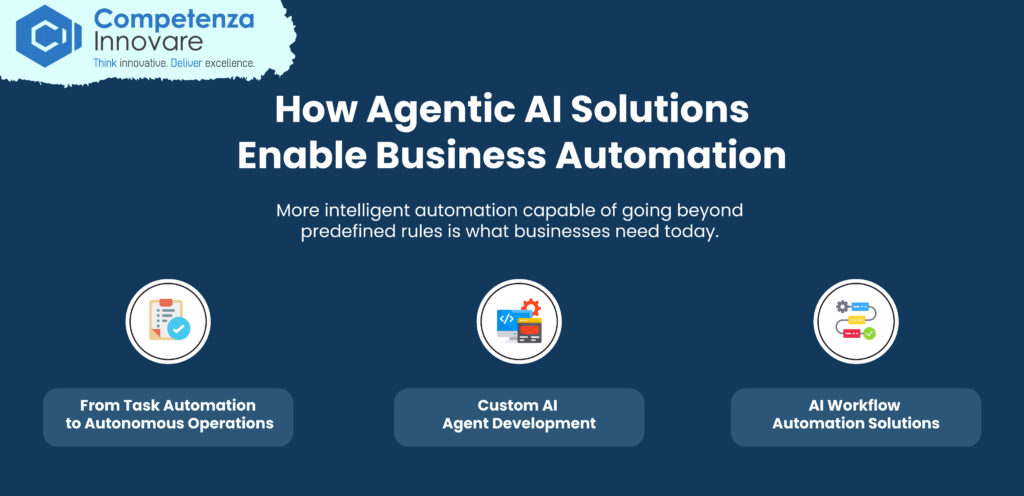
How Agentic AI Solutions Enable Business Automation
More intelligent automation capable of going beyond predefined rules is what businesses need today. The agentic AI solutions can assist organizations in automating complex processes and decision-making and enhancing operational efficiency.
From Task Automation to Autonomous Operations
Traditional automation works with repetitive tasks dependent on predetermined instructions. The agentic AI goes even further to analyze information, execute decisions, and perform multi-step tasks with slight human intervention.
Custom AI Agent Development
Businesses are able to develop industry-specific AI agents, which are unique to them, through AI agent development services. These solutions facilitate automation of processes, integration of systems, and operation across the business.
AI Workflow Automation Solutions
AI workflow automation solutions bridge AI agents, business applications, and workflows to automate the end-to-end processes. This assists in helping organizations to streamline and enhance coordination and minimize the use of manual effort.
Benefits for Enterprises
Enterprise agentic AI solutions have a variety of advantages, such as:
- Reduced operational costs
- Faster execution
- Improved productivity
- Better customer experiences
- Scalable business growth
The agentic AI will allow business entities to be more efficient and responsive to evolving needs through intelligent automation and coordination of workflows.
When Should Businesses Use AI Agents, Agentic AI, or Agentic Workflows?
Whereas AI agents are designed to facilitate automation, the purpose of agentic AI and agentic workflows target different business requirements even though they are all geared towards automation. In finding out the correct solution, it is necessary to factor in the complexity of your processes, decision information, and the automation goals.
Use AI Agents When
Enterprise automation AI agents are the most suitable when it is a specific task that needs to be automated and the productivity of everyday tasks should be enhanced. They are ideal for:
- Customer support and virtual assistants
- Appointment scheduling
- Lead qualification
- Knowledge retrieval and employee support
AI agents can assist the business in decreasing manual labor, enhancing response time, and making operations more efficient.
Use Agentic AI When
Agentic AI in business automation can be the one used when companies require systems capable of reasoning, planning, and executing multi-step goals on their own. It is usually used to treat:
- Managing complex business objectives
- Automating decision-making
- Coordinating multiple tools and systems
- Supporting enterprise operations
Agentic AI is especially useful to the businesses that desire smarter and more autonomous automation.
Use Agentic Workflows When
An autonomous AI workflow system is suited to automating entire business operations that encompass several steps, groups, and technologies. They are usually applied in:
- Customer onboarding
- Invoice and claims processing
- Employee onboarding
- Procurement and approval workflows
These processes connect people, systems, and AI to streamline operations and provide consistency in the process.
Understanding when to use AI agents, agentic AI, or agentic workflows, businesses can adhere to the proper way of automation, become more efficient, and get maximum benefits out of their investments in AI.
The Future of Enterprise Automation with Agentic AI
Since agentic AI solutions will be continuously expanded in the future, enterprises will transition to smarter, independent, and larger automation designs. The main trends that make the future include the following:
- Autonomous Business Operations – The AIs will be able to handle the complex tasks and workflows with the minimum number of people, which will have a positive impact on their speed and efficiency.
- AI-Powered Digital Workforces – Intelligent AI services for businesses will power employees working on routine tasks, data analysis, and facilitation of business processes.
- Industry-Specific AI Agents – More frequently, organizations will implement industry-specific AI agents, which can be in health, financial, manufacturing, and retail areas.
- Multi-Agent Ecosystems – Multiple AI agents will interact, exchange information, and orchestrate activities to accomplish intricate business tasks.
- Human-AI Cooperation – AI will collaborate with employees and will help teams to make improved decisions, be more productive, and engage in higher-value activities.
- Self-Optimization of Workflows – Artificial intelligence will continuously monitor its performance, will headbang, and will just improve workflows given time.
Enterprise AI solutions are not only going to enable businesses to create smarter operations and automation and streamline these processes but also ensure their growth over the long term through intelligent automation as these operations become more efficient.
Conclusion
As AI is increasingly implemented, the distinction between AI agents, agentic AI, and agentic workflows should guide businesses in developing the appropriate automation strategy. Although AI agents are aimed at specific task automation, agentic AI allows making intelligent decisions and acting autonomously, and agentic workflows can automate entire business systems and teamwork.
The options available to you determine the appropriate style to adopt based on your business objectives, level of complexity, and scalability scope. The technologies can be applied to support efficiency, productivity, and customer experiences; to automate your routine; to streamline your work processes; or to apply smart enterprise automation.
The decision-making about investing in specific agentic AI solutions, AI agent development services, and AI workflow automation solutions will be increasingly significant, as companies will start making themselves more autonomous and AI-focused in their operations. Our work at The Competenza involves companies with the design and implementation of custom AI-based applications that develop smarter automation, streamlined operations, and long-term growth. The combination of the appropriate mix of AI agents, agentic AI, and workflow automation makes it possible to discover new opportunities of innovation and compose a competitive advantage for organizations.
FAQs
What are AI agents?
AI agents are intelligent computer applications that will be utilized in discrete task operations, such as customer service, making appointments, determining leads, and searching information. Trying to make business more efficient, they utilize existing data and automate operations with the help of available data and tools.
What is Agentic AI?
On the one hand, agentic AI is a highly sophisticated AI that can plan, reason, make decisions, and execute a multi-step goal on its own. The agentic AI is capable of change and adaptation, unlike the conventional AI tools, and the pursuit of more general business objectives.
What is the difference between AI agents and Agentic AI?
The primary distinction lies in the fact that AI agents are oriented to accomplishing a single objective, whereas agentic AI is able to handle more complicated goals by planning and reasoning autonomously and taking independent decisions. The autonomy of agentic AI is greater compared to conventional AI agents.
What are agentic workflows?
Agentic workflows are automated business processes that have AI agents, business rules, automation tools, and human approvals to automate end-to-end operations. They assist the organizations to be more efficient and less manual.
What is the interaction between AI agents, Agentic AI, and agentic workflows?
AI agents do individual work, agentic AI is able to do decision-making and goal execution, and agentic workflows are structures to tie these functions together in entire business processes. They also combine to develop smarter and scalable automation applications.
What are typical uses of Agentic AI?
Automation of business processes, optimization of supply chains, financial processes, management of IT services, automation of customer services, and enterprise decision support are among the most common use cases of agentic AI.
What will AI agents do to automate the enterprise?
Businesses use AI agents to automate their daily operations, improve their productivity, reduce their operational expenses, introduce superior customer experiences, and assist with everyday tasks of their employees.
When do businesses need to use Agentic AI?
In most businesses, agentic AI is needed when they need a self-directed system able to manage complex workflows, coordinate various tools, make decisions, and achieve strategic business objectives.
What are business multi-agent AI systems?
Multi-agent systems consist of a number of AI agents cooperating to perform complex jobs and processes. They enhance scalability, operational efficiency, speed of decision-making, and automation ability of the enterprise.
What can agentic AI solutions do to benefit businesses?
The AI solutions provided by the agentic are designed to assist organizations to automate processes, streamline workflows, enhance decision-making, reduce manual work, and allow scalable business expansion. They are also becoming part of new automation strategies in enterprises.
What are AI workflow automation solutions?
AI workflow automation solutions utilize AI agents, automation tools, and business applications to automate end-to-end workflows. These solutions enhance the management of the processes, lead to a decrease in the number of bottlenecks, and enhance the efficiency of operations.
What does the Competenza contribute to the implementation of agentic AI?
The Competenza offers agentic AI solutions, AI agent development services, and custom AI agent development to fit business requirements. The Competenza assists companies to develop AI-enabled operations that are highly scalable and ready to meet future needs by integrating smart automation, enterprise integrations, and workflow orchestration.