

Artificial intelligence has already transformed the functioning of online stores, not only the product suggestions and chatbots but inventory predictions too. However, there is a new wave of AI innovation: agentic AI in ecommerce.
In comparison to older AI systems, which react to a particular stimulus or behave within a certain set of rules, agentic AI development is able to think of a goal, make choices, and initiate action on those choices and reform itself based on them in response. Rather than merely aiding ecommerce teams, ecommerce AI agents have the ability to perform complex workflows independently in customer service, marketing, merchandising, inventory management, and operations.
With the heightening competition and the never-ending increasing customer expectations, ecommerce brands are seeking smarter means of enhancing customer experiences without compromising operational efficiencies. This is where agentic AI for ecommerce is becoming a game changer.
This guide will discuss the best agentic AI applications in e-commerce, how to implement AI, business advantages thereof, and what AI-driven ecommerce will look like in the future.
What Is Agentic AI in Ecommerce?
Agentic AI are those AI systems that behave independently toward goals. In contrast to traditional AI applications that react to or answer queries or rely on predefined rules, agentic AI in ecommerce applications plan, take an action, monitor results, and repeat until a goal is achieved without one step-at-a-time human directives.
In ecommerce it can be thought of as AI that does not simply suggest a product when requested to do so but actively determines who is most likely to convert on what product, surfaces the appropriate offer at the appropriate time, and changes its strategy as the relevant customer reacts or not without human intervention.
How Agentic AI Differs from Traditional Ecommerce Automation
The old method of automation in ecommerce is more rule-based. In case a customer leaves a cart, email after two hours. When inventory becomes depleted to a set level, then place an order. When one of the competitors decreases his or her price, mark it down to reconsider. Such workflows are handy yet immutable—they do what they are programmed to do, no more.
e-commerce agentic AI that is goal-oriented, not rule-oriented. Since maximizing conversion rate is the goal, an agentic AI system will decide independently how to target its customers, how to message to target customers, when to offer a discount, and in which order to follow up—and optimize them as learning occurs to help in the next decision. It is the distinction between an implementation of a set of instructions and a determination of what the instructions are supposed to be.
Why Ecommerce Businesses Are Investing in Agentic AI
The business argument is clear-cut. The agentic AI-driven e-commerce businesses are operating with larger product catalogs, more touchpoints with the customer, more intricate supply chains, and paying more aggressive competition than the industry has ever experienced before. Human teams are unable to keep track of all variables and optimize them at the same time.
The benefits of ecommerce agentic AI solutions have already begun to be felt and measured by early adopters in terms of conversion rates, average order value, customer retention, and operational cost. The investing businesses are putting up infrastructure that they believe will form the backbone of ecommerce digital transformation in three to five years. Top Use Cases of Agentic AI in Ecommerce:
1. Personalised Shopping Assistants
One of the most visible agentic AI use cases in ecommerce is the personalized shopping assistant—an AI that actively guides customers through discovery and purchase rather than passively responding to queries.
Understanding Customer Intent
AI shopping assistants are agentic and not only match keywords. They would take into account the entire context of a customer’s behavior: browsing history, previous purchases, session dwell time, search patterns, etc., and construct an example of what that customer really wants to do in real time.
Personalised Product Discovery
Instead of showing a static category page, agentic AI will be used to create a product discovery experience on a case-by-case basis. Ranking and the filtering of the catalog are done according to the presumed likes and the present-day session behavior—one of the pillars of AI e-commerce personalization.
Real-Time Shopping Recommendations
AI recommendations of products are updated as the customer navigates the store. Someone who is shopping for running shoes and performance socks will be shown a different set of recommendations than someone who is shopping for running shoes and casual clothes—adjusting automatically without having to wait to enter a new session.
Guided Purchase Decisions
In higher-value purchases, agentic AI assistants can lead customers through a systematic decision-making process—posing clarifying questions, refining selections, pointing out salient features, and exposing social proof—in a manner resembling an experienced in-store sales consultant.
2. AI-Powered Product Recommendation Agents
The AI-based ecommerce recommendation agents will spur objective growth in the average value of orders with contextual, dynamic product suggestions—much higher than what the fixed “customers also bought” blocks can provide.
Cross-Selling and Upselling
Based on the entire purchase context category, price point, customer group, and real-time browsing behavior, agentic recommendation agents spot cross-sell and upsell opportunities and present the most commercially valuable neighboring products at the most receptive time.
Dynamic Product Suggestions
The AI product recommendations are not predetermined at the page load. AI as an agent constantly revises its recommendations throughout the session as new indicators populate the session so that each visit to the site is a varied experience.
Context-Aware Recommendations
Different customers are offered various recommendations depending on their specific context using the same product. When two visitors are on the same product page, a returning premium customer will be offered a different suggestion list compared to a first-time visitor to the site who has arrived via a price-comparison site.
Increasing Average Order Value
Effective agentic recommendation engines are the factors that push basket additions that customers do desire—generating quantifiable increments in average order value that are consistently unmatched by generic recommendation modules.
3. Intelligent Customer Support Agents
One of the applications of agentic AI to ecommerce brands with the highest ROI is agentic customer care, addressing all possible types of regular queries on its own without involving human agents and letting them engage in high-value interactions instead.
24/7 Customer Assistance
Customer support based on AI agent development—an implementation of AI chatbots in e-commerce—deals with product details, orders, returns, and sizing advice 24/7, with no wait times or operational schedule limitations.
Order Tracking and Status Updates
Instead of sending customers to a tracking page, agentic support agents will actively update customers on the status of their orders, catch possible delays before they are realized, and take corrective action when something goes wrong, contacting the carrier, starting a replacement or issuing compensation automatically.
Returns and Refund Management
The AI order management will process the overall returns process independently—returning the item, labeling, sending back money, and creating a manual inventory update—within a business-defined set of parameters.
Multi-Channel Customer Support
The agentic support agents can work across all channels—chat on websites, emails, WhatsApp, social messages, and voice—but keep the context of the dialogue constant so that the customer does not need to repeat themselves no matter the channel.
4. Cart Abandonment Recovery Agents
One such commercial use of agentic AI in e-commerce involves AI cart abandonment recovery—to transform revenue that otherwise goes permanently down the drain.
Identifying Drop-Off Points
Ecommerce agentic AI looks at the point during the purchase process where each customer stopped and the reasons behind that—price, delivery costs, payment friction, or distraction—and utilizes that data to create the most suitable recovery process.
Personalised Recovery Campaigns
Recovery messages are individually customized and basket-abandoned. The customer that is dropping off due to shipping costs is sent a different message on a different timeline than the customer that dropped off during payment entry.
Automated Discounts and Offers
Where a giveaway can likely distribute the sale without needlessly washing up margin, agentic AI will use it automatically—using the incentive to calibrate its discount to the price sensitivity and basket value of the customer rather than putting an incentive on all the abandoned carts.
Improving Conversion Rates
The addition of effects of individualized, contextual cart recovery to a generic two-hour email can be tracked through measurable increases in recovered revenue and overall e-commerce conversion rates.
5. Inventory Management Agents
Inventory management agentic AI operates on one of the most operationally and commercially significant functions in e-commerce—ensuring the right inventory in the right location at the right time.
Real-Time Inventory Monitoring
The agentic inventory agents are continuously tracking the inventory levels at all locations—warehouse, retail, and third-party fulfillment—to ensure the velocity at the SKU level in order to forecast shortfalls before they occur.
Automated Replenishment Decisions
Instead of marking down low inventory as something to review by a buyer, agentic AI automatically triggers a replenishment order, determining the optimal order quantities, suppliers, and timing to achieve a balance between cost effectiveness and the risk of stocking out.
Stock Level Optimisation
With AI inventory management, the most favorable balance between overstocking and understocking is an endless process—adjusting itself to the changing patterns of demand instead of relying on a regular review of the planning processes.
Preventing Overstocking and Stockouts
The integration of real-time sales flows and demand indicators with the supplier lead time data provides agentic AI with an always-accurate inventory level that would always be hard to achieve with human-operated systems.
6. Demand Forecasting Agents
AI demand forecasting agents use a wider array of signals compared to traditional forecasting models—making more accurate predictions that directly result in purchasing, inventory planning, and promotional strategies.
Predicting Product Demand
The forecasting agents are agentic and can be described as a combination of sales history, web traffic trends, social signals, search trend data, and macroeconomic indicators to generate demand forecasts at the SKU and category levels.
Seasonal Trend Analysis
The patterns of seasonal demand are determined and automatically considered, with the twists to a regional customer and type of product variations that any buyer is not already acquainted with at the top of the newspaper’s level.
Sales Forecasting
Rolling sales forecasts update automatically as information becomes available—they present a clearer and more recent view to commercial and operations teams of what is likely to happen in demand than a periodic manual forecasting process can.
Inventory Planning
Demand forecasts are directly used in the inventory plan—modifying purchases and safety stock levels automatically as the forecast changes instead of a quarterly planning cycle.
7. Dynamic Pricing Agents
AI pricing optimization is among the most profitable impact applications of agentic AI to e-commerce—real-time price management of thousands of SKUs at once.
Competitor Price Monitoring
Competitor pricing – Agentic pricing agents can watch market price changes in real time across all the products involved—track competitor pricing moves in real time across markets, competitors’ websites, and price aggregators.
Real-Time Price Optimisation
Automatic price adjustment occurs in response to competitive actions, demand changes, inventory control, and customer segments—under business-specific guardrails—to optimize revenue without human intervention.
Promotional Pricing Strategies
Promotional pricing choices—what to discount, how deeply, how long, and to whom—are selected based on their effects on margin, demand responsiveness, and competitive circumstances as opposed to historical precedent.
Maximising Profit Margins
At a level of granularity and speed of many thousands of SKUs’ center-of-pricing at once, agentic AI is maximizing margin at the margin-maximizing price point over a range of SKUs simultaneously.
8. Ecommerce Marketing Automation Agents
One of the most general uses of agentic AI in e-commerce, which is planned to be broader, is AI marketing automation—campaign strategy, audience segmentation, personalized email, and ad budget.
Campaign Planning and Execution
Marketing agents of agentic AI negotiate and run campaigns independently—they decide and define the audience, channels, and schedule; create variations of the content; and distribute the budget based on the specific business goals.
Audience Segmentation
Customer segments are constructed and updated in real-time, depending on behavioral data on a customer basis—creating audience structures that capture current customer behavior and not how they were previously profiled months ago.
Personalised Email Marketing
All emails are personalized on an individual level—subject line, content, product selection, offer, and send time—with much better engagement and conversion rates than personalization at a segment level.
Ad Budget Optimisation
Agentic AI dynamically allocates and reallocates ad spend, distributing it to each channel and campaign in real time, based on performance information—it is always redistributing the budget towards the things that work and away from the things that do not.
9. Fraud Detection and Risk Management Agents
Revenue and customer trust are defended by autonomous e-commerce fraud detection systems—assessing all transactions in real time against an ever-evolving model of normal and abnormal behavior.
Transaction Monitoring
Each operation will be evaluated immediately—suspicious behavior is noticed before the fraud is committed and not reported.
Suspicious Activity Detection
The agentic fraud agents can detect pattern combinations that go unnoticed by rule-based systems and act upon them in real time instead of flagging them to be reviewed.
Payment Fraud Prevention
High-risk transactions will be blocked, disputed, or sent to be reviewed by humans automatically—thresholds will be tuned so as to reduce false positives without compromising effective fraud detection.
Account Security Enhancement
Account monitoring agentic AI notices account behavior indicative of account takeover, unusual login locations, address changes, and unusual order patterns and implements a protective action before fraudulent orders are put in place.
10. Order Management and Fulfilment Agents
The operational support of agentic e-commerce is AI order management—making the order lifecycle, the process of receiving the orders to delivery notification, fully automated.
Automated Order Processing
The orders are automatically processed, verified, and sent to the relevant fulfillment location automatically—and real exceptions are automatically flagged to be reviewed by a human, as opposed to each and every order being manually handled.
Warehouse Coordination
Agentic AI manages the picking, packing, and dispatch of warehouse movements—optimizing workflows to ensure maximum throughput and minimum errors during busy times.
Shipping Optimisation
The choice of carrier, the service level, and the routing are optimized on a per-order basis based on the cost, delivery promise, and customer preference—automatically and on a large scale.
Delivery Tracking and Notifications
Linking customers to proactive correct delivery updates without them chasing—and in cases of delays, agentic AI detects them early, provides proactive delivery communications, and takes steps to remedy them as needed.
11. Customer Retention and Loyalty Agents
The use of AI customer journey optimization, via agentic retention agents, deals with one of the most appreciated—and least considered—commercial opportunities in the e-commerce space: retaining the customers that you already have.
Predicting Customer Churn
Instead of letting customers disengage later on, agentic AI recognizes customers with early disengagement indicators such as decreased purchase frequency, depth of sessions, and email engagement and intervenes before it becomes inactive, making the relationship still rescueable.
Personalised Loyalty Programmes
The loyalty rewards are customized according to each customer’s tastes and habits and not implemented via any mass-marketing system like a points system of rewards—this will make the program really exciting to an individual customer.
Reward Optimisation
The nature, timeliness, and worth of rewards are optimized using agentic AI so as to optimize the retention impact per pound spent on marketing—instead of using a set of rewards that tends to be evenly applied regardless of their influence on individual customers.
Customer Lifetime Value Growth
The long-term impact of retention, which is personalized, proactive churn prevention, and optimized loyalty management, is a measurable growth in customer lifetime value, the metric that best represents the long-term well-being of an e-commerce business.
12. Autonomous Merchandising Agents
Use of agentic AI when running merchandising automates the work of catalog optimization, category management, and positioning of products—tasks that are very resource-intensive in staff and have direct influence on revenue per visitor.
Product Catalogue Optimisation
The performance of the catalog is constantly optimized by agentic merchandising agents—under-performing listings are removed, product descriptions are made more effective, and high-potential products that are not getting the exposure they deserve on their conversion rate are brought to the fore.
Category Management
The optimization of category structure and navigation is determined by how the customers browse and purchase, and not by how the merchandiser thought the customers would when the category was created.
Search Ranking Improvements
AI-enhanced search and discovery prioritize the internal search results in real time—relevance, commercial priority, and real-time conversion data—to place the product with the highest probability of converting first in the search result list for each query.
Automated Product Placement
The placements of homepages, categories, and campaigns are all maintained on their own—experimenting with product combinations, measurement of effects of conversion, and placement of the prime somewhere, whatever is performing best at the given time.
Also Read: Agentic AI in Logistics
Roadmap for Implementing Agentic AI in Ecommerce
E-commerce agentic AI implementation is a phased program, not a single deployment. The businesses that get the most from it are the ones that build the right foundations before scaling.
Phase 1 – Data Foundation: Clean, connected, accessible data is the prerequisite for effective agentic AI. Audit customer data, product data, transaction data and behavioral data in all systems. Loopholes and inconsistencies at this point simply restrict the capabilities of agentic AI.
Phase 2 – Use Case Prioritization: This step involves determining the two or three agentic AI use cases in e-commerce that will have the quickest measurable commercial benefit to your particular business. Personalization, cart abandonment recovery, and inventory management are the most prevalent points of entry. Show the addition of value and then expand.
Phase 3 – Platform and Integration Decision: Select e-commerce agentic AI products that will be added to your pre-existing stack comprising an e-commerce platform, CRM, ERP, and marketing tools. The use of complex custom integrations slows the deployment and adds to the maintenance cost overhead.
Phase 4- Pilot and Measurement: Implement all use cases as a pilot at a controlled level with specific success metrics, proceeding to full implementation. Compare performance to a predetermined control group—not historical performance, which cannot be regarded as an accurate control due to the way too many variables can be affected without controlling.
Phase 5 – Governance and Guardrails: Establish the limits of AI autonomy and the aspects of its behavior that will escalate human scrutiny. Develop clear policies prior to go-live relating to pricing limits, refund limits, and unusual inventory decisions, rather than as a reaction to a situation, like the unexpected.
Phase 6 – Scale and Optimize: Once pilots are authenticated, scale to the rest of the customer base and the products. Regularly review the performance and tweak the guardrails, and the next agentic AI will be deployed to e-commerce applications for the use cases.
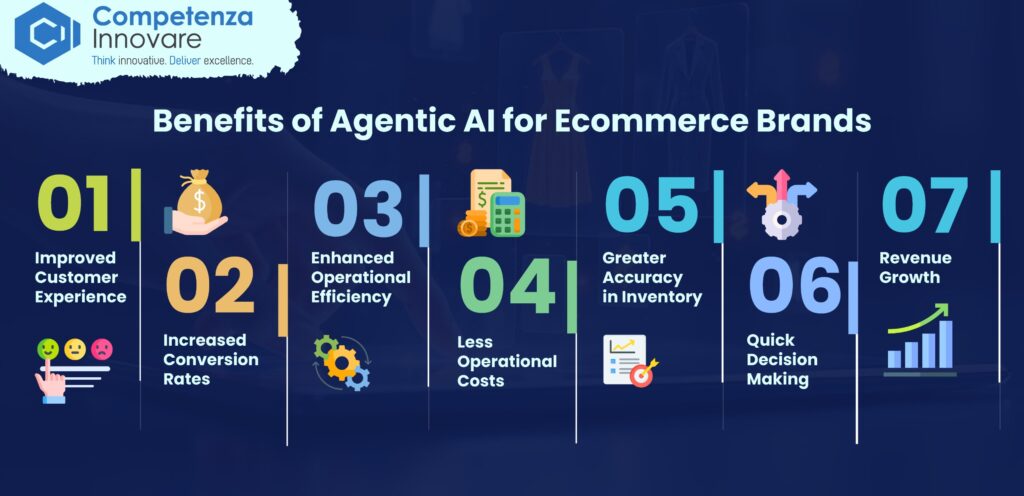
Benefits of Agentic AI for Ecommerce Brands
- Improved Customer Experience: The entire interaction with the customers—AI search and discovery to post-purchase support—is all channel-aligned, contextual, and personalized. The difference between customer expectations and receipts is brought down to a quantifiable degree.
- Increased Conversion Rates: AI e-commerce personalization, contextual cart recovery, and AI shopping assistants turn more browsers into buyers—with significant influence on overall conversion rate and average order value.
- Enhanced Operational Efficiency: AI inventory management, AI order management, detection of fraud, and AI customer support automation eliminate manual overhead, which consumes the operational team capacity without providing strategic value.
- Less Operational Costs: The number of human hours spent on routine operations is reduced, the fraud losses are minimized, the level of write-downs is more accurate, and the ad cost is more efficient; all lead to the situation of a quantifiable saving in cost that is sustained.
- Greater Accuracy in Inventory: AI demand forecasting and automated replenishment maintenance keep stock levels optimized at all times—minimizing the perceived cost of overstocking as well as the revenue cost of stockouts.
- Quick Decision Making: Decisions that once had to be assembled, analyzed, and approved by management are automatically made in real time—at the pace and at the scale that autonomous e-commerce solutions can enable and at which human decision-making cannot keep pace.
- Revenue Growth: The combination of increased conversion rates, larger baskets, enhanced customer retention, and increased efficiency will directly translate into revenue growth—both through growth in the top line and increase in margin.
The Future of Agentic AI in Ecommerce
The existing generation of agentic AI in online stores is remarkable—yet it is an early instance of what the technology will bring during the next three and five years.
- Smart, Aimed Search and Discovery: The AI-based search and discovery will cease to rely on the matching of the keywords completely. Customers will specify what they desire using natural language, images, or voice, and agentic AI will decipher purpose and surface the correct product in a manner that is cataloged or not.
- More Proactive Customer Support: AI customer support agents will become more than reactive and more proactive, i.e., determine the problems before they will be faced by the customers. The shipment that is delayed will result in the initiation of proactive communication and compensation even prior to the complaint being raised.
- Automated Merchandising and Inventory Management: AI-based inventory management and merchandising will be functioning with greater autonomy; the entire process of management of demand signal to purchase order to product placement will not go through review cycles, which can slow down these processes.
- Autonomous Customer Retention: Retention will be an ongoing, automated process instead of a regular campaign. AGI will observe all the engagement indicators of each customer in real-time and will deploy a personalized AI-based customer journey optimization the instant that they have started to become disengaged.
- Hyper-Personalized Shopping Experiences: AI e-commerce personalization will also be able to take product recommendations a step further; it will be able to bring personalization into every aspect of the shopping experience—the navigation, search results, pricing, promotions, content, and communication—at the individual level in real time.
- Self-Optimizing Ecommerce Operations: The long-term trend is to autonomous ecommerce systems that recognize their own inefficiencies and that have their own optimization objectives, and that make their own optimization improvements—human teams are involved in strategy, creativity, and decision-making that really do need human judgment.
Ready to Transform Your Ecommerce with Agentic AI? Let’s Build Your AI-Powered Future Today.
Conclusion
Agentic AI in the e-commerce business should not be treated as a feature enhancement but rather as a strategic change of the paradigm in which online shopping functions. The competenza has provided twelve use cases in this blog denote the best opportunities in the nearest future in the spheres of customer experience, optimization of revenues, and efficiency of operations.
The companies that want to invest in e-commerce agentic AI solutions at this point are not because this technology is new. They are doing so because the business case—through AI e-commerce personalization, AI customer support automation, AI inventory management, AI demand forecasting, and AI marketing automation—is hard to overlook.
The technology is not immature enough to present actual results in the present day. The question for most e-commerce businesses is ceasing to be whether to use agentic AI to support e-commerce, but rather, where to begin and how fast to go.
Frequently Asked Questions
What is agentic AI in e-commerce?
In e-commerce, agentic AI means AI systems that focus on achieving specific business goals—maximizing conversion rate, optimizing inventory, recovering abandoned carts—by planning, executing, evaluating results, and modifying themselves continuously without human guidance in steps.
What is the difference between agentic AI and conventional e-commerce automation?
Traditional e-commerce automation operates on determined rules. The agentic AI operates on objectives—identifying the optimal set of actions, performing them, assessing outcomes, and developing its strategy depending on the lessons it gets. Smart e-commerce automation is fitted to adjust to changing conditions instead of collapsing in response to changes.
Which are the key agentic AI applications in e-commerce?
Its main applications are AI shopping assistants, AI product suggestions, AI customer support robots, AI cart recovery, AI inventory control, AI demand forecasting, AI price optimization, AI marketing robots, fraud detection, AI order fulfillment, customer retention, and autonomous merchandising.
What is the duration of implementation of e-commerce agentic AI?
An average sizable pilot with one use case takes between six and twelve weeks between data audit and live deployment. Larger multi-use-case programs that are carried out over six to eighteen months based on the complexity of integration and the quality of existing data infrastructure.
Will agentic AI work with small e-commerce?
Yes. The best approach to AI in e-commerce, starting with one or two high-impact agentic AI use cases in smaller businesses, is to rely on cloud-based e-commerce agentic AI solutions that do not need any substantial investment in infrastructure.
What information will agentic AI require to be effective in e-commerce?
AI agentic eCommerce needs clean and linked information regarding customer behavior, transaction history, product catalog, inventory, and performance in marketing. The quality of data is the most relevant metric of how the AI-driven e-commerce systems are ideally working in practice.