

Several organizations continue to use legacy applications that are expensive to maintain, hard to update, and cannot keep up with evolving business requirements. AI in Application Modernization is one of the most urgent parts of ensuring efficiency, scalability, and innovative applications as companies undergo the digital transformation, cloud technologies, and modern software architecture.
The modernization of AI applications is assisting businesses with making this process faster by automating the process of checking the applicability of applications, scanning of codebases, and dependency determination and making the process of migration planning easier. As legacy applications are modernized using AI, the organizations are able to modernize these applications more quickly, minimize their technical debt, enhance the quality of their software, and become cloud-native applications with reduced risk. Intelligent code refactoring, automated testing, performance optimization, and cloud migration support are just a few AI services contributing towards how enterprises are modernizing.
This blog will discuss the effects of AI-assisted modernization of applications on aging software, the most notable advantages of the trends, and the measures that businesses can take to develop modern applications that will sustain them into the future.
What Is Application Modernization?
Application modernization refers to the process of revising and transforming the current software applications to enhance performance, scalability, security, and compatibility with modern technologies. The organizations are experiencing the use of legacy systems that were developed years ago that are no longer suitable to serve changing business needs, customer demands, or the digital transformation agenda. Consequently, the modernization of legacy applications has been a major focus of enterprises aiming to be competitive and agile.
To achieve modernization, organizations aim to minimize the technical debt, decrease maintenance, enhance user experiences, and be able to innovate faster. Instead of having to upgrade all systems and replace them with new ones, business organizations have a few modernization methods that they can adopt depending on the objectives of the company and the available infrastructure.
Common application modernization approaches include:
Rehosting
Lift and shift, also known as rehosting, is an approach to relocating applications between on-premises environments and the cloud with minimum code changes. This plan helps businesses to expand and be effective in infrastructure.
Replatforming
Replatforming is the art of slightly modifying an application so that it can run in a compatible manner with modern cloud platforms, databases, or operating systems without affecting the essential functionality of the application.
Refactoring
Refactoring is aimed at reorganizing and optimizing application code to enhance its performance, maintainability, and scalability without alleviating its fundamental business logic.
Rebuilding
In other situations, organizations can construct applications with new technologies and architectures and still maintain the business requirements and functionality.
Replacing
In cases where legacy systems are not able to address the needs of the business, organizations may opt to upgrade their legacy systems to more flexible and long-term valued modern software solutions.
One primary objective of modernizing the enterprise application is to leave the monolithic architecture behind and instead move to the cloud-native environment based on microservices or APIs, containers, and DevOps. The transition allows it to be more scalable, create deployments faster, be more resilient, and integrate with newer technology like artificial intelligence and automation.
The digital transformation is changing industries, and application modernization critically assists in enabling organizations to be more innovative, enhance operational efficiency, and develop technology ecosystems that can withstand the future.
Why Traditional Application Modernization Is Challenging
Whereas application modernization services are beneficial in assisting organizations to become more efficient, scaled, and innovative, not all of them can be done simply. Most organizations continue to use complex legacy systems that have been operating over the years, and thus, modernizing is too hard, too expensive, and time-consuming. These issues frequently drag back the modernization efforts of legacy applications and put projects at risk.
Complex Legacy Architectures
Most of the legacy applications are monolithic with old technologies that are hard to tweak or even to integrate with newer systems. These applications tend to fail to meet modernization with business needs due to their inability to accommodate scalability, flexibility, and cloud adoption.
Technical Debt Accumulation
Decades of updates, patches, and ad-hoc fixes can create a lot of technical debt. Obsolete code leads to higher maintenance costs, poor performance by the application, and more difficulty in adding new features or improvements to the application. This has the ability to drag back the modernization efforts of the enterprise applications and raise the operational costs.
Hidden Dependencies and Documentation Gaps
There can be unregistered integrations and custom configurations and dependencies of history systems. With little documentation, it is hard to know how the applications interface with other systems, and this raises the possibility of making mistakes, delays, and other unpleasant surprises in the modernization project.
Long Timelines and High Costs
Conventional modernization activities include hand determination of the appraisal of the application, testing of coding, migration planning, and testing. These tests are time-consuming, expensive, and have specialized skills associated with them. Consequently, numerous organizations discover that an old-fashioned method of modernization of applications can be more time-consuming and may take longer to yield outcomes.
These are some of the challenges leading companies to consider AI-based application modernization, which may aid in automating major operations and thereby decrease complexity and hasten the modernization process.
How AI Is Revolutionizing Application Modernization
The AI application modernization acquires power as an efficient tool that companies seek to modernize older systems in a quicker and more efficient way. AI helps to automate various sophisticated tasks during modernization and decrease human activities, increase accuracy, and speed up transformation projects. AI-enabled application modernization can help the company speed up its application modernization process, be more confident, and start with application assessment and migrate and test the application.
1. AI-Powered Application Discovery and Assessment
Among the initial measures of modernization is the need to comprehend the current application environment. AI is able to scan large codebases automatically, depict dependencies, analyze application architectures, and show areas where improvements are necessary. This can assist organizations in having better visibility of the legacy systems and the identification of modernization opportunities faster than when using the traditional assessment techniques.
2. Intelligent Code Analysis and Refactoring
Within the framework of AI software modernization, AI-based software may look at the source code and indicate redundant or obsolete code and even infer that there might be a defect that could impact performance or maintainability. Code refactoring strategies can also be suggested by AI to assist in simplifying the applications, enhancing the code quality, and getting the systems ready for the modern architectures.
3. Automated Legacy-to-Modern Architecture Transformation
AI is helping organizations to re-architect monolithic applications into more dynamic and scaled applications. It can also be used to make the transition to microservices, recommend the API modernization process, and support the containerization effort. These features allow companies to create cloud-native applications, making them more compatible with the current development and deployment environment.
4. AI-Powered Cloud Application Modernization
AI plays a great role in cloud application modernization and helps organizations analyze and assess whether they are ready to be in the cloud, design their strategies of cloud migration, and optimize their infrastructure. AIs can help businesses take cloud modernization projects to another level through workload analysis and advice on the best environments to deploy by enhancing performance, scalability, and cost-efficiency.
5. Automated Testing and Quality Assurance
Modernization of an application is a task that involves testing, and AI can help in this task greatly. Systems that make use of artificial intelligence can generate test cases, detect defects, automate regression testing, and pinpoint potential risks before being deployed. This assists organizations to enhance the quality of their software, minimizing the amount of time to test it and ensuring their modernized software is reliable and safe.
Through automation of the essential modernization processes, AI-based application modernization allows companies to minimize complexity, shorten timelines of the project, and attain improved performance in their efforts to modernize their legacy applications.
Benefits of AI-Powered Application Modernization
Companies are migrating to application modernization through AI to facilitate the modernization effort and provide better business outcomes. By increasing automation, maximizing analysis, and leveraging data-driven insights, AI can support any business in the modernization of applications acquired at a lower risk and cost. The intelligent application modernization has the following advantages in part.
- Slow speed of modernization: It turns off time-intensive processes of app evaluation, bubble mapping, dependency mapping, and testing through AI assistance. This assists organizations in undertaking modernization projects more quickly and hastens their migration to modern applications out of their legacy systems.
- Minimized Costs of Modernization: Conventional modernization efforts can be time-consuming and need special resources and manual work. With the advent of AI to modernize its applications, therapists have the opportunity to automate many processes, reduce the complexity of a project, and even reduce the overall costs of the modernization and streamline them.
- Reduced Technical Debt: AI is able to point out legacy applications that have obsolete code and redundant elements as well as processes that are inefficient. Early identification of such problems helps organizations to reduce technical debt, ease maintenance, and develop a better basis on which to build the future.
- Enhanced Performance of Applications: AI enhances optimization of the application architecture, code quality, and example utilization. This in turn has facilitated modernized applications, which are more performance-oriented and faster in response besides being reliable in terms of user experience.
- Heightened Security and Compliance: Legacy applications can be vulnerable to security and aged environments. In total, AI will be helpful in determining potential risks, in fixing vulnerabilities, and in helping to meet compliance requirements to make organizations create more robust and safer applications.
- Increased Developer Productivity: AI allows development teams to focus on more valuable activities through automation of repeatable processes such as code reviews and testing and analysis of documentation. This shoots up efficiency and makes the process of providing new features and updates fast.
- Heightened Scalability and Business Role: Modernized applications are at an advantage to support business needs as they change. Intelligent application modernization enables organizations to create scalable and cloud-ready systems that can easily adapt to growth and changes in the market, as well as customer expectations.
In general, AI-powered application modernization enables organizations to modernize the existing applications within a shorter time, save on costs, enhance software quality, and develop adaptable technology ecosystems that enable them to achieve long-term business expansion.
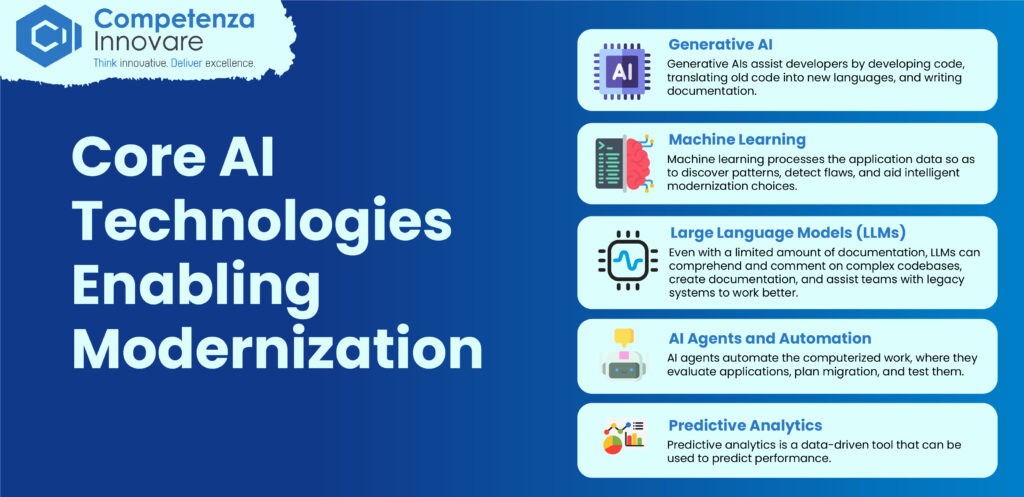
Core AI Technologies Enabling Modernization
There are a number of AI technologies assisting organizations to be fast in updating their AI software by automating intricate work and enhancing the quality of modernization.
Generative AI
Generative AIs assist developers by developing code, translating old code into new languages, and writing documentation. This saves man energy and accelerates modernization endeavors.
Machine Learning
Machine learning processes the application data so as to discover patterns, detect flaws, and aid intelligent modernization choices. It assists organizations to become more efficient and to optimize the performance of applications.
Large Language Models (LLMs)
Even with a limited amount of documentation, LLMs can comprehend and comment on complex codebases, create documentation, and assist teams with legacy systems to work better.
AI Agents and Automation
AI agents automate the computerized work, where they evaluate applications, plan migration, and test them. This assists in streamlining the modernization processes and enhancing productivity.
Predictive Analytics
Predictive analytics is a data-driven tool that can be used to predict performance and possible risks and enhance better planning during the modernization process.
This combination of technologies accelerates AI software modernization, as it becomes much faster, more efficient, and more effective for the needs of the organization in need of legacy application modernization.
Real-World Use Cases of AI Application Modernization
Companies in the business world are applying AI to modernize enterprise applications more rapidly, enhance their application performance, and modernize old systems. The following are typical application cases.
- Banking and Financial Services: Banks and other financial services use AI to update the base banking apps, improve the functionality of banking systems, and help meet regulations. AI assists in examining old systems, reduces the process of modernization, and safeguards financial platforms.
- Healthcare Systems: AI finds its application in healthcare organizations to modernize the old healthcare apps and enhance system interoperability. By transforming the old applications, trends are now becoming more convenient in sharing data, enhancing patient experiences, and streamlining healthcare services.
- Retail and E-Commerce Platforms: Retailers use AI to power up e-commerce platforms, improve customer experiences, and meet the increasing user demands. Contemporary applications are faster, offer custom-made experiences, and enhance layering in their workload during the peak days of shopping.
- Manufacturing and Supply Chain Systems: AI in manufacturing has been used to modernize manufacturing systems and to incorporate modern ERP solutions. This helps in improving the supply chain visibility, efficient procedures, and overall operational efficiency.
- Enterprise Business Applications: AI is used by many organizations to upgrade their old ERP and business applications. The AI aids in the automation of the workflow, enhancing connections between systems and assisting companies to be more effective and minimizing manual labor.
These applications illustrate how the process of AI-powered enterprise application modernization can assist businesses to become more agile and efficient and ultimately boost their long-term business performance.
Best Practices for Successful AI-Driven Application Modernization
It is not enough to implement new technologies and see the AI-driven application modernization. Companies must have a plan to upgrade old applications and minimize risks and realize business value in the long term. The best practices will help the companies to realize all the benefits of application modernization services and development of scalable and future-ready applications.
- Complete Application Assessment – Investigate the existing applications, dependencies, and technical debt to discover modernization opportunities.
- Focus on High-Impact Applications – Proceed with business-critical systems of the highest value and modernization paybacks.
- Give a clear modernization roadmap – diagram the objectives, plan, and priorities so as to have the modernization process underway successfully.
- Combine AI with Human Knowledge – Combine the AI automation and understanding and delegate strategic decision-making to expert teams.
- Elevating to Cloud-Native Principles – Cloud technologies, microservices, and APIs are the technologies and services that can be leveraged to enhance scalability and flexibility.
- Concentrated on Security and Governance – Make sure apps are at the required security and compliance levels and governance.
- Ongoing monitor and optimize applications – Monitoring the performance and optimizing the same frequently in response to the evolving business requirement.
With all these best practices, organizations would be able to fast-track modernization of AI-powered applications, enhance application performance, and realize successful modernization results.
Ready to modernize your legacy applications with AI? Connect with Competenza to plan your transformation today.
Why Businesses Should Invest in Application Modernization Services
The new applications are critical in enhancing performance, scalability, security, and business agility. Nevertheless, most organizations still use outdated systems that reduce chances of growth and innovations. Application modernization services may help businesses reduce the level of technical debt and increase operational efficiency, as well as remain relevant to the dynamic market demands.
With the Competenza, organizations are able to modernize legacy apps, embrace cloud-native technologies, and hasten digital transformation. This enables organizations to build safe yet scalable and long-term applications that help in the long-term success.
Conclusion
By empowering companies to modernize legacy applications faster and more cost-effectively and with superior performance, AI is transforming application modernization. The possibility to migrate to the cloud, automated analysis of the code, and smart testing allow building on AI-enhanced application modernization, thus facilitating organizations in building scalable and future-ready applications. To enable businesses to accelerate the digital transformation process, modernize the correct applications and services, and stay competitive in the rapidly changing world of technology, businesses need to invest in digital transformation.
FAQs
What is the modernization of AI applications?
Application modernization using artificial intelligence The process of automating and refining application modernization techniques such as analysis of code, dependency mapping, testing, migration planning, performance optimization, and using artificial intelligence.
How can AI help modernize legacy applications?
AI can help the organizations to upgrade the old applications by locating the old code, improving the application architecture, automating tests, and recommending cloud migration and modernization plans.
What are the benefits to the use of AI to modernize applications?
Some of the most notable benefits would be the reduction of the velocity of the modernization cycle, reduction of costs, reduction of technical debt, better application performance, enhanced security, and scalability.
What is the difference between traditional and AI-driven application modernization?
Conventional modernization depends on manual testing and evaluation of code, whereas the application modernization based on AI involves automation and smart analysis to accelerate the decision-making process and simplify the project.
Is it possible to use AI to modernize cloud applications?
Yes, some of the ways AI can be used to measure cloud readiness, optimize infrastructure, suggest migration strategies, and assist organizations to migrate applications to cloud-native environments more effectively.
What industries are the beneficiaries of AI application modernization?
Industries such as banking, healthcare, retail, manufacturing, and enterprise services are using AI-powered application modernization as a way of improving efficiency, scalability, security, and business flexibility.
Why would businesses invest in application modernization services?
Application modernization services help a company to reduce technical debt, increase application efficiency, improve security, further digitization, and build a future-oriented software platform.
What can The Competenza do to assist in the modernization of applications?
The Competenza assists companies to modernize legacy applications in a strategic manner, with the use of cloud-native modernization, AI-based solutions, and the ability to modernize applications in a more scalable manner based on business objectives.