

Businesses are also seeking smarter approaches to industrialize workflows, enhance effectiveness, and turn down manual effort. Although this classical Robotic Process Automation (RPA) can work successfully in situations when the task is repetitive, involves rule-based operations, and can be easily corrected, further into even more sophisticated operations that need decisions to be made, flexibility, and immediate reactions, the classical version of the tool fails to function efficiently.
This is the field where agentic AI for workflow automation is altering the scenario. In contrast to classical RPA bots, which operate based on predetermined RPA rules and procedures, agentic AI workflows are implemented on the basis of intelligent AI agents by analyzing the input materials, making decisions and performing actions independently. Such systems will be able to respond to changing conditions, interface with numerous business applications, and automate more complex work flows with little human intervention.
Automation of agentic workflow in healthcare and supply chains, finance, and customer service may help organizations to streamline a process, improve accuracy, and boost productivity. This guide will explain the reasons as to why agentic AI solutions are more than a next-generation version of traditional RPA, why they are the most significant, how they are being applied in practice, and why they are shaping intelligent business automation in the future.
What Is Agentic AI Workflow Automation?
The Agentic AI Workflow Automation is an intelligent AI agent that automatically performs tasks, makes decisions, and fulfills business processes by having minimal human interference. In contrast to the automation tradition where rules are adhered to, agentic AI workflows have the ability to learn the context, consider information, and dynamically respond to diverse situations. That enables companies to automate the more complicated workflows and enhance the operational efficiency.
Understanding Agentic AI
This is known as agentic AI, that is, AI systems that are capable of making their own decisions and accomplishing certain objectives. Although the interaction between the user and AI assistants is normally based on requests, autonomous AI agents are able to plan, act, and control themselves. They have the capability of making decisions, solving problems, and amending their actions when things change, and they do this using real-time data and reasoning.
A goal-oriented approach assists organizations to automate flexibly oriented workflows of decision-making and incessant optimization.
Core Components of Agentic AI Workflows
The following are some of the most significant technologies under agentic workflow automation:
- Large Language Models (LLMs): Helps AI agents in understanding, processing, and generating information.
- Planning Engines: Get the agents to be capable of breaking down goals into action steps.
- Memory and Context Awareness: Allow agents to remember the history of a dialogue and use this information to make judgments.
- Tool Integrations: Integrate the agent with the business systems, e.g., CRM, ERP systems, and communication platforms.
- Continuous Education: Agents assisting the poor enhance and change over time.
By integrating such capabilities, businesses can automate advanced operations and improve productivity and smarter decision-making in their operations through the assistance of agentic AI workflows.
Understanding Traditional RPA and Its Limitations
Before the advent of agentic AI, which automates workflows, robotic process automation (RPA) was being deployed by most organizations in a bid to automate manual business processes. The traditional RPA is supposed to enhance efficiency by adhering to set regulations and undertaking established routines without the involvement of humans.
How Traditional RPA Works
Software bots are the traditional RPA and complete repetitions of the task with predefined instructions. These bots adhere to systematic procedures and are coded to perform functions that include data input, invoice management, generation of reports, and submission of forms.
Due to the fact that RPA functions based on defined rules, it is most appropriate when the processes are predictable and when the data is very structured. It is therefore useful as a tool of automation of routine tasks and manual work overloads.
Key Challenges of Traditional RPA
Although robotic process automation can enhance productivity, it has a number of limitations concerning the contemporary business processes.
- Lack of Poor Adaptability: RPA bots are not adaptable to workflow changes or unexpected variables.
- Difficulty Handling Unstructured Data: Mail, documents, images, and natural language may prove difficult to handle through a traditional system.
- Needs Continuous Updates: There is often a need to reconfigurate or rewrite bots according to the workflow modifications.
- Absence of Alternate Action: RPA does as he is ordered to but cannot analyze any situation and will not take any decision independently.
- Reliance on Predefined Rules: only what has been coded into the bots has been explicitly encoded to do.
These constraints have been necessitated by the reality that business is driving towards more flexible and smart workflow automation that can alter, learn, and make decisions independently. This is where agentic AI is ramping up as the subsequent step in the automation of business.
Agentic AI vs Traditional RPA: What’s the Difference?
Robotic Process Automation (RPA) is also used to automate business processes, but of course, in a different manner in comparison with agentic AI. Traditional RPA operates according to the set rules to do the same tasks, whereas agentic AI is capable of analyzing information, making decisions, and responding to any modulations. This renders agentic AI a higher form of intelligent automation of workflow.
| Feature | Traditional RPA | Agentic AI |
| Decision-Making | Rule-Based | Autonomous |
| Adaptability | Low | High |
| Learning Ability | None | Continuous |
| Data Handling | Structured Data | Structured & Unstructured Data |
| Human Intervention | Frequent | Minimal |
| Scalability | Moderate | High |
When comparing the Agentic AI and RPA, the former is more flexible and intelligent. In comparison to traditional bots, AI agents vs. RPA bots can handle complex processes, adjust to the changing circumstances, and are continually improving. This will help businesses to automate more processes, become more efficient, and become more agile.
How Agentic AI Transforms Workflow Automation
Opposite rule-based work, agentic workflow automation can help an organization to get beyond the past and move to the next level of maximizing workflow using AI agents to decide on changes and get the best workflows. This helps make AI workflow automation smarter, more adaptable, and efficient.
Autonomous Decision-Making
In comparison to conventional automation tools, AI agents have the capabilities to analyze a situation, evaluate the data at hand, and select an optimal course of action to meet a certain target. They are not based only on known scripts; they enable them to cope with more complicated business processes with little or no human involvement.
Dynamic Workflow Orchestration
Conditional real-time adaptive workflows based on conditional change can be created using agentic AI. Active data and a change in the process or some unforeseen problem—the AI agents can modify their activities and maintain the course of work without manual interventions all the time.
Cross-System Integration
One of the significant benefits of AI workflow management is that it can operate on numerous business systems. AI can be agentic and relate and interact with:
- CRM systems
- ERP platforms
- Databases
- Communication and collaboration tools
This enables data to flow across systems smoothly as well as enables the automation of end-to-end business processes.
Continuous Optimization
The agentic AI is a continuous learner based on the performance of workflows and results. Through evaluation of findings and pinpointing areas of improvement, AI can streamline processes and eventually lead businesses to be more efficient, eliminate errors, and achieve improved operational performance.
The agentic workflow automation is a combination of autonomous decision-making, real-time adaptability, and continuous learning, which helps organizations to achieve better automation of complex workflows than more conventional automation solutions.
Benefits of Agentic AI Solutions for Enterprises
AI applications are agentic solutions that assist businesses in automating intricate operations, increasing efficiency, and better making decisions. As companies begin to use enterprise AI automation, they are able to enjoy the following benefits:
- Improved Operational Efficiency: Automates the process across the departments, minimizes the bottlenecks, and enhances the productivity.
- Reduction in Workloads: May be manual or administrative work and helps workers focus on work of higher value.
- Fast Decision-Making: Real-time data analysis based on insights and faster business decisions.
- Greater Accuracy and Consistency: Can minimize the frequency of human errors, provides the identical workflow, and increases the reliability of data.
- Improved Scalability: Scale add with economic feasibility, and customers can scale up without incurring great changes in the cost of operation.
- Enhanced Customer Experiences: Mobilizes response time, develops more leveraged service, and provides more interactive customer experiences.
- Enhanced Productivity: Makes running a business feel less complex and also helps the team to achieve more within a given time limit.
- Cost Savings: Intelligent automation will do away with manual labor, maximize resource utilization, and result in cost savings through operating costs.
- Quick Business Operations: Quickens the working cycle, approvals, and carrying out of the tasks in the organization.
- Improved Service Delivery: Enhances the performance of the businesses and assists the businesses in providing more services in a quicker and more consistent manner.
Against the backdrop of the never-ending digital environment, smart decision-making and AI business automation enable organizations to operate cheaper, expand, and remain in front of others.
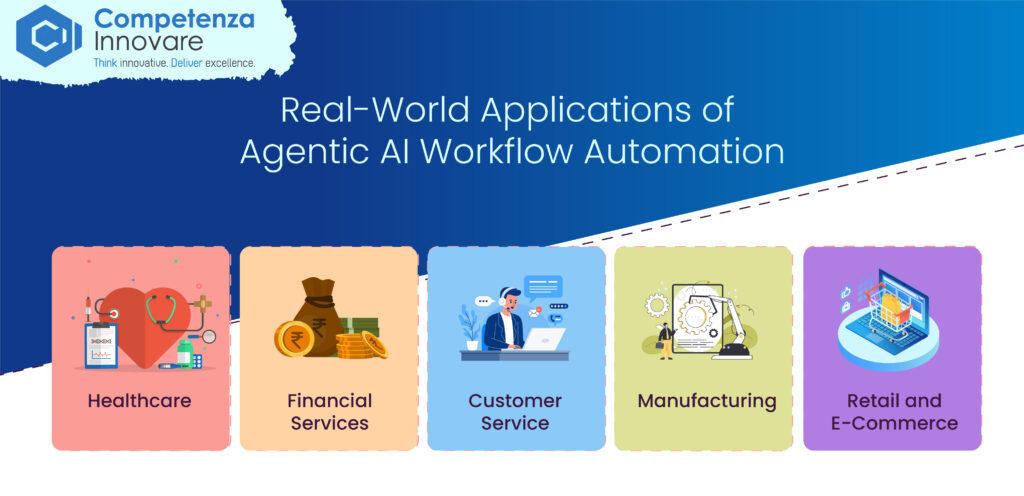
Real-World Applications of Agentic AI Workflow Automation
Automation of agentic AI workflows can effectively assist organizations in automating complex processes, enhancing efficiency, and improving decision-making across industries. The intelligent agents in collaboration with autonomous workflow automation allow businesses to optimize the processes and improve their results.
Healthcare
The Agentic AI in Healthcare is used to automate administrative systems and patient services, including
- Appointment scheduling and management.
- Automated claims processing and verification.
- Patient communication and follow-up reminders.
- Quick access to health and medical services and information.
Financial Services
Enterprise AI automation helps financial institutions to achieve accuracy, reduce risk, and speed up operations by:
- Real-time fraud prevention and detection.
- Checking compliance and regulatory reporting.
- Review and processing of loans.
- Decision support and automated data analysis of financial data.
Customer Service
By enabling agentic AI, businesses performing in the same way can offer quicker and more personalized services by:
- Unmanned support gurus that get customer requests.
- Auto sorting and clearing of tickets.
- Multichannel customer relationships through chat, email, and messaging.
- Improved response times and customer satisfaction.
Manufacturing
Using AI automation, business manufacturers will optimize business production and operations by:
- Improving supply chain visibility and coordination.
- Foreseeing the issue of predictive maintenance of equipment.
- Less employee downtime and operational interruptions.
- Funding smarter planning and allocation of resources.
Retail and E-Commerce
The applications of Agentic AI in e-commerce with retailers are directed towards a more personalized and efficient shopping process, and they may include
- Computer-assisted inventory control and stock tracking.
- Individualized product suggestion and experience.
- Control of inventory and forecasting demand.
- Faster order processing and customer support.
The following real-life examples reflect the changing nature of autonomous workflow automation in business operations through enhancing efficiency, minimized manual work, and elevated customer experiences in industries.
Key Indicators That Your Business Needs Agentic AI
When the nature of workflows becomes harder, businesses might have to stop at a stage where a traditional automation solution can no longer provide the speed, flexibility, and intelligence that they need a modern business to operate. These are just several symptoms that it is time to go to work with agentic AI in regard to workflow automation.
Frequent Workflow Exceptions
Traditional automation is effective for repeatable rules and deterministic processes. Using exceptions often means that the employees will have to take over and ensure their workflows run continuously. The AI workflows of agentic types will be able to analyze the situations, change more effectively, and cope with exceptions.
High Volumes of Unstructured Data
Each day, business processes receive and send bulk mail, paperwork, customer inquiries, and chat messages. In contrast to automation based on rules, agentic AI solutions can think about and respond to unstructured information, enhancing the efficiency of workflows and manual labor.
Complex Approval Processes
Often approval workflows done by organizations become more complex and slower as organizations expand. Intelligent Routing Automation: AI workflow automation is capable of smartly directing requests, prioritizing play, and aiding in a reduction in the schedule across departments.
Multiple Disconnected Systems
Once the data is distributed all over the CRM, ERP system, HR, finance, and communication systems, it consumes more time when teams are required to traverse between systems. These systems can be interconnected by autonomous AI agents and can automate activities in the whole workflow.
Slow Decision-Making
A decision regarding business is usually based on a collection of information. Intelligent workflow automation assists with the analysis of data more quickly, providing connected information and benefiting faster decision-making processes.
Rapidly Changing Business Requirements
The market circumstances and customer needs, as well as operation priorities, may alter rapidly. Conventional automation needs regular updates, whereas agentic AI workflows can dynamically adjust to business requirements.
Rising Operational Costs
When there is still a growing pace of manual work, inefficiencies within the process, and demands in terms of resources, despite the use of automation, it can be considered that a more developed way should be applied. Enterprise AI automation assists in enhancing productivity, resource optimization, and overhead minimization in operations.
When these disadvantages begin to reoccur throughout the organization, then usually it is a good indication that the automation based on rules has hit its boundaries. By using Workflow Automation with Agentic AI, companies can also automate more sophisticated processes, be more agile, and build smarter, scalable processes.
Building Blocks of an Agentic AI Architecture
As organizations adopt the use of agentic AI to workflow automation, a suitable architecture becomes a major success factor. An agentic AI ecosystem is a combination of data and intelligence, autonomous agents, workflow coordination, and governance to support smart and adaptive business processes. Together, these building blocks present the foundation for scalable and agentic AI processes, which help companies to be more productive, automate complex operations, and facilitate intelligent decision-making across the business.
What Powers Autonomous Workflows?
Effective agentic AI for workflow automation involves a layer architecture that empowers AI agents to access business data, make decisions, and execute tasks and work safely across systems. Combining intelligence, automation, and administration, businesses can create scalable agentic AI operations that will improve efficiency and contribute to smarter business procedures.
Data Layer (ERP, CRM, Databases, APIs)
The architecture is based on the data layer, which connects business applications with databases and the enterprise systems. It pushes real-time data to AI agents, which may be used to help them perceive the situation and take relevant measures.
Intelligence Layer (LLMs and Reasoning Models)
The layer of intelligence provides the ability of AI to process and understand data and make effective decisions. The agents of AI solutions can execute more complex work tasks than traditional automation of rules based on large language models (LLMs) and reasoning.
Agent Layer (Autonomous AI Agents)
This layer is made up of smart agents that have the capacity to perform, communicate with the systems, and make decisions. These autonomous AI agents are used to automate the processes and respond to evolving business needs.
Workflow Layer (Task Orchestration)
The workflow layer is the layer that maintains the inter-system and interdepartmental coordination activities. It makes sure that tasks are carried out in a proper order, which intertwines into a smooth and efficient AI workflow automation.
Governance Layer (Security, Compliance, Monitoring)
The governance layer provides checks and balances through security control, compliance, monitoring, and tracking performance. It assists organizations to introduce enterprise AI automation in a way that is safe and responsible.
It is possible to have all the layers forming a scalable intelligent workflow automation platform, which could be applicable in automating the workflow of an organization, even in improving the decision-making processes and efficiency of the operations of an organization.
Agentic AI Implementation Roadmap
Adoption of the agency AI workflow automation should be done in a systematic way that will guarantee efficient adoption and value in the long term. A roadmap, a stepwise approach, assists organizations in staying risk-averse, maximizing the performance of the delegation, and achieving the benefits of intelligent expansion of automation.
Steps to Successful Adoption
- Discover Your High-Impact Workflow Opportunities: To start with, you must identify business processes that are either redundant, time-consuming, or decision-intensive and apply these to an agentic AI workflow in a way that may generate the most business value.
- Test Current Experiments in Automation: Model the current automation software, business applications, and workflows and get familiar with where you can authentically get AI agents to work effectively.
- State Business Objectives and KPIs: Possess their own purpose, e.g., to be more effective, to be cheaper, to work faster, or to be more customer-friendly. Brainstorm wanted KPIs whose improvement is quantifiable.
- Integrate AI Agents and Core Systems: AI autonomous agents have the potential to be embedded in ERP, CRM, databases, and other business applications, which means that workflows and data are ideal for adoption.
- Establish Governance and Security Policies: Design governance, compliance, surveillance and human control policies to be responsible and believable to accept AI.
- Pilot Workflows in Controlled Environments: Introduce workflows on a mini level to check their efficiency and presence of possible challenges and streamline the workflows prior to their extensive application.
- Use Cases: Major Successes Across Business Unit: Prove successful, and then use the agentic workflow to support more teams and business functions to make a bigger difference.
- Ongoing Always Improve Performance: Constantly monitor workflow results, interpret performance indicators, and train AI agents to be more accurate, more efficient, and to deliver better business performance.
This staged process also encourages the organizations to introduce and deploy the agentic AI solutions more efficiently while maximizing the importance of enterprise AI automation and nurturing the value of business over the long term.
Challenges of Implementing Agentic AI Workflows
Although the advances of AI workflow automation contain huge benefits, organizations should consider various challenges to achieve success in the adoption process and the long-term financial gain.
- Data Quality and Availability: Agentic AI is based on accurate and up-to-date data. Poor data quality or being incomplete may influence the decision-making process as well as work performance.
- Security and Privacy Issues: Businesses should ensure that they protect confidential data, and AI systems should comply with the data privacy standards and the data security standards.
- Combination with Existing Systems: The existing AI may not easily be combined with older software and infrastructure many institutions already use.
- Governance and Compliance Requirements: In order to make sure that AI systems are liable according to regulations in the industry, companies can implement transparent policies, inspections, and controls.
- Human Oversight and Change Management: The employees should be well educated about the AI systems and be open to learn new procedures. To cope with the exceptions and accountability, manual control can still be used.
- Ethical AI Practices: In order to address the risks and increase the credibility of AI, organizations are advised to embrace transparency and fair and ethical AI practices.
- Autonomous Systems Trust Grants Autonomy in Construction: Trust is a type of state in construction. Attempting to utilize AI, businesses have to demonstrate that they will be useful, that they deserve it, and that they are versatile to the objectives of the business.
By countering these threats and reducing them, the organizations will be able to reap the maximum possible benefits out of enterprise AI automation and be sure that the agentic AI process speed will be safe, reliable, and efficient.
Discover how Agentic AI can automate complex workflows, boost efficiency, and transform your business operations.
Why Businesses Are Investing in Agentic AI Solutions
Organizations are integrating agentic AI solutions in an attempt to be competitive in a fast-changing environment and to improve efficiency and automate repetitive processes and work. Unlike general automation, agentic AI possesses a decision-making capability, adapts to new situations, and regulates processes using a minimum of human interventions.
This assists organizations to become faster to innovate, be cheaper to do business with, and be more resilient to business challenges. Enterprise AI automation allows companies to achieve scalability as they expand, supporting more and more workloads, without compromising productivity and service quality.
To support this transformation, Competenza helps businesses implement intelligent agentic solutions of AI that enable them to streamline their operations and improve decision-making, and it results in long-term growth. Organizations adopting agentic AI will be able to develop smarter, more responsive workflows and be equipped to take on the future of business automation.
Conclusion
The Workflow Automation with Agentic AI is assisting companies to go beyond the confines of conventional RPA by allowing smarter, more adaptable, and ethical work processes. Being able to make decisions, adapt to the changing conditions, and automate intricate operations, Agentic AI enhances efficiency, productivity, and business performance.
As more organizations implement digital transformation, agentic AI solutions will be instrumental to enhance innovation, scalability, and long-term expansion, and intelligent automation will be an attractive investment with high returns in the future.
FAQs
What is Agentic AI workflow automation?
The AI agentic workflow automation uses smart AI agents to perform activities, make decisions, and manage workflows in a way that contributes to minimal human intervention. It is able to adapt to the dynamic environment and cope with more complex business operations, which is not the case with conventional automation.
What is the difference between Agentic AI and traditional RPA?
The concept of traditional RPA lies in preprogrammed rules since it emulates the monotonous workforce, whereas agentic AI has the ability to work with information, decide, and modify actions according to up-to-date data. This allows Agentic AI to be more flexible and capable of handling dynamic workflows.
Can we replace RPA with agentic AI?
Not always. RPA is still applicable to simple tasks that are rule-based. Nevertheless, RPA can be complemented or supplemented by the use of agentic AI, as it must handle complex workflows, which need to be reasoned about, flexible, and decision-making.
Which industries are the best fit for agentic AI workflows?
The healthcare industry, along with other financial, customer service, manufacturing, and retail industries, can use the agentic AI workflows in enhancing efficiency, minimizing manual processing, and optimizing operations.
Do Agentic AI solutions fit enterprise environments?
Yes. The agentic AI solutions can be configured to interface with the enterprise systems and operate on a large scale as well as automate workflows across various departments while meeting security and compliance mandates.
What are the key advantages of Agentic AI in workflow automation?
Among the key positives, it has enhanced efficiency in operations, alleviated the burden on manual work, accelerated decision-making processes, enhanced precision, scaled up, and provided better customer experiences.
What are the ways businesses use Agentic AI workflows?
The process is usually initiated by businesses through the identification of automation opportunities, ensuring the introduction of AI agents into the current systems, setting workflow objectives, and optimizing performance to achieve better outcomes over time.
What does the future of Agentic AI in business automation hold?
The future of agentic AI encompasses additional self-directed processes, multi-copilot collaboration, intelligent decision-making, and end-to-end integration of business processes to enable organizations to be more agile and efficient.