

In the present era of digital competition, startups and enterprises tend to run out of business because they spend a lot of time and finances developing a complete product without first validating the concept. The minimal viable product (MVP) comes in here. An MVP development is the simplest form of a product, which contains just the basis features required to address a particular user problem. It helps to test the idea on a real market in order to realize whether users actually need the solution within a short period of time before it is developed to the full extent.
The primary objective of creating an MVP is to minimize risk, minimize cost, and quicker product validation. Businesses tend to release a bare minimum version initially, gather feedback on how the real users use it, and do it progressively. That is a way of attaining product-market fit, minimizes resources being wasted on it, and enables smarter decision-making. This is why MVP is a common practice in startups and SaaS products as well as mobile app development as an initial step to transforming an idea into a successful software product development.
What Is a Minimum Viable Product (MVP)?
The Minimum Viable Product (MVP) refers to the most basic form of a product that contains the bare minimum of features required to address a particular user problem. During MVP development, the primary emphasis is not to create a full-fledged or perfect product but to create a bare-bones working product and experiment with it on the market. The strategy assists the startups and businesses to realize that their idea may or should be useful instead of spending a lot of money on the development of a complete product. The reliable sources such as Atlassian, Appinventiv, and Product School explain that MVP is one of the components of the lean startup approach, in which learning from the genuine users plays a bigger role than the initial addition of features.
The primary objective associated with the minimum viable product is to test ideas in the early phases and minimize the risk to create something that is not in demand by the users. Companies create a basic form of a product instead of spending months creating a complete product, release it, and watch user interactions with it, then start refining it-based responses. This makes MVP development a clever and economical approach, particularly for startups, since it consumes less time, the cost of development is less by half, and it is more likely to get a product-market fit.
Why MVP Development Is Important
MVP development is significant as it assists startups and businesses to create a barebones of their product fast at minimal cost, minimal risk, and minimal development time. Companies do not create a complete product that includes all features but rather work on the core functionality that will address the primary user problem. This will enable the businesses to pilot their idea in the real market, gather a response, and make changes based on the real user needs so as to scale up the product.
Cost Efficiency (Reduces Development Cost and Risk)
MVP development saves on total development cost by not wasting money on the requirements at the initial phase. The level of investment undertaken by businesses is only up to the functionality required, which reduces the financial risk in case the idea fails in the market.
Also Read: How Much Does It Cost to Build a Software Product
Early Idea Validation (Helps Validate Product Ideas Early)
Under the MVP, enterprises can now test their idea with real users very fast without depending on assumptions. Early user feedback will help identify the usefulness of the product and its ability to address a real problem.
Faster Time to Market (Quick Launch Advantage)
Because MVP features only core features, it would be much quicker to develop and implement than a denser product. This helps businesses to penetrate the market during the initial stages, acquire users swiftly, and respond to the market need in a prompt manner.
Investor Confidence (Attracts Investors and Stakeholders)
An MVP is a reality on the ground of a concept for investors compared to a paper idea. It represents early adherence, consumer passion, and commercial prospects, which cultivates smallness and outcomes in improved funding possibilities.
Better Product Growth (Improves Product-Market Fit)
MVP development works to help businesses to improve their product according to the actual user feedback. The continual advancements keep the product moving in the proper direction, with a high likelihood of realizing high product-market fit and sustainability.
MVP vs Prototype vs Proof of Concept
Confusion between MVP, prototype, and proof of concept (PoC) is quite significant in developing an MVP since each of them is used in building and validating a product in a different manner. These three terms are mostly interchanged, yet they are applied in different phases of the product development in order to test ideas, designs, and technical feasibility.
| Type | Meaning | Purpose | Stage | Key Focus | Example |
| Proof of Concept (PoC) | A small test to check if an idea is technically possible | Validate technical feasibility | Early stage | “Can this idea work?” | Testing if AI can detect images correctly |
| Prototype | A visual or basic model of the product | Show design and user flow | Before development | “How will it look and feel?” | Clickable app design in Figma |
| MVP (Minimum Viable Product) | A working version of the product with core features | Validate real market demand | After prototype | “Do users actually need it?” | Basic app with login + main feature |
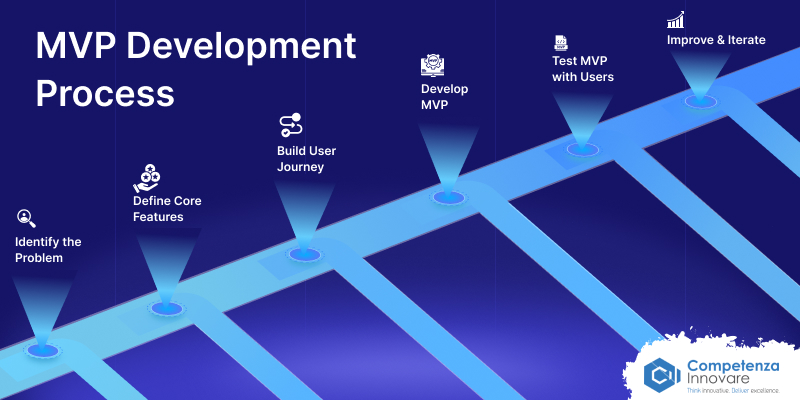
MVP Development Process (Step-by-Step Guide)
The MVP development process is a methodology that is especially applied to how to build an MVP (minimum viable product) in which the objective is to release a rudimentary version of a product, test it with actual users, and refine it according to the feedback. It is common in MVP product development and startup MVP development and is based on the lean startup methodology to minimize risk, cost, and time.
Step 1: Identify the Problem
Making the problem to which you are applied straight is the first step of MVP development. Businesses put the pain points of the real users on the front stage, and they have a clue about the problems that the target audience is facing. A compelling MVP begins with a clear problem since, without it, the product does not really have a market value.
Step 2: Market Research
This is followed by market research, including competition research and target audience research. This will aid in the realization of available solutions, gaps in the market, and expectations of the users. It helps in making sure that your minimum viable product is based on factual demand rather than assumptions.
Step 3: Define Core Features
At this step, only basic features required to resolve the primary problem are formulated by businesses. This is a major consideration in how to build a minimum viable product, in which optional features are shunned to ensure that development is simple, rapid, and economical.
Step 4: Build User Journey
In this case, the user flow will be made to facilitate easy use of the product. Visualizing the user journey aids better UX and makes sure that the user can accomplish activities without any issues. An easy and straightforward user experience enhances the adoption of the MVP.
Step 5: Develop MVP
At this stage, the development of the actual MVP is commenced with the proper tech stack or no-code tools. Agile methods are followed in many startups and allow them to develop startups in small steps within a short time. We are not aiming at making a perfect product but merely a working one.
Step 6: Test MVP with Users
After creating the MVP, the MVP is then tested on actual users. The feedback is gathered by MVP tests, usability tests, and early user interaction. This assists in justifying the product concept and checking whether it provides a solution to the user problem or not.
Step 7: Improve and Iterate
The product is enhanced after testing based on actual feedback. This will be a part of the lean startup MVP strategy whereby the process is ever evolving so as to enhance performance, features, and user experience. The cycle assists in the realization of better product-market fit in the long run.
Key Features of a Successful MVP
In MVP development, the criteria of a successful MVP (or minimum viable product) have nothing to do with adding more features—it is about creating the appropriate features in a manner that are simple, fast, and clear to tackle a real user problem. As per best practices on MVP product development, an excellent MVP involves usability, performance, and constant enhancement based on actual user feedback.
- Minimal UI/UX: Interface must be simple and easy to navigate so that the user is able to know how the product functions without being confused after a short time.
- Makes a Good MVP Important: The good MVP only solves one core problem and does not go to the point of claiming other features.
- Scalable Architecture: The MVP must be basic but in such a way that it can be expanded later on to support new functionality.
- Quick Response: The product must be fast loading and operate without any complications to make the user have a pleasant experience at the beginning.
- Integration of User Feedback: Proper MVP gathers user feedback and utilizes it to enhance and refine the product towards greater results and product-market fit.
MVP Development Cost (2026 Guide)
The cost of MVP development in 2026 will be determined by the number of features, design complexity, technology stack, and development team. In MVP development, it is targeted to create a minimal product that has the core functionality; thus, the cost is significantly less in comparison with full product development. MVP is utilized first in startups to validate their ideas before making a significant investment.
MVP Development Cost Breakdown:
| MVP Type | Features | Estimated Cost (USD) | Best For |
| Basic MVP | Simple UI, one core feature, basic backend | $5,000 – $15,000 | Startups, idea validation |
| Standard MVP | Multiple core features, better UI/UX, user login, database | $15,000 – $50,000 | SaaS product development, growing startups |
| Advanced MVP | Complex features, scalable architecture, integrations, analytics | $50,000 – $100,000+ | Large startups, investor-ready products |
Factors Affecting MVP Cost
Cost in how to build an MVP is affected by a few major attributes. The largest factor is feature complexity since the more complex the features, the longer the development time. The quality of UI/UX design also impacts cost, where a superior design needs to put in more work. The technology stack proposed (web, mobile, or no-code tools) and the destination of the development team also determine the total price.
How Long Does It Take to Build an MVP?
The duration of developing an MVP is determined by the complexity of the product, features, design, and technology employed. In how to build an MVP, the aim is to get a working product as fast as it can be done to ensure that businesses test their concept, gather feedback, and refine it until development is complete.
MVP Development Timeline:
| MVP Type | Timeline | Description | Best For |
| Small MVP | 2–6 weeks | Basic product with one core feature and simple UI | Idea validation, early-stage startups |
| Medium MVP | 6–12 weeks | Multiple core features with better design and database | SaaS products, growing startups |
| Complex MVP | 3–6 months | Advanced features, integrations, and scalable architecture | Large startups, investor-ready products |
Examples of Minimum Viable Products (MVPs)
In the MVP creation, successful businesses begin with a barebones version of the product, and once they see that it is actually demanded by the users, they will begin to scale. The following examples of minimum viable products reveal that large platforms started with simple features only.
Airbnb (Basic Listing Website)
- Started as a simple website with basic property listings
- To gauge demand, founders rented their own apartment.
- None of the advanced services such as payment and automation initially.
- Assisted in proving the concept of short-term online rentals.
Dropbox (Video Demo MVP)
- Launched with a mere explanation video rather than a complete product.
- Demonstrated the file synchronization between devices.
- Tested to gauge user interest prior to development.
- Early tested and proved high demand.
Uber (Limited City Launch)
- Launched only in San Francisco at first
- Simple application that links riders and drivers.
- No high-tech options such as price algorithms or international growth.
- Assisted in test-marketing real demand within a controlled region.
Instagram (Photo Sharing MVP)
- Originally became a photo-sharing app.
- Only concentrated on uploading and applying filters.
- No fancy stuff such as reels, tales, or advertisements at first.
- Attracted rapid users thanks to ease and speed.
From these examples of MVPs, it is evident that successful products have their basic building blocks, undergo early market tests, and develop upon real user responses in MVP development.
Ready to Turn Your Idea Into an MVP? Let Competenza Build, Validate, and Scale It With You.
Common Mistakes in MVP Development
When it comes to MVP development, most of the startups fail not due to the idea but due to the fact they commit preventable errors in the process of developing the minimum viable product. Any of these mistakes can make the validation process slower and more expensive, and such errors may make a project less successful, which was the aim of an MVP.
Adding Too Many Features
The most significant trap to make is to add too many features at the initial stages. When it comes to building an MVP, core functionality should be considered. Adding additional features makes it more expensive, slower to launch, and other features difficult to test in a real market.
Ignoring User Feedback
An MVP is one devised to learn by real users. The failure to heed feedback is to miss out on great information that can be used to improve the product. In MVP product development, user feedback plays a critical role in product refinement and product market fit.
Poor Market Research
Lack of good market research means that there is a possibility of businesses putting up something that is not required. An essential process of MVP development is understanding its competitors and user demand, and a failure to do so will result in a poor product validation.
Wrong Target Audience
When MVP is tested by a wrong audience, then the feedback will not be useful. It is essential to state who the right target users are to create successful validation and retain the meaning of the results and findings when conducting MVP testing.
Overbuilding Before Validation
Most teams waste a lot of time creating an impeccable product when they should launch early. A lean startup MVP has the purpose of launching quickly, certifying ideas, and enhancing them afterwards. The overbuilding makes it more risky and slows down the learning process by the actual users.
MVP to Full Product Development
Once the MVP has been developed successfully, the product is no longer a simple version but a full-scale solution depending on the preliminary user feedback and the market needs. This is the last step in how to build an MVP, as the focus no longer is currently on validation but scaling, performance improvement, and more advanced features to facilitate long-term growth and product-market fit.
Key Points:
- Increase the system performance and scale to support growing users.
- Scale the product when the MVP is highly demanded and engaged.
- Include fancy functionality as per actual user feedback.
- Work on enhanced usability and functionality.
- Create a long-term product development plan.
Conclusion
The development of MVP is also among the best options to transform an idea into a successful product in the fast-paced digital market. Rather than creating a high-risk and costly product, businesses create a Minimum Viable Product (MVP) including only core features. This aids in rapid validation, actual user response, and accelerated enhancement, and thus it is not difficult to have a high product-market fit. Having known the meaning of MVP, how MVP can be built, how many MVPs cost, how long it can take, which MVPs can be used, and what the most common pitfalls are, it is obvious that the base of any productive startup development is MVP. It enables businesses to test concepts early on, minimize failures, and scale when real demand has been demonstrated. At The Competenza, we understand that MVP development is not about developing software but developing the correct product the correct way. By focusing on lean growth, user-based feedback, and scalable solutions, businesses can be developed faster and smarter and operate successfully in the highly competitive markets.
FAQs
What is the development of the MVP?
The concept behind coming up with MVP as a simple type of product that is a combination of only the minimal features is called MVP development. It is employed to test the concept in an actual market prior to making a complete investment in product development. This helps companies to check the demand early and not design unnecessary features.
Why is MVP important in startups?
MVP can be applied to startups to help reduce costs, mitigate risk, and test ideas in the fast track. Instead of it taking months to develop a fully developed product, startups launch a bare-bones version, get genuine user feedback, and improve to achieve a better product-market fit.
What does an MVP have in it?
An MVP consists of minimum functionalities just adequate to address a single problem of great significance to the users. It is not about advanced functions or sophisticated systems but about the strip functionality, simple interface/user experience, and natural testing.
What is the time taken to develop an MVP?
Time is dependent on complexity. A small MVP can be completed in 2-6 weeks, a medium MVP in 6-12 weeks, and a complex MVP can be completed in 3-6 months. The idea is to always launch fast so that businesses can begin to test their idea as soon as possible.
How much does MVP development cost?
MVP development cost depends on the features, design, and technology. A basic MVP can cost around $5,000–$15,000; a standard MVP, around $15,000–$50,000; and advanced MVPs can go beyond $50,000. Costs are raised as needs of complexity and scalability are met.
What is the main purpose of an MVP?
The main purpose of an MVP is idea validation. It assists the business in knowing whether the users really require the product, and hence, the company can test the assumptions, alleviate risk, and create what is required by the market.
What are MVP, prototype, and PoC?
A PoC (Proof of Concept) is a confirmation of the technical feasibility, a prototype demonstrates the design and user flow, and an MVP is a functioning product with fundamental features utilized by the actual users to confirm that the demand is present in the marketplace.
What are the key features of a successful MVP?
Some of the typical errors made are having too many features, lack of input from the users, lack of proper market research, trying to target the wrong audience, and over-building without validation. These failures are capable of adding expense and failure to succeed.
What are the major aspects of an effective MVP?
Some of the typical errors made are having too many features, lack of input from the users, lack of proper market research, trying to target the wrong audience, and over-building without validation. These failures are capable of adding expense and failure to succeed.
What follows the development of MVP?
Once MVP has been successful, businesses commence with full product development in which they scale the product, introduce new advanced features, enhance performance, and develop a long-term roadmap according to the actual users and the demands on the market.