

The majority of failed software projects fail not due to poor engineering but due to other factors. They do not work because the thing is people are wrongly built, with wrong features, with the wrong users, and with the wrong problem. The product discovery phase is there to avoid just that. Product discovery is the methodical way of knowing what you are developing, why you are developing it, and whether you are developing anything that actually has a chance of working by the time you write the first line of code.
The product discovery process has no special methodology or area. Before committing themselves to full builds, the development teams in the US, UK, Europe, Australia, and India have taken it to be a standard practice. And well deserved. Switching direction at the point of software product development discovery only cost a fraction compared to switching direction after 6 months of software development. However, most businesses, especially time-to-market-strained ones, start right ahead of it without considering it to be an investment in risk management as it is.
Product discovery in software development is the process of substituting presumptions with fact. It unites your development team, your business stakeholders and your users around a common understanding of what the product must do, and how it will do it, before the budget clock starts to tic toc. This guide outlines what the product discovery phase means, when you require it, what is delivered and how to make the product discovery process effective.
What Is the Product Discovery Phase?
Product discovery is a systematic research process that isolates successful product development and costly failures.
The product discovery phase is a time-boxed research and planning phase (prior to software development). Typically, product discovery requires two to eight weeks based on the complexity of the product and is a cross-functional process done by a team of product owners, business analysts, UX designers, architects and key stakeholders who collaborate to outline what, who, and what the product has to provide.
The activities undertaken at this stage include researching the business problem, investigating the target users, studying the competitive environment, drawing up technical requirements, risk analysis and delivery of a set of artifacts such as a product roadmap, feature requirements, wireframes or prototypes, and project plan, which should provide the development team with a solid foundation that is dotted with clear, tested artifacts.
There is a difference between product discovery and the development phase. Development implements a solution that is specified. Discovery determines the kind of solution to be. Omitting the discovery phase would be a move by going through the execution without the definition being finished, which is one of the surest methods of creating software that fails to achieve its goals.
When Is the Product Discovery Phase Needed?
All projects do not demand the same level of discovery, yet a majority demand some.
Elevation of product discovery is not always necessary to the same level across projects. A lightweight discovery exercise might be sufficient when it comes to a well-understood improvement to a product with an established user base and a set of needs. However, in 80 percent of cases, especially new products, major rebuilds, or complicated platform work, a formal discovery period is required.
A comprehensive product discovery process is always appropriate in the following cases:
- New product development: Assumptions regarding the needs of the user, fit, and technical feasibility of a new product must be proved out before development is undertaken on an item that does not exist.
- Products of unknown requirements: When the target users are not well known, or when what is being solved is a complex, multifaceted problem, user research on discovery will help to avoid constructing features the user does not want or need.
- Complex technical environments: The products to be built that involve multiple systems and handle sensitive data, are regulated industries, or need new technical architecture early use technical exploration during the discovery phase prior to development.
- Products at startup and early stage: In the US, the UK, and the EU (and most other countries with finite runway) and in cases where the cost of a venture taking the wrong path is existential, discovery is, commercially, one of the highest-value investments.
- Modernization projects of the legacy type: It is a very common feature of projects in modernization to not know what a legacy system does at all and then to expect to redevelop it in a similar manner to how it used to be. This is the very task of discovery.
Key Benefits of Product Discovery
Understand why the investment and time in product discovery would be rewarded many times over during the development process.
Reduces Project Risk
Discovery elicits the risks of technical, commercial, and user adoption when cheap to handle. Some technical constraint, which would have failed a three-month sprint of development, would cost an afternoon to find out about in discovery. When a user requirement is inconsistent with a solution as proposed, a design iteration is required to fix it before the development can proceed; a months-long rework is required to fix it after the development.
Validates Product Ideas Before Investment
The discovery phase can provide the results of product validation that are the most valuable in terms of commerce. The question that discovery is addressing before spending serious development money is the one that is of ultimate interest, which is, “Does this product address a real problem to real users in a manner that makes business sense?” Yes, it is not necessarily it, and finding out that it is in discovery but not after six months of development is invaluable.
Aligns Stakeholders Around a Shared Vision
Misalignment of stakeholders between various individuals in an organization retaining varied (unspoken) assumptions concerning what the product is to perform is one of the most constant causes of the development of projects. The product discovery workshop lifts the veil of secrecy on these assumptions, uncovers contradictions, and creates a documented, consensus understanding of product goals, scope, and criteria of success everyone is operating under.
Produces Accurate Estimates and Planning
Estimation of software projects is infamously difficult. Estimation of projects that have not taken into consideration the requirements always fails in terms of budget, time, or both. Discovery generates the technical architecture knowledge, detailed requirements, and prioritized scope, without which creating accurate custom software development project planning cannot be done. Estimates of development done post-discovery is much more reliable than development estimates done prior to discovery.
Improves Product Quality and User Experience
The good thing about products being developed based on the actual research undertaken by users in the course of discovery is that they are always better products. User research provides the real needs of the user and not what the stakeholders think the user requires. This understanding influences feature prioritization, UX design, and product flow in manners that result in increased adoption, improved user satisfaction, and improved commercials.
How to Conduct a Product Discovery Phase: Step-by-Step Process
An organized process that makes uncertainty an understandable and proven development strategy.
Step 1: Define the Business Problem and Objectives
Any product discovery process needs to start with aligning the team around the problem being solved. What is the business challenge? What is success like? What are the business objectives that should be met with the product? Are there any restrictions like budget, timeline, regulatory, or technical?
It is called an alignment session, usually on the first day of a product discovery workshop—it results in a documented problem statement and a list of success criteria that are measurable and on which all further discovery work is based. The discovery activity, especially without this base, could go in the wrong direction that is not in line with the business goals.
Step 2: Conduct User Research
The primary investigative process of the discovery phase is the user research. It is the art of engaging in conversation with the people who will actually utilize the product by means of user interviews, polling, observation in the field, and insights into the current usage where feasible and gathering data on the needs, frustrations, workflows, and priorities those people will have.
The user research conclusions, user personas, user journey map, and validated user story outputs substitute assumptions with evidence. They determine what the product must accomplish for its users as opposed to what the team vocalizes it must accomplish. In the development of products in various markets (US, UK, India, Southeast Asia, or the world), it is the user research that will then make sure that the product design does not represent the cultural notion that the development team has but the real circumstances under which the product is going to be used.
Step 3: Analyse the Competitive Landscape
Knowing what is already available (and why users prefer or do not prefer those options) is a useful part of product strategy development in the discovery phase. Competitive analysis determines what the new product can offer (the gaps), what features it must have to be viable (the table-stakes), and what differentiation can be employed to lead to adoption.
Step 4: Define and Prioritise Requirements
The requirements analysis during the discovery phase converts the problem definition, user research, and competitive analysis into a documented set of functional and non-functional requirements. These are in turn prioritized, usually with a framework such as MoSCoW (Must Have, Should Have, Could Have, Won’t Have), determining what is included in the initial product development scope and what is deferred.
The stage of scope definition is intertwined with the two, budget and timeline. Out-of-scope features are not estimated. Features that are in scope get the attention they need during architecture and planning. This is what renders the following development estimates that follow the discovery to be reliable.
Step 5: Conduct Technical Architecture Assessment
This is the discovery stage to explore the technical method, the technology stack, integration requirements, infrastructure architecture, data model, and security considerations that will be used to form the development project. In products that are complex, this exploration shows limitations and potential that have a big impact on software product development cost, time, and risk.
Technical discovery work is not the work of a final architecture specification (which is design-phase work), but it has sufficient technical clarity that it can produce realistic estimates and identify the most risky technical decisions that must have been settled on prior to commencing development.
Step 6: Run a Product Discovery Workshop
A product discovery workshop gathers the cross-functional team—product owners, product stakeholders, UX designers, business analysts, product architects, and the head of the development team—at one organized, facilitated workshop synthesizing the research and generating the discovery deliverables.
An efficiently organized discovery workshop schedule includes problem validation, user persona review, user journey mapping, feature prioritization, technical constraints review, risk identification, and roadmap planning. The result is a common, written knowledge about the product which everyone has developed and invested in.
Step 7: Produce Discovery Deliverables
This result of the product discovery process generates a certain set of artifacts that the development team relies on as the basis of the build:
- Product vision statement – A brief statement of what the product is and what the product is about.
- User personas and journey maps – Fixed knowledge of the target users and their requirements.
- Prioritized feature backlog – Early product requirements, sorted by priority.
- Wireframes or interactive prototype – graphical scheme of the most important flows of the product.
- Technical architecture overview – The technology approach and major technical decisions.
- Project roadmap- Software development plan (career stages, milestones and schedule).
- Risk register – Risks identified and the suggested mitigation strategies.
- Refined project estimate – Development cost and schedule according to the scope requirements.
Ready to Turn Your Product Idea Into a Clear Development Plan? Talk to Competenza Today.
What Team Roles Are Involved in Product Discovery?
The people in the room during the discovery process are the right people, and they define the quality of what is extracted. An effective product discovery process involves a cross-functional team. Each role offers a view that cannot be offered by other roles:
- The product owner or product manager: has the responsibility of being the boss of the discovery process- this involves defining business objectives and sorting the stakeholders out, as well as making priority decisions.
- A business analyst: conducts the requirements gathering and functional and non-functional requirements and generates the structured artifacts, which convert the information found in the discovery process to development inputs.
- UX designer: Manages user research, creates user personas and journey maps, and creates wireframes or prototypes, which illustrate the idea behind the product, which are then approved by the stakeholders.
- A solution architect or tech lead: Inquires about the technical methodology, finds constraints and opportunities, estimates the technical complexity, and provides the technical input to the proper project planning.
- Key business stakeholders: supply the business background, business goals, domain expertise, and the organizational endorsement of scope and priorities that give the outputs of the discovery their authority.
- The development team lead: offers a development angle of viability, effort, and sequencing and makes sure that the discovery is developed based on the facts about what can be made and when.
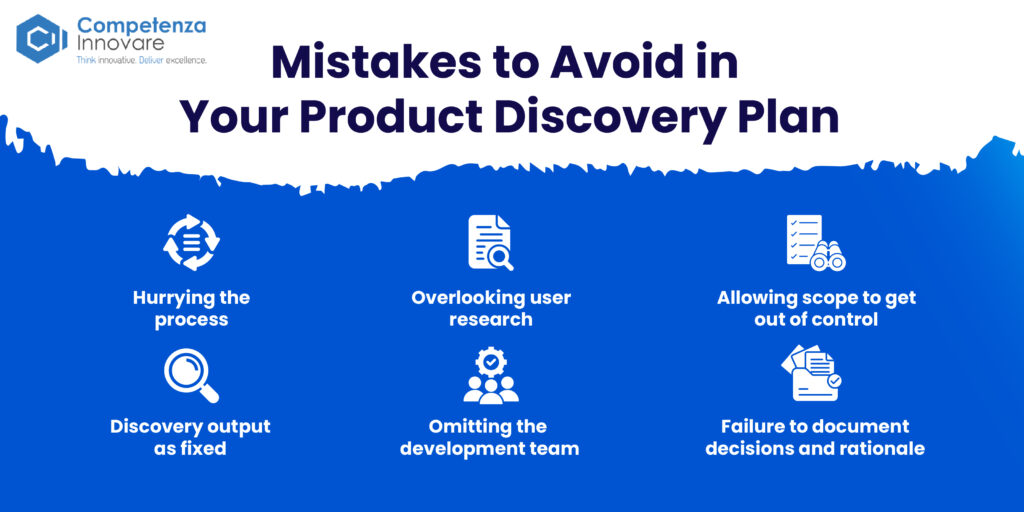
Mistakes to Avoid in Your Product Discovery Plan
Sometimes, these types of mistakes jeopardize discovery and put the projects on the wrong path.
- Hurrying the process: It is impossible to conduct discovery as a one-day process. Shrinking a schedule to reach development sooner and sooner leads to inconsistent results of incomplete understanding and bad estimates, the last thing discovery should do.
- Overlooking user research: Discovery that is based on the assumptions of the stakeholders instead of actual user insight is discovery as a pseudonym. The entire issue is to prove any assumptions, and that involves communicating with the real users, not merely the commissioners of the product.
- Allowing scope to get out of control: Discovery can easily become a scope expansion activity when not carefully handled. All stakeholders possess features that they wish to include. The product discovery model must have an organized prioritization procedure that maintains scope and budget and timeline constraints.
- Omitting the development team: Requirement development done solely by business stakeholders without technical advice would result in commercially viable and technically infeasible requirements. Discovery Previous SOC The technical view prevents costly mistakes in the development process.
- Discovery output as fixed: Discovery gives us an initial point to develop but does not give a definitive specification. The product roadmap and backlog is supposed to be considered live documents that are updated as the team learns through the build, especially with an agile project, which involves iteration being part of the process.
- Failure to document decisions and rationale: Workshop-made verbal discovery decisions were not documented, and this creates uncertainty when it comes to development. All the important decisions, such as in/out of scope and out/in scope and why, must be recorded in a format that is accessible by the entire team during the project.
Conclusion
Product discovery is not overhead, but instead, the most commercially efficient investment prior to a software development project starting. It replaces costly assumptions with proven evidence, brings stakeholders together with a common product vision, generates the right requirements and estimates that enable development planning to be dependable, and determines the risks before they can become problems.
For beginners checking a new concept, businesses planning an important platform investment, or product teams revamping an already existing platform, the question is not whether to ascertain product discovery. It is the way to do it. The competenza teams that spend time in an in-depth, well-facilitated discovery process always create superior products within budget and with less expensive redirections in the process of creation.
Frequently Asked Questions
What is software product discovery?
The product discovery phase is a prestructured pre-development procedure that establishes what a software product should be by researching users, evaluating requirements, assessing technology, and aligning with stakeholders by user research, requirements gathering, technical evaluation, and stakeholder congruency before development has started.
Are there any standard timelines of product discovery?
It generally takes two to eight weeks to complete most product discovery processes, which varies with the complexity of the product, the parties involved, and the extent of user research. Determined, simple products with known requirements can be discovered in two to three weeks.
What are the deliverables of a product discovery phase?
The key product discovery deliverables are a product vision statement, user personas and journey maps, a prioritized feature backlog, wireframes or prototypes, a technical architecture overview, a project roadmap, a risk register, and a refined development estimate.
How does a product discovery workshop work?
A product discovery workshop is a direct, intensive, usually one to three-day, structured workshop during which the cross-functional team synthesises findings of research, assumptions are validated, features are prioritized, and the documented outputs of the workshop are the guides to the development process.
Is product discovery necessary for startups?
Yes, at least in the case of startups. Discovery assists startups to check that they are addressing an actual problem prior to dedicating their complete development funds to an approach that might not satisfy the market.
How is product discovery distinguished from product design?
Product discovery is the definition of what the product would be and a test of whether it is solving a practical user problem. Product design describes the appearance, detailing how it will appear.
Who is to be included in the product discovery process?
Furthermore, the product discovery team will have a product owner or product manager, a business analyst, a UX designer, a solution architect or technical lead, key business stakeholders, and the development team lead.
What is the impact of product discovery on minimizing software project risk?
Product discovery identifies risks in technology, commerce, and acceptance of the product by users prior to investment in development. The identified risks in the discovery stage can be addressed either by design or by adjusting the scope or by technology.