

Bringing a product idea into a successful solution cannot be only developed, but it must be validated. Businesses should ascertain the technical feasibility, user-friendliness, and compatibility of the idea with market demand before committing such time and capital. This is where PoC (Proof of Concept), prototype, and MVP (Minimum Viable Product) come in the process of product validation. They all play different roles, and they assist in mitigating the risk at various product development phases.
A POC software development helps you to determine whether your idea is technical. A prototype assists in visualizing the design of the product and user experience. An MVP is a complete product or software that delivers core features to establish market demand and to receive feedback on the actual use of the product. The distinction between a prototype and an MVP and PoC can help us make a wiser decision about products. Making the appropriate choice at the appropriate moment may conserve resources, accelerate growth, and enhance your likelihood of creating a successful product.
In this guide we shall discuss the main distinctions between a PoC, a prototype, and an MVP; their advantages; expenses; and the appropriate time to implement each.
Understanding the Product Validation Journey
Validation is the beginning of creating a successful product. Prior to full emergence, organizations must pilot the idea to examine its viability, accessibility, and relevance to the market. This is termed a product validation process. A formalized product discovery technique can reduce risk and streamline the decision-making in the development process.
Product Validation Journey
Idea → PoC → Prototype → MVP → Full Product
The stages contribute a particular role to the product development process.
1. Idea
Every product begins with a concept—a problem to be addressed or a market opportunity. The businesses identify the product vision, target audience, and core value proposition at this level.
Key focus:
- Problem identification
- Market research
- Product goals
2. Proof of Concept (PoC)
A Proof of Concept (PoC) is used to confirm the technical ability of the idea. It assists in answering one essential question: Is this product constructible? This step will narrow the technical risk before significant investment occurs.
3. Prototype
After establishing that it is possible, the next thing is the construction of a prototype. A prototype provides an interactive or visual representation of a product to test user workflows, design, and functionality. This measure will help to improve usability and user experience.
4. MVP (Minimum Viable Product)
A Minimum Viable Product (MVP) is the first viable prototype of the product with essentials. It is programmed to take off quickly, gauge its actual-life demand, and consult with the users. Market validation is achieved in this phase.
5. Full Product
Once the MVP is successfully tested and analyzed, companies may proceed with the full product development and add new functionality, enhance the scalability, and work on the user experience.
Why This Sequence Matters
Different kinds of risks are decreased by every stage:
- PoC reduces technical risk
- Prototype reduces design risk
- MVP reduces market risk
This process, as a result, aids in improving the planning of the product roadmap and gives businesses the assurance to develop products better.
What Is a Proof of Concept (PoC)?
A Proof of Concept (PoC) is a low-technology initial validation process that examines the possibility of a concept of a product. It assists businesses to decide whether the major idea would be practical prior to investing in comprehensive development.
The primary one a PoC answers is, How can this idea be made to work technically?
Benefits of a PoC
- Tests technical feasibility
- Reduces risk
- Saves time and cost
When to Use a PoC
A PoC can be applicable in products with the following:
- AI or machine learning
- Blockchain
- Complex technologies
Example
A healthcare organization can develop a PoC that examines the feasibility of AI to understand patient data correctly. Simply put, a proof of concept assists in verifying the practicality and feasibility of an idea and its worth seeking.
What Is a Prototype?
A prototype is an approximate or a visual representation or preview of a product in the form of a prototype that is used to show what the product would look like and how it would behave. It assists teams to test design, user flow, and experience.
Key Question
What should this product look and work like?
A product prototype is design validation-oriented as opposed to a PoC, which is technically feasible.
Why Use a Prototype?
A prototype can assist businesses:
- Validate product design
- Test user experience
- Improve user flows
- Gather early feedback
When to Use a Prototype
A prototype would be helpful when:
- Design and UX are important
- User journeys need testing
- Early feedback is required
Example
An example is that a food delivery application may create a prototype that is clickable to test the navigation, order, and user experience during the development. Software prototyping is a way of helping the business to smooth out product design and increase usability before the actual product is developed.
What Is an MVP?
Minimum Viable Product (MVP) A Minimum Viable Product (MVP) is the first working prototype of a product having the bare minimum features. It aims to become operational within a short period of time, market test, and seek actual user response.
Key Question
Will people desire and pay this?
An MVP, unlike a PoC or prototype, is a finished product that is utilized by the actual users in the market.
Why Build an MVP?
An MVP can assist businesses.
- Test market demand
- Gather user feedback
- Reduce development risk
- Improve product decisions
When to Use an MVP
MVP is applicable when:
- Your product idea is validated
- You are ready for market testing
- You need real customer feedback
Example
A startup that develops a ride-sharing application can release an MVP that includes core functions, like booking, payments, and rides tracking and then extend functionality. Concisely, a minimum viable product assists enterprises to confirm demand as well as optimize their MVP plan before scaling the development.
PoC vs Prototype vs MVP: Key Differences
Whereas PoC, prototype, and MVP are all a part of the product validation process, they are not exactly the same. Knowing how to distinguish them will enable businesses to decide the appropriate way at the appropriate level.
A Proof of Concept (PoC) focuses on the technical, a prototype on design and user experience, and market validation on an MVP (Minimum Viable Product).
Key Comparison:
| Factor | PoC | Prototype | MVP |
| Purpose | Technical Validation | Design Validation | Market Validation |
| Main Focus | Feasibility | UX/UI & Flow | Real Product |
| Key Question | Can it work? | How will it look? | Will users buy it? |
| Users | Internal Team | Test Users | Real Customers |
| Development Stage | Early | Mid | Pre-Launch |
| Cost | Low | Medium | High |
PoC vs Prototype vs MVP: Cost Comparison
Cost is among the largest considerations in selecting between a PoC, prototype, and MVP. The total budget varies based on features, complexity in products, technology stack, and development demands. Generally, the more you progress, the costs rise in the process of validation of your idea to launching in the market.
Cost Comparison:
| Stage | Estimated Cost |
| PoC | $5,000 – $15,000 |
| Prototype | $10,000 – $30,000 |
| MVP | $20,000 – $100,000+ |
PoC vs Prototype vs MVP: Timeline Comparison
The estimated timeline of PoC, prototype, and MVP projects varies based on the complexity of the product, product features, and technical requirements. Generally, the timeline rises when the product is merged towards being introduced into the market.
Timeline Comparison:
| Stage | Timeline |
| PoC | 1–3 Weeks |
| Prototype | 2–6 Weeks |
| MVP | 2–6 Months |
Also Read: How to Reduce Software Development Costs Without Cutting Quality
Benefits of PoC, Prototype, and MVP
All steps of the product validation process have their benefits. Knowing the worth of a PoC, prototype, and MVP can assist businesses to make more intelligent choices to develop the product and minimize risks.
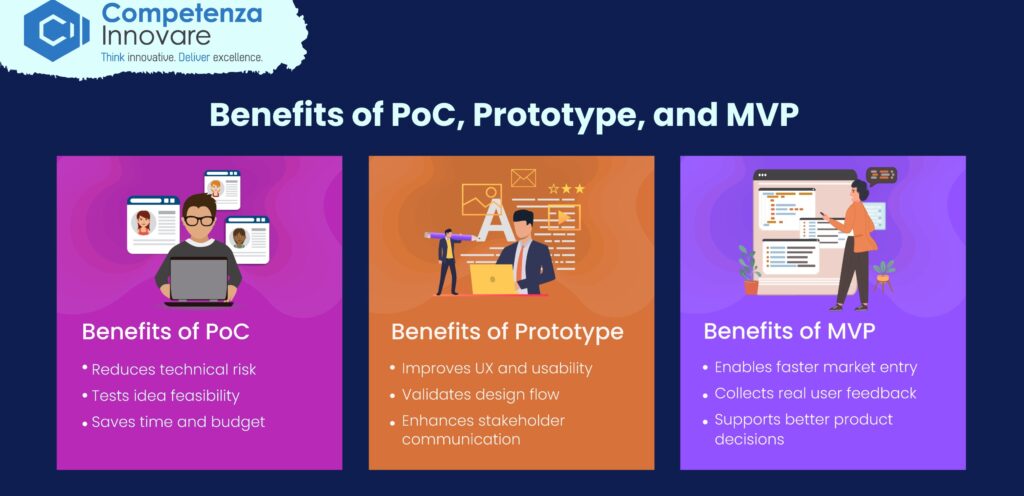
Benefits of PoC
A Proof of Concept (PoC) helps confirm technical feasibility prior to development.
- Reduces technical risk
- Tests idea feasibility
- Saves time and budget
Benefits of Prototype
A prototype assists in the visualization of the product and enhances user experience prior to the development itself.
- Improves UX and usability
- Validates design flow
- Enhances stakeholder communication
Benefits of MVP
A Minimum Viable Product (MVP) facilitates business organizations to create faster and experiment with market demand with the real users.
- Enables faster market entry
- Collects real user feedback
- Supports better product decisions
In short, PoC reduces technical doubt, a prototype increases product design, and MVP promotes viability of demand in the market.
When Should You Build a PoC, Prototype, or MVP?
A PoC, prototype, or MVP should be adopted depending on what the level of your product is and what your business goals are. Both aid in testing various aspects of your product prior to development.
When Should You Build a PoC?
PoC is the best when you have to test that it is technically feasible. It assists in confirming the possibility of your idea working, particularly more complex products such as AI, blockchain, healthcare, or block solutions in fintech.
When Should You Build a Prototype?
A prototype is useful when you have to test the product design, user flow, and user experience. It works well on products like SaaS dashboards and mobile apps, as well as e-commerce sites where usability matters.
When Should You Build an MVP?
An MVP is ideal in case you are willing to live only with the simplest of features and how it sells. It helps in obtaining real user feedback and is typically used by startups, marketplaces, and sub-app applications.
Concisely, a PoC is designed to assess feasibility, a prototype may be utilized to evaluate the design, and an MVP may be utilized to evaluate the market.
Ready to Validate Your Product Idea? Let Competenza Build the Right PoC, Prototype, or MVP.
What Should You Build First?
The correct starting point is based on your product complexity, business objectives, and validation requirements. The no-one-size-fits-all approach does not exist. The selection of the suitable stage allows minimizing risk, cutting costs, and enhancing product success.
Scenario 1: Complex Product → Start with PoC
You need a Proof of Concept (PoC) when you start with a product that involves a complex technology or technical uncertainty. It can be utilized in ascertaining technical feasibility prior to making the choice of full development. It is most applicable to AI, blockchain, and health products, as well as fintech.
Scenario 2: UX-Heavy Product → Start with Prototype
User experience and design are worth providing; start with a prototype. This will help in pretesting user flows, design, and usability before development. It is optimal in mobile applications, SaaS applications, and e-commerce products.
Scenario 3: Simple Validated Idea → Start with MVP
You already have an idea that is already vetted and that is technically simple; start with an MVP. This enables you to get up fast, gauge market demand, and get actual user feedback.
Standing plainly, begin with a PoC on technical validation, a prototype with design validation, and an MVP with market validation.
Real-World Examples
The examples of real life demonstrate how a PoC, prototype, and MVP are applied to different stages of the product development.
Example 1: PoC (Proof of Concept)
Product Idea: AI-Powered Diagnosis Platform
One of the healthcare companies wishes to create an AI-based tool that can recognize disease using the patient data. They also produce a PoC before proceeding to create the final product to know whether the AI can analyze the data and give plausible results.
Goal: Validate technical feasibility
Example 2: Prototype
Product Idea: Food Delivery App
A startup planning to launch an app based on food delivery creates a clickable prototype to explore the screens in the app, user flow, and ordering experience. This assists in enhancing the usability prior to the development.
Goal: Validate design and user experience
Example 3: MVP (Minimum Viable Product)
Product Idea: Ride-Sharing Platform
An MVP is developed by a startup and is the minimal amount of capabilities, such as the opportunity to make a ride booking, pay, and track the live ride. This enables them to be launched quicker and get genuine user feedback.
Goal: Validate market demand
All these examples demonstrate that a PoC tests viability, a prototype enhances design, and an MVP checks demand prior to scaling.
Common Mistakes Startups Make
Most startups commit errors when developing a product because they do not follow necessary validation processes. These errors may lead to higher costs, late launches, and a decrease in product success.
- Ignoring Validation: Development of a product without proper validation can lead to unwarranted risk-taking. Testing with a PoC, prototype, or MVP will help reduce uncertainty during early system development.
- Overbuilding the MVP: The MVP should only contain core features. A list of features that are excessive is an expense, and also time extends the period of adoption.
- Ignoring User Feedback: User feedback helps in making the product better. Poor product decisions may arise as a result of not considering it.
- Conflating PoC and Prototype: A PoC may be used to assess the technical feasibility, whereas a prototype aims at design and usability. Knowledge of distinction should be done to make a better choice of product.
These errors can be avoided to enable startups to be smarter and risk less.
Conclusion
The difference between a PoC, prototype, and MVP is a key to developing successful digital products. The stages are each useful, enabling firms to minimize technical, design, and market risks when developing a product. A PoC proves technical feasibility, a prototype can be used to optimize user experience and design, and an MVP can be used to validate market value by testing it on a real user. At The Competenza, we shall guide companies on the right approach to validate their products based on their goals, product complexity, and market needs. Through the appropriate strategy, enterprises will have the chance to minimize operations risks, to streamline costs, and to create products with confidence.
FAQs
What is the difference between a PoC, a prototype, and an MVP?
A proof of concept (PoC) is used to test the technical viability of an idea. A prototype relates to product design, user flow, and usability. A Minimal Viable Product (MVP) is defined as a prototype of the product developed with minimal functionality to verify the market requirement. Each of them plays different roles in the product validation process.
What should I create first, PoC, a prototype, or an MVP?
The appropriate point of right is dependent on the complexity of your product and business objectives. In case of uncertainty in technical feasibility, start with a PoC. Start a prototype in case user experience is the priority. An MVP is a preferable option in case your idea is approved and only needs testing in the market.
Does every product require a PoC?
Of course, not all products need a proof of concept. A PoC can be applied mainly to products, which require intricate technology or new solutions. PoCs are commonly used by businesses involved in AI, blockchain, healthcare, or fintech products to minimize technical risk prior to development.
Is it possible to develop an MVP without a prototype?
Yes, it is possible to create an MVP without a prototype in the case of simple products, having a clear list of requirements. A prototype can, however, be used to test design and enhance usability before actual development. This usually minimizes the design-related challenges in the development process.
What is the time required to create a PoC, prototype, or MVP?
The construction schedule varies depending on the product complexity, product features, and technical specifications. Estimates of a PoC last about 1-3 weeks, and a prototype lasts about 2-6 weeks. An MVP generally requires 2-6 months of building since it requires growth, testing, and preparation of the launch.
What do a PoC, prototype, or MVP cost?
It is priced according to the product scope, complexity, and technology needs. A PoC generally costs between $5,000 and $15,000. A prototype may cost $10,000 to $30,000, while an MVP can range from $20,000 to $100,000 or more depending on features.
What is the value of product validation?
Product validation assists the businesses in determining that the idea is practical, user-friendly, and in tandem with the market demand. It minimizes the risks of development and will not end up spending money on untested ideas. Proper validation also enhances product decisions and raises the likelihood of success in the long term.
What are some of the advantages of creating an MVP?
MVP can assist the businesses to release with minimal features. It enables businesses to explore market demand, get actual user feedback, and enhance the product according to the customer feedback. This will minimize risk and aid smarter product development decisions.
Which kinds of products best make use of a prototype?
The products that exhibit significant design and user experience should find it most beneficial to have a prototype. This covers mobile applications, SaaS, e-commerce, and customer-facing software. Prototypes assist businesses to test the usability and enhance product flow prior to development.
What role can Competenza play in product validation?
We assist companies at Competenza by developing PoCs, Prototypes, and MVPs to test business ideas. Our team aims at minimising risk, minimising cost of development and ensuring rapid success of products. We assist businesses in developing scalable digital products with assurance.