

The financial services sector has been undergoing a drastic change, proceeded by the development of artificial intelligence, open banking, embedded finance, and digital payments. Due to the growing need among the consumers to experience financial services with security, speed, and customization, companies are engaging in the development of FinTech software aimed at providing innovative services that respond to the needs of the contemporary markets. FinTech software is changing the delivery and management of financial services through digital banking platforms and payment apps, lending and investment management systems, and more.
To create successful FinTech software in 2026, it is not necessary to create something by oneself. The business makes priority areas of regulations, data protection, smooth user experiences, scalability, and interdependence with modern financial ecosystems. With the current competition in the financial technology sector, organizations are in need of solutions that are not simply finding solutions to the issues of customers but are dynamic to changing regulations and new technologies.
This is a full resource that explores all the facts you need to know about the development of FinTech software in 2026, including the current trends in the industry, the greatest features, the development cycle, the technology stack, the security specifications, the cost views, and the best practices. Starting a FinTech startup, modernizing financial services, or developing a custom financial platform, this guide would inform you through the main steps to develop a secure, scalable, and future-proof FinTech software.
What Is FinTech Software Development?
FinTech software development refers to the act of developing digital products that enable companies to provide safe and effective as well as user-friendly financial services. These solutions incorporate the banking, payment, lending, insurance, and investment industries.
Understanding FinTech Software
FinTech software is a mixture of technology and financial services that aim to facilitate transactions, increase security, and make customer experiences more fulfilling. In the world of the modern age, the technologies applied to optimize financial operations by automation and to deliver real-time services are AI and cloud computing along with data analytics.
Key benefits include the following:
- Faster financial transactions
- Enhanced compliance and security.
- Better customer experiences
- Automated financial processes
Types of FinTech Software Solutions
Depending on their requirements, businesses can create various FinTech solutions. Popular examples are digital banking solutions, payment systems, digital wallet solutions, lending and loan management solutions, investment and wealth management solutions, and insurance technology (InsurTech) solutions.
Why FinTech Software Is Growing in 2026
FinTech software demand is on the rise due to the increasing popularity of digital financial services. The companies are pouring in new options to satisfy the expectations of the customers and enhance efficiency in their businesses.
Major growth factors include:
- Increasing digital transactions
- Need individual financial services.
- Growth of embedded finance.
- Implementation of AI-based financial solutions.
Such market trends have a role to play in developing smarter, more secure, and scalable FinTech solutions in 2026.
Key Market Trends Shaping FinTech Software in 2026
The fintech industry has been a constantly evolving market, and now, more than ever, more and more businesses are establishing new technology to improve their financial services and security as well as improve customer experiences. Many major trends are likely to shape the future of FinTech software development in 2026.
AI-Powered Financial Services
AI is becoming an inseparable part of new FinTech solutions. Businesses are also automating their operations and making better decisions and providing more customized services with the help of AI.
Key applications include:
- machine learning-powered customer service and chatbots.
- Frauds and fraud detection by real-time monitoring.
- Smart decision analytics based on predictive financial analytics.
Open Banking and API Ecosystems
Open banking is simplifying the sharing of data where third parties access information through financial institutions in a secure manner. This forms loosely coupled and responsive financial systems.
Benefits include:
- Make safe data exchange among financial providers.
- Seamless third-party integrations
- Enhanced customer experiences and accessibility of services.
Embedded Finance Expansion
Embedded finance is an initiative that allows the firms to embed financial services within their applications, making transactions easier to consumers.
Examples include:
- In-app payments and e-wallets
- Buy Now Pay Later (BNPL).
- Integrated financial products to create new revenues.
Enhanced Cybersecurity and Compliance
As digital financial services are constantly on the rise, security and compliance are becoming a priority. FinTech companies are becoming committed to new advanced technologies to protect the information of customers and to meet the guidelines.
The main focus areas are:
- Attracted more security for data and privacy.
- State-of-the-art identity verification system.
- Greater regulatory compliance and prevention of frauds.
These are trends that will guide the creation of smarter, more secure, and customer-focused FinTech software solutions in 2026.
Essential Features of Modern FinTech Software
The current FinTech software has to be safe, easy to use, and able to manage financial transactions effectively. The right features assist the businesses in performing better services, providing better security, and fulfilling the expectations of the customers.
- Safe User Authentication – In FinTech, software security is a priority. The features have included multi-factor authentication, biometric verification, and identity management, which have helped in providing protection to users. accounts and sensitive financial information. These security facilities reduce fraud and build trust among the customers.
- Payment Processing and Transactions – FinTech application should provide faster and hassle-free payment methods. Provision of real-time payments, digital wallets, and execution of cross-border transactions have the potential of facilitating the easy transfer, receipt, and use of money in different formats by users.
- KYC and AML Compliance – Compliance functionalities help financial businesses ensure that they comply with the rules and regulatory requirements of the industry in order to thwart financial crime. The verification of AML customers based on KYC ensures the identification of customers, and various suspicious actions are more easily observed and controlled.
- Financial Analytics and Reporting – Financial analytics solutions help companies to track their performance and make more adequate decisions. Reporting features, real-time dashboards, and transaction monitoring can provide valid insights into the financial operations, as well as customer behavior.
- AI-Induced Automation – AI is helping FinTech companies to improve performance and customer experiences. By adopting AI-based functionality, businesses have the potential to enhance the efficiency and optimality of the services they deliver by providing their customers with personalized financial advice as well as automated operations and smart financial services.
These should be the key features of the modern FinTech software to make sure it is safe, compliant, efficient, and prepared to fulfill the increasing needs of the digital financial services.
Step-by-Step FinTech Software Development Process
To create successful FinTech software, it is necessary to approach the given task in a well-organized manner and strike the right balance between user requirements, security, compliance, and scalability. The right development process assists businesses in developing sound and future-oriented financial solutions.
Step 1: Define Your Business Goals and Target Audience
The first one is to define what problem your software will be addressing and who your software will benefit. Knowing customer pain points, business interests, and market opportunities will assist in developing a solution that will cater to the actual user needs, and it will facilitate business development.
Step 2: Conduct Market Research and Competitor Analysis
Research the FinTech market to give an overview of the current solutions, what products are on offer, expectations of customers, and trends. The competition analysis can help to determine the existence of any gaps in the market and can unlock the possibility to offer special features or better user experience.
Step 3: Select the Right FinTech Business Model
Choose the model of business that suits your goals and market. This may be a banking platform, payment or lending application, investment platform, or insurance software. The correct model has given a great sense of direction in terms of development and further growth.
Step 4: Create a Product Roadmap
A product roadmap is a map showing the features, the stages of development, and the long-term vision of your software. Start enumerating key capabilities, consider an MVP (Minimum Viable Product), and evaluate the ability to scale to enable growth in the future.
Step 5: Design User-Centric UI/UX
Fintech applications should be easy and user-friendly to use. Highlight a basic interface and convenience and trust-building interfaces that make financial transactions so easy and secure for the users.
Step 6: Develop the Software Architecture
Implement a strong technical system, which will improve performance, security, and scalability. FinTech programs have now shifted towards a microservices design, API-first design, and (cloud-based) infrastructure to be elastic and stable.
Step 7: Build and Integrate Core Features
Create the key components responsible for driving the platform. These can be payment gateways, payment banking APIs, analytics, user management, and security functions necessary to facilitate a smooth flow of financial transactions.
Step 8: Test Security and Performance
Thorough testing of the software should be undertaken before it is launched to align the functionality and level of security. Some of the potential issues are identified and fixed through functional testing, security testing, performance testing, and compliance testing.
Step 9: Deploy and Launch the Product
After the tests are exercised, generate the software within a safe cloud. A system to monitor the system configuration, a system to monitor system performance, a system to monitor the system implementation, and documentation to help in a successful deployment.
Step 10: Maintain and Continuously Improve
Storing fintech software in a continuous form is to facilitate the software being competitive and safe. Constant enhancement of functions, security patches, performance, and user feedback analysis will make sure that the platform will remain an effective platform and stay informed about the market trends.
Such measures will help businesses have solid, scalable, and customer-focused fintech software that will bring lasting value and help in future growth.
Choosing the Right Technology Stack for FinTech Software
The success of secure, scalable, and high-performing FinTech software development lies in how to choose the right tech stack. Its usage should be supportive of real-time transactions, data security, regulatory compliance, and business expansion in the future. A current-day FinTech software usually incorporates the following technologies:
Front-End Technologies
- React
- Angular
- Vue.js
Back-End Technologies
- Node.js
- .NET
- Java
- Python
Database Solutions
- PostgreSQL
- MySQL
- MongoDB
Cloud and Infrastructure
- AWS
- Microsoft Azure
- Google Cloud
Third-Party Integrations
- Payment APIs
- Open Banking APIs
- Identity Verification Services
- KYC & AML Verification Tools
- Fraud Detection Services
Security and Compliance Requirements for FinTech Software
Security and compliance are valuable aspects of FinTech software development. Financial applications contain sensitive information and carry out financial transactions; thus, the high level of security measures can help their users and garner trust.
- Data encryption and protection: The FinTech software deploys encryption and secure data storage to ensure that customer-related information and payment and financial records are not accessed freely.
- Regulatory Compliance Standards: FinTech applications have to comply with the regulations (GDPR, PCI DSS, AML, and KYC) to guarantee data protection, secure payments, and effective customer identification.
- Fraud Prevention Systems: Fraud prevention attributes help in detecting and preventing suspicious behavior. AI is used to monitor, analyze the risks, and track transactions, which would improve security and minimize financial risks.
- Secure API Management: APIs are used to interconnect FinTech software and payment gateways as well as with computer-based banking systems and third-party services. The aid of secure authentication, access control, and monitoring helps to protect these connections.
Effective security and compliance measures can help companies to build trustful and secure FinTech applications.
FinTech Software Development Cost in 2026
In 2026 FinTech software development cost depends on the type of application, functionality, and security requirements and the level of customization. The most basic MVP costs less, and more advanced FinTech systems involving AI, integrations, and compliance demand additional investment.
Estimated Development Cost by Product Type
| FinTech Software Type | Estimated Development Cost |
| MVP FinTech Application | $20,000 – $50,000 |
| Digital Wallet Platform | $40,000 – $100,000 |
| Lending Platform | $50,000 – $150,000 |
| Investment Platform | $60,000 – $200,000+ |
| Enterprise FinTech Solution | $100,000 – $500,000+ |
It may vary based on the nature of the technology stack used, size of the development team, project requirements, security policy, and maintenance requirements.
Also Read: How Much Does It Cost to Build a Software Product
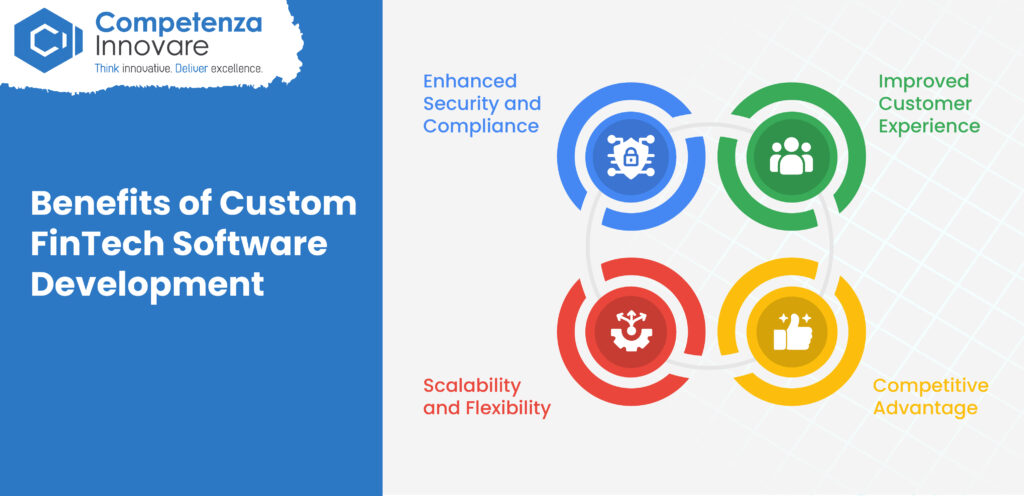
Benefits of Custom FinTech Software Development
Business custom FinTech software helps businesses to develop trustworthy, scalable, and easy-to-use financial systems. It allows companies to create functionalities that most effectively serve their specific needs and improve the performance and customer experience.
Enhanced Security and Compliance
The development of individual FinTech solutions may take into consideration the industry regulations and proactive security. This helps in protecting financial data, reducing risks, and making such standards as KYC and AML compliant.
Improved Customer Experience
Custom software can help provide more personalized financial services with easy interfaces and user-friendly user experiences. Companies are able to offer quicker, more convenient, and entertaining experiences to the customers.
Scalability and Flexibility
Possible custom FinTech software can be expanded as business requirements evolve. The businesses are able easily to add new features, accommodate more users, and adapt according to the dynamics of the market.
Competitive Advantage
The peculiarities and tailor-made solutions help companies to be more uncommon than others. The rapid innovation and superior control over product advancements are also made possible by custom development.
Common Challenges in FinTech Software Development
The development of FinTech software requires security, compliance, integration, and performance management concerns. These problems help in the construction and establishment of effective financial solutions that are dependable and expandable by companies.
- Regulatory Complexity: The FinTech software should be in accordance with changing financial regulations and compliance strategies related to regions. It is not an easy task to make sure that such standards as the KYC, AML, and data privacy are met.
- Security risks to data: Financial applications are sensitive in processing sensitive data or money, and data security is an issue of concern. The risks of cyberattacks, data breaches, and frauds are potentially effective protection tools that may be implemented to protect the information of customers.
- Legacy Systems Compatibility: This might not be simple to integrate new FinTech software with old financial systems. The compatibility issue and data migration should be appropriately planned and skillful.
- Scalability and Performance: FinTechs should be capable of handling more users and transactions. A scalable system facilitates accelerated performance and dependability as well as operation of the business when it expands.
Future of FinTech Software Development Beyond 2026
The future of FinTech software will be oriented towards more intelligent technology, higher levels of security, and personalized financial experiences. The improved financial services with advanced solutions will be used to continue and satisfy the dynamic needs of customers.
AI-Driven Financial Ecosystems
FinTech platforms will use AI to provide personalized financial services, data analysis, and automation of the process. Smart devices will enhance decision-making and generate more favorable customer experiences.
Embedded Finance Everywhere
Financial services are going to be more embedded in applications. The shopping channels will offer payments, lending, and other financial services on their sites.
Hyper-Personalized Banking
FinTech solutions are going to require application of real-time data and AI insights to provide personalized suggestions, financial guidance, and smarter banking experiences.
Advanced Fraud Prevention
Due to the utilization of AI, security algorithms will enable the identification of threats and monitoring of transactions, as well as the prevention of fraud. Financial platforms will be bolstered by constant monitoring that will improve their safety and integrity.
Build secure, scalable FinTech solutions with expert developers and accelerate your financial technology vision today.
How to Choose the Right FinTech Software Development Company
In choosing the correct company to implement the FinTech software development, it assists corporations in developing safe, scalable, and efficient finances. Identify a partner who has FinTech experience and a demonstrated ability to deliver an effective technology stack and experience in areas related to security and compliance, such as AML, KYC, and PCI DSS. A great development partner should also help sustain and enhance the product on an ongoing basis. The Competenza assists the companies in creating tailored FinTech solutions using present-day technologies and location-specific solutions.
Conclusion
The development of a successful fintech software in 2026 must incorporate innovative technology, high security, regulatory compliance, and outstanding user experiences. Through the systematic FinTech software development cycle, companies can create fault-tolerant and scalable financial solutions that are flexible and are proof of the future. A partnership with a reliable software development company in the fintech sector would help in getting developments tracked down, reducing risks, and creating high-performing financial software to keep up with the dynamism of needs on the market.
Frequently Asked Questions (FAQs)
What is FInTech software development?
The process of developing digital financial solutions to assist businesses in providing secure and efficient services (digital banking, payments, lending, insurance, and investment management) is called FinTech software development. These solutions operate on technologies, such as AI, cloud computing, APIs, and data analytics, to enhance any financial processes and customer experience.
What is the time required to develop FinTech software?
The construction of FinTech software is based on the project scope, features and integrations, and security requirements. An MVP with simple features will require a time of about 3 to 6 months, and a sophisticated FinTech platform can take 6-12 months or more.
Which technologies are applied to create FinTech applications?
The development of FinTech applications results in the use of the latest technologies such as React, Angular, Node.js, Java, Python, cloud technologies (including AWS and Azure), secure databases, APIs, and AI-powered solutions. The technologies are applied to create scalable, secure and high-performance financial systems.
What are the security needs of FinTech software?
FinTech applications require a high level of security,, including encryption of data, a multi-factor authentication system, secure APIs, and fraud detection and verification of identity. The compliance with such regulations as the KYC, AML, GDPR, and PCI DSS also plays its part in the safety of financial data and inspires trust.
How much does FinTech software development cost in 2026?
Depending on their application type, features, complexity, technology stack, and compliance requirements, FinTech software development costs can be variable. An MVP can also be affordable as opposed to more mature solutions, which can prove to be costly to invest in, like digital banking solutions, lending solutions, and enterprise FinTech applications.
What can AI do to enhance the creation of FinTech software?
The automation of FinTech software with the help of AI makes the product customized according to a customer, analyzes their financial data, and detects fraud. AI-based smart capabilities like predictive analytics, chatbots, and smart recommendations assist businesses in developing smarter financial solutions.
How do FinTech applications play a part in regulation compliance?
There are ten FinTech applications that facilitate compliance by providing identity checks, tracking of the transaction, data security, and secure payment systems. Compliance with regulations (such as KYC, AML, GDPR, and PCI DSS) helps companies to act in accordance with legislative and security laws.
Why do businesses like custom FinTech software development?
Tailored FinTech software applications allow businesses to create solutions that are goal-oriented, client-focused, and process-oriented. It is more scalable, flexible, and safer and has the ability to add custom functionality as compared to commercial financial software.
What can be the challenges in FinTech software development?
The most significant challenges are control of regulation requirements, protection of sensitive financial data, integration with existing systems, scalability, and performance. These will be handled in a well-planned and developed manner.
What FinTech software development company do I pick?
Find a technology firm that provides software in the domain of fintech, has experience, has technical capabilities, and knows about all aspects of security and compliance. The Competenza helps companies to build highly secure and scalable FinTech solutions using cutting-edge technologies and development practices targeted at the industry.