

The choice of the tech stack is one of the most vital choices of software product development. Your current technology decision will directly impact the performance, scalability, security, development speed, maintenance cost, and compatibility of your product down the road. Regardless of the type of software you are developing, be it a new SaaS, enterprise application, customer portal, or digital product, the technology stack that brings about optimal growth and innovation will be key.
A tech stack is a collection of frontend, backend, database, infrastructure, and development tools to construct and operate a software product. Most companies engage in the planning process only on features and functionality, and neglecting technology choices might cause expensive issues in the future. A stack that is old or inadequate will impose technical debt, reduce scalability, and incur higher maintenance costs, and ultimately the software will have to undergo heavy resource expenditure in terms of legacy application modernization to remain competitive and secure.
The engineering of modern software products cannot be achieved by mere selection of popular programming languages or frameworks. Technology decisions made by organizations must consider business objectives, user expectations, scalability requirements, security standards, integration needs, and future development plans. The optimum technological stack must address the immediate development requirements as well as future business transformation to allow a team to implement rapidly in response to evolving market preferences and technological advancements.
With the rapid growth in digital transformation sweeps within industries, businesses are finding it quicker to invest in custom software development and software product development services with an emphasis on flexibility, cloud preparedness, and maintainability. With agile development software, scalable architectures, and even the current type of software development solutions, the correct technology choice can greatly lessen the risk besides enhancing time to market and operational efficiency.
In this guide, we will discuss the most important considerations in selecting a tech stack in your software product, the pitfalls to avoid, and the best practices in creating future-ready applications. You also will learn how strategy-based decisions in technology can be helpful in preventing technical debt, engineering software products, and reducing the use of expensive modernization projects in the future.
What Is a Tech Stack?
A tech stack is defined by the set of technologies that are used to develop and operate a software application. It includes the tools, architecture, computer infrastructure, databases, and systems that result in the development of the software product. Scalable, performance-based, and secure applications require careful consideration in the technology stack choices when utilizing a large-scale form of application development.
A basic technology stack is comprised of the following layers:
Frontend Technologies
The users interact with the application on its front end. It is obsessed with user experiences, design, and responsiveness.
The next popular front-end technologies are
- React
- Angular
- Vue.js
Backend Technologies
The functions powered by the backend and holding the main functionality and business logic of the application are the API and data processing functions.
Common technologies that are used in backends are:
- Node.js
- .NET
- Java
- Python
Database Layer
The databases hold application data, which is carefully maintained in such a way that the information is readily accessible.
Popular database options would be the following:
- PostgreSQL
- MySQL
- MongoDB
Cloud Infrastructure
Cloud solutions include the capability to support, scale, and operate the apps.
The top cloud providers are the following:
- AWS
- Microsoft Azure
- Google Cloud
DevOps and Automation Tools
DevOps would help in the automation of testing, deployment, and maintenance of the system, which also helps in the fast and reliable development of software.
Common tools include:
- Docker
- Kubernetes
- Jenkins
- GitHub Actions
These fundamental building blocks will enable businesses to make better technology choices and develop software products that are more easily maintained, scaled, and modernized as the requirements change.
Why Choosing the Right Tech Stack Matters
The technology stack your use of is a factor that will succeed or fail your software product. It affects the rate of development and user experience, scale, security, and long-term maintenance. When developing software products, choosing proper technologies initially can make companies prevent expensive dilemmas and build a more concrete base to further expand.
Faster Product Development
The correct technology stack would facilitate the work of development teams to develop, test, and deploy applications more efficiently. These standard structures and resources improve the processes and teamwork and save development. This enables companies to create faster software products and implement new products or features in the market quicker.
Better Scalability
Your application must be scalable as user demands increase, without compromising on performance. A scalable architecture helps to accommodate the additional users, data volumes, and transactions while ensuring the seamless experience. This has been of particular significance to companies that invest in custom software development and those who invest in digital growth over the long term.
Lower Long-Term Costs
The decisions after technology affect the maintenance costs as well as the operational costs directly. Advanced technologies have less to upgrade, include, or maintain, and they further enable organizations to mitigate their technical debt and prevent unneeded redevelopment expenses during the software product lifecycle.
Improved Security
The current frameworks, platforms, and cloud services are updated and patched with security-related issues on a regular basis. The selection of trusted technologies assists in enhancing the security of applications, safeguarding sensitive information, and even aiding compliance where necessary.
Easier Future Modernization
Technology is dynamic, and software products need to move with variations in the business and market demands. It becomes far easier to upgrade and integrate the future with technologies that have a large community and vendor base. It also simplifies the process of modernizing the old applications that may come as a result of older or unintegrated systems.
All of that being said, the successful engineering of software products is supported by having the right technology stack, which enhances performance and scalability as well as maintainability. It enables companies to develop trusted applications in the present and be ready to undergo innovation and modernization projects in the future.
Key Factors to Consider Before Choosing a Tech Stack
The process of choosing an appropriate tech stack goes beyond selecting popular technologies. The most appropriate technology choices are those which are in line with your business objectives, product needs, and long-term expansion strategies. The following are some of the considerations to be made before a software product development endeavor.
Business Objectives
All your technology decisions must serve the purpose of your software product. Before you choose your frameworks or platforms, ask:
- What problem is the software solving?
- Who are the users of interest?
- What business outcomes do you want to achieve?
An illustrative example is a customer-facing application where user experience and performance can be the focus and an internal business system where efficiency and integration capabilities can be prioritized. An effective approach to software product development begins with business requirements as opposed to technology fads.
Product Complexity
The technologies and architecture that you need to support your product depend on its complexity. Applications can be used in different ways, with different technical requirements, including:
- SaaS platforms
- Enterprise applications
- E-commerce systems
- Customer portals
- Internal business applications
Improved performance, serviceability, and scalability can be ensured by the choice of the technologies that ought to be applied to the specifics of the project.
Scalability Requirements
As the business expands, it will need software support to expand with it. In assessing a tech stack, one should take into account:
- Expected user growth
- Data volumes
- Concurrent users
- Geographic expansion
By ensuring scalability is built in to the architecture at the start, it is possible to prevent performance bottlenecks and expensive redevelopment later. This is one of the main factors that are considered in software product engineering and custom software development projects.
Security and Compliance
A factor in the use of technologies regards security, especially where one is dealing with sensitive information. You need to possibly comply with the regulations, including
- HIPAA
- GDPR
- PCI DSS
The appropriate technology stack should support security best practices, data protection requirements, and compliance standards that, depending on your business, are of interest.
Budget and Development Resources
The selection of technology can have a profound effect on how much it costs to build a software product and resource availability. Take into account such aspects as the following:
- Licensing costs
- Infrastructure expenses
- Developer availability
- Ongoing maintenance costs
The choices made regarding technologies that are well embraced within the community and with easy access to talent can help in curbing any development complications and high operational costs in the long run.
Time-to-Market
Speed is a key consideration when a startup or a business launches a minimum viable product (MVP). The choice of technologies that will aid in quick development, testing, and deployment can contribute to the faster adoption of the products in the market without compromising on quality and scalability.
Through a close consideration of these points, businesses will be able to make technology choices that facilitate the successful development of software products, enhance long-term maintainability, and lessen the inevitability of future modernization difficulties.
Evaluate Technology Longevity and Community Support
When selecting a tech stack, you need to consider more than just what you are developing now. Among the reasons the applications become legacy systems is one of the most explicitly applied technologies that do not become long-term and cannot adapt to the changes in the business needs.
Before making a decision, evaluate factors such as the following:
- Community adoption: Technologies that have many users can have a larger community of developers, better documentation, and more learning options.
- Vendor support: Good vendor support facilitates continued updates, security patches, and technical support.
- Release frequency: Active maintenance is shown through regular updates, and the technology is being continuously improved.
- Long-term roadmap: Apprehending the future of a certain technology would make it easier to avoid services that would prove to be outdated.
- Maturity of the ecosystem: A mature ecosystem has availability of tools, integrations, libraries, and experienced developers.
Popular and well-supported technologies are more stable and hence are safer to use in the development of software products. They also have the capability of lowering maintenance issues, facilitating scalability in the future as well as minimizing the effort needed to undertake a massive modernization of your software as your application gets older.
Popular Tech Stack Options for Different Software Products
Software products may have different technical requirements; hence, the selection of the appropriate technology stack is a major aspect of software product development. The type of technologies that you choose must be in tandem with your business objectives, application needs, scale-ability needs, and future growth plan.
| Software Product Type | Common Tech Stack |
| SaaS Applications | React, Node.js, PostgreSQL, AWS |
| Enterprise Applications | Angular, .NET, SQL Server, Microsoft Azure |
| AI and Data-Driven Applications | Python, FastAPI, PostgreSQL, Cloud AI Services |
| E-commerce Platforms | React, Node.js, MongoDB, AWS |
These are combinations of popular technologies, but the most appropriate is determined by the needs of your project. Throughout the software product engineering, the business needs to think more about the adoption of the technologies that facilitate performance, maintainability, scalability, and growth in the future instead of following the market trend.
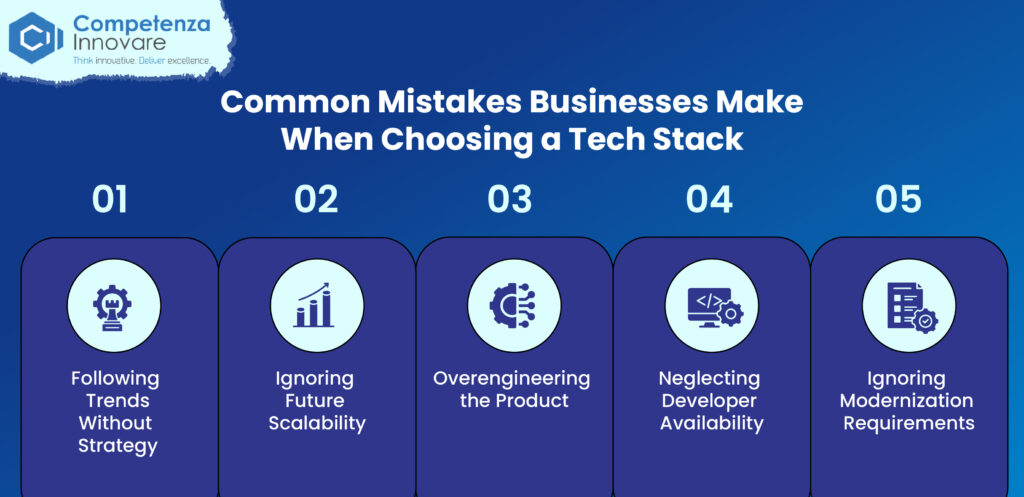
Common Mistakes Businesses Make When Choosing a Tech Stack
Selection of a suitable technology stack is a significant aspect of software product development. Nonetheless, most companies are preoccupied with short-term needs, and they do not consider issues influencing long-term performance, scalability, and maintenance. These are some of the pitfalls that should be avoided to minimize technical debt and achieve the success of your software product over the long term.
Following Trends Without Strategy
Popular technologies are sometimes in the spotlight and are not always suitable for every project. It might cause unnecessary complexity in implementation due to the sheer fact that implementing a framework because it is trending does not align with your business objectives, product requirements, or the available development capabilities to implement it. Strategic decision-making needs to be motivated by technology.
Ignoring Future Scalability
Most applications are installed based on the needs at the present moment without any future development in mind. When the number of users, volume of data, and business needs scale, an inappropriate tech stack may turn out to be a significant constraint. Intended scalability Early scalability planning can make sure your application can be scaled without necessarily redeveloping it, putting it into shackles.
Overengineering the Product
The development may be complicated and more expensive by adding the unnecessary technologies, features, and architectural layers. Overengineered solutions can also postpone development and have the effect of increasing maintenance and difficulties in updating the application.
Neglecting Developer Availability
Availability of skilled developers is also a factor in the success of a software product. The selection of niche or less-adopted technologies may complicate talent acquisition, require more cost in the development process, and pose major long-term maintenance burdens. Technologies that have a high community adoption usually have more expertise available and are easy to support.
Ignoring Modernization Requirements
Decisions on technology must be made bearing in mind future upgrades and changes in business requirements. In not looking into the long-term maintainability, outdated systems, insecurity issues, and integration headaches may be experienced. Organizations must, in most instances, undergo very expensive legacy application modernization efforts, as the initially used technology stack was unable to enable expansion or innovation.
Educating businesses to avoid these usual pitfalls will allow them to make more informed technology choices that will result in a successful software product development process, better maintainability, and provide the foundation to ensure future growth.
How the Wrong Tech Stack Leads to Legacy Systems
Selecting the inappropriate technical stack might cause issues that will occur later on your software product even after the development. Although an application might be good in the short run, an outdated or inappropriate technology can complicate scaling, maintenance, and upgrading as time goes by.
Some common issues include:
- Technical debt that slackens on further development.
- Difficulties in integrating with new tools and platforms.
- Technology vulnerabilities to unsupported technologies.
- Performance constraints when the user demands increase.
- Increased maintenance and operating expenses.
A number of warning indicators that a technology stack is perhaps growing outdated include the following:
- Incompatible platforms of frameworks or programs.
- Outdated infrastructure limiting performance.
- Delayed updates and slow release cycles.
- Lack of scalability as the business expands.
Once these issues start to affect business operations, organizations may have to invest in the modernization of their legacy application to modernize their systems and enhance performance, security, and flexibility.
The most effective strategy for averting these problems is to make a decision regarding technology, keeping the future in mind. An intelligently designed tech stack will facilitate the successful development of software products and business-need adjustments and keep applications dependable and scalable over many years.
Build a future-ready software product with the right tech stack—talk to Competenza today.
How Competenza Helps Businesses Build Future-Ready Software Products
Developing a successful software product does not only depend on the choice of technologies. It also needs the appropriate expertise so that your product can be scalable, secure, and adaptable to the future business requirements.
Competenza assists companies with complete software product development and software product engineering services, including technology selection and custom software design, deployment, and continuous enhancement. The team employs agile software development practices to provide solutions that will aid the growth and minimize the long-term technical challenges.
To organizations that handle old systems, The Competenza offers modernization services on legacy applications as well to enhance their performance, security, and scalability. End-to-end product development support enables firms to create contemporary software products that are prepared to succeed in the long term.
Conclusion
The success of a software product begins with an appropriate technology base. Selecting a tech stack that fits your business interests, scalability objectives, and the user requirements can enhance the performance, cover the scales, and make it easier to update later. It also assists in lessening the technical debt and forms a more adaptable ground on which to develop.
Making informed technology decisions early allows businesses to create software products that are more readily maintained, adapt to emerging market demands, and facilitate long-term success. An architecture that is designed carefully can not only address the needs of the moment but also future development and modernization of your application.
Frequently Asked Questions (FAQs)
What is a tech stack of a software product?
A tech stack is a combination of technologies used to build, run, and maintain a software application. It typically includes front-end and back-end technology, databases, cloud computing, development tools, etc. The relevant technology stack will help and back successful product development of the software and long-term business expansion.
Which is the appropriate tech stack to apply when creating a software product?
Choosing the right tech stack, you are supposed to start by being aware of what your long-term goals are with your business, what your product is, what your target market is, what your scalability requirements are, what your protection requirements are, and what your budget is. An optimally designed technology stack must be in place to carry both the present and future operations.
What is the importance of choosing the appropriate tech stack?
The technology stack has a direct influence on the speed of development, performance of an application, scalability, security, and cost of maintenance. The choice of the right technologies would help the businesses to create a plausible software product and reduce future development and modernization challenges.
What are the factors in choosing a tech stack?
Businesses ought to consider the complexity of the product; the rate of user growth; the necessity of securing and meeting compliance; availability of the developers; the cost of the infrastructure; and their long-term technology protection.
Does a wrong tech stack affect business growth?
Yes, this inappropriate tech stack may cause performance problems, technical debt, and integration and scaling problems. Issues may slacken the business growth and raise the expenses incurred in maintenance in the long term.
What about the way a tech stack helps in software scalability?
A scalable technology stack has the capability to enable an application to support more users, data, and workloads without compromise in performance. This assists companies in increasing their software products with the increase in the demand of the customers.
Which are the most popular tech stacks of current software products?
Examples of popular options are React, Node.js, PostgreSQL, AWS, Angular, Python, .NET, and Microsoft Azure. The most appropriate choice will be based on your particular software product development needs and business goals.
What can businesses do to prevent establishing legacy systems?
To mitigate risks of the legacy systems, businesses need to choose up-to-date, well-supported technologies; ensure scalability; and regularly verify the technology stack to align it with the changing business requirements.
Which applications require legacy application modernization?
The modernization of legacy applications is warranted when old technology results in security threats, performance, integration constraints, or high maintenance expenses that affect the business processes.
What role can engineering of software products play in the selection of a tech stack?
Software product engineering assists the businesses to assess technologies, develop scalable architectures, and make sound technology choices. This guarantees the software products a level of security, maintainability, and readiness to grow and innovate in the future.