

One of the poorest disciplines in the industry is that of software project estimation. Research in the US, the UK, and Europe consistently indicates that most software projects go above and beyond their initial budget, initial schedule, or both as well as that poor software development estimation is nearly always a contributing factor. This is not because developers and project managers are not doing a good job. Nevertheless, project development estimation is honestly challenging, and most organizations do not estimate with the rigor that the issue demands.
Software development estimation is not a quest to predict the future with accuracy. It is concerned with less uncertainty to an extent such that software development budget confirmation, team make-up, scope prioritization, and go-to-market planning can be made with reasonable confidence. A good estimate is not an obligation of delivering at a specific price and time. It is a rational estimation by the available information and the more perfect as the project advances and the less the uncertainty.
This guide will discuss how to estimate a software development project with a reasonable degree of accuracy, starting with the basics of what drives cost and complexity, then on to the most popular software estimation techniques, and finally the real-world steps that can be taken to generate estimates worth basing a project plan on.
Why Software Project Estimation Goes Wrong
The initial step towards preventing failure modes is to understand them.
The majority of failures in software project budget estimation have the same cause of the issue. Half the battle is to realize them.
Optimism bias: It is a well-documented cognitive battle that takes development teams always underestimating the effort required to do something, even with detailed specifications. The so-called planning fallacy in the behavioral science community makes individuals predict completion times using the best-case plans instead of the available averages.
Missing Requirement: You cannot plan the incomplete requirements. The process of gathering requirements that are done in haste, insufficiently, or ambiguously brings about correspondingly low estimates. The scope assumed during estimation time is hardly the one that gets constructed.
Neglecting non-development labor: The work that a software project produces is only some of its code. All time- and budget-consuming and all regularly undervalued or not included in original project estimates are project management, QA, UI/UX design, infrastructure setup, security review, documentation, deployment, and stakeholder review.
No contingency: The software projects are faced by unknown technical complexity, variable requirements, and external dependencies, taking a slip down. No contingent estimates of these realities are that they are wishful thinking.
Pressure to make low numbers: In organizations where budget approval requires that the estimate be less than a specific limit, systematic pressure is exerted to make optimistic estimates that are approved, instead of realistic estimates that are more accurate. This dynamic generates approvals of projects that would have been impractical to approve at the approved budget.
What Factors Affect Software Development Cost Estimation
It is always good to know what is being measured by the technique before the choice of a development budget estimation technique. Reducing software development cost is a variable function of multiple interacting variables:
Project scope and feature complexity: The first is the number of features that will be included in the project, feature complexity itself, and the interactions among the features. Very different estimations are made between a ten-feature application with simple CRUD functionality and a ten-feature application with real-time data processing, complicated business logic, and multi-system integration.
Technology stack: Technology decisions impact the pace of development and access to skilled software developers. Well-established stacks with vast talents (React, Node.js, Python, and Java) tend to give more accurate estimates than newer or more specialized technologies where there are not so numerous reference projects.
Team size/ Team experience: An experienced developer in the domain is usually two or three times quicker than a junior developer with less experience. The composition of the team, the number of elderly to young people, and the availability of experts in particular technologies have a tremendous impact on both speed and project development estimation precision.
Integration requirements: Integrating apps with multiple third-party systems, legacy platforms, or external APIs adds complexity and risk that is infamously hard to estimate software development budget for. Only during the development process do the use of third-party systems, their limitations, documentation quality, and API behaviors that are revealed fully.
Security and compliance concerns: Applications that are covered by regulatory frameworks HIPAA in the US, GDPR in the EU, FCA regulations in the UK, and PCI-DSS worldwide need more how to ensure software security during development, audit records, data protection, and compliance records. These aspects increase workload that must be estimated specifically as opposed to assuming it to be reflected in feature estimates.
Non-functional requirements: Performance targets, scalability requirements, availability SLAs, as well as accessibility standards would need further development, testing, and infrastructure investments. Another frequent cause of late cost overruns in projects is non-functional requirements that are defined late or revealed in testing.
Top Software Development Estimation Techniques
1. Expert Judgment
Quick, knowledge-based, and efficient with known issues.
The most common software estimation that is commonly applied is expert judgment. The requirements are reviewed by an engaged developer, architect, or project manager who has the relevant knowledge in the domain and comes up with an estimate based on their experience in similar projects.
Judgment Expert judgment is very rapid and does not need a formal approach. The correctness of its judgement is wholly in the quality and relevance of the experience of the expert. In projects that are very similar to those in the past, expert judgment works well. In new projects, new technology layers, new fields, or odd-scale criteria, it is the least dependable technique that can ever be used because the professional has nothing to compare to.
Expert judgment should be employed as a sanity check on estimates garnered by other tools in a more organized manner and not as the solution to complex or unknown projects.
2. Analogous Estimation (Top-Down Estimation)
The estimation baseline is the use of historical data on similar projects.
Analogous estimation is the comparison of the new project to the completed projects of this type and magnitude, but with known differences. Assuming that a similar application required 2,000 development hours to create and the new application seems to be 20% more sophisticated, a similar estimation would estimate 2,400 development hours.
Such a technique is effective with organizations whose library of completed projects provides good effort data and when the new project is truly similar to previous work. It is quick to create and it is comparatively simple to convey to non-technical stakeholders.
Its weakness lies in that adjustment factor, and the percentage that the new project differs with reference is an opinion in itself and may bring a lot of inaccuracy. This technique totally depends on the quality and relevancy of the historical data.
3. Work Breakdown Structure (WBS)
Breaking the project into quantifiable units of work to estimate downwards.
A Work Breakdown Structure subdivides the project into smaller and smaller segments—phases, features, user stories, and tasks—until every item is sufficiently detailed to give a reasonable estimation. Each element is then estimated to generate the overall project estimate.
The most comprehensive and arguably the most reliable of the usual software methods of estimation is the WBS-based estimation, as it compels the estimator to contemplate all aspects of the work, rather than to think at a high level. It also brings out the requirement blank when you are unable to further refine a feature due to unclear requirements, i.e., that is an indication that requirements are yet to be clarified before the estimate can be done.
Time is the trade-off. A detailed WBS of a complicated project spans days or weeks to come up with. The investment in the detailed WBS can be too early when the scoping is performed at the first stages and the approximate order of magnitude is needed.
4. Story Points and Planning Poker
Relative sizing and team consensus agile estimates.
The standard agile estimation unit is story points, a relative amount of effort, complexity, and uncertainty allocated to each user story in a backlog. Story points compare work to work in the same backlog rather than estimating in terms of hours (which standardizes estimates to the productivity of that individual).
The most common story point estimation technique used is planning poker. Team members separately choose a card denoting how they think a particular story will take, based on a Fibonacci-like scale (1, 2, 3, 5, 8, 13, 21), and all cards are visible at the same time. In situations where there is a wide range of estimates, the team will brainstorm the causes and then re-estimate. The process exposes both unspoken assumptions and surface risk and yields estimates that transcend those of an individual but pertain to the collective experience of the team.
In agile, project estimation is based on story point estimation, which is great in estimating sprints and refining the backlog. To estimate the story points in terms of calendar time, it is necessary to trace the velocity of the team across a series of sprints—the average number of story points that will be finished in each sprint—and thus initial estimates of the sprint have a greater degree of uncertainty than future sprints.
5. Three-Point Estimation (PERT)
The expression of uncertainty explicitly by optimistic, pessimistic, and most-likely scenarios.
The three-point estimation commonly used as PERT (Program Evaluation and Review Technique) gives three estimates of every work item: the optimistic estimate (assuming that everything is all right), the pessimistic estimate (assuming that something is very bad), and the most likely estimate (the expected one). These values are mathematically added up to give a weighted estimate, which quantifies the uncertainty in a more realistic manner as compared to a one-point estimate.
The PERT formula will be Estimate = (Pessimistic + 4 x Most Likely + Optimistic)/6.
Three-point estimation is especially helpful on projects that are subject to a high level of technical uncertainty, are using new technology stacks and new integrations, and whose requirements are not fully defined. By ensuring its definition of the ranges of outcomes, it conveys the inherent uncertainty of the estimation to the stakeholders in a manner that is not visible in single-point estimates.
6. Function Point Analysis
The idea of measuring the size of software by its functionality delivered instead of lines of code.
Function Point Analysis (FPA) quantifies the size of software by counting the number of functional units of a system (inputs, outputs, queries, files, and interfaces) plus some weighting of complexity to get a count of function points. This number is then translated into effort with industry-standard or organization-specific productivity rates.
It is technology-independent and measures what the software is doing but not the construction of it, which makes it valuable in comparing effort between technology stacks or in generating estimates before the technology strategy is completely defined. Mainly in enterprise or government software development in the US, UK, and Europe, independent sizing offers a uniform foundation on which contractor estimates can be judged or benchmarked.
FPA is a costly process and labor-intensive, with the worth in the hands of trained analysts. With most commercial software projects, only large, complex engagements can justify independent sizing to mean significant commercial value.
7. COCOMO Model
Project size and complexity driver-based algorithmic cost modeling.
The Constructive Cost Model (COCOMO) is an algorithmic software modeling of cost estimation that employs a mathematical formula to estimate effort, project size (in terms of lines of code or function points), and a list of cost driver ratings that comprise product, platform, personnel, and project factors.
COCOMO best applies to larger software projects of parametric modeling effort, of the type normally found in government contracts, military projects, or big enterprise programs. It is not common as the primary estimation method (often used in commercial development projects) but the principles, present in all its forms, that project size, complexity, and team capability all interact to establish effort are true independent of which estimation method is used.
Also Read: How to Evaluate a Software Development Partner
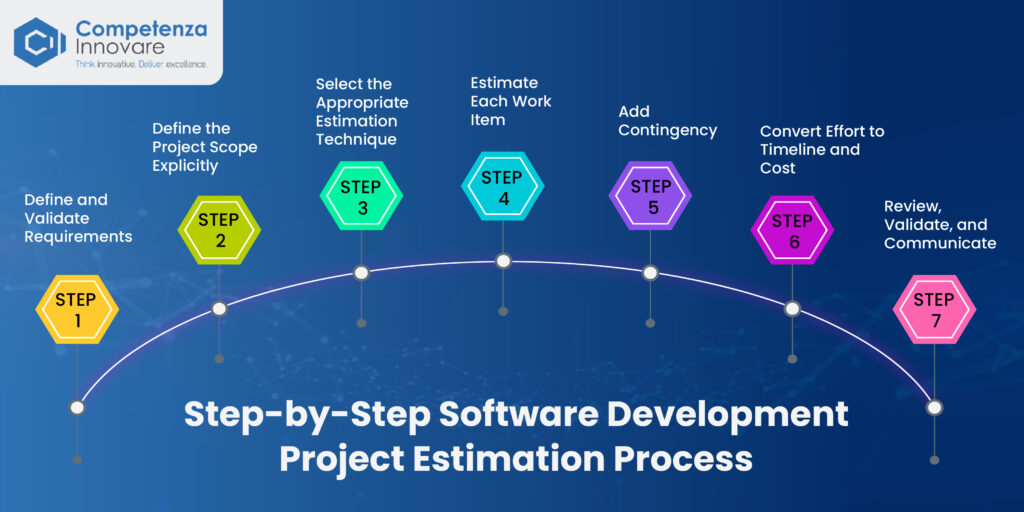
Step-by-Step Software Development Project Estimation Process
An efficient, repeatable procedure of generating estimates that are reliable.
Step 1: Define and Validate Requirements
The quality of requirements is directly proportional to estimation accuracy.
To apply any estimation technique, the requirements must be suitably documented to aid estimation. This implies functional requirements, what the software should do, and non-functional requirements, performance, security, scalability, and accessibility. Opening up the requirements leads to estimates with a correspondingly broad range of uncertainty.
Launch before engaging in estimation. All uncertainties solved now are estimation errors that have been avoided at the bottom.
Step 2: Define the Project Scope Explicitly
The content covered is equally of importance to the out of scope.
A software project scope specifies what the project will provide and specifically what will not be provided. This is blatantly clear, yet unclear scope boundaries at estimation time are constantly inflated through growth in the development process, causing overruns that would have been completely avoided.
Split the scope into measurable parts with the names of WBS. All the features, integration, infrastructure, and non-development work items—project management, QA, UI/UX, deployment, and documentation—must be found in the breakdown.
Step 3: Select the Appropriate Estimation Technique
Associate technique with phase of project and quality of information.
Various estimation methods are applicable in different project life cycle phases. In cases where early scoping and budgetary approvals are required, similar estimation and expert judgment will give adequate accuracy with minimal effort. Story points and planning poker are the forms of sprint planning that make sense to use in agile projects. The bottom-up estimation, using WBS and budget, is the most reliable foundation of detailed project plans with committed timelines and budgets.
Multi-method combination top-down estimation in many teams to approve earliest budgets and bottom-up WBS estimation with three-point refinement in committed plans for the project.
Step 4: Estimate Each Work Item
Estimation of all ground-level components, tasks, and deliverables.
Defining that scope, and having chosen the estimation technique, estimate work items in the WBS, one by one. Record effort, the complexity rating, and any assumptions that the estimate relies on per item. Document assumptions explicitly. This estimate assumes that the third-party API is well-documented and that it meets its performance, since when assumptions turn out to be incorrect, the effect on the estimate must be identifiable.
Use the same technique for all items. Estimates that are very uncertain should be estimated using three-point estimation to define the range explicitly instead of going directly to an estimated value that obscures the uncertainty.
Step 5: Add Contingency
Build up what you are sure you do not know.
Any software project is not executed by the numbers. The concept of technical complexity is revealed in the course of development. Requirements change as the people involved make early appearances. Dependencies of third parties are unstable. Padding is not contingency; it is a good recognition of the fact that estimated effort is an expression of known scope and that there will be unknown scope.
Industry standards recommend a contingency of 15 to 25 percent on well-defined projects, 25 to 40 percent on projects with high technical uncertainty, and more on those that deal with novel technology or integrate complexly on projects with partially defined requirements. The relevant contingency level is supposed to be values that are reported to stakeholders and not obscured with exaggerated line-item estimates.
Step 6: Convert Effort to Timeline and Cost
Converting hours to calendar time and dollars.
The number of hours of development is not directly proportional to calendar time. The calendar days of a particular effort estimate are influenced by team size, hours of work per day, leave, meetings, and work streams. A 1,000-hour project that is undergone by a team of five individuals who in one day work six hours productively would require more than 33 working days as opposed to 125. Parallel streams decrease time; sequential dependencies increase time.
In-house teams are used under fully loaded rates, salary plus benefits, equipment, licenses, and overhead; or agreed daily or hourly rates or an external vendor. Fully loaded developer rates in the US, UK, EU, and APAC markets differ considerably on a market and seniority factor-selected basis in any estimate of cost as opposed to generic benchmarks.
Step 7: Review, Validate, and Communicate
Estimates must be reviewed by themselves and be honestly documented.
The output of a single estimator must always be checked by someone who was not part of the initial estimation, preferably into a field of technical knowledge. This external audit identifies blatant flaws, questions baseless assumptions, and puts the overall sanity checks with other similar projects.
Communicating estimates to stakeholders, express them in a range, not at a single point. An approximate project of $2,000 to $2,500 hours tells the truth of uncertainty. The estimation of a project of $2,000 hours indeed suggests a precision not effectively created in the estimation process and establishes a failure narrative when the actual is $2,300 hours.
Agile Software Estimation: Specific Considerations
The difference is how estimation is carried out in agile environments.
Agile estimation contrasts with conventional estimation in one aspect: instead of coming up with one estimate of the whole project at the beginning of the project, agile teams estimate with refinement going dividend by sprint as the velocity of the team and the maturity of the requirements are known.
During the agile estimation process, it is normally started by an initial high-level project estimate with analogous estimation or rough WBS breakdown to set a budget envelope to be accepted by the stakeholders. Story points and forward projection with planning poker are then used to plan individual sprints at the sprint level, and velocity information of completed sprints increases the accuracy of forward projections.
In the case of agile projects, the best estimation artifact that can be used by the stakeholders is an estimated range of the total project deliverable with the current size of the backlog divided by the current velocity that the team tracks, with the specific recognition that the range will diminish as velocity settles and the backlog is refined.
Software Project Estimation Checklist
A worldly-wise guide to any software development estimation process.
| Estimation Step | Completed |
| Requirements documented and validated | ☐ |
| Scope defined with explicit boundaries | ☐ |
| WBS covering all deliverables including non-dev work | ☐ |
| Estimation technique selected and applied consistently | ☐ |
| Assumptions documented for each major estimate | ☐ |
| Non-functional requirements estimated explicitly | ☐ |
| Third-party and integration complexity assessed | ☐ |
| Contingency applied and justified | ☐ |
| Effort converted to calendar time correctly | ☐ |
| Cost calculated using market-correct rates | ☐ |
| Independent review completed | ☐ |
| Estimate presented as a range, not a single point | ☐ |
Get an accurate software project estimate with expert guidance on costs, timelines, and requirements today.
Common Software Estimation Mistakes to Avoid
The fallacies that continually yield unreliable estimates.
Estimating with requirements undefined: It is making a fixed estimate before the requirements are steady, not making an estimate. Production is not significantly better than a guess.
Projects not counting non-development: QA, UI/UX, project management, DevOps, documentation, and deployment—have a consistent 30 to 50 percent overhead on pure development. Systematically low estimates that leave these items out are made in advance of the project itself.
No contingency: All software projects face complexity unexpectedly. No contingency estimates are not lean estimates; they are not complete.
Anchoring to budget: To use an estimate to fit a set budget figure is not estimation; it is a business judgment in disguise. The latter must be well differentiated.
Single-point estimates of uncertain work: The approach of reporting one number when the work is highly uncertain gives an incorrect impression of the degree of reliability of the projection to the stakeholders. Use ranges. Use three-point estimation. Bring the uncertainty to the fore.
Conclusion
Software project estimation is a science and not an art. It involves systematic methods, accurate requirements, truthful contingency, and disciplined process—to be strictly followed and not as a mere protocol to begin development.
The Competenza that have done similar work previously invest time in requirements gathering prior to estimation, employ structured techniques as opposed to relying on gut feel, and report their estimates in range form, which is honest in communicating uncertainty.
Enhancing the accuracy of estimation is among the best investments that can be brought about by organizations that are located in the US, UK, EU, India, and so on when it comes to doing software project planning. Estimates that are found to be credible lead to a greater chance of completing the project on time, on budget, and with what was promised.
Frequently Asked Questions
What is software project estimation?
Estimation of software projects is the procedure of estimating the work of effort, time, and financial endeavor needed to finish a software development venture. It operates through structured methods such as story points, WBS, and three-point estimation to make requirements into projections that are applicable in budget approval, resource planning, and commitments of timelines.
What are the most popular techniques to estimate software?
The most recent software estimation methods are expert judgment, analogous estimation, Work Breakdown Structure (WBS), story point estimation with planning poker, three-point estimation (PERT), function point analysis, and COCOMO. It is a combination of top-down techniques of early budgetary approval and bottom-top techniques of committed project plans that is used on the majority of projects.
What is the accuracy of software project estimates?
There is no estimation method that provides perfect accuracy. This is to make sure that the state of uncertainty is minimized to the extent that the decisions made are sufficiently bold. The estimates made by conducting a detailed requirement gathering and a breakdown of WBS are usually in the range of 20-30 percent. Rough estimates made at an early stage and relating to order of magnitude could be within a range of plus or minus 50 percent or more.
What is the best way to communicate software development estimates?
Always use estimates as ranges but not numbers. Between 1,800 and 2,400 hours is straightforward with truth-telling about uncertainty and realistic expectations. Single-point estimates suggest accuracy that the estimation process fails to generate and generate unrealistic delivery commitments.
What is the impact of agile development on the estimation of software projects?
Agile teams use story points to estimate iteratively and to estimate planning poker but do not generate a single initial estimate of the project. A high-level budget envelope is defined early with similar or cruder WBS estimation, and sprint-level estimation is refined ongoing as the velocity of the team is known and needs turn into requirements.
What should a software project estimate contain as contingency?
Old standards in the industry indicate 15 to 25 percent contingency on well-defined projects and 25 to 40 percent contingency on projects involving great technical ambiguity, undeveloped technology, or vague requirements. Contingency must be placed in a transparent manner before the stakeholders are not covered up in exaggerated line-item quotations.
What is a work breakdown structure? What is its use in estimating software?
A Work Breakdown Structure (WBS) breaks down a project into increasingly smaller parts until elements too small to estimate predictably are reached. Each element is then aggregated to have bottom-up estimates of the whole project. WBS estimation is the most meticulous and, in most cases, the most precise method of dealing with the intricate projects.
What is the impact of requirements quality on estimating a software development cost?
Directly and significantly. The incomplete, ambiguous, or unstable requirements result in inaccurate estimates since the estimator must make assumptions concerning what is actually going to be built. Any estimation time ambiguity in requirements is an eventual cost overrun in the development. Among the most rewarding activities in software project planning is investing in rigorous requirements gathering followe