

Security breaches are unlike money since they cost a business more. They lose the customer trust and regulatory status, and in regulated ones they can lead to the acquisition of the operating licenses. However, most software weaknesses resulting in breaches are not that advanced, zero-day exploits; they are simple-to-avoid vulnerabilities that were introduced during development and had never been discovered previously between the occurrence and the release of the product. Secure software development is not the construction of systems that are impregnable. It is about creating systems that cannot be readily knocked in without necessity.
The threat scene in 2026 is no easier. Cyberattacks are more robotic, more specific, and more well-funded than ever. In all of the largest markets, GDPR in Europe; HIPAA and CCPA in the US; DPDP in India; and an expanding world of sector-specific security laws. Software security best practices are no longer a nice-to-have addition to the product; in the US, the EU, the UK, and other jurisdictions, they are a minimum for commercial and legal affairs of development teams. What secure software development really means, the best practices to avoid the most frequent vulnerabilities, and how to deploy a secure development lifecycle that proves to work in practice are discussed in this guide.
Why Software Security During Development Matters
The later the security vulnerability is found out, the higher the cost to fix the vulnerability. When the vulnerability is discovered during code review, it is a fraction of the cost of fixing the vulnerability in production as well as the production after exploitation. A study by the National Institute of Standards and Technology has always demonstrated that defects resolved during the design phase cost 30 times cheaper than defects resolved after release.
In addition to the direct cost of remediation, the business impact of unsecured development of software is terrible. The reputational harm after a security breach makes it hard to acquire and keep customers in a manner that cannot be quantified yet is real in effect. In the case of enterprises that are in regulated business, financial services, healthcare, or government security, failure can spread to the operational license risk.
It is only commercially reasonable to build the software security in as it was from the beginning. Security that was retrofitted subsequent to development is always more costly, inefficient, and difficult to maintain than protection that was planned during creation.
What Is a Secure Software Development Lifecycle (SSDLC)?
A secure software development services lifecycle is one that incorporates security practices at all stages of the software development process, starting with the requirements up to design, development, testing, deployment, and maintenance. The SSDLC does not regard security as an endpoint that oversight will be conducted before a release but instead introduces security thinking and security validation as part of the whole build.
The three most popular models of secure SDLC implementation are secure SDLC frameworks and Microsoft’s Security Development Lifecycle (SDL), the Software Assurance Maturity Model (SAMM) by OWASP, and the Secure Software Development Framework (SSDF) by NIST. They approach slightly differently, though they are all based on the same principle. Software security in the design phase is most efficient and most economical when it is integrated into the process instead of being attached afterwards.
12 Software Security Best Practices for Development Teams
1. Adopt a Security-by-Design Approach
Security by design reflects the fact that the design is a first-class consideration in a project rather than an addition made at the conclusion after the implementation has completed. This is through identification of security requirements and functional requirements at the requirements stage. Who should have gained what information? Which are the levels of data classification? What are some of the regulatory frameworks? What are the worst-risk system elements?
Software security requirements delivered at this point influence architectural decisions, which can be made at a comparable cost, multiplied exponentially more cheaply today than they will be to change at some point in the future. In the US and UK, organizations with sector-specific security commitments, such as FCA regulations, HIPAA, and PCI-DSS, require security requirements to be explicitly compared to those frameworks prior to the initial design choice.
2. Conduct Threat Modeling Early
The art of identifying potential attack vectors that a system is vulnerable to prior to construction is called threat modeling. The most popular framework used in systematic security analysis in software development is the STRIDE model: Spoofing, Tampering, Repudiation, Information Disclosure, Denial of Service, and Elevation of Privilege.
A threat modeling exercise has its output in the form of a prioritized list of risks and controls necessary to reduce them directly to the architecture and design requirements. Threat models that are created prior to the writing of the software will repeatedly yield more secure code than those that are created through testing to identify vulnerabilities later. Threat modeling is one of the most profitable investments a software developer can make towards ensuring the software is secure during the process of development.
Also Read: How to Rescue a Failing Software Development Project
3. Apply Secure Coding Practices
Secure coding practices are the particular rules used by developers to prevent the possibility of implementing common vulnerabilities. In fact, the most common types of software vulnerabilities that are exploited in real-life attacks are the OWASP Top 10, which contains injection attacks, broken authentication, security misconfigurations, insecure direct object references, and cross-site scripting.
Some secure software coding practices are
- Input validation: Do not trust outside sources. Check all inputs in accordance with format, type, and length prior to processing.
- Output encoding: Encode output in the way it will be displayed in the context to avoid injection attacks.
- Use parameterization statements: SQL parameterization You should never use standard statements to interact with the database but use parameterized ones in order to avoid SQL injection.
- Least privilege: Authorize only necessary permissions to the components, services, and users.
- Error processing: Report same error message back to the user. In an error message, do not include stack traces, database information, or internal systems.
- Secrets management: The use of credentials, API keys, or certificates should never be hardcoded. Store secrets with a management service and turn over credentials frequently.
Official secure coding standards must be written documents, controlled by version number, and not be at the discretion of individual developers.
4. Implement Static Application Security Testing (SAST)
The use of static application security testing will examine the source code to identify security vulnerabilities without running the application. SAST tools read written code during the CI/CD pipeline and detect possible issues, including injection vulnerabilities, unsafe application of cryptography functions, hardcoded secrets, and memory-unsafe memory operations.
By incorporating SAST into the development cycle, developers can now have the benefit of immediate feedback on security problems at the most cost-effective point in the development process. A variety of tools such as SonarQube, Checkmarx, Veracode, and Semgrep are extensively used by both enterprise and mid-market development teams in the US and UK to do it.
SAST is not by itself a full software security solution; it causes false positives and is not able to detect runtime vulnerabilities, but it is a necessary part in any comprehensive application security program.
5. Implement Dynamic Application Security Testing (DAST)
Unlike SAST, which analyzes code in a static mode, the Dynamic Application Security Testing mode is used to test the application dynamically by simulating real-world attacks on the running application. DAST tools scan the application in search of vulnerabilities such as authentication bypasses, session management bugs, injection vulnerabilities, and improperly set security headers, finding bugs that would not be obvious unless the application were actually running.
DAST is to be run as a part of a CI/CD pipeline that automatically runs on every major code change in staging environments. Automated dynamic testing has become popular in the development environment of enterprises with tools such as OWASP ZAP, Burp Suite, and Rapid7 InsightAppSec.
6. Conduct Regular Code Reviews with a Security Focus
Security testing automated tools are important but not enough. Education-oriented manual code inspection, in which scrutinizers particularly seek vulnerability patterns, insecure design choices, and bending of secure coding guidelines, apprehends problems that automatic tools overlook.
All changes that are security-related should be required to pass over a code review gate during the development process. Reviewers ought to be trained on how to engage in secure coding and learn about the OWASP Top 10 and the threat model of the application under review. In controlled settings, financial services in the UK and EU and healthcare in the US with documented code review processes are frequently more than a compliance requirement; they are also a security control.
7. Manage Third-Party Dependencies and Open-Source Risk
Most current applications have large open-source aspects, libraries, frameworks, and utilities not authored by the development team and that might have vulnerabilities of which they are aware. Software Composition Tools: Software Composition Analysis (SCA) tools analyze the dependencies on an application against vulnerable vulnerability databases such as the National Vulnerability Database (NVD) and the NIST CVE database to find vulnerable components before they go into production.
Open-source risk management involves a proper Software Bill of Materials (SBOM), a full inventory of all the third-party components and all versions thereof, and implementing a system to monitor, patch, and substitute the vulnerable dependencies as new vulnerabilities are reported to be known. The Log4Shell vulnerability in 2021 showed the dramatic consequences of a lack of visibility of dependency inventory by organizations.
8. Implement DevSecOps Practices
DevSecOps is a variation of the DevOps model where the continuous integration and continuous deployment pipeline involves security tooling and security responsibilities. DevSecOps does not view security as a disjointed team or a disjointed step but ensures security validation is an automated component of each code commit, each build, and each deployment.
An older version of DevSecOps comprising SAST and SCA in the CI pipeline, DAST against staging environments, infrastructure-as-code security scanning, container image scanning, and automated compliance checks are all alive and running automatically, with no developer intervention. Instead of being accumulated, such security issues are raised up front, during the workflow of the developer that addresses them.
As a software security governance best practice, DevSecOps is becoming both a compliance requirement in the UK and EU in the context of enterprises and development organizations working within DORA, NIS2, or other software security rules.
9. Implement Strong Authentication and Access Controls
Weaknesses of broken authentication and access control are regularly among the number of top software security vulnerabilities within applications in the real world. Effective and secure software development should include clear design and implementation of authentication and access control measures that should be robust by default.
Key implementation requirements include the following:
- Multi-factor authentication of all user accounts, especially administrative access
- Secure session management, appropriate token expiry, and secure transmission and appropriate invalidation on logout.
- Role-based access control (RBAC): the ability of users to have access to only the data and functions their role allows.
- Third-party authentication using OAuth 2.0 and OpenID Connect instead of its own authentication infrastructure.
- Brute force attack prevention in the form of account lockout policies.
Authentication and access control measures are to be explicitly tested as a security testing program and not assumed to be adequate since they are seen to work successfully.
10. Encrypt Data at Rest and in Transit
Encryption of data is an essential software security feature that is poorly enforced in too many programs. All sensitive data, customer personally identifiable information, payment information, health data, and authentication data should be encrypted during storage and transmission.
In the case of data in transit, TLS 1.2 or 1.3 must be applied to all communications. Some common misconfigurations that expose applications to man-in-the-middle attacks include expired or self-signed certificates, weak cipher suites, and HTTP fallback settings.
In data at rest, data encryption is the standard of sensitive data storage, which is AES-256. The management of encryption keys, including their generation, storage, rotation, and revocation, is as significant as the encryption itself. Storing keys with data they secure gives no advantage in terms of security.
11. Perform Penetration Testing
Penetration testing, in the approach of security professionals to crack a system in the same way real attackers would crack it, offers a layer of validation that cannot be emulated by automated tools. Experienced penetration testers discover weaknesses that are caused by the interplay of numerous apparently harmless elements, business logic weaknesses that can be observed only by an attacker, and configuration aspects that are overlooked by security analysis tools.
Penetration testing ought to precede major releases, follow major architectural changes, and be on a regular schedule, once per year with most applications and more often with high-risk systems in regulated industries. In organizations with FCA regulation or in the US processing payment card data that undergoes the PCI-DSS regulation, penetration testing is a compulsory control, not a quality optional measure.
Also Read: How to Estimate a Software Development Project
12. Establish a Vulnerability Disclosure and Incident Response Process
No software is completely secure. The best organizations to cope with security incidents are those that have prepared for such incidents with documented vulnerability disclosure procedures, incident response playbooks, and communication plans all ready to go the moment they are required.
An external responsible disclosure policy provides a safe avenue through which external researchers can communicate in a clear manner about vulnerabilities identified. An incident response plan identifies which party does what and in what sequence when a security incident has been reported with or without containment, investigation, remediation, regulatory notification as necessary, and communication with customers.
In the EU, GDPR obliges one to provide information about the violation of personal information to supervisory organizations within 72 hours of identification. Breach notification in the US depends on the state but is applicable to all states of the union (the 50 states). These notification schedules need to have a response process that is prepared rather than designed when it is required.
Common Software Security Vulnerabilities to Avoid
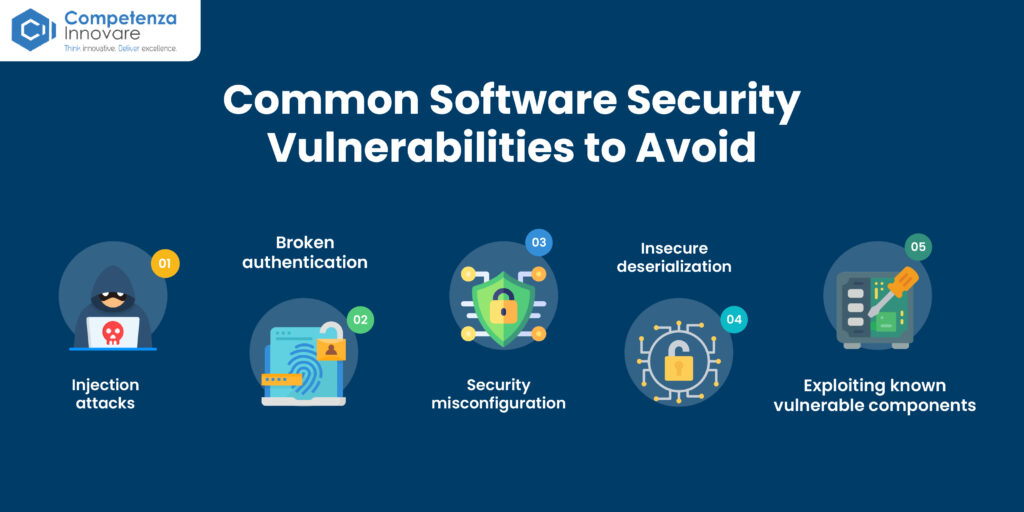
Knowing which vulnerabilities result in the greatest real-world harm assists development teams in focusing their attention on secure software development efforts. The OWASP Top 10 is the most authoritative source of information:
- Injection attacks: SQL, NoSQL, and command injection are still among the most exploited types of vulnerabilities. They are reliably prevented by parameterized queries and stringent input validation.
- Broken authentication: Credential stuffing and account takeover attacks use weak password policies, insecure session tokens, and a lack of multi-factor authentication on a regular basis.
- Security misconfiguration: Open cloud storage buckets (112,000), default credentials, unnecessary services, and security headers are causing a considerable number of real-world breaches.
- Insecure deserialization: It is insecure to deserialize data provided by untrusted parties without verification, as the attackers can execute arbitrary code or modify application logic.
- Exploiting known vulnerable components: Open-source libraries and frameworks that are not patented are one of the primary attack vectors in the attack on the supply chain, and it is a type of threat that has increased significantly over the last three years.
Software Security Checklist for Development Teams
| Security Practice | Implementation Stage | Priority |
| Security requirements defined | Requirements | Critical |
| Threat modeling completed | Design | Critical |
| Secure coding standards documented | Development | Critical |
| SAST integrated in CI pipeline | Development | High |
| Dependency vulnerability scanning (SCA) | Development | High |
| Code review with security focus | Development | High |
| Authentication and access controls tested | Testing | Critical |
| Data encryption verified | Testing | Critical |
| DAST against staging environment | Testing | High |
| Penetration testing completed | Pre-release | High |
| Security headers configured | Deployment | Medium |
| Incident response plan documented | Operations | High |
| Vulnerability disclosure policy published | Operations | Medium |
Build secure, scalable software with Competenza’s expert development and security solutions today.
Software Security for Different Industries
- Financial Services (US, UK, EU): Software dealing with payment information should already be compliant with PCI-DSS, requiring particular secure coding concepts such as reviewing code prior to launch, vulnerability scanning, and penetration testing. The FCA regulating the UK firms requires them to display operational resilience, which includes application security controls. There are other DORA requirements of digital operational resiliency on EU firms.
- Healthcare (US): Applications processing secure health data must follow requirements of the HIPAA Security Rule, which entails ways to secure access, logs, encryption of data, and responding in case of an incident. HITRUST certification is becoming a mandatory pre-procurement policy on the side of health-related technology providers.
- Government and Public Sector: UK government digital services should be based on NCSC secure development guidance and follow Cyber Essentials or Cyber Essentials Plus certification standards. US federal contractors need to comply with NIST SP 800-53 security controls and CMMC requirements of defense-sensitive work.
- SaaS and Consumer Applications: GDPR compliance of applications used by EU users needs to be data protection by design, where privacy and security are part of the application architecture rather than treated as a post hoc addition. The CCPA of California has comparable US consumer application requirements.
Conclusion
Secure software development is not another track from good software development. The activities incorporated in this guide—threat modeling, secure coding, automated security testing, dependency management, strong authentication, encryption, and penetration testing—are disciplines that contribute to making the software better and more secure.
The competenza that designs security into their software development lifecycle early always incur lower costs to remediate, experiences reduced incidents, and risk less on regulatory burden compared to those that view security as a step to undertake until release. This is not a valid excuse to leave security to the last minute in 2026 when a threat actor can be more successful in their actions and the regulatory requirements of that time are tougher than ever. Create secure software at the outset. The other one is always more costly.
Frequently Asked Questions
What do you mean by secure software development?
Secure software development is an approach where quality protection is applied to all software development stages, such as requirement and design, encompassing coding, testing, deployment, and maintenance instead of considering security as the last check before software launch.
What is the most important software security best practice?
Early threat modeling during the design phase will provide the best outcome of any single practice security measure. Architecture decisions made based on identifying attack vectors prior to writing code are cheaper to get right than changing once it is written.
What is DevSecOps, and why is this important?
DevSecOps is the process that systematically captures security tooling and security responsibilities into the CI/CD pipeline—ensuring security validation across all builds and deployments. It moves security to the left-hand side of the development process; it discovers vulnerabilities at an earlier stage when it is cheaper to respond to them.
How many times do we want to do the penetration testing?
Penetration testing should be performed on most applications once a year and prior to significant releases. Applications within regulated sectors, financial services, healthcare and government High-risk applications often need to undergo more frequent testing.
What is a Software Bill of Materials (SBOM)? What is its significance?
Given an application, an SBOM is a list of every third-party component, as well as open-source libraries, used by the application. It allows organizations to locate and react to vulnerabilities that have just been revealed in their dependencies rapidly, and this has become critical due to the rise in the number of supply chain attacks.
Which are the most common vulnerabilities in software?
The most common ones, which are reflected by the OWASP Top 10, are SQL injection, broken authentication, security misconfiguration, and components with known vulnerabilities. These represent a great percentage of real-life breaches, and all would be averted with correct secure coding practices.
Do startups and enterprises differ with regard to software security?
The concepts are identical, with the level of implementation varying. Further complexity should be a last resort before startups adopt the most impactful practices, input verification, dependency scanning, and robust authentication. Organizations should have full-blown DevSecOps pipelines, formal penetration testing initiatives, and documented incident handling policies.
What are the compliance frameworks around software security?
The broadest available software security standards are the OWASP SAMM and NIST SSDF for development practices, the PCI-DSS for payment applications, HIPAA for US healthcare, GDPR for apps serving EU users, and ISO 27001 for overall information security management. Guidelines of NCSC and Cyber Essentials requirements should also be considered by UK organizations.