

Home / Blog / How to Evaluate a Software Development Partner: A Complete Checklist
Evaluate a Software Development Partner

How to Evaluate a Software Development Partner: A Complete Checklist

July 15, 2026 Nishant Agrawal 30 min read

Selecting the appropriate software development partner is among the most significant choices that any business making an investment in tailored software, a SaaS platform, or digital goods would make. The appropriate partner can also speed up the process, enhance product quality, and help in long-term expansion. The bad decision may result in delayed timelines, cost increases, flawed code, and expensive resettlements.This is why you will need to know how to analyze the evaluate software development partner before choosing to work with him. In a partnership, skills in technology are not enough. It is also about the industry knowledge, eloquence, and consistency in getting the job done and being creatively aware of your business objectives.

The process of selecting the software development vendor can be overwhelming given that there are a large number of vendors. Starting with technical skills and project management and ending with post-launch services and pricing, each aspect works towards project success.

This full software development partner checklist will assist you in evaluating the vendor, comparing alternatives, identifying red flags, and selecting one that will fit your business requirements, budget, and long-term objective.

Why Choosing the Right Software Development Partner Matters

The success of your project directly depends on the choice of software development partner. The ideal partner will assist you in creating quality software and budgets and attaining the long-term business objectives. Misaligned partners may result in time loss, budget excesses, and inefficient outcomes.

The Hidden Cost of Choosing the Wrong Vendor

Making a bad selection of a vendor usually costs more than anticipated. The costs that may be hidden may be slow launches, poor code quality, security, and rework that is costly. What appears to be a cheap alternative might be very appealing in the short run, but poor performance will cause greater losses in the future.

Why Software Development Projects Fail

Lack of technical expertise, ineffective communication, inadequate planning, and not having a clear understanding of the requirements poor planning are some of the causes of failure. many software projects. Without adequate analysis, companies play up chances of procrastination and project failures.

Common Vendor Selection Mistakes

When it comes to the software development vendor selection process, cost is the sole consideration of many businesses. The main errors are neglecting the quality of technical evaluation, disregarding the importance of communication, and not reviewing previous jobs or client feedback.

A good comprehension of a software development company will reduce the risks and will ensure that you are able to identify the right company with whom you can achieve success in the long run.

Before You Start: Define Your Project Requirements

Before analyzing any vendor, you require an understanding of your project needs. The most qualified software development partner would not be able to provide the right solution without goals, budget, and technical requirements. Proper planning of the software development procurement process makes it more efficient and improves the process of selecting vendors.

Clarify Business Goals and Success Metrics

First find out what you want to do. Is it a new product you are working on, operations, or scaling of existing software? Established business objectives make the vendors anticipate what you expect and prefer to offer the appropriate method.

Key questions to ask:

  • What problem are you solving?
  • Who are your target users?
  • What does success look like?

Set realistic goals of success, for example, growth of users, and how a solution can impact money, performance, or efficiency.

Define Budget and Timeline

In project set-ups, develop realistic timelines and plans. This assists in screening vendors that fit your size of the project as well as delivery expectations.

Consider:

  • Development costs
  • Infrastructure costs
  • Maintenance costs
  • Expected launch timeline

Having clarity on budget prevents lack of alignment in the future.

Identify Technical Requirements

Identify your technical needs that are considered to be a must-have. Technical compatibility can be more easily evaluated in this way.

Examples include:

  • Preferred tech stack
  • Cloud infrastructure
  • Security requirements
  • Third-party integrations
  • Scalability needs

Here are major software supplier evaluation requirements in technical assessment.

Create a Vendor Evaluation Scorecard

A scorecard aids in comparing vendors in an objective manner as opposed to the decisions made based on the pricing alone.

Evaluate vendors based on:

  • Industry experience
  • Technical expertise
  • Communication
  • Delivery process
  • Pricing transparency
  • Support capabilities

A systematic scorecard simplifies the process of supplier selection, and it minimizes risks of decision-making.

Software Development Partner Evaluation Checklist

When selecting a suitable software development partner, it is not merely about price comparisons. It is the assessment of technical skills, knowledge of domain, delivery process, and communication style as well as long-term reliability. A structured checklist also assists the business to reduce risk, eliminate poor selection of vendors, and deliver successful projects according to business needs.

1. Industry Experience and Domain Expertise

The ideal software development partner must possess experience in your industry or business area. This is important since industry-specific knowledge aids them in coming to terms with the workflow, user expectations, and compliance requirements. Experienced vendors are also able to propose superior solutions using real-life exercise cases, instead of assumptions.

When analyzing the vendors, evaluate their case studies, previous customers, and the complexity of projects that they have worked with. This is a critical aspect of due diligence software vendors and can serve to more accurately align when selecting a custom software vendor.

2. Technical Expertise and Architecture

Technical knowledge is important in developing scalable, secure, and high-performance software systems. A trusted partner possesses the latest technologies, cloud platform, API, database, and system architecture design.

Their approach to scalability, performance optimization, and architecture-level security is also noteworthy. An appropriate assessment of the software development team needs to reinforce the idea that the vendor can support the current needs and future growth beyond technical constraints.

3. Discovery and Planning Process

It requires a clear discovery phase to succeed with the project. Any estimate made by a professional vendor should take the time to learn about your business objectives, user needs, technical specifications, and product vision in the long run.

This process is usually accompanied by a requirement workshop, solution planning, effort estimation, and roadmap definition. Inaccurate scopes and timelines are usually caused by vendors who do not take this step. An effective discovery process directly enhances the factors of success in software development projects and mitigates the project risks to a great extent.

4. Development Methodology

The development methodology is the way that predetermines the efficiency of the project implementation and delivery. Regardless of the vendor adhering to Agile, Scrum, Waterfall, or a combination of any two (or three), the process is to be transparent and organized and is flexible to change.

Quality suppliers have a consistent sprint cycle, tracking of progress, and reporting to ensure that there is ongoing visibility. Based on best practices of software outsourcing, it is guaranteed that there is enhanced collaboration, accelerated delivery, and enhancements in flexibility when developing.

5. QA and Testing

Quality assurance plays a significant role in providing stable and reliable software. An effective QA process will make sure that problems are detected earlier before they enter into the production environments.

An acceptable partner must be guided by a mixture of manual testing, automation testing, performance testing, security testing, and regression testing. This systematic process will minimize bugs, enhance system reliability, and maximize the user experience following deployment.

6. Security and Compliance

Security is an inevitable aspect of software development. Secure coding is among the qualities of a responsible partner that are adhered to, as well as observing the standards of the industry regarding their requirements in the project.

This can be GDPR, HIPAA, PCI DSS, or some other regulatory framework. Not only do strong security practices ensure the protection of sensitive data but also minimize long-term business and legal risks of software products.

7. Communication

Communication is very necessary to establish successful project implementation. A good vendor maintains transparency through regular updates, structured reporting, and a channel of communication.

The paths up the escalation ladder and the rate of solving the problem are also critical to be learned. Effective communication minimizes misunderstandings, enhances cooperation, and makes the project meet business expectations.

8. Development Team

Assessment of the real development team is not an issue of merely scanning the sales presentations. The experience, stability, and availability of developers have a direct influence over how well projects are done and on the reliability of the delivery.

The members of a strong team usually consist of seasoned developers, quality assurance engineers, architects, and DevOps specialists. This is more so in light of long-term projects, including the dedicated development team selection.

9. Portfolio and References

The portfolio of a vendor would give an insight into his or her practical experience and ability to deliver. The way case studies solve problem complexities and facilitate business value is explained through reviewing case studies.

Client references would shed more light on quality of communication and reliability and execution of projects. This measure instills confidence prior to ultimate selection and minimizes risks of vendors.

10. Pricing and Terms

The models of pricing differ in accordance with the type of project, as well as the requirements of flexibility, such as fixed price, time and material pricing model, and dedicated team structure. The correct model will be based on the complexity of the project and the flexibility needed.

The pricing should be transparent; there should be a clear display of the costs, and no hidden charges should be made. Comparisons with a suitable software development company must never be on initial price alone but on long-term value.

11. Contracts and IP

The legal clarity is necessary to safeguard business interests. Every contract is to be signed with a review of the ownership rights, confidentiality terms, and terms of exit.

This entails the full ownership of intellectual property, access to the source code, an NDA, and avoidance of vendor lock-in. These are some of the elements that are of paramount importance in the software development RFP checklist.

12. Post-Launch Support

The process of software development is not done at deployment. It is important to have continuous maintenance since it enhances performance, rectifies failures, and makes some further upgrades.

An assuring partner offers SLA support, periodic updates, bug fixes, and system monitoring. This guarantees stability, security, and further growth of the products in the long term.

Questions to Ask Before Hiring a Software Development Company

The right questions aid you in considering the experience, reliability, and technical strength of a software vendor. The following are the questions to pose to a software development company that enhance the process of decisions throughout the software development vendor selection process and minimize project risks.

Key Questions to Ask: 

Have you done similar projects as ours?

Make sure that they are experienced in your industry or the complexity of similar products. This assists you in knowing what their true technical and domain knowledge is.

What is your estimation of timelines and cost?

Estimation of a good company needs to be done in a systematic manner to depend on requirements, complexity, and scope and not make assumptions.

What do you do when there is a change in scope?

Software projects also change, and thus it is highlighted how they handle change requests without compromising on quality and timelines for delivery.

What happens if deadlines are missed?

Ask them what system they employed in managing the risk, what policy of communication they have, and how they assume the delay when they work on real projects.

What is your post-launch support?

Ascertain their post-launch services, including problem fixes, updates, monitoring, and maintenance, to ensure that they are long-run stable.

Software Development Partner Comparison Matrix

A software development partner comparison matrix is useful when you are comparing two or more software development vendors in a well-organized manner. It is a significant procedure in the software development vendor selection process since it eliminates the element of guesses and aids in making decisions based on facts. Not a proposal or sales discussion alone, a comparison table lets you evaluate such major factors as experience, technical expertise, communication quality, and pricing transparency. This is an advanced method of evaluation of the software development company, and it assists in finding the most trustworthy partner.

CriteriaVendor AVendor BVendor C
ExperienceStrong industry experienceModerate experienceGood general experience
Technical SkillsStrong architecture & scalabilityAverage technical depthGood frontend skills
CommunicationClear and proactive updatesSlow responseAverage communication
PricingTransparent and structuredLow but unclear costsMid-range pricing

A structured comparison can enhance software vendor due diligence by enabling companies to more readily discern the variation among capability, reliability, and cost. This guarantees improved vendor selection and low risk in the project.
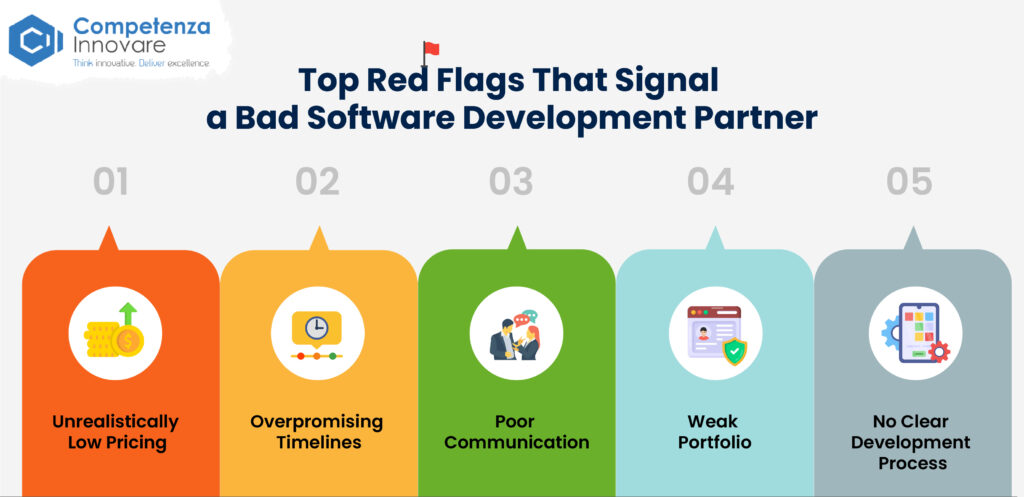
Top Red Flags That Signal a Bad Software Development Partner

Early detection of warning signs can assist you in saving your money on making expensive errors in the vendor selection process of software development. Gaining knowledge on common red flags of software development partners enables businesses to mitigate risk and make more confident vendor choices. The following are some of the largest red flags to look out for when assessing a software development partner.

Unrealistically Low Pricing

When the price appears to be too good, then there is usually some kind of risk associated with it. Very cheap suppliers can cut corners or compromise quality, technical skill, security, or delivery. Although pricing matters, long-term value must be taken into consideration by the business and not the lowest price.

Poor Communication

One of the largest causes of the failures of software projects is poor communication. Lack of transparency, confusion, and delays may be caused by slow reactions, vague updates, and lack of transparency. A trusted software development partner must show good and effective communication during the project.

No Clear Development Process

An established planning and development process and testing as well as a delivery process must be in place with a professional vendor. When a company is unable to demonstrate how they handle the projects, then it is a big red flag. A successful project execution requires powerful processes.

Weak Portfolio

A weak portfolio may be a signal of lack of experience or quality of delivery. When a vendor is unable to demonstrate pertinent case studies, successful projects, or good client references, it will be tough to believe their abilities.

Overpromising Timelines

Be careful of suppliers who take overambitious time cases to deliver without fully comprehending the project requirements. The statement of fast promises can seem enticing, and most often they result in missed time, low quality, and the failure of the projects.

By identifying these software development partner red flags early on, you can make informed choices and select the partner that will provide quality, reliability, and long-term value.

Final Checklist for Selecting the Right Software Development Partner

Before making your final decision, use this checklist to evaluate every important area. A structured software development partner checklist helps reduce risks and improves the software development vendor selection process.

  • Technical expertise
  • Strong portfolio
  • Transparent pricing
  • Security readiness
  • Clear communication
  • Reliable development process
  • Strong client references
  • Post-launch support

Price is not everything when it comes to the choice of the partner in software development. Pay attention to experience, reliability, and long-term value to achieve a successful project and improved business results.

Conclusion

The choice of software development partner is not a vendor choice but a long-term business investment. The correct partner is the one that will make your ideas scalable, secure, and high-performing digital solutions. Through structured assessment, companies will mitigate risks and prevent expensive errors and select a business partner who will generate value. At Competenza, we have a belief that the development of software begins with appropriate strategy, a high level of cooperation, and long-term development.

FAQs

How do you evaluate a software development partner?

To assess a software development partner, the following aspects must be evaluated: technical knowledge, experience in the industry, communication, pricing, security, and delivery. A structured software development partner checklist assists companies in comparing the vendors and their strengths and minimizing risks in the project before deciding on a final choice.

Is it better to have a local or offshore software development partner?

The local and offshore software development partners have their own pros. The local suppliers tend to be more communicative and easier to collaborate with, whereas offshore suppliers are able to be cost-effective and able to access global talent. The correct decision would be based on your project scope, budget, and business priorities.

Why does technical expertise matter in making a choice on a software partner?

Techniques play an important role in designing secure, scaled, and high-performance software. Successful evaluation of software development teams can help ascertain that a vendor has the right skills, architecture expertise, and technology experience to accommodate the long-term development.

How can I reduce risks of outsourcing software development?

Risk reduction can be achieved by following a basic software development partner checklist, case studies, reviewing client references, and and good communication and security practices. Good selection of the vendor reduces delays, budget limitations, and delay risk.

What are the biggest red flags in software development partners?

Red flags on software development partners are poor communication, poor portfolio, poor grasp of the development process, poor timelines, and poor prices, which are lower than they should be. Early detection of such red flags assists businesses to circumvent monetary errors.

Why is post-launch support important in software development?

Provision of support is a significant element in ensuring the performance, security, and reliability of software after development. Regular maintenance (bug fixing, system monitoring, security, and further upgrades to ensure long-tSelecting the appropriate software development partner is among the most significant choices that any business making an investment in tailored software, a SaaS platform, or digital goods would make. The appropriate partner can also speed up the process, enhance product quality, and help in long-term expansion. The bad decision may result in delayed timelines, cost increases, flawed code, and expensive resettlements.

This is why you will need to know how to analyze the software development partner before choosing to work with him. In a partnership, skills in technology are not enough. It is also about the industry knowledge, eloquence, and consistency in getting the job done and being creatively aware of your business objectives.

The process of selecting the software development vendor can be overwhelming given that there are a large number of vendors. Starting with technical skills and project management and ending with post-launch services and pricing, each aspect works towards project success.

This full software development partner checklist will assist you in evaluating the vendor, comparing alternatives, identifying red flags, and selecting one that will fit your business requirements, budget, and long-term objective.

Why Choosing the Right Software Development Partner Matters

The success of your project directly depends on the choice of software development partner. The ideal partner will assist you in creating quality software and budgets and attaining the long-term business objectives. Misaligned partners may result in time loss, budget excesses, and inefficient outcomes.

The Hidden Cost of Choosing the Wrong Vendor

Making a bad selection of a vendor usually costs more than anticipated. The costs that may be hidden may be slow launches, poor code quality, security, and rework that is costly. What appears to be a cheap alternative might be very appealing in the short run, but poor performance will cause greater losses in the future.

Why Software Development Projects Fail

Lack of technical expertise, ineffective communication, inadequate planning, and not having a clear understanding of the requirements poor planning are some of the causes of failure. many software projects. Without adequate analysis, companies play up chances of procrastination and project failures.

Common Vendor Selection Mistakes

When it comes to the software development vendor selection process, cost is the sole consideration of many businesses. The main errors are neglecting the quality of technical evaluation, disregarding the importance of communication, and not reviewing previous jobs or client feedback.

A good comprehension of a software development company will reduce the risks and will ensure that you are able to identify the right company with whom you can achieve success in the long run.

Before You Start: Define Your Project Requirements

Before analyzing any vendor, you require an understanding of your project needs. The most qualified software development partner would not be able to provide the right solution without goals, budget, and technical requirements. Proper planning of the software development procurement process makes it more efficient and improves the process of selecting vendors.

Clarify Business Goals and Success Metrics

First find out what you want to do. Is it a new product you are working on, operations, or scaling of existing software? Established business objectives make the vendors anticipate what you expect and prefer to offer the appropriate method.

Key questions to ask:

  • What problem are you solving?
  • Who are your target users?
  • What does success look like?

Set realistic goals of success, for example, growth of users, and how a solution can impact money, performance, or efficiency.

Define Budget and Timeline

In project set-ups, develop realistic timelines and plans. This assists in screening vendors that fit your size of the project as well as delivery expectations.

Consider:

  • Development costs
  • Infrastructure costs
  • Maintenance costs
  • Expected launch timeline

Having clarity on budget prevents lack of alignment in the future.

Identify Technical Requirements

Identify your technical needs that are considered to be a must-have. Technical compatibility can be more easily evaluated in this way.

Examples include:

  • Preferred tech stack
  • Cloud infrastructure
  • Security requirements
  • Third-party integrations
  • Scalability needs

Here are major software supplier evaluation requirements in technical assessment.

Create a Vendor Evaluation Scorecard

A scorecard aids in comparing vendors in an objective manner as opposed to the decisions made based on the pricing alone.

Evaluate vendors based on:

  • Industry experience
  • Technical expertise
  • Communication
  • Delivery process
  • Pricing transparency
  • Support capabilities

A systematic scorecard simplifies the process of supplier selection, and it minimizes risks of decision-making.

Software Development Partner Evaluation Checklist

When selecting a suitable software development partner, it is not merely about price comparisons. It is the assessment of technical skills, knowledge of domain, delivery process, and communication style as well as long-term reliability. A structured checklist also assists the business to reduce risk, eliminate poor selection of vendors, and deliver successful projects according to business needs.

1. Industry Experience and Domain Expertise

The ideal software development partner must possess experience in your industry or business area. This is important since industry-specific knowledge aids them in coming to terms with the workflow, user expectations, and compliance requirements. Experienced vendors are also able to propose superior solutions using real-life exercise cases, instead of assumptions.

When analyzing the vendors, evaluate their case studies, previous customers, and the complexity of projects that they have worked with. This is a critical aspect of due diligence software vendors and can serve to more accurately align when selecting a custom software vendor.

2. Technical Expertise and Architecture

Technical knowledge is important in developing scalable, secure, and high-performance software systems. A trusted partner possesses the latest technologies, cloud platform, API, database, and system architecture design.

Their approach to scalability, performance optimization, and architecture-level security is also noteworthy. An appropriate assessment of the software development team needs to reinforce the idea that the vendor can support the current needs and future growth beyond technical constraints.

3. Discovery and Planning Process

It requires a clear discovery phase to succeed with the project. Any estimate made by a professional vendor should take the time to learn about your business objectives, user needs, technical specifications, and product vision in the long run.

This process is usually accompanied by a requirement workshop, solution planning, effort estimation, and roadmap definition. Inaccurate scopes and timelines are usually caused by vendors who do not take this step. An effective discovery process directly enhances the factors of success in software development projects and mitigates the project risks to a great extent.

4. Development Methodology

The development methodology is the way that predetermines the efficiency of the project implementation and delivery. Regardless of the vendor adhering to Agile, Scrum, Waterfall, or a combination of any two (or three), the process is to be transparent and organized and is flexible to change.

Quality suppliers have a consistent sprint cycle, tracking of progress, and reporting to ensure that there is ongoing visibility. Based on best practices of software outsourcing, it is guaranteed that there is enhanced collaboration, accelerated delivery, and enhancements in flexibility when developing.

5. QA and Testing

Quality assurance plays a significant role in providing stable and reliable software. An effective QA process will make sure that problems are detected earlier before they enter into the production environments.

An acceptable partner must be guided by a mixture of manual testing, automation testing, performance testing, security testing, and regression testing. This systematic process will minimize bugs, enhance system reliability, and maximize the user experience following deployment.

6. Security and Compliance

Security is an inevitable aspect of software development. Secure coding is among the qualities of a responsible partner that are adhered to, as well as observing the standards of the industry regarding their requirements in the project.

This can be GDPR, HIPAA, PCI DSS, or some other regulatory framework. Not only do strong security practices ensure the protection of sensitive data but also minimize long-term business and legal risks of software products.

7. Communication

Communication is very necessary to establish successful project implementation. A good vendor maintains transparency through regular updates, structured reporting, and a channel of communication.

The paths up the escalation ladder and the rate of solving the problem are also critical to be learned. Effective communication minimizes misunderstandings, enhances cooperation, and makes the project meet business expectations.

8. Development Team

Assessment of the real development team is not an issue of merely scanning the sales presentations. The experience, stability, and availability of developers have a direct influence over how well projects are done and on the reliability of the delivery.

The members of a strong team usually consist of seasoned developers, quality assurance engineers, architects, and DevOps specialists. This is more so in light of long-term projects, including the dedicated development team selection.

9. Portfolio and References

The portfolio of a vendor would give an insight into his or her practical experience and ability to deliver. The way case studies solve problem complexities and facilitate business value is explained through reviewing case studies.

Client references would shed more light on quality of communication and reliability and execution of projects. This measure instills confidence prior to ultimate selection and minimizes risks of vendors.

10. Pricing and Terms

The models of pricing differ in accordance with the type of project, as well as the requirements of flexibility, such as fixed price, time and material pricing model, and dedicated team structure. The correct model will be based on the complexity of the project and the flexibility needed.

The pricing should be transparent; there should be a clear display of the costs, and no hidden charges should be made. Comparisons with a suitable software development company must never be on initial price alone but on long-term value.

11. Contracts and IP

The legal clarity is necessary to safeguard business interests. Every contract is to be signed with a review of the ownership rights, confidentiality terms, and terms of exit.

This entails the full ownership of intellectual property, access to the source code, an NDA, and avoidance of vendor lock-in. These are some of the elements that are of paramount importance in the software development RFP checklist.

12. Post-Launch Support

The process of software development is not done at deployment. It is important to have continuous maintenance since it enhances performance, rectifies failures, and makes some further upgrades.

An assuring partner offers SLA support, periodic updates, bug fixes, and system monitoring. This guarantees stability, security, and further growth of the products in the long term.

Questions to Ask Before Hiring a Software Development Company

The right questions aid you in considering the experience, reliability, and technical strength of a software vendor. The following are the questions to pose to a software development company that enhance the process of decisions throughout the software development vendor selection process and minimize project risks.

Key Questions to Ask: 

Have you done similar projects as ours?

Make sure that they are experienced in your industry or the complexity of similar products. This assists you in knowing what their true technical and domain knowledge is.

What is your estimation of timelines and cost?

Estimation of a good company needs to be done in a systematic manner to depend on requirements, complexity, and scope and not make assumptions.

What do you do when there is a change in scope?

Software projects also change, and thus it is highlighted how they handle change requests without compromising on quality and timelines for delivery.

What happens if deadlines are missed?

Ask them what system they employed in managing the risk, what policy of communication they have, and how they assume the delay when they work on real projects.

What is your post-launch support?

Ascertain their post-launch services, including problem fixes, updates, monitoring, and maintenance, to ensure that they are long-run stable.

Software Development Partner Comparison Matrix

A software development partner comparison matrix is useful when you are comparing two or more software development vendors in a well-organized manner. It is a significant procedure in the software development vendor selection process since it eliminates the element of guesses and aids in making decisions based on facts. Not a proposal or sales discussion alone, a comparison table lets you evaluate such major factors as experience, technical expertise, communication quality, and pricing transparency. This is an advanced method of evaluation of the software development company, and it assists in finding the most trustworthy partner.

CriteriaVendor AVendor BVendor C
ExperienceStrong industry experienceModerate experienceGood general experience
Technical SkillsStrong architecture & scalabilityAverage technical depthGood frontend skills
CommunicationClear and proactive updatesSlow responseAverage communication
PricingTransparent and structuredLow but unclear costsMid-range pricing

A structured comparison can enhance software vendor due diligence by enabling companies to more readily discern the variation among capability, reliability, and cost. This guarantees improved vendor selection and low risk in the project.

Top Red Flags That Signal a Bad Software Development Partner

Early detection of warning signs can assist you in saving your money on making expensive errors in the vendor selection process of software development. Gaining knowledge on common red flags of software development partners enables businesses to mitigate risk and make more confident vendor choices. The following are some of the largest red flags to look out for when assessing a software development partner.

Unrealistically Low Pricing

When the price appears to be too good, then there is usually some kind of risk associated with it. Very cheap suppliers can cut corners or compromise quality, technical skill, security, or delivery. Although pricing matters, long-term value must be taken into consideration by the business and not the lowest price.

Poor Communication

One of the largest causes of the failures of software projects is poor communication. Lack of transparency, confusion, and delays may be caused by slow reactions, vague updates, and lack of transparency. A trusted software development partner must show good and effective communication during the project.

No Clear Development Process

An established planning and development process and testing as well as a delivery process must be in place with a professional vendor. When a company is unable to demonstrate how they handle the projects, then it is a big red flag. A successful project execution requires powerful processes.

Weak Portfolio

A weak portfolio may be a signal of lack of experience or quality of delivery. When a vendor is unable to demonstrate pertinent case studies, successful projects, or good client references, it will be tough to believe their abilities.

Overpromising Timelines

Be careful of suppliers who take overambitious time cases to deliver without fully comprehending the project requirements. The statement of fast promises can seem enticing, and most often they result in missed time, low quality, and the failure of the projects.

By identifying these software development partner red flags early on, you can make informed choices and select the partner that will provide quality, reliability, and long-term value.

Final Checklist for Selecting the Right Software Development Partner

Before making your final decision, use this checklist to evaluate every important area. A structured software development partner checklist helps reduce risks and improves the software development vendor selection process.

  • Technical expertise
  • Strong portfolio
  • Transparent pricing
  • Security readiness
  • Clear communication
  • Reliable development process
  • Strong client references
  • Post-launch support

Price is not everything when it comes to the choice of the partner in software development. Pay attention to experience, reliability, and long-term value to achieve a successful project and improved business results.

Conclusion

The choice of software development partner is not a vendor choice but a long-term business investment. The correct partner is the one that will make your ideas scalable, secure, and high-performing digital solutions. Through structured assessment, companies will mitigate risks and prevent expensive errors and select a business partner who will generate value. At Competenza, we have a belief that the development of software begins with appropriate strategy, a high level of cooperation, and long-term development.

FAQs

How do you evaluate a software development partner?

To assess a software development partner, the following aspects must be evaluated: technical knowledge, experience in the industry, communication, pricing, security, and delivery. A structured software development partner checklist assists companies in comparing the vendors and their strengths and minimizing risks in the project before deciding on a final choice.

Is it better to have a local or offshore software development partner?

The local and offshore software development partners have their own pros. The local suppliers tend to be more communicative and easier to collaborate with, whereas offshore suppliers are able to be cost-effective and able to access global talent. The correct decision would be based on your project scope, budget, and business priorities.

Why does technical expertise matter in making a choice on a software partner?

Techniques play an important role in designing secure, scaled, and high-performance software. Successful evaluation of software development teams can help ascertain that a vendor has the right skills, architecture expertise, and technology experience to accommodate the long-term development.

How can I reduce risks of outsourcing software development?

Risk reduction can be achieved by following a basic software development partner checklist, case studies, reviewing client references, and and good communication and security practices. Good selection of the vendor reduces delays, budget limitations, and delay risk.

What are the biggest red flags in software development partners?

Red flags on software development partners are poor communication, poor portfolio, poor grasp of the development process, poor timelines, and poor prices, which are lower than they should be. Early detection of such red flags assists businesses to circumvent monetary errors.

Why is post-launch support important in software development?

Provision of support is a significant element in ensuring the performance, security, and reliability of software after development. Regular maintenance (bug fixing, system monitoring, security, and further upgrades to ensure long-term success of the business) is all sound support.erm success of the business) is all sound support.

Nishant Agrawal
Author