

Automation is currently an essential aspect of contemporary business practices, where it assists a company to enhance productivity, minimize manual efforts, and facilitate procedural complexities. Over the years, Robotic Process Automation (RPA) has been used to assist businesses to automate repetitive tasks that are based on rules, including data entry, invoice processing and reporting. Nevertheless, with firms evolving to more intelligent automation, there is a new methodology referred to as “agentic AI,” which is redefining how automation is done.
The increasing debate on whether to have agentic AI or RPA is not necessarily one where one technology embodies the other one. It has to do with the knowledge of how conventional automation systems and AI-based systems can resolve various business problems. Whereas RPA presupposes using the existing guidelines to perform a specific task, the more advanced AI functions help agentic AI make decisions, comprehend missions, adapt to changing events, and finish a complex process.
With the development of automation of enterprises and AI-based automation, now companies begin to think about how AI agents can help them become more productive, make better decisions, and work more effectively. Compared to traditional RPA bots, independent AI systems can analyze data, interact with different applications, and perform multi-step activities with the minimum human operator help.
This is a guide aimed at elaborating on the fundamental differences between agentic AI development and robotic process automation, their pros and cons, business use, and how companies can choose the right method for automation in 2026.
What Is RPA (Robotic Process Automation)?
Robotic Process Automation (RPA) is a software-driven system situated on robotized bots that execute monotonous rule-following tasks that are usually performed by employees. These robots are applied to perform specially established programs, which may involve input of data, scanning of invoices, report preparation, and updating data among other business platforms. RPA helps companies to become more accurate, reduce manual handling, and facilitate operations with the help of the automation of frequent operations.
Traditional RPA is an important element of process automation in business and enterprise automation, as it is applicable to structured and predictable processes. RPA, in contrast, will not act independently to obtain context and make decisions of greater complexity or build in changing circumstances as AI-based systems did. It is based on pre-established rules, which is the reason why it is very effective when dealing with repetitive tasks and less efficient with dynamic workflows that need to be able to reason or to make decisions.
What Is Agentic AI?
Future technology, where AI systems can understand goals, manipulate data, make decisions and perform tasks with greater autonomy are called “agentic AI.” Unlike traditional automation, which follows a preset set of rules, Agentic AI can think, adjust to new situations, and make several moves to achieve an attractive objective.
In the context of the present intelligent automation, agentic AI is self-guiding as a virtual agent and has the ability to plan and act as well as optimize working processes with minimum human involvement. It can work with numerous tools and unstructured data and can be engaged in more complex jobs, such as customer support, business operations, research projects, and decision-making processes. This qualifies Agentic AI as a valuable component of AI-powered automation and the future of enterprise automation, in which companies require more adaptive and flexible solutions.
Agentic AI vs RPA: Key Differences Explained
The distinction between Agentic AI and RPA is reduced to the methods of automation of the technologies. Whereas traditional RPA is aimed at automating repetition instead of accompanying tasks in accordance with the set parameters, agentic AI tends to pursue the objectives by assessing the scenarios, making decisions, and modifying workflows. Both technologies are used to favor intelligent automation, but each one is developed to suit the complexities.
RPA is effective when the entire process is well defined and predictable with all the steps known. Conversely, the agentic AI suits dynamic situations in which work entails argument, versatility, and engagement with various systems. Knowing such variations helps companies decide on the appropriate strategy on enterprise automation.
| Factor | RPA (Robotic Process Automation) | Agentic AI |
| Automation Type | Rule-based automation that follows predefined instructions | Goal-based automation that works toward achieving specific outcomes |
| Decision Making | Limited decision-making based on fixed rules | Advanced decision-making using AI reasoning and context understanding |
| Learning Ability | Does not learn or improve independently | Can improve performance through AI models and feedback |
| Data Handling | Mainly works with structured data like forms and spreadsheets | Handles structured and unstructured data such as text, documents, and conversations |
| Workflow Type | Best for fixed and repetitive processes | Suitable for dynamic and complex workflows |
| Adaptability | Low adaptability when processes change | High adaptability to changing situations and requirements |
| Human Intervention | Requires more human involvement for exceptions and changes | Reduces human involvement by handling multi-step tasks autonomously |
| Technology Approach | Uses software bots to execute tasks | Uses AI agents that can reason, plan, and perform actions |
Whereas RPA is still useful in automating common business processes, Agentic AI introduces automation to a broader scope by providing intelligence and independence. The evolution of most organizations is turning towards a blend of both techniques, where RPA robots are in charge of repetitive tasks and AI interface agents are in charge of complex decision-based processes.
Also Read: Agentic AI in Logistics
Agentic AI vs Traditional RPA: How Their Approach Differs
The primary consideration in agentic AI vs. traditional RPA is how they approach automation. Conventional RPA is constructed to do predefined tasks based on fixed rules, whereas agentic AI is created to reason about goals, analyze situations and act according to the altering circumstances. This causes Agentic AI to be a more permissive solution to the businesses that may need to go beyond the benefits of task automation to cleverer AI workflow automation.
Conventional RPA consists of a well-defined workflow wherein all operations have been pre-programmed. As an illustration, an RPA bot can read data in a document and input it in a system; however, it will not make decisions in case of an attack of unexpected information. By comparison, the agentic AI is able to analyze various inputs, comprehend context, and decide as well as manage more intricate processes with reduced human effort.
The distinction can be interpreted in terms of their automation strategy:
Traditional RPA workflow:
Input → Predefined Rules → Task Execution → Output
Simple repetitive tasks, such as data entry, invoice processing and report generation that require repetitive processes, can be applied to RPA.
Agentic AI workflow:
Goal → Analyze → Plan → Execute → Improve
The agentic AI depends on AI reasoning and autonomous abilities to accomplish multistage work. It can process both structured and unstructured data, other tools communicate with it, and its activity can be adjusted in accordance with the emergent data.
This transformation is the transformation of old automation to intelligent automation and enterprise AI automation, where businesses need to have systems that will not only be able to perform tasks but also assist in decision-making and evolve with the demands of the business. In lieu of fully substituting RPA, Agentic AI is used in conjunction with current automation tools to develop new higher-order and scalable automation of business processes.
AI Automation vs RPA: Understanding the Difference
The AI automation vs. RPA difference has to do with the way in which the two technologies address tasks, data and decision-making. Unlike RPA, which seeks to automate the routine operations with the use of a list of rules and guidelines, AI automation permits the creation of intelligent workflows as it provides an element of intelligence, learning, and flexibility.
Key Differences:
- Automation Style: RPA is rule-based automation, in which bots will respond to an existing set of rules. The AI automation is implemented by utilizing smart systems that are capable of processing situations and making decisions based on the situation.
- Decision-Making Capability: RPA does not possess much decision-making power and is suitable to predictable processes. In more complicated decisions, AI automation will be able to assess information, find patterns and assist.
- Data Handling: RPA uses structured data mostly, including spreadsheets, forms, and databases. The AIs can process both structured and unstructured information, including documents, text, and conversation, which can be fully automated.
- Flexibility Workflows: RPA will be planned to work on predefined and repeated tasks. AI automation can cope with dynamic workflows that may vary based on new information and have new processes.
- Flexibility: Standard RPA will have to be set to business regulations. Continuous learning and AI models can be utilized to improve and develop AI automation.
- Costs: The most common functions that RPA is popular in data entries, bill payments and report creation. The human-friendly applications of AI automation will enhance the sophisticated use cases like customer service automation, predictive analysis, and intelligent workflow management.
- Role in Modern Automation: RPA continues to play a significant role in business process automation, with AI automation assisting the business progress to intelligent automation, hyperautomation and beyond to more complex enterprise automation solutions.
Business Use Cases of RPA and Agentic AI
RPA and Agentic AI are significant to the workflows in modern business process automation, and they are applied to different workflows. RPA is primarily applied to repetitive, rule-oriented tasks, whereas agentic AI is oriented towards intelligent decision-making and handling of complex processes. The intelligent automation and enterprise AI automation are growing together with their support.
Business Use Cases of RPA
Robotic Process Automation (RPA) is increasingly used to assist businesses in automating repetitive tasks and enhancing accuracy and effectiveness as well as decreasing the workload on humans. It is most effective in structured processes that lay down well-defined rules.
- Finance: Invoice payment, payment reconciliation, and financial reporting Finance RPA is typical to automate data entry, validation and repetitive financial tasks.
- HR: RPA is applied by organizations in the employee onboarding process, payroll automation, and resume screening workflows to streamline administration and create a more efficient and effective process.
- Operations: RPA helps with the extraction of data, reporting of data compliance, and updating records of customers by transferring data between systems and keeping specific records true to date.
Business Use Cases of Agentic AI
In agentic AI, automation goes beyond merely performing simple tasks and allows AI agents to reason about goals, make decisions and dynamic workflows. Such agentic AI applications are taking significance among other businesses implementing advanced automation strategies.
- Customer Service: AI agents are able to comprehend customer requests, offer solutions, retrieve necessary information and escalate any problematic cases that eventually require support by human agents.
- Supply Chain: Agentic AI is able to analyze information, forecast disruption, optimize the inventory, and advise behavior based on the evolving business conditions.
- Enterprise Operations: AI agents can process workflows, assist in approvals, and coordinate cross-system operations by interacting with various business tools and applications.
RPA can be used to automate the more predictable tasks, while agentic AI can be used to provide the more adaptable and intelligent workflows. Most organizations are integrating the two technologies in order to generate extensible automation in the enterprise.
Benefits of Agentic AI Automation
The agentic AI automation concept is revolutionizing the manner in which business entities adopt modern automation as it enables systems to address intricate workflows, make intelligent decisions, and satisfy changing needs. Unlike other traditional automation tools, which follow a set of rules, agentic AI may support autonomous workflow automation by identifying goals, data interpretation, and task accomplishment, which involves minimum human intervention and multi-step accomplishment.
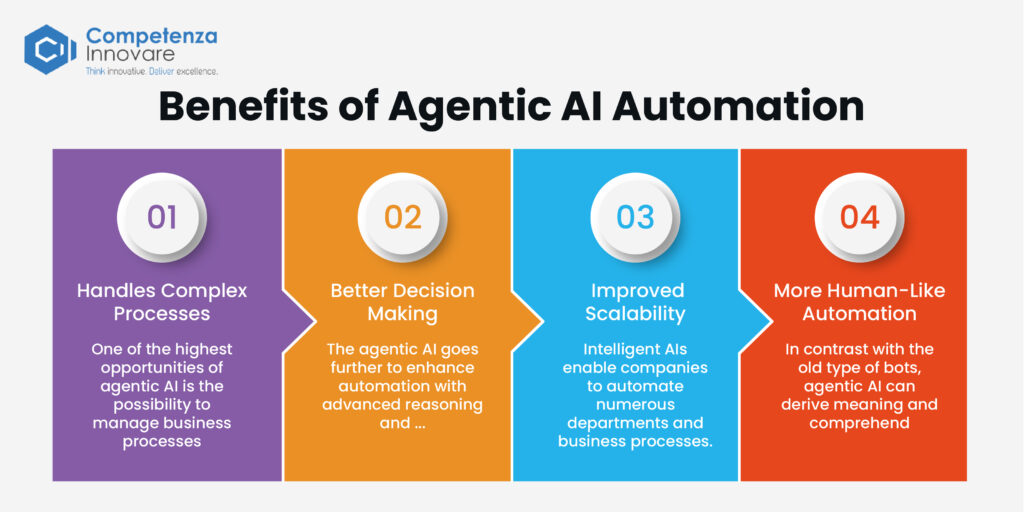
1. Handles Complex Processes
One of the highest opportunities of agentic AI is the possibility to manage business processes that have multiple steps, systems and decisions. The AI agents are able to examine tasks, develop action plans, communicate with various tools, and accomplish workflows that are hard to automate using conventional RPA.
As an illustration, an AI agent is able to review the information, detect problems, make communications with various systems, and carry out an entire process to its conclusion.
2. Better Decision Making
The agentic AI goes further to enhance automation with advanced reasoning and decision-making introduced. Compared to just working with the set of rules, AI agents are able to understand data and the situation, turn them into patterns, and suggest the most suitable action.
This improves the performance of automation of AI processes by businesses where faster decision-making, extra insights, and dynamism are needed in the processes.
3. Improved Scalability
Intelligent AIs enable companies to automate numerous departments and business processes. Some of the areas Amazon AI agents can assist include customer service, operations, finance, and supply chain management of various workflows according to business requirements.
This assists businesses in creating a customizable automation of processes, which can expand when the processes are complicated.
4. More Human-Like Automation
In contrast with the old type of bots, agentic AI can derive meaning and comprehend the context, as well as react more rationally in new circumstances using natural language. This facilitates more natural human-robot interactions.
Incorporating reasoning, learning and adaptability allows the businesses to move towards more intelligent automation and more advanced enterprise automation.
Also Read: Agentic AI in Ecommerce
Benefits of RPA for Businesses
Robotic Process Automation (RPA) is still a potentially significant technology in the business sphere that aims to enhance their efficiency and automate their workflows. RPA also assists companies in automating their workflows, minimizing human work, and enhancing accuracy in various units through enterprise automation and intelligent process automation. It is particularly useful in processes that are rule-based, predictable and structured.
1. Faster Task Execution
Manual processing cannot be compared to RPA bots in terms of speed to complete repetitive tasks. They are able to work around the clock without breaks and assist businesses in doing the bulk of work like keying data, processing invoices, producing reports and updating records within shorter periods of time.
It enables the employees to work on the higher-value activity, and automation takes care of the routine working activities.
2. Reduced Human Errors
Mistakes are usually done in the process of manual work, particularly when dealing with a large amount of data. RPA enhances accuracy since it involves adherence to rules and consistency in the execution of tasks.
To businesses, this is used to ensure that one has better quality data, enhanced compliance, and minimal errors in critical workflows.
3. Cost Reduction
RPA also makes the processes of manual, repetitive work much less necessary with the use of automation and minimized operational costs. Automation is a cost-effective strategy that allows businesses to attain productivity without the extra workload.
RPA also enables businesses to optimize their resources by enabling employees to invest more of their time on strategic and creative activities.
4. Easy Implementation
The main strength of RPA lies in the fact that it can be deployed without significant alterations to the systems. RPA bots will be compatible with existing apps, and they will operate according to existing workflows, which will be less challenging to adopt by businesses.
It is most applicable in stable processes that have definite rules and thus is a viable backbone to an intelligent automation strategy adopted by the organizations developing a larger strategy.
Although RPA is very effective with repetitive tasks, companies are also integrating the robot with AI technologies to design more advanced automation solutions that can assist not only with efficiency but also with more intelligent decision-making.
Limitations of Traditional RPA and Agentic AI
Although both RPA and agentic AI possess strong automating instruments, there are some limitations. Learning about these issues will assist companies in determining the correct path to take in developing their automation strategy based on AI and transitioning to the types of intelligent systems that go beyond the traditional approaches to automation.
Limitations of Traditional RPA
Analogs of traditional RPA are quite efficient in terms of regular and systematized workflows; however, there are restrictions in comparison to current AI-driven automation. When flexibility, reasoning or navigation is needed in a process, the distinction between rule-based automation and AI is evident.
- Needs Predefined Rules: RPA bots will follow predetermined rules and predefined workflows. They will only be able to do what they are programmed to do, and therefore, there will be a need to have any change in the process done manually.
- Failure to cope with unplanned circumstances: RPA excels with a set of repeat activities and cannot deal with novel situations, ambiguous traces of data, or scenarios demanding human judgment.
- Limited Decision-Making: RPA can make decisions but lacks context and makes complicated choices. It follows the rule, devoid of the capacity to process information and make the most suitable decision.
- Breaks When Processes Change: When system, workflow or data profiles change, RPA bots may require adaptation to get them to continue functioning properly.
Limitations of Agentic AI
Although the features of automation provided by Agentic AI are more advanced, there are several challenges, which businesses ought to consider before implementing it. The approach of strong AI automation needs to be planned, governed and managed.
- Implementation Complexity: Deploying Agentic AI may be more complex than traditional automation due to running AI models, integrations, workflows, and continuous optimization.
- Data Quality Requirements: Agentic AI is developed to operate with precise and real information. Poor or incomplete information can have an effect on the AI decisions and performance.
- Security Issues: Since AI agents will be allowed to access systems and sensitive information, the companies must ensure they have proper security systems to protect the data and prevent unethical activities.
- Governance issues: The rules of governance should clearly state how to regulate the conduct of AI and risk control as well as responsible use of autonomous systems.
- Human control is required: even a good reasoning agentic AI requires humans to oversee crucial decisions, compliance and business control.
The technologies each have various strengths and challenges. RPA can still be applied in workflows that are stable and are based on rules, whereas agentic AI can be applied in the more flexible and intelligent workflows. The appropriate route should be chosen depending on the complexity of the business processes and the aim of automation.
Should You Use RPA or Agentic AI?
The decision to use RPA or Agentic AI depends on the kind of process that your firm wants to automate. The question of whether to employ RPA or agentic AI is without a single answer because of a range of automation problems that the technologies deal with. Some of the tasks RPA fits best are those that can be predicted or have rules governing them, but those that fill agentic AI involve complex workflow and require reasoning, flexibility, and decision-making.
Choose RPA When:
RPA is the right choice when your process is terribly thudding, right and possesses a simple guideline. It is best used with such jobs where all the steps are known and data to work with is laid out.
You should consider RPA when:
- The approach is repetitive: the tasks are repeated frequently, and they are carried out in the same manner.
- Regulations are in place: The business process is controlled with specific business rules and does not require more complex decisions.
- Data is formatted: Data is structured: This generally means tabulated data or data in the form of spreadsheets, forms, databases or system documentation.
- The working process is rather stable: The processes remain consistent and do not require numerous adaptations.
Can Agentic AI Replace RPA?
The agentic AI is not fully substituting RPA; rather, it is extending the power of automation. RPA can be applied to routine, rule-based jobs, whereas agentic AI is intended to handle complex workflows based on reasoning, flexibility, and decision-making.
It is likely that in the future the automation will be used as a tandem of the two, rather than separately. RPA is capable of dealing with routine procedures and structured tasks, and agentic AI can deal with dynamic processes, process information, and make intelligent choices. A mix of both enables businesses to develop more intelligent automation and enterprise automation.
Discover the right automation strategy for your business with Competenza’s AI and RPA solutions.
Future of RPA and Agentic AI in 2026 and Beyond
This will have a combination of RPA and agentic AI in the future of automation. As RPA will remain to robotize repetitive and rule-based tasks, agentic AI shall assist businesses to deal with complex workflows and need to make decisions, be flexible and make arguments.
Organizations will transition to intelligent automation and hyperautomation in 2026 and later, with RPA bots extending and collaborating with the artificial intelligence (AI) agents in markets to enhance business efficiencies, decrease manual processes, and develop smarter business processes. RPA is not going to be fully replaced by agentic AI but will be extended to new application areas due to increased automation.
Conclusion
The Agentic AI vs RPA comparison demonstrates that both technologies will play a significant role in the future of automation. Although traditional RPA has demonstrated its superiority in repetitive and rule-based work, agentic AI extends the limits of the repetitive and rule-based to include reasoning and adaptable and autonomous decision-making in more complex work processes.
Businesses are not obligated to choose one of the technologies in place of the other. The appropriate answer will be based on their automation requirements, the intricacy of processes, and their future objectives. RPA can take over the structured work, such as the processing of data and their reporting, whereas the agentic AI can assist in smarter business process automation, intelligent workflows, and enterprise decision-making.
The convergence of RPA with agentic AI automation will facilitate the creation of more scalable and flexible automation plans due to the fact that organizations become intelligent automation and find employment in enterprise AI automation. In 2026 and beyond, The Competenza assists businesses to learn the emerging technologies and select the appropriate approach to automation that enables them to enhance their efficiency, innovation, and digital transformation.
Frequently Asked Questions (FAQs)
What is the difference between RPA and Agentic AI?
Traditional RPA (Robotic Process Automation) implies fixed rules to roboticize routine tasks, and agentic AI has the potential to understand goals, handle data, and make and change decisions based on changing career trends. RPA is oriented towards task execution, in which case further smart and more self-driven automation is encouraged by the agentic AI.
Will RPA be replaced by Agentic AI?
No, Agentic AI does not completely replace RPA. Organized operations like data entry, invoicing, and reporting are also good applications of RPA. The agentic AI expands the automation systems down to complex processes, unstructured data, and decision-making.
Should the businesses adopt RPA or agentic AI?
It is a decision that is based on the process requirements. Repetitive and rule-based workflows are the choices that businesses should turn to RPA to follow because they are routine and need to be performed by artificial intelligence instead of by humans.
What are the key business applications of RPA?
Finance operations such as processing invoices and payment reconciliation; human resources such as employee recruitment and payroll automation; and operations such as data extraction, reporting and customer data promotion are examples of areas where RPA is used.
What are the key enterprise applications of Agentic AI?
The agentic AI is applied in high-automation cases like automation of customer service, supply chain optimization, enterprise workflows, business analysis, and processes needing AI-based decision-making.
How is Agentic AI different from AI automation and RPA?
RPA is rule-based, and AI automation brings intelligence and flexibility. The idea of agentic AI extends to allow AI agents to perceive goals, design courses of action, and execute multi-step processes with less human intervention.
What is the advantage of combining RPA and Agentic AI?
A blend of the two technologies assists companies to develop more brilliant automation. RPA effectively trains repetitions, whereas agentic AI treats multidimensional workflows, choices and dynamic business processes.
What are the disadvantages of traditional RPA?
Traditional RPA is based on set rules, limited in its ability to make decisions, and may not be effective when processes change or the data format alters. It is suitable in a stable working environment but not suitable in dynamic business environments.
What are the problems businesses should remember before implementing agentic AI?
Implementation complexity, data quality, security, governance and human oversight considerations should also be taken into consideration by businesses. A clear AI automation strategy is important for successful Agentic AI adoption.
Which is the future of RPA and Agentic AI?
The next phase of automation development will be a combination of RPA and agentic AI to achieve smarter enterprise automation systems. Similar to the state of RPA, the workflow barriers, rationale, and self-service will continue to experience innovation by the agentic AI.