

The logistics business has been a game of margins. The winning companies are the ones that can transport goods at a faster rate, reliably, and at a cheaper rate compared to their counterparts on scale, in any environment that hardly ever works together. The role of agentic AI in the logistics industry is fundamentally reshaping the manner in which that game is being played, and operations, which once were reactive with rules and regulations being dictated to companies, are now being played by autonomous systems that plan, act, and self-correct on the fly.
The tools at the disposal of logistics operators in the decades were essentially reactive. The systems made a record of what had occurred. What went wrong was pointed out by analysts. Decisions were influenced by reports, which were already more than hours or days old when they landed on earth by managers. The agentic AI of logistics is playing that role by not providing humans with improved reports to read but using autonomous agents that observe, make decisions, and take action throughout all the functions of operations without having to wait to be told what to do by the humans.
This blog discusses the use cases of agentic AI in logistics and what agentic AI in logistics means in practice: twelve uses of agentic AI in logistics that are already producing measurable outcomes, the implementation roadmap, and future directions of the technology in three to five years.
What Is Agentic AI in Logistics?
Agentic AI in logistics, also known as autonomous AI in logistics, is defined as AI systems pursuing specified goals on their own—planning what should be done to reach a goal, taking on those actions, observing the results, and modifying themselves depending on the result of the observation. In contrast to traditional AIs that have been developed to react to a query or provide suggestions to a human to carry out, agentic AIs are actors.
Logistically, it translates into AI in logistics, which does not merely signal a tardy shipment—the vehicle is rerouted, the customer is notified, the warehouse schedule is resorted to, and the delivery window is corrected automatically. The difference between a system that tells decisions and the system that determines and implements decisions is known as the difference.
The agentic AI-powered logistics based on agentic architecture are deployed continuously across each node of the supply chain at once at an unprecedented speed and scale that cannot be matched by human-managed operations.
How Agentic AI Differs from Traditional Logistics Automation
Conventional logistics automation is rule-based and event-driven. A GPS system uses directions in a turn-by-turn manner. Low stock is indicated by a warehouse management system. A TMS produces a delivery plan based on a set of parameters. These systems are useful but are essentially inert—they perform what they have been written to and no more. They malfunction or need human help when the condition they are programmed to cope with varies.
Smart logistics automation based on agentic AI operates in a different way. Instead of adhering to some rules, agentic systems make decisions based on goals. Since the objectives include reducing delivery cost and retaining a 98% on-time rate, an agentic logistics system will decide the best carrier, route, schedule, and contingency plan—and update each of them constantly as the real world changes. It does not require a human to notice that a change of the initial plan is invalidated and command a change by the traffic event. Logistics agentic AI development recognizes the scenario, analyzes it, and takes action.
Why Logistics Companies Are Investing in Agentic AI
The business need is simply that. The cost of fuel, the cost of labor, and the expectations of the customers are also increasing. Carrier traffic is unpredictable. Dysfunction in or disruptions in supply chains due to geopolitical happenings, extreme weather, or congestion at ports are more common and uncommon than they were ten years ago.
Rule-based systems or manually operated processes do not cope with such complexity as well as AI-driven logistics operations. Already launched logistics agentic AI applications are providing quantifiable savings on transportation costs, fuel usage, and warehouse labor hours—in addition to delivering customer satisfaction and reliability in delivery that are directly translated into retention and revenue.
The enterprises that are making investments in logistics digital transformation using agentic AI today are not acting like a gambling dice roll. They are already reactive to operational forces that are already actual and competitive threats of early adopters who are already accelerating more and working at a cheaper rate. Best Agentic AI Uses in Logistics:
1. Intelligent Route Optimisation with Agentic AI
One of the most impactful and quickest-to-implement applications of agentic AI in logistics is agentic optimization of routes—it provides a tangible reduction in fuel costs and also an improvement in on-time delivery within the initial weeks of operation.
Real-Time Route Planning
The agentic route optimization agents do not generate the plan at the beginning of the day and command the drivers to implement it. They track all vehicles in the delivery cycle in real time. Check traffic conditions, road blockages, vehicle loads, time windows, and fuel levels and adjust the routes as the conditions change. A traffic accident would have resulted in a late delivery time with a traditional plan but will be detected and redirected prior to the driver hitting the impacted road.
Traffic and Weather-Based Decision Making
To predict disruptions before they can impact delivery performance, AI route optimization agents utilize live traffic feeds, weather data, and historical pattern data. When a weather front is crossing an area of the delivery region, it is taken into consideration in the routing decision hours ahead—not after vehicles are already stranded in it.
Fuel Cost Optimisation
The agentic systems have not only time optimization but also fuel efficiency—an agentic system considers road gradient, vehicle weight, speed profile, and idling time to optimize fuel consumption throughout a fleet. In large fleet operations, which are run to tight margins, the benefit of this kind of optimization of fuel consumption is a commercially important factor.
2. Agentic AI for Fleet Management
AI fleet management is more than a monitoring of the vehicles. The agentic types of fleet management systems are actively optimizing how all the vehicles within the fleet are used. serviced, and utilized—minimizing cost and maximizing asset utilization without turning up management overhead.
Vehicle Utilisation Optimisation
The agentic AI considers the load capacity, route density, and delivery time windows on the entire fleet—delivering vehicles and drivers with the aim of maximizing productive delivery and minimizing deadhead mileages. The non-utilized vehicles and non-optimal combinations of drivers and routes are also pointed out and automatically rectified.
Predictive Maintenance Scheduling
The agentic AI can be used to perform predictive logistics analytics based on vehicle telematics data to predict impending mechanical breakdowns well before they occur. Optimization of maintenance against any operational calendar to minimize disruption and sudden downtime would be of a significantly higher cost than emergency repairs.
Driver Performance Monitoring
The agentic fleet management agents observe driver behavior, harsh braking, excessive idling, speeding, suboptimal route compliance, and feedback, which enhances safety and fuel economy. Performance data is acted upon in real-time as opposed to weekly reviewing of aggregated reports.
3. Warehouse Management with Agentic AI
The complexity of the operations of contemporary fulfillment conditions in terms of SKU counts, volumes of orders, and service levels all growing simultaneously is addressed by agentic AI warehouse management.
Inventory Allocation
The location of inventory in the warehouse, which agentic AI makes, is determined by the order speed, item size, picking rate, and efficiency of the fulfillment route—it continues to optimize the location of inventory as the demand trend varies and not by a predetermined slotting strategy.
Picking and Packing Optimisation
Intelligent warehouse automation agents plan pick paths to reduce travel time in the warehouse, bundle orders to optimize pick movement, and globally plan robotic and human pickers. The outcome is an increased throughput at the same or reduced labor hours.
Warehouse Resource Coordination
The agentic systems arrange resources in the warehouse (staff, equipment, dock assignments, inbound deliveries) to sustain throughput at peak times without causing bottlenecks. In case of a surge in inbound volume or outbound demand, resources get automatically rearranged instead of one having to wait until a supervisor reassigns them.
4. Demand Forecasting with Agentic AI
The basis of inventory planning, warehousing planning, and transportation planning is based on AI demand forecasting in logistics. The agentic forecasting agents generate better and more up-to-date predictions than the traditional statistical models—they are fed directly to operational decisions instead of being interpreted manually.
Seasonal Demand Prediction
To predict changes in demand weeks or months ahead, agentic AI uses historical sales information, market data, schedule of promotions, and external information—weather, economic, and social data—to enable operations divisions to modify capacity and inventory levels well ahead of peaks.
Supply Planning
The agentic AI-generated demand forecasts are directly used to drive supplier order quantities, lead time planning, and safety stocks—bridging the gap between forecasted demand and supply chain response automatically.
Inventory Forecasting
At SKU and location, agentic-level demand forecasting agents keep continuously refreshed forecasts, which are used to make replenishment decisions, to allocate warehouse space, and to plan transportation—supplanting periodic planning cycles with a constantly optimized working image.
5. Shipment Tracking and Visibility Agents
Logistics visibility in real time is both a business requirement in 2026 in the B2B and B2C settings. Shipment tracking agents (agentic AI) provide this kind of visibility and work in tandem to enable more proactive operational choices—not just communications with customers.
Real-Time Tracking
The video badges Visibility agents: The agentic visibility users are able to compile tooling information about the carriers, cars, warehouses, and customs in one real-time operational visualization—locating the whereabouts of all signals, their present status, and the next steps to fulfill their delivery assurance.
Delivery Delay Prediction
AI shipment tracking agents detect potential delays before they happen—assessing traffic conditions, carrier performance patterns, weather predictions, and customs service times and indicating potentially delayed shipments when they still have time to be fixed. Rerouting or switching carriers or communication to customers occurs before notification of missed delivery.
Customer Notifications
Delivery notices are sent out automatically, proactively—without the customer service representative having to look at tracking and write mail. When it is not the same, the customer is aware even before he has to inquire.
6. Autonomous Inventory Management Through Agentic AI
One of the most commercially significant applications of agentic AI in logistics is the optimization of inventory—it influences the working capital, the cost of warehouses, and the service rates at the same time.
Also Read: Agentic AI in EdTech
Replenishment Decisions
The agentic inventory management agents trigger the replenishment themselves—they determine the most optimal quantities in orders, which supplier to use, which distribution node to reach, and when to place an order to manage both cost-efficiency and risks of stockouts. Exception review is done by human buyers, and all transactions are not approved.
Stock Optimisation
Agentic AI keeps stock levels at the optimum at all times—updating the safety stock computation with variations in demand volatility, seasonal changes, and supplier lead times. Planning cycle reorder points that are fixed and not adjusted on a regular basis lead to a combination of both excess inventory and being out of stock. Both failure modes are eradicated through agentic AI.
Overstock Prevention
The agentic inventory systems recognize the risk of overstock before excess inventory accumulates—starting promotional activities, redistribution to high-demand destinations, or authorized transfers to suppliers automatically, as opposed to waiting until a quarterly inventory audit is done and a problem is found that has been building up over months.
7. Transportation Management with Agentic AI
AI transportation management using agentic systems streamlines all aspects of the transport procurement and execution process—carrier selection, freight cost, delivery scheduling, and compliance—automatically and repeatedly.
Carrier Selection
With agentic transportation management, agents compare carrier options on-the-fly with a composite of price; performance in terms of transit time, reliability, and capacity availability; and lane-specific track record, automatically choosing the better carrier to use on each shipment, instead of starting with a preferred carrier list that might not reflect current market reality.
Freight Cost Optimisation
The agentic AI negotiates and optimizes freight expenses by consolidating shipments, choosing the most economical service degrees regarding the actual time sensitivity of a shipment, and locating possibilities to switch between spot and contract rates, depending on the current market conditions.
Delivery Scheduling
Scheduling and management of delivery windows are autonomous—the capacity of carriers, receiving windows by customers, and outbound warehouse capacity are coordinated to achieve optimal schedule performance and minimal window penalties.
8. Agentic AI for Supply Chain Risk Management
Supply chain management of agentic AI goes beyond optimization of operations to predicting risks and mitigating them proactively—one of the most strategically significant functions in the current logistics that is minimally automated today.
Disruption Detection
The agents of agentic AI supply chain risk observe an unending stream of external signals—port congestion reports, geopolitical news, weather, supplier financial health signals, industry news, etc.—and detect the emergence of disruptive events before they get to the operational layer. An inbound shipment effective in two weeks’ slowdown is received in the port and acted on today.
Supplier Risk Monitoring
The agentic systems monitor performance of suppliers, financial stability, and exposure to geographic risks in real time—rating every supplier based on a dynamically evolved risk model and identifying increasingly poor positions before they lead to supply shortages.
Contingency Planning
In case of disruption, agentic AI does not simply send an alert; it can calculate the alternatives to the sourcing, assess the effect on costs and the level of service of each, and offer information ready to make a decision to the procurement team. It, in certain situations, assumes contingency measures on its own given specific parameters.
9. Agentic AI Customer Service and Support Agents
Logistics agentic AI customer support fulfills the large number of mundane shipment requests that drain customer service resources—but can respond faster and more precisely than a human agent at scale.
Shipment Status Queries
The agentic customer service agents give feedback on shipment status in real time and at high accuracy—extracting real-time tracking system, carrier API, and warehouse management platform data to give delivery status without a human customer service agent having to manually check the query.
Delivery Updates
Anticipatory delivery notifications are automatically created and dispatched—they inform the customer about the assured time of delivery, possible delays, and the successful delivery without any intervention from the customer service personnel. Customers can receive the information necessary to them even before they require it.
Claims and Issue Resolution
As agentic AI, claims are resolved automatically based on a narrow range of conditions, such as damaged goods, lost items, late deliveries, etc. The claim is registered, evaluated according to policy, and handled with proper compensation or substitution without effective handling of manual cases against simple situations.
10. Logistics Control Tower AI Agents
The most holistic use of agentic AI in logistics is logistics control tower AI, which offers end-to-end visibility and autonomous decision-making to the entire supply chain network through a single point of operation.
End-to-End Visibility
The data of all nodes in the supply chain, including keyed suppliers, manufacturing, warehouses, carriers, customs, and last-mile delivery, are centralized by agentic control tower agents to create a real-time operational image. Nothing is invisible. Any delay, deviation, and performance deficiency is observed in real time.
Operational Monitoring
Agentic AI keeps track of all operational KPIs in real-time—on-time performance, cost per shipment, warehouse throughput, inventory accuracy, and carrier compliance—pointing out the deviations in advance before they become more significant issues.
Autonomous Decision Making
The operational decisions within pre-approved ranges are made and enacted autonomously by agentic control tower agents without seeking human sign-off on decisions that urgent time pressure compels them to make.
11. Last-Mile Delivery Optimisation Agents
The most expensive and operationally complex part of the logistics chain—a last-mile delivery—is the part that consumes a disproportionate portion of the delivery cost, as well as the moment in the customer experience that counts the most. The last-mile operations are autonomously optimized, on a level of granularity and responsiveness unattainable by traditional planning tools, through agentic AI.
Dynamic Delivery Sequencing
The deliveries are sequenced by dynamically scheduling agentic last-mile agents to change stop order, timing, and vehicle assignment while the day progresses—customer availability windows fluctuate, access problems appear, and delivery attempts are made or fail. Statically planned route schedules, which are not able to respond to afternoon reality, are instead updated to continuously optimized schedules.
Failed Delivery Management
In case a delivery attempt fails, agentic AI can also consider the subsequent best action: rescheduling with the customer, redirecting to a collection point, or assigning to a different vehicle already on the road, and execute it independently. There is a reduction in the cost as well as time lost due to failed deliveries, which have not been well managed.
Customer Preference Integration
Individual customer delivery preferences, including safe drop-offs, preferred time windows, and alternative addresses, are automated into routing and scheduling by agentic last-mile agents, enhancing first-attempt delivery rates and customer satisfaction at the same time.
12. Freight Audit and Invoice Management Agents
A feature of freight auditing that the vast majority of logistics organizations are familiar with and few large organizations have is success at scale. Carrier invoices have errors—duplicated charges, incorrect rates, and accessorials charged in error—at a rate that is a significant cost leak across huge freight expenditures. Agentic uses automation to do the audit of the full invoice volume rather than sampling.
Automated Invoice Matching
The freight audit agents are agentic in nature and compare all the carrier invoices against the contracted rate, actual shipment, and agreed service level—they automatically identify differences as compared to manual spot-checking, which identifies only a fraction of the errors.
Dispute Management
In case the billing discrepancy is detected, agentic AI starts a conflicting investigation process by its own merits—collecting the data on the concerned shipment, creating the documentation of the dispute, and tracing the resolution to credit or correction without the need to have manual case management.
Carrier Performance Benchmarking
In addition to auditing individual invoices, agentic AI consolidates freight spend and performance data with the carrier to generate in-progress benchmarking to guide carrier selection, contract negotiation, and procurement strategy—transforming the audit role into a strategic source of commercial intelligence.
Also Read: Agentic AI in Ecommerce
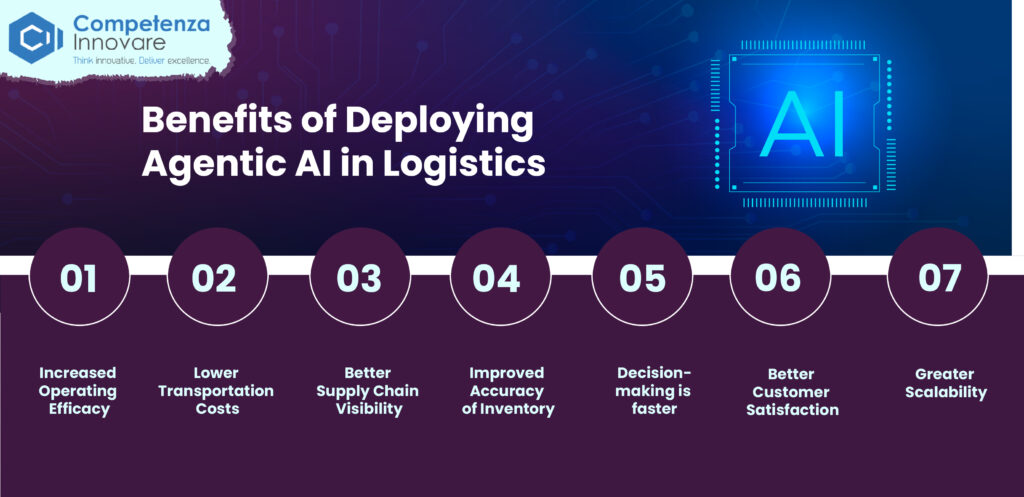
Benefits of Deploying Agentic AI in Logistics
Increased Operating Efficacy: Autonomous logistics systems take care of the planning, scheduling, routing, and exception management with no hand-waving burden on the operational team’s capability. Freight is transported by the same number of human touchpoints—much faster and with fewer errors.
Lower Transportation Costs: AI-driven route optimization, carrier choice, and freight optimization problems, as well as improvements in fuel efficiency, are all actions that can provide quantifiable savings in per-shipment transportation costs. At scale, these are large savings on high-volume workloads.
Better Supply Chain Visibility: Real-time visibility of all shipments, all carriers, and all warehouse sites will provide operations teams with the information to make better decisions—and will provide agentic AI with all the information it requires to make autonomous decisions within acceptable areas of operation.
Improved Accuracy of Inventory: AI inventory optimization and autonomous restocking maintain the level of stocks in a constant state of calibration—lowering the cost of excess stock in working capital and the cost of stockouts in service loss.
Decision-making is faster: A decision that used to take data collection, data examination, escalation, and sign-off occurs automatically in real-time at the pace and frequency that logistics processes dictated and that human decision processes could not consistently fulfill.
Better Customer Satisfaction: Timely missionary shipment tracking messages, precise delivery prediction, first-attempt delivery enhancement, and expedient claims management correspondingly enhance customer experience that leads to retention and repeat business.
Greater Scalability: Autonomous logistics processes scale without corresponding growth in the number of people. With increasing volumes of shipments, agentic AI takes the extra complexity without the extra management levels.
Roadmap for Implementing Agentic AI in Logistics
Implementation of logistics agentic AI is not a project but a program. Those organizations that benefit most of all do the correct groundwork in advance of scaling.
Phase 1 – Select High-Value Use Cases: All the twelve use cases may not be of equal commercial importance to all logistics operations. Start with the largest gap between the actual performance and potential—usually route optimization, inventory, or shipment visibility—and begin there. First wins inspire self-confidence in the organization and fund subsequent steps.
Phase 2 – Test Data Preparation: Agentic AI can be as good as the data it is acting on. Check your current car telematics; warehouse management; and vehicle carrier performance, inventory, and customer delivery paperwork. Reveal gaps and incompatibilities and integrations that previously were nonexistent before getting into deployment commitments.
Phase 3 – Unify Logistics Systems: Agentic AI uses both data to get established, where interlinked data of the TMS/WMS/ERP/carrier API/customer systems are required. Trace your present-day integration environment and see what should be developed or enhanced to provide agentic agents with real-time access to data.
Phase 4 – Pilot AI Agents: Run every use case in a controlled pilot with specific success measures and a well-established baseline. Compare effects with a similar control period or control group—that of a previous year under different volumes and market conditions.
Phase 5 – Scale Across Operations: When pilots have proven positive impact, scale to the entire operational network. Create a continuous performance monitoring system and schedule guardrail adjustment review periods and develop a roadmap to roll out additional use cases at a time.
Transform Your Logistics with Agentic AI — Start Building Smarter, Autonomous Operations Today.
The Future of Agentic AI in Logistics
Autonomous Supply Chains: The trend is toward supply chains that plan, procure, and execute with no oversight—human teams are concerned with strategy, exception handling, and relationships between suppliers and customers, which are not a matter of algorithms. The supply chain management AI will manage an end-to-end handling of the operational execution layer.
Self-Optimizing Logistics Networks: Logistics networks will become proactive and undergo constant adjustments to demand trends, cost information, and service level performance, such as limiting scattering of warehouses, carrier associations, routing schemes, and location of inventory.
AI-Powered Logistics Control Towers: Restoring AI to its logistics control towers will turn into the new standard operating model of complex supply chains—they will offer a single network of visibility and will make autonomous decisions about every node, carrier, and geography.
Hyper-Automated Warehouses: Agentic AI will plan robotic and human warehouse tasks in real-time—optimizing each square meter of warehouse area, each pick order, and each inbound and outbound operation in real time and with minimal supervision overhead.
Predictive and Prescriptive Logistics: Predictive logistics will become predictive analytics turning into prescriptive analytics, providing logistics operators with a decision engine that will self-refine its own accuracy and self-prescribe based on its own self-assessment results.
Conclusion
The agentic AI in logistics is not a technology of the future—it is a current reality of the companies that have already implemented it. The application scenarios in this article reflect the most evident first-step opportunities within the areas of route optimization, fleet management, warehouse management, supply chain risk, and customer service.
The logistics companies that have already undertaken investments in AI logistics solutions are developing operational advantages that will multiply. Logistics based on AI that gets smarter with each delivery, each warehouse cycle, and every disruption of the supply chain improves with each iteration—a competitive advantage and reliability difference between first movers and the rest of the market, which will continue to grow.
Most logistics operators will not need to ask whether agentic AI is value-producing in 2026. The signs of that are obvious. The question is what to begin with for the use cases and what is the rate of scaling out.
The Competenza uses agentic AI that automates your logistics business operation by optimizing routes, controlling inventory, organizing warehouses, and handling customer inquiries without human touch. Your crews cease fighting fire and work on development. Your margins are more effective at the beginning.
Frequently Asked Questions
What is agentic AI in logistics?
In logistics, agentic AI involves autonomous AI systems that strive to achieve specific operational goals—reducing the delivery cost, preserving service levels, and maximizing inventory—through planning, execution, monitoring, and self-adjustment and adaptation without human guidance at every step.
What is the difference between agentic AI and conventional logistics automation?
Old logistics automation adheres to unchanging guidelines and involves human intervention when things do not proceed as per the programmed guides. Smart logistics automation on agentic AI bases rationalizes the plan—deciding the most appropriate course of action in isolation and changing dynamically in response to changing circumstances.
What are the key agentic AI applications in logistics?
The main applications are AI route optimization, AI fleet management, agentic AI warehouse management, AI demand forecasting, AI shipment tracking, autonomous inventory management, AI transportation management, supply chain risk management, customer service automation, logistics control tower AI, last-mile delivery optimization, and freight audit management.
What is the time of AI implementation of logistics agentic AI?
An application with a narrow scope of one high-value use case—like optimizing routes or monitoring shipments—is common and expected to require eight to fourteen weeks between data evaluation and live deployment. Extended multi-use-case programs are stretched over one to twelve to twenty-four months with the complexity of integrating systems with data availability.
What information does agentic AI require in logistics?
Logistics agentic AI needs real-time vehicle monitoring and telematics, warehouse management, carrier APIs, inventory, and customer delivery history. The consideration of data quality, connection, and accessibility of these sources is what matters the most when defining the speed and performance results of deployment.
Can agentic AI assist in mid-size logistics operations?
Yes. The most valuable way to start with mid-size operators is one or two use cases. AI route optimization and AI shipment tracking are the most typical entry points, and cloud-based logistics agentic AI solutions, including those that can be easily integrated with an existing TMS and WMS, can be implemented without significant infrastructure investment.
What is a logistics control tower AI agent?
Logistics control tower AI agent development is an agentic AI system that includes global visibility of the entire supply chain network and autonomous operations choices—rerouting a shipment, allocating warehouse resources, or switching carriers—within approved decision-making without awaiting human oversight of e