

The choice that you make at the beginning of a software development project is not necessarily a choice involving technology. It is concerning money, namely, the way you and your development partner will work out with regard to money. The issue of fixed price vs time and material is a question that arises on all outsourcing engagements, and arriving at the wrong response can cost anyone a lot more than the difference between the hourly rates.
Both models work. There is actual business logic behind both of them. The issue is that either too many businesses fail to do one or the other without a proper assessment of which fits in the given project. A fixed-price contract is more secure since the figure does not fluctuate. A time and material contract is riskier as it is. Yet not all of those instincts hold, and selecting the incorrect engagement model in the context of software development services can be as costly as selecting the incorrect vendor.
In this guide, the fixed-price contract vs time and materials decision is segmented. We are going to be discussing how either model works and where one model works better than the other and the questions you need to answer before committing to either. Be it an MVP, modernization of a legacy system, or an outsourcing product on a long-term basis. The right engagement model simplifies the entire project and improves the probability of success.
Why Choosing the Right Engagement Model Matters
Software processes are notorious with respect to budget overruns and failures to meet deadlines, and the engagement model is playing a larger role in this than most clients are accustomed to. Where the software development pricing model is inappropriate to the kind of project, you get friction at all levels: change requests that delay the project, budget discussions that delay delivery, and vendors whose incentives are creating behaviors that do not align with your actual outcome.
The right software development pricing model is determined upfront and will bring interests into harmony, minimize conflict, and ensure that the business relationship between the parties is predictable. It is not some formal aspect of the law; it is the choice of a project manager with tangible implications.
Common Software Development Pricing Models
The two most common engagement models in software outsourcing are fixed and time and material. Another model, the dedicated team or staff augmentation model, is occasionally spoken of along with them, but project-based work, the fixed price vs T&M comparison, encompasses most of the decisions.
What Is a Fixed Price Engagement Model?
A contract involving a fixed-price contract is a form of software development contract in which the overall project cost is negotiated at the start of the contract. The scope, timescale, and deliverables are determined by the client and the vendor before work is started—and the price does not fluctuate with the length of time the work takes.
How Fixed Price Contracts Work
The vendor bases their work estimation on a specific specification and adds a buffer of risk to cater to uncertainty and forwards the entire cost of the project. That price is paid by the client, in a single advance payment or in installments agreed upon at the milestones, and the vendor delivers to specifications. Any other work not in the first request is a formal change request, which means extra cost and renegotiation.
Key Characteristics of the fixed-price engagement model
- Work is defined before it starts with scope, time schedule, and price.
- Client has small financial risk after signing the contract.
- Vendor is exposed to the risk of underestimating effort.
- Change management is an official and contractual one.
- Best applied to projects with fairly well-documented requirements.
Typical Pricing Structure
Fixed-price contracts tend to be goal-based: a percentage of signing the contract, a percentage of major delivery phases, and a terminal payment of getting the project approval. Such a structure provides clients with the checkpoints to check the progress before the next payment is made.
Pros of Fixed Price Contracts
Budget Predictability
The most intuitive advantage of a fixed-price contract is that it is aware of its total cost on day one. In the context of businesses with limited budgets, whose board-level approval is necessary or even is required by regulation in their procurement, such predictability is really worthwhile. At the end of the month there are no surprise invoices.
Clear Deliverables
Since the scope is given in advance, all people are aware of what it is that is being built and what success will look like. The clarity eliminates ambiguity and facilitates the acceptance tests, and the vendor is more likely to be held responsible on the delivery front.
Reduced Financial Risk
After signing the contract, the client will be secure against cost overruns due to internal inefficiencies of the vendor company. Should the vendor take longer than anticipated in delivering the project, then that is their issue—not yours.
Cons of Fixed Price Contracts
Limited Flexibility
A fixed-price contract views the specification as a commitment of a contract. Any change—even a minor one that will prove to be beneficial to the product—will necessitate a formal change request, a need to negotiate, and, in most instances, extra cost. Practically, this renders fixed-price projects inflexible in a manner that may cause a detriment in the final product quality.
Scope Change Challenges
Software requirements nearly always change as the development advances. Early builds are visible to the stakeholders, and they realize that something must change. Market conditions shift. The priority is different according to user research. In a fixed-price environment, each of these is a negotiation. Instead of creating software, teams take time to cope with the requests of change.
Longer Planning Phase
Since the specification should be mature prior to signing the contract, pre-priced projects load a lot of planning and documentation efforts. This requirements definition upfront may represent an appreciable delay to writing a line of code in businesses that must move fast.
Recommended to Read: Why Product Discovery Phase Is Important Before Software Development
What Is a Time and Material (T&M) Engagement Model?
A time and material contract is a type of software development contract that is used when the client pays an agreed rate per time and resources used. No set total project cost—the ultimate price will depend on the amount of work that is done.
How Time and Material Contracts Work
The client and vendor will set an hourly or daily price per type of resource—developers, designers, QA engineers, and project managers. The vendor is driven by the priorities of the client and charges for time spent. The client gets frequent invoices of the actual hours logged with time sheets usually supporting them or project management tool reports.
Billing Structure
T&M is normally done monthly, although it is calculated on hours worked the last period. Most of the vendors generate detailed resource- and task-breakeven time reports. Rates are set. Although the overall price is not established, the client is aware of the unit price of work regardless of whether the overall price has been predetermined or not.
Agile Project Compatibility
Agile development is at home in time and material contracts. Agile practices are anchored in the principles of iterative delivery, constant feedback, and changing requirements, all of which are mutually exclusive with a fixed-scope contract. A development contract created agilely nearly always involves T&M pricing since the entire agile concept is that the product gets developed depending on what is learned throughout the development.
Pros of Time and Material Contracts
Greater Flexibility
In a T&M contract, a diversion incurs no cost other than the time taken on the rework. The requirements may change due to the development of knowledge. Priorities may change in reaction to feedback from users or market changes. The project development roadmap remains within the control of the client all through the project.
Faster Project Start
Due to the absence of the need to establish full specifications until work starts, T&M projects may commence far earlier than fixed-price ones. The initial brief and set of priorities is sufficient to kick off development. This speed advantage is especially important when it comes to early-stage products and where speed to market grants actual commercial benefits.
Continuous Improvement
T&M projects do not have a stage where a product is considered done, such that it cannot be improved any more, without a new contract. Ongoing additions, refinements, and improvements can be made to features—much closer to the long-term product development than a model where a delivery is a one-time event.
Cons of Time and Material Contracts
Less Cost Predictability
The lack of a definite total is a real drawback to businesses that require a certainty of the budget. It could take a T&M project longer and even be more expensive than initially anticipated, especially when requirements are not known or requirements change regularly.
Requires Active Client Involvement
T&M projects involve active scope and priority management by the client. The absence of client engagement through reviewing progress, making priority decisions, and prompt feedback can lead to a lost project or a piece of work that will no longer be applicable to the business’s needs. Such a model asks interested customers to pay and a disinterested one to be identified.
Budget Management Challenges
Software project budgeting demands discipline indefinitely in the absence of a set ceiling. Regular progress reviews, burn rate controls, and explicit prioritization structures are all capacities to maintain T&M projects in a business in check.
Fixed Price vs Time and Material: Side-by-Side Comparison
| Factor | Fixed Price | Time and Material |
| Cost Predictability | High – total known upfront | Variable – depends on hours worked |
| Flexibility | Low – changes require formal process | High – priorities can shift freely |
| Project Scope | Must be defined fully upfront | Can evolve throughout project |
| Speed to Start | Slower – requires full specification | Faster – starts with high-level brief |
| Risk Distribution | Client protected; vendor carries overrun risk | Shared – client manages scope and spend |
| Change Management | Formal change requests required | Informal – built into workflow |
| Agile Compatibility | Poor | Excellent |
| Best For | Fixed scope, defined deliverables | Evolving requirements, ongoing development |
| Client Involvement | Lower during delivery | Higher throughout |
| Long-Term Product Development | Difficult | Natural fit |
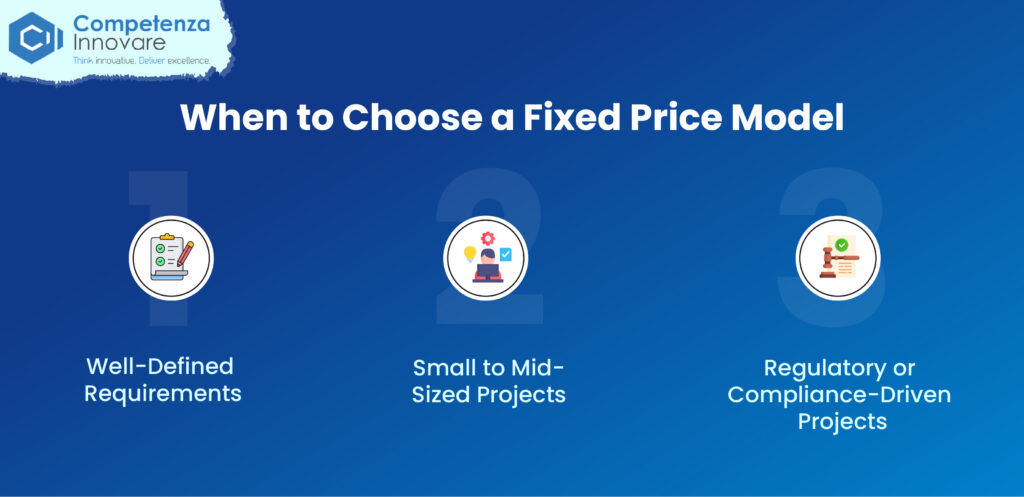
When to Choose a Fixed Price Model
Well-Defined Requirements
A fixed price is strongest when requirements are well documented, consistent, and probably not to be changed. When you have such a technical specification, have all the user stories, and are assured that the scope is not going to shift, a fixed-price contract provides you with certainty of the budget without any significant cost in the way of flexibility.
Small to Mid-Sized Projects
In smaller and more narrowly scoped projects—one feature-based app, redesign of a website, or a particular integration—fixed price can be the most viable choice. The specification activity is reasonable in terms of size, the risk buffer is not excessive, and the timeframe of delivery is short enough that requirements are not expected to vary significantly.
Regulatory or Compliance-Driven Projects
In sectors like healthcare, financial services, and government, where the procurement rules could insist on the use of fixed-price contracts or where the regulatory environment dictates that a properly documented and audited scope is fixed price, it is sometimes the only sensible option no matter what development methodology choice might otherwise be.
When to Choose a Time and Material Model
Agile Development Projects
When your project is implemented with agile methodology—sprints, backlog, and continuous delivery—the T&M contract is the logical commercial complement. Time and material contracts in Agile projects are rightly incentivized: the vendor is compensated based on the value he is bringing in each sprint, and the client is entitled to reprioritize the backlog as knowledge progresses.
What Is MVP Development?
A typical decision step for startups and product teams is fixed price or time and materials to develop an MVP. T&M nearly always prevails here. The entire purpose of an MVP is to make assumptions—i.e., requirements will evolve as you discover what works and what does not. When an MVP is locked or set to fixed-price specifications, it destroys the point in creating one.
Evolving Requirements
Any project in which requirements will be subject to change—due to market evolution, due to a process of aligning stakeholders, or due to a product definition phase of evolution—must be on a T&M contract. The flexibility cost is a real cost, but it is almost always less than the cost of dealing on a fixed-price chance whereby requirements are equally volatile.
Long-Term Product Development
In continuous software development—creating, sustaining, and enhancing a live product over months or years—the only model that would be reasonable is T&M. Events are fixed-price contracts. Development of products is a never-ending process. An attempt to execute a continuous process by a sequence of fixed-price events creates very large commercial and operational overhead on both sides.
Fixed Price vs Time and Material for Enterprise Projects
Enterprise software projects are large, complex, and long, which makes it structurally challenging to have fixed-price contracts. Enterprise-level requirements are seldom stable to the point to enable comprehensive upfront specification, and the risk margins providers construct when developing fixed-price bids on large projects may increase the overall cost by 20 to 40 percent over the top line.
T&M is generally seen to yield superior results and superior value to fixed price at the enterprise level by most enterprise organizations that engage with IT outsourcing engagement models. The magic is the ability to govern enterprise T&M projects client-side: project management maturity on the side of the client can make the difference in terms of project success in being able to actively manage scope and make prioritization decisions.
Choose the right engagement model for your project. Talk to Competenza’s software experts today.
How to Choose the Right Software Development Engagement Model
In taking the choice between a fixed-price and T&M price approach, be honest in responding to the following four questions:
Is the scope fixed?
Provided, yes—and you have the evidence of that stability recorded in the form of a complete specification—a fixed price is possible. T&M is more secure in case of any meaningful uncertainty in scope.
How likely are requirements to change?
In the event that market conditions, congruence of stakeholders, or user research might materialize to change your priorities in the course of the project, include such an option in the contract at the beginning. T&M is created precisely to that purpose.
What is the budget flexibility?
When you are guaranteed a particular number at the board budget level and cannot vary, a fixed price provides such an assurance to you. T&M can produce a superior ROI if you are flexible on the range of budgets; you can invest more in the event if the product requires it.
How involved will stakeholders be?
The T&M pricing model involves active participation of clients. When your internal stakeholders are unable to make regular reviews, timely feedback, and continuous prioritization decisions, a T&M project will go adrift. A fixed price offers more structure to less engaged clients—but has its own set of risks when the requirements change despite the contract.
Conclusion
The fixed price vs time and material decision is not concerned with the inherent betterness of one model over the other. It is more of the model that best suits your project. A fixed price is used when the scope is well-defined, the requirements are not dynamic, and when the priority is spending certain sums of money. Time and work at hand when requirements will change, speed of getting on with things, or the project is long-term in nature.
T&M pricing is particularly more appropriate than fixed pricing for the majority of software projects, especially in agile development and enterprise IT. However, the correct answer is always derived out of your context. The above four questions serve as your decision framework on the pricing model; be realistic as to what your project really fits, and select the appropriate model with the competence that reflects commercial incentives as to what outcome you really require.
Frequently Asked Questions
What is the main difference between fixed price and time and material contracts?
A fixed-price contract specifies the fixed cost at the beginning depending on a fixed scope. Time and material contract fees are based on the actual hours worked at fixed rates, and the total is not predefined. A fixed price provides certainty on the cost of the budget; T&M provides flexibility.
What engagement model should an agile development use?
Time and material. Agile development is founded on requirement changes and periodic delivery—neither of which can be accommodated by the fixed-price contract. Agile projects’ time contracts and material contracts have been the reason why they are the industry standard.
Is a fixed-price contract necessarily cheaper?
Not necessarily. Video vendors establish a buffer against underestimation using risk buffers built into fixed-price bids. In projects where requirements may be uncertain or may evolve, a fixed-price contract can be very expensive when compared to a well-run T&M engagement with the same scope.
What is the most appropriate model to use when developing an MVP?
Time and material. The MVP development process is a learning and iteration process—you will alter requirements over time as you de-risk assumptions. When you enforce MVP on a fixed-scope contract, it becomes more difficult to react to what you will discover during development.
Is a budget limit per time and material contract possible?
Yes, a care in several T&M contracts is a not-to-exceed (NTE) clause, establishing a limit on the amount of money that can be spent. This will provide clients with a certain level of protection on the budget and maintain the flexibility of the T&M model.
What is the best model in enterprise software projects?
The enterprise IT outsourcing engagement models have preferred T&M, especially when dealing with long-term or big projects. Enterprise-level requirements are also seldom stable enough to enable precise fixed-price estimation, with the risk buffers on large fixed-price bids potentially costing a lot.
How do I manage the cost on a time and material contract?
By using active scope management, periodic sprint reviews, prioritization of backlog entries, and monitoring of the burn rate. A client requirement—T&M cost control not only rewards proactive, strategic clients, but it also unveils passive clients.
What is the most prevalent engagement model used in software outsourcing in the US and UK?
The two models are commonly found in the US, the UK, and Western Europe. Public sector and regulated industry procurement more often have a fixed price, where there is a need to have a fixed cost in the budget approval processes. T&M also leads in product development, startup projects, and enterprise digital transformation programs where agility is prioritized over cost certainty.