

In 2026, cloud adoption will be the core of digital transformation as business entities are migrating workloads to vendors such as AWS, Azure, and Google Cloud at a rapid pace. Nevertheless, even with the increased adoption, many of the cloud migration projects are ending in failure or experiencing severe failures. The majority of them fail not because of the limitations in technology but because of preventable cloud migration missteps like inadequate planning, lax governance, and overlooking complexity.
According to some studies and industry experiences of the leading experts in the field of cloud computing, issues such as misinterpretations of cloud migration strategy, false security settings, overbooking the cost, and the absence of cloud readiness evaluation are common for organizations. These issues may have a substantial effect on performance, security, and ROI.
In this guide, we dissect the top 7 cloud migration mistakes and how they can be avoided in 2026 to provide real-world solutions and best practices in cloud migration to enable enterprises to make the transition a success. You might be about to take a small load of work or do a complete cloud migration of an enterprise; either way, you need to know these pitfalls of cloud migration to successfully create a scalable, secure, and cost-effective cloud infrastructure.
Why Cloud Migration Projects Fail (Mistakes)
Most cloud migration projects fail due to the underestimation by many organizations of the complexity involved in the process of application, workload, and data migration to the cloud. Although cloud platforms are scalable, flexible, and cost-effective in the long term, proper cloud migration planning, security, governance, and cost control are needed to implement a successful migration. The absence of a well-defined cloud migration plan causes businesses to experience delays, increased budgeting costs, and performance and security risks.
Mistake #1: Skipping a Cloud Readiness Assessment
A cloud readiness assessment should be in place to commence any migration project. It helps in evaluating infrastructure, application dependency, workloads, and business goals to determine how ready systems are to be embraced in clouds. Other organizations do not perform this step and move workloads as they are, and it typically results in compatibility problems, technical debt, and performance problems.
- Evaluates infrastructure and application readiness
- Identifies migration risks early
- Prevents compatibility issues
- Improves migration success
Mistake #2: Choosing the Wrong Migration Strategy
Which cloud migration strategy plays a pivotal role in achieving cost-effectiveness and scalability. Lift-and-shift migration is what many organizations bank on since it is faster, but more often than not, it constrains the real benefits of relying on a cloud. An effective cloud migration model must take into consideration the business objectives, the complexity of workloads, and future cloud modernization strategies.
- Rehost for quick migration
- Replatform for moderate optimization
- Refactor for cloud-native transformation
- A wrong strategy reduces performance and efficiency
Mistake #3: Ignoring Security and Compliance Requirements
One of the largest challenges of cloud migration is security. Companies that do not put solid security planning on the cloud tend to experience data breaches or compliance and operational risks. Efficient migration also requires proper access management, compliance planning, and the security controls.
- Weak security increases breach risks
- Poor access control creates vulnerabilities
- Compliance gaps increase regulatory risk
- Governance improves cloud security
Mistake #4: Underestimating Data Migration Complexity
The migration of data is usually more complicated than anticipated, particularly with the context of enterprise migration of clouds in terms of high workloads and databases. Planning is also a poor design that may cause downtime, low transfer rates, and loss of data during migration.
- Large data transfers need planning
- Downtime impacts operations
- Data loss risks increase
- Bandwidth affects migration speed
Mistake #5: Poor Cost Planning and Budgeting
The most frequent cloud migration error is poor cost planning. Some of the businesses have the illusion that cloud migration lowers the costs automatically and unconsciously; cost issues such as storage, bandwidth, scaling, and underutilization of resources can also begin to burden the spending readily without effective checks and balances.
- Hidden costs of cloud migration
- Over-provisioning increases expenses
- Poor planning causes overruns
- Cost monitoring improves ROI
Mistake #6: Lack of Cloud Governance
Cloud governance guarantees organizations control, visibility, and security in the cloud environments. Lack of governance tends to make businesses face resource sprawl, ineffective access management, and inefficient operation control.
- Improves resource management
- Increases visibility
- Reduces security risks
- Prevents uncontrolled usage
Mistake #7: Failing to Optimize After Migration
Cloud movement is just the initial phase of the migration. A lot of companies do not scale the workloads post-migration, which leads to poor-performing performance and higher long-term costs on the cloud. Ongoing optimization, automation, and improvement of infrastructure are key success factors in the long run.
- Improves performance
- Reduces cloud costs
- Enhances monitoring
- Supports long-term efficiency
How to Avoid Cloud Migration Mistakes
Preventing errors of migration to the cloud should begin with a clear strategy, solid planning, and ongoing optimization during the migration process. Most cloud migration failures occur since they only make the business concentrate on the migration workloads rather than creating a systematic strategy to achieve success in the long run. Adherence to cloud migration best practices will aid risk mitigation, enhance performance, and lead to the successful cloud migration.
- The initial step would be an in-depth cloud readiness assessment to analyze the infrastructure, workloads, security needs, and risks of migration to the cloud.
- Develop a task cloud migration plan consisting of clear business objectives, a roadmap of migration, and workload priorities to minimize delays and enhance deployment.
- Choose the right migration strategy of every workload rehosting, replatforming, and refactoring based on the business and technical requirements.
- Minimize vulnerabilities in security in migration to cloud services by offering high access control, encryption, and governance policies early in life.
- The matching of a plan will avoid the budget mania and the murky expenses of cloud frameworks by estimating the number of storage, bandwidth, scaling, and functions.
- Establish good cloud governance to promote resource visibility, maintain control, and achieve compliance in clouds.
- Monitor and track workloads after migration and enhance performance and minimize price and cloud efficiency over time.
These good practices would help organizations to cut across typical cloud migration pitfalls, escape difficulties in cloud transformation, and realize long-term cloud success. fall, circumvent cloud transformation obstacles, and succeed in cloud success in the long term.
Cloud Migration Checklist for Success
An effective cloud migration needs to be planned effectively, implemented seamlessly, and optimized. A managed cloud migration checklist helps business organizations in the mitigation of risks, security improvement, and providing high performance.
Pre-Migration Checklist
Ahead of migration, business needs to undertake a cloud readiness assessment of infrastructure and application readiness. Development of application inventory and dependency mapping is utilized to determine workloads and comprehend the connections within systems. This phase plays a crucial role in developing a rational migration strategy.
During Migration Checklist
Testing and validation should also be used during the movement of workloads to prevent any form of problems during the migration. The security controls, like access management and encryption, aid in the protection of data and lowering risks. Constant tracking also aids in limiting the downtime and ensuring a smooth transition.
Post-Migration Checklist
Once migrated, businesses should attend to performance and optimization of costs, as well as monitoring. Good monitoring enhances visibility, cost optimization reduces any unnecessary cost, and performance tuning ensures that clouds and scalability are effectively used in the long run.
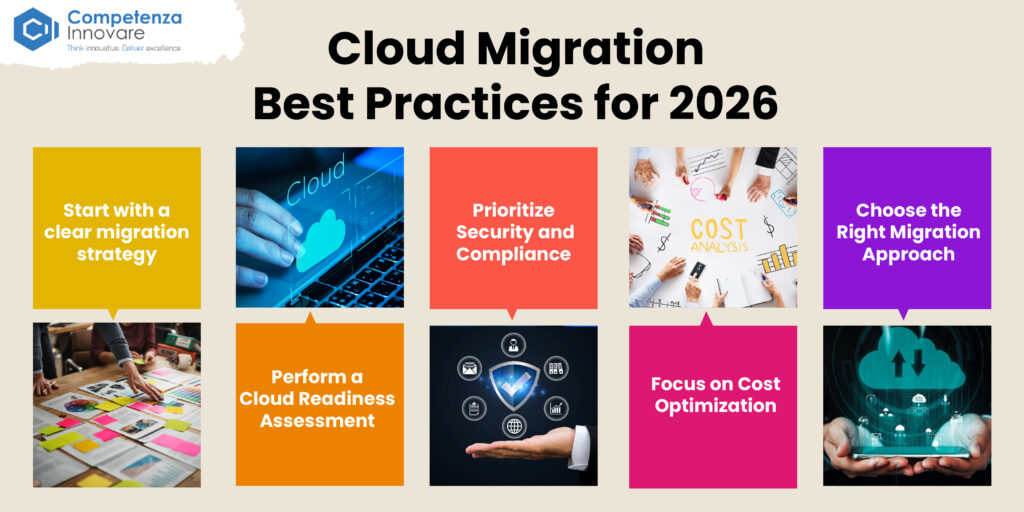
Cloud Migration Best Practices for 2026
Migration requires a more intelligent strategy and planning as cloud adoption gains momentum in 2026. An effective cloud migration is no longer merely the process of transferring your workloads from an existing infrastructure to a cloud platform but also enhancing scalability, security, performance, and cost-effectiveness. Good practices of cloud migration enable organizations to mitigate risks and expensive errors and gain success in the cloud in the long run.
Start with a clear migration strategy
A clearly outlined cloud migration plan is paramount to success. Businesses need to set identifiable goals, set priorities, and create an elaborate cloud migration roadmap before they can move the workloads. Proper planning will help to reduce wait times, enhance productivity, and improve cloud migration failures.
Perform a Cloud Readiness Assessment
A cloud readiness assessment will ask the organizations to examine their infrastructure, applications, and workloads to know the activities that need to be carried out prior to the migration. This helps to identify the technical defects, compatibility, and perils of the migration during previous stages to enable a hassle-free implementation process and enhanced outcome.
Prioritize Security and Compliance
Security must be kept high during the migration process as well. The business world ought to enforce high access control measures and encryption as well as compliance measures in order to minimize cloud migration security threats. Well-built governance enhances the defense against data breaches and regulatory issues.
Choose the Right Migration Approach
The migration path should not apply to all the workloads. Depending on business requirements and application complexity, the business is supposed to select the appropriate strategy between rehosting, replatforming, and refactoring. Performance is enhanced by the right approach, leading to a successful cloud migration.
Focus on Cost Optimization
The cost management of clouds is of high priority in 2026. To prevent needless costs, organizations must constantly check the use of the clouds, remove the resources that are not in use, and optimize workloads. A successful cost plan enhances cloud ROI and long-term efficiency.
Use Automation and Monitoring
One of the features in the contemporary cloud setting is automation and constant observation. Automated deployment, performance tracking, and monitoring enable the businesses to enjoy more efficiency, less manual involvement, and easy identification of problems quickly and conveniently.
Continuously Optimize After Migration
Cloud migration is not a process. The post-migration optimization plays a key role in boosting the performance, capacities, and cost-efficiency. Long-term cloud success is attained by regular monitoring, tuning of performance, and workload optimization.
Adhering to such cloud migration best practices in 2026, businesses can establish a secure, scaled, and cost-effective cloud-based environment and reduce risks to the migration components and enhance the overall performance.
Avoid costly cloud migration mistakes—partner with Competenza for a smarter, secure migration strategy.
How Competenza Can Help Ensure a Smooth Cloud Migration
Effective cloud migration needs to extend beyond simply migrating workloads to the cloud. It requires adequate cloud migration planning, an appropriate strategy of migration, effective security, and optimization. Lacking professional assistance, companies can make various cloud migration errors that result in slowness, performance, and security concerns and unforeseen expenses. The Competenza helps organizations design complex cloud migration issues mitigated by their own-made solutions that resolve scalability, security, and cost.
- Conducts substantial cloud readiness testing to measure the infrastructure, applications, and workloads before the migration.
- Plans an effective migration to the cloud depending on the business need as well as technical factors.
- Helps select the most appropriate migration plan to the cloud to offer the most appropriate performance, scaling, and security plans.
- Enhances security by government, compliance planning, and risk management in order to minimize the cloud migration security risks
- Optimizes costs of the clouds through better resource planning and monitoring as well as cost management procedures.
- Ensures optimization of post-migration processes towards long-term better performance and efficiency and cloud ROI.
Competenza, with skills in cloud modernization and enterprise cloud migration, assists enterprises in creating secure, scalable, long-term successful cloud environments.
Conclusion
Cloud migration can present notable benefits to businesses such as enhancement of scalability, enhanced performance, flexibility, and cost-efficiency in the long run. But the process of cloud migration cannot be accomplished by merely migrating workloads to the cloud. Lack of proper cloud migration planning, security, governance, and ongoing optimization places organizations at the risk of expensive errors, which can slow the pace of progress and lessen ROI.
All cloud migration errors like not conducting a cloud preparedness analysis, selecting an incorrect cloud migration plan, neglecting data migration controls, underrating the intricacy of data migration, inadequate cost planning, absence of cloud administration, and subpar optimization of data migration post-migration can cause cloud migration failures. To reduce risks and ensure that the migration process goes well, such situations should also be addressed at the initial stage.
In Competenza, we support businesses to overcome the challenging cloud transformation barrier by designing tailored migration initiatives, skilled plans, and scalable cloud solutions. Through cloud migration best practices and collaboration with cloud migration specialists, organizations will be able to mitigate the risk of migration and enhance their efficiency as well as the value of cloud adoption in 2026 and beyond.
FAQs
What are the most prevalent cloud migration mistakes?
The most common mistakes of moving to the cloud include failing to conduct a cloud readiness evaluation, choosing the wrong cloud migration strategy, ignoring security and compliance requirements, underestimating the complexity of data migration, insufficient cost planning, lack of postmigration optimization, and poor cloud management. Such mistakes are often the reasons for cloud migrations, cost overruns, and performance issues.
What is the problem of cloud migration project failure?
Failure in the cloud migration project is highly blamed on poor cloud migration planning, failure to establish business objectives, poor governance, security aspects, and failure to make correct assumptions on technical complexity. An insufficient systematic cloud migration strategy may cause stalling, downtime, financial runaway, and operational problems in business.
What does cloud readiness assessment mean?
A cloud readiness assessment is that system that evaluates the structure, applications, workloads, and even security needs of the organization prior to the migration. It assists the detection of the technical gaps, migration risks, and compatibility troubles in order to support a successful cloud migration.
Which cloud migration strategy is best?
The optimal strategy of cloud migration will rely on business objectives, complexity of applications, and need of workload. The most popular strategies are rehosting, replatforming, and refactoring. Selecting an optimal cloud migration strategy enhances performance, scalability, and cost-effectiveness.
What are the largest cloud migration security risks?
The key security threats associated with major cloud migrations are information security breaches, improperly configured access control, ineffective encryptions, misaligned compliance, and improper governance. These risks may be contained to others through effective security planning and compliance management to curb them in the migration process.
How can companies reduce cloud migration costs?
To minimize costs incurred in cloud migration, businesses can enhance cloud migration planning, monitor cloud usage, remove idle resources, and optimize workloads. Budgeting and cost tracking solutions allow optimizing cloud ROI and minimizing unwarranted costs.
Why is cloud governance important?
The significance of cloud governance is that it aids organizations in remaining visible and secure and in complying with and controlling cloud resources. Effective cloud governance leads to less risk in operations, better management of resources, and unregulated use of the cloud.
What are the biggest data migration challenges?
Risks affecting data migration common to large-scale data migration are data transfer volume, risk of downtime, loss of data, bandwidth bottlenecks, and dependencies of an application. These risks of cloud migration projects can be mitigated by proper planning and testing.
What are the best practices of cloud migration in 2026?
The most prominent future cloud migration best practices to consider in 2026 are the use of a cloud readiness test, development of a clear migration roadmap, focus on security, optimization of cloud costs, automation, and post-migration continuous monitoring of the workloads.
What can Competenza do to assist in cloud migration?
Competenza helps businesses having complex cloud change demands in streamlining transformation procedures by tailoring cloud migration schemes, plotting and execution, security consciousness, and cost-effective optimization. This will aid organizations in reducing the chances of cloud migrations and also achieve successful cloud adoption.