

Projects of cloud migration virtually never present at the bottom of the initial business case. The first cost is infrastructure, migration tooling and a sensible pad, and then the actual bill comes with egress charges no one has charged in, a refactoring no one has scoped, and a monthly cloud bill that is steadily increasing, and the finance team is yet to figure out where the problem lies. There is nothing exotic or unusual about the hidden costs of cloud migration. They are the logical result of planning that emphasizes that migration itself and not everything that migration intersects is planned.
Cloud migration cost is actually hard to estimate accurately, as the cost drivers go way beyond compute and storage costs. Data transfer costs, application refactoring, license modification, security enhancement and the continuous cloud expenditure that occurs after go-live all have a real cost attached to them and most of them were not included on the spreadsheet that initially justified the migration. The same is reported in organizations in the US, UK, EU, and APAC: cloud migration spending of companies on paper, expecting to be solid, then increases by a quarter to half after implementation.
This guide spills the 12 most prevalent cloud migration hidden costs, understands why enterprises habitually underbudget all of them, and provides you with the practical framework of readiness appraisal, plan choice, FinOps, and continuous observation in making your migration budget sincere all the way through planning to continued operations.
Why Cloud Migration Costs Often Exceed Expectations
The difference between the budget amount and the real bill and why it is still occurring.
The majority of cloud migration cost factors causing overspend are not unknown. They can be known but are regularly omitted in starting estimates since they lie outside the definition of migration as a process as limited to infrastructure provisioning and data transfer and within the much larger rubric of everything that migration actually does to be successful.
The Difference Between Expected and Hidden Costs
The following are some of those line items that are expected in every cloud migration budget: compute, storage, and licenses of migration tools. Cloud migration hidden costs are line items that are only revealed after the project has been initiated, such as egress fees due to data movement patterns that no one modeled, refactoring work realized during the migration process, and cloud spend that builds up in the months following go-live as no one is deliberately working on consumption. Most cloud migration budgets fail at the point of this dichotomy between these two groups.
What are the hidden costs of cloud migration?
Expenses that are not visible or are grossly underestimated during the planning phase.
The hidden cost of cloud migration is the costs that occur during migration or after migration that were not fully considered in the essence of the business case initially. They do not come out of the blue; they are more or most foreseeable cost areas that are out of planning simply because they demand deeper technical uncovering than most preliminary evaluations undertake.
Ignoring these costs can lead to:
- Budget overruns
- Longer migration timelines
- Unexpected cloud bills
- Reduced project ROI
- Delayed digital transformation initiatives
An actual cloud migration budget ought to include a one-time move charge as well as operational costs.
Why Businesses Underestimate Cloud Migration Costs
There is always one or a combination of reasons why businesses underestimate the cloud migration cost: discovery has not been performed, it has been performed in a hurry or not performed at all, the migration plan has been decided before the application portfolio is fully understood, cloud infrastructure has been deployed to match the on-premise utilization, and its active utilization is expected to be self-managing instead of a management effort. All these gaps compound each other, and the outcome is a cloud migration budget that is realistic when compared to a more direct project that would be easy to understand than the one being implemented.
There are various reasons behind flawed cost estimates:
- Underestimating application complexity
- Disregarding dependencies on legacy systems.
- Lack of evaluation of cloud readiness.
- Overlooking employee training
- Selecting the wrong migration strategy.
- Failure to plan long-term cloud optimization.
12 Hidden Costs of Cloud Migration
The cost categories that most often increase the cost of the cloud migration even higher than was originally planned are
1. Application Assessment and Discovery
Application assessment, dependency mapping, architecture review, security audit and data profiling can cost between $10,000 and $50,000 depending on the complexity of the application but are often omitted completely as a cost item on the initial migration budgets. Organizations that do not undertake discovery to pay up this initial outlay almost universally incur a much greater overrun later when relied-upon dependencies and undocumented business logic are revealed midway through the migration, at the time they are the most costly to resolve.
Organizations need to evaluate the following before migrating any workload:
- Application architecture
- Technology stack
- Infrastructure dependencies
- Third-party integrations
- Security risks
- Performance bottlenecks
This evaluation is used to decide if an application can be rehosted, replatformed, or refactored. Although the evaluation is an initial investment, it can aid in avoiding the incurred costs in the event of errors during the migration.
How to avoid unnecessary costs
- Implement an effective application inventory.
- Prioritize business-critical applications.
- Find technical debt prior to migration.
- Develop a step-by-step migration plan.
2. Data Transfer and Cloud Egress Fees
One of the most widely underestimated costs in any migration program is cloud data transfer costs, especially egress fees, which are paid when leaving the network of any cloud provider. Big amounts of data are transferred in the first migration, and continuous data transmission across regions or to external systems after migration can increase by thousands per month in monthly cost that is often insignificant to consider in projections made before the migration. The companies that are data-heavy in their migration between AWS and Azure and on-premises are the ones most susceptible to this type of double-underwriting AWS migration costs and dual-underwriting Azure migration costs.
Common charges incurred by the businesses include:
- Cross-region traffic
- Cross-cloud transfers
- Disaster recovery replication
- Frequent database synchronization
- Large-scale backups
These cloud data transfer costs may easily run out of proportion when they are not factored in the planning process.
How to avoid unnecessary costs
- Reduce unwarranted outbound traffic.
- Locate store data near end users.
- Archive inactive data.
- Check network usage frequently.
- Consider egress pricing when choosing a cloud provider.
3. Application Refactoring
Programs needing code modifications to work in a cloud environment, like those with hardcoded file paths, dependencies unfriendly to cloud-based infrastructure, or architecture that does not port cleanly to a virtualized or containerized environment, lead to refactoring operating expenses that are often only learnable after migration has already started. This can be one of the most frequent causes of lift-and-shift cloud migration cost estimates widening considerably mid-project to become more of a partial replatforming project than the originally planned rehost project.
Organizations often believe that they can just migrate existing applications without any modification. As a matter of fact, legacy applications can entail the following:
- Code refactoring
- Database modernization
- API development
- Containerization
- Microservices adoption
- Performance optimization
The improvements raise the initial application modernization costs but enhance the scalability and security as well as long-term maintainability.
How to avoid unnecessary costs
- Select the appropriate migration plan per application.
- Refactor where it has definite business value.
- Upgrade high-priority systems initially.
- Make use of pre-existing business logic where possible.
4. Downtime and Business Disruption
Migration windows, cutover events and parallel running periods with both the legacy and modern systems running in parallel foot a real business cost: transactions are lost, productivity decreased and an impact on customer service that never presents itself anywhere in the technology budget but is an actual cost of the migration. Even a handful of hours of scheduled downtime can be decisively revenue-decisive, as is the case with customer-facing applications, in which regressions of revenue in relation to downtime ought to be explicitly modeled.
Poor migration planning can result in:
- Lost productivity
- Revenue loss
- Customer dissatisfaction
- Delayed operations
- Emergency support costs
Rollback plans and well-defined recovery procedures must always exist on the applications that support critical business processes.
How to avoid unnecessary costs
- Phased migrations are better than big-bang deployments.
- Perform schedule migrations when the traffic is low.
- Migration of tests to staging environments.
- Does develop rollback and disaster recovery plans.
5. Licensing and Subscription Changes
Leaving constant software on-premise licenses in favor of cloud subscriptions or substituting custom-built software with SaaS software equivalents alters the fundamental cost in a manner that cannot be converted until a pre-migration financial model is completed. Particular legacy licensing deals cannot at all easily be moved into cloud deployments and may need to be renegotiated with the vendor, often incurring inadvertent cost and inadvertent delay in the timeline of migration.
How to avoid unnecessary costs
- Check all your current software licenses prior to migration.
- Know Bring Your Own License (BYOL) choices.
- Eliminate unused or duplicate software.
- Compare cloud providers in terms of licensing models.
6. Security and Compliance Upgrades
Cloud security costs, IAM redesign, encryption implementation, compliance control validation, and penetration testing are often assumed to be part of the overall migration effort and not to be a separate line item in their own budget. In regulated industries working within GDPR in the EU, in healthcare in the USA as with HIPAA, or with methods of payment data protection in any country, these security and compliance costs are often high, to the point of not being tacked on to the main migration work.
How to avoid unnecessary costs
- Be a security-by-design organization.
- Use best practices of cloud security at the earliest.
- Automate compliance monitoring where possible.
- Periodically assess cloud security policies.
7. Cloud Infrastructure Overprovisioning
One of the most prevalent and most preventable causes of cloud overspending is provisioning cloud infrastructure to scale to on-premise capacity instead of right-sizing instances to the pattern of actual cloud usage. Cloud infrastructure costs are often 20-40 percent above what they should be in the first few months following the migration without active right-sizing discipline, which only widens each billing cycle until someone decides to apply some active right-sizing.
Such unwarranted resources slow growth in cloud infrastructure costs and the overall ROI.
How to Avoid It
- Optimize workloads in response to actual usage.
- Support auto-scaling of variable workloads.
- Arrange non-production areas to close during the off working hours.
- Audit cloud utilization and clean up unneeded resources.
8. Employee Training and Change Management
An application that has been migrated but not usable by the staff members does not provide the business value thought of in the business case. A real cost that often lacks its own line item in migration budgets, but it is nevertheless a vital requirement to achieving the full value of migration: training of end users of a new interface and training of IT teams on how to operate in a new cloud environment.
The following are typical training expenses:
- Cloud certification programmes
- Internal workshops
- New operational processes
- Documentation updates
- Change management initiatives
Though these investments raise the short-term expenses, they decrease operational errors and enhance the long-term adoption.
How to Avoid It
- Begin employee training prior to the start of migration.
- Create detailed cloud documentation.
- Offer job-specific learning directions.
- Promote ongoing development of cloud skills.
9. Third-Party Integration Costs
All third-party integrations that an application depends on, such as ERP systems, CRM platforms, and payment processors, will need to be reconsidered and possibly significantly reconstructed to fit the new cloud environment. The complexity of integration This is always underestimated during migration planning processes, as the complete scope of an application in terms of integration dependencies is never well documented anywhere prior to the start of the migration discovery process.
Migration of an application may require reconfiguring or rebuilding integrations with the following:
- CRM platforms
- ERP systems
- Payment gateways
- Identity providers
- Analytics tools
- External APIs
There are also vendors who might also bring a new pricing model on the migration of applications to the cloud.
How to Avoid It
- Determine all integrations in the planning stage.
- Before deployment into production, test the integrations.
- Add API license fees and maintenance to your migration budget.
- Scraps abandon the old integrations where feasible.
10. Performance Optimization
Applications that entirely met expectations in an on-premise setup may behave differently when deployed to the cloud, especially in regards to network latency, database connection behavior, and overall I/O performance with cloud-native storage. Where necessary it is true and often an unbudgeted cost to work at the point of post-migration performance optimization, but the work must be recognized as such until the point where the application is actually running in production in its new environment.
Activities in performance optimization can involve:
- Database tuning
- Load balancing
- Application caching
- Code optimization
- Content delivery network (CDN) implementation
Though these enhancements contribute to the project cost, they will facilitate user experience and long-term scalability.
How to Avoid It
- Performance test in advance before and after migration.
- Keep track of application performance.
- Regularly optimize databases and application code.
- Apply the managed cloud services where suitable.
11. Monitoring and Cloud Management Tools
The cloud monitoring costs, including application performance monitoring tools, log aggregation solutions, dedicated cloud cost management software, and security monitoring services, are recurring operational costs not borne at all or borne in a much different form in the on-premise environments. These are tools that are required to run safely and cost-effectively in the cloud, and they are real new spend, which must be modeled in the total cost of ownership comparison.
Numerous organizations invest in more platforms to:
- Infrastructure monitoring
- Application performance monitoring
- Log management
- Security monitoring
- Cost reporting
- Backup and disaster recovery
Cloud overspending and failures can remain overlooked or even not noticed within months unless appropriately monitored.
How to Avoid It
- Adopt monitoring at the beginning of the day.
- Resort to built-in cloud monitoring services.
- Establishes budget notices and automated expenditures.
- Peak cloud expenditure on a periodic basis.
12. Vendor Lock-In Costs
Cloud vendor lock-in costs become relevant later in the life of a cloud migration when the cost of leaving the proprietary services of a provider is prohibitively high or when negotiations to renew a contract yield terms that are unfavorable and of little or no competitive advantage. Proprietary managed service architectures can provide actual short-term efficiency, but dependency can have long-term costs whose costs need to be explicitly factored in when deciding on the migration strategy itself.
Cloud vendor lock-in costs often include:
- Application redesign
- Data migration
- Integration changes
- Staff retraining
- New licensing costs
Although convenience may respond faster when using vendor-specific services, businesses ought to consider convenience with flexibility in the long term.
How to Avoid It
- Portably oriented design applications.
- Where possible, use open standards.
- Lock down applications that are suitable.
- Document cloud structure and dependencies.
- Breakdown of cost of cloud migration.
Cloud Migration Cost Breakdown
Where the actual spend is amassed throughout the entire migration lifecycle, rather than at the time of cutover.
| Phase | What It Covers | Common Hidden Cost |
| Planning | Discovery, assessment, strategy selection | Skipped or under-scoped discovery work |
| Migration | Data transfer, refactoring, cutover execution | Egress fees, unplanned refactoring effort |
| Testing | Performance, security, and regression testing | Underbudgeted QA and testing effort |
| Optimization | Right-sizing, FinOps governance setup | Overprovisioned infrastructure carried forward |
| Ongoing Operations | Monitoring, maintenance, continued support | Unmanaged and accumulating cloud overspend |
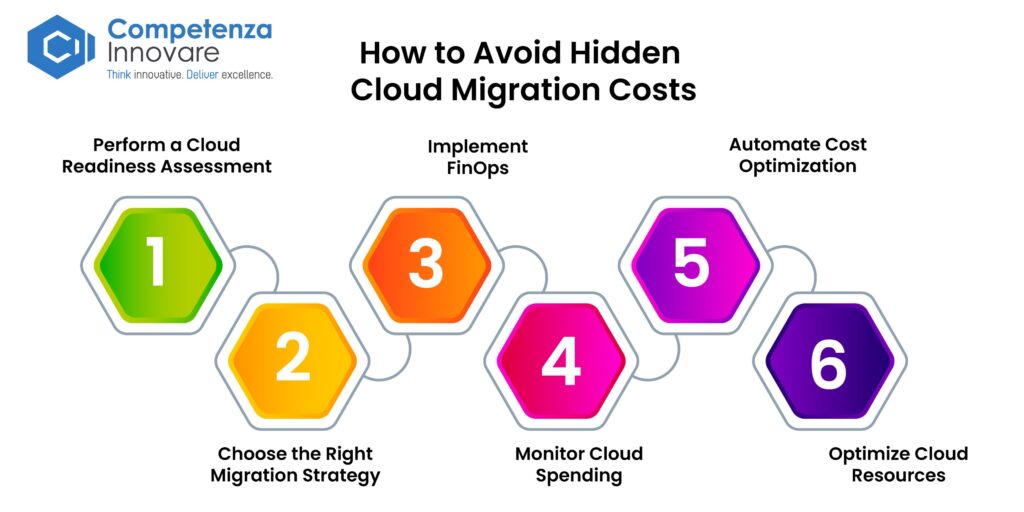
How to Avoid Hidden Cloud Migration Costs
Real-world measures to bridge the gulf between planned and actual spend on cloud migration.
Perform a Cloud Readiness Assessment
A detailed preparation analysis prior to strategy choice reveals the dependencies, complexity of integration, and general technical debt behind most of the hidden costs before there is time to plan around them, but not until the migration is in progress and they find out how expensive it has become to fix.
Choose the Right Migration Strategy
Rehosting, replatforming and refactoring have significantly different cost profiles and different hidden cost risks. Not emulating the strategy to the true features of each application but defaulting to a single strategy in the portfolio as a whole will eliminate overinvestment in applications that required less and underprovisioning of applications that actually required more.
Optimize Cloud Resources
Scale all instances to real measured workload requirements as opposed to copying on-premises capacity allocations. This single domain discusses one of the biggest and most consistent areas of cloud overspend that are documented throughout the migration programs all over the world.
Implement FinOps
Before migration is completed, there should be a set of FinOps best practices: cost visibility, clearly defined financial ownership, and ongoing optimization discipline, rather than a retrofit once the initial high cloud bill is received and finance begins to pose difficult questions.
Monitor Cloud Spending
Expenses with constant monitoring against the budget and automated notification of any anomaly in the spending patterns identify the overspend early before it is a big and uncontrollable chunk of expense, and this becomes a trend that has been growing quietly over the months.
Automate Cost Optimization
Scheduled scaling, based on predictable patterns in workloads; automated right-sizing suggestions; and proactive reserved instance control all help to reduce the manual effort one must apply to ensure cloud spend is actually in line with the actual business requirement on a consistent basis.
Cloud Migration Cost Comparison: Rehost vs Replatform vs Refactor
| Strategy | Typical Cost | Hidden Cost Risk |
| Rehosting | Low | Overprovisioning, unaddressed technical debt |
| Replatforming | Medium | Integration retesting, managed service migration |
| Refactoring | High | Parallel running cost, extended timeline overrun |
Plan Your Cloud Migration With Confidence—Talk to Our Experts Before Hidden Costs Impact Your Budget.
Cloud Migration Budget Planning Checklist
| Budget Item | Included? |
| Application assessment and discovery | ☐ |
| Data transfer and egress fees | ☐ |
| Refactoring contingency | ☐ |
| Downtime and disruption cost | ☐ |
| Licensing and subscription changes | ☐ |
| Security and compliance upgrades | ☐ |
| Right-sizing and FinOps setup | ☐ |
| Training and change management | ☐ |
| Third-party integration retesting | ☐ |
| Post-migration monitoring tools | ☐ |
Best Practices to Reduce Cloud Migration Costs
While creating any cloud migration budget, always build a contingency of 20-30 percent. Discovery should not be compromised due to timing. Instead of all play in real time, create FinOps governance in advance. Right-size it on and on. And model the impact of cloud migration ROI in three to five years, not only initial migration regularity, to learn the real overall cost of ownership.
These best practices can guide you throughout your cloud migration journey:
- Fully complete cloud preparedness assessment prior to migration.
- Identify business goals and success metrics.
- Select an excellent strategy to migrate both applications.
- Move workloads experiencing business issues.
- Track cloud utilization and expenses with five-star quality.
- Adopt steps of FinOps throughout the organization.
- Check licensing contracts prior to migration.
- Invest in change management and training of the employees.
- Optimize cloud resources and storage on a regular basis.
- Compare cloud migration ROI versus business objectives.
Conclusion
Underplanned, not unpredictable, are the hidden costs of cloud migration. The twelve classifications in this guide explain most of the budget overruns that have been reported in various programs on migration. Discuss them directly during the planning phase, and the difference between the estimated and the real cost of cloud migration becomes much less.
At Competenza, migrating a single application or modernizing an enterprise portfolio, the knowledge of these cloud migration cost factors will enable you to make decisions where necessary and prevent costly surprises.
Key Takeaways
- The hidden costs usually contribute to a substantive proportion of the entire cloud migration costs.
- Migration planning and testing of applications minimize unforeseen costs.
- The cloud egress costs and licensing, as well as infrastructure overprovisioning, are typically overlooked.
- The cost of security, compliance and employee training must be part of all migration budgets.
- Ongoing cloud optimization control of cloud costs aids in managing the long-term costs of operations.
- FinOps practices enhance transparency on cloud consumption and expenditure.
- Selecting the appropriate migration strategy reduces risk and increases ROI.
- Cloud migration must also be regarded as a continuous process of optimization, not a project.
Frequently Asked Questions
What are the most typical hidden costs of cloud migration?
Data transfer and egress charges, application refactoring, security/compliance upgrades, cloud infrastructure overspending, and monitoring tools are the most common hidden costs. All these normally translate to 20-40 percent of the original migration budget.
What makes cloud migration more costly than anticipated?
There is an excess spend in cloud migration costs due to the initial budget planning that is usually limited to infrastructure and migration tooling without factoring in discovery, refactoring, training, and cost of the continued cloud spending, which is realized after go-live. These cost factors are underscored, though predictable.
What can I do to cut the hidden cost of cloud migration?
Conduct an extensive cloud readiness assessment prior to strategy selection, select the appropriate migration strategy suitable to each application, right-size the cloud resources in an ongoing fashion, establish active FinOps governance, and actively monitor day one production cloud spending.
What are cloud egress charges, and why are they important?
Cloud egress charges refer to charges that data exiting a network of a cloud provider incurs. They are important since migration of large amounts of data and continued migration even after migration completes may involve high recurring costs that may not be properly modeled during pre-migration budgets.
Does migration strategy impact hidden costs?
Yes. Rehosting reduces initial costs and increases the risk of overprovisioning. Replatforming will introduce integration retesting expenses. Refactoring poses the greatest likelihood of hidden costs in running in parallel and schedule lengthening. Each application has its peculiar features that should be matched with strategy choice.
What is cloud overspend, and how prevalent is it?
Unplanned cloud infrastructure spending potentially greater than planned cloud infrastructure spending is often due to overprovisioning, idle resources, and passive cost management. It is also overwhelmingly widespread; the majority of organizations with no FinOps governance record have 20 to 40 percent more cloud expenditures than what was estimated in the initial year.
What is FinOps, and how does it save cloud migration costs?
FinOps is the concept of introducing financial accountability and ongoing optimization of cost to cloud spend. It minimizes the cost of cloud migration by bringing cloud visibility, ownership and active right-sizing discipline, which removes the slow cost creep of cloud spending that results when the cloud spend is not actively governed.
Should I expect some hidden costs of a cloud migration to budget for?
Yes. Experience in the industry indicates that a 20-30 percent contingency should always be added to any cloud migration budget with the express purpose of inoculating any budget to reflect findings during the discovery, refactoring requirements, and the optimization efforts that need ongoing activity in the months post-go-live.