

All cloud migration programs eventually end up on the same basic question: how do you actually move each application? Not all workloads can be treated the same, and assuming that is one of the surest paths to developing a migration that is more expensive, time-consuming, and results in less than anticipated. Rehost vs replatform vs refactor is the choice that determines the size, price, risk, and value of any application in your migration portfolio.
The three cloud migration strategies are a continuum of intervention. Rehosting relocates an application to the cloud with little or no modification, is rapid, is low risk, and is limited in what it can accomplish besides modernizing the infrastructure. Replatforming is a process of making specific optimizations to the application that enhance performance and compatibility with clouds and do not require re-architecture. Refactoring fundamentally re-architects the application, which is the greatest investment, the greatest risk, and the greatest payback. Rehosting vs. replatforming vs. refactoring is not a one-time decision to make on an entire portfolio. It is a decision on a per-application basis following the fair evaluation of what each of the applications requires and what the business can effectively justify to fully commit to any one of the applications.
This guide gives the framework to make that decision, thoroughly covering the operation of each strategy, the situation in which each strategy applies, the cloud migration strategy comparison across the dimensions that count, and the pitfalls that can lead organizations astray.
What Are Cloud Migration Strategies?
The outlined strategies that define the way in which an application is transferred between an on-premise or legacy context and cloud infrastructure.
A cloud migration strategy is the outlined method of transferring a particular application or group of applications out of the current environment and into a cloud destination. The strategy identifies the extent to which the application will be transformed during migration, the duration of the process, the cost of the process, and the appearance of the application after reaching the new environment.
There is no one-size-fits-all cloud migration approach. A predictable and stable requirements batch processing system cannot be approached the same way as a customer-facing application that should run at scale owing to the changes of modern APIs. The connections between cloud migration and application modernization are worth considering: migration shifts an application to the cloud; modernization upgrades what the application does and the way it does it. There are strategies of cloud migration that achieve the two at the same time. The rest only achieve the former, and modernization is done at a later stage.
Understanding Rehosting (Lift and Shift Migration)
The quickest route towards cloud infrastructure with the least change to the application itself.
What Is Rehosting?
Rehosting or lift-and-shift migration involves migrating an application in its current environment to cloud infrastructure without altering the code, architecture, or business logic of the application. The app is operated using virtual machines in the cloud and not on the physical on-premises servers, yet it is the same in all other aspects.
How It Works
The migration team develops virtual machine images or containers mirroring the existing server environment, migrates the application and application data to those environments in the target cloud, reconfigures network connectivity and DNS, confirms that the application is running properly in the new environment, and decommissions the on-premise infrastructure. This is more of an infrastructure development than application development.
Advantages of Rehosting
- Speed: The quickest of the three cloud migration strategies is rehosting. When time-to-cloud is the key factor, applications can be transferred in weeks, not months, and thus it is the best choice.
- Low risk: Since there is no change in the application itself, the threat of introducing new bugs and breaking the current capabilities as well as reducing the business operations is greatly diminished as compared to more invasive strategies.
- Reduced initial cost: With no effort spent on application development, the cost of rehosting is dominated by infrastructure and migration tools, significantly much lower compared to refactoring or replatforming.
- Data center exit: In the case of organizations with inevitable data center exit deadlines, lease expiries, hardware expiries, or regulatory compliance motivations, rehosting is the discussion that offers the quickest method by which on-premises infrastructure is decommissioned.
Limitations of Rehosting
There is limited modernization value of rehosting. An application that was once slow, scaled poorly, or was expensive to maintain on-premise will do all three again in the cloud unless the architecture has changed. In lift and shift migration, technical debt is carried over. Auto-scaling features, managed services, and serverless computers are cloud-native features that are unavailable to an application not adapted to utilize them. And the cost of cloud infrastructure used to run applications that are not right-sized or optimized used to be higher than expected.
Best Use Cases for Rehosting
Rehosting is an appropriate cloud migration approach when the application has been functioning satisfactorily in the current state and modernization of the infrastructure is the primary reason driving migration and not application optimization. It is applicable to applications with a deadline to a data center, those whose workload is stable and requires less elasticity, and the ones whose business case for modernization does not warrant the replacement or refactoring expenses in the short term.
Estimated Cost and Timeline
Compared to replatforming the same application, rehosting is about 30-60 percent cheaper and may take between two and eight weeks with medium-complexity workloads. Post-migration infrastructure expenses can be similar to or a little more than those of on-premise unless right-sizing is not addressed, a fact that makes rehosting a stage at the beginning of a longer process of modernization.
Understanding Replatforming
Performance optimizations tailored to gain cloud improvements without complete re-architecture.
What Is Replatforming?
Replatforming is a process of moving an application to the cloud and performing only small, specific changes such that the application can leverage the capabilities of a cloud platform without an underlying re-architecting of the application. The fundamental logic, structure, and functionality are preserved. Its platform is updated in a selective manner.
How It Works
The most common replatforming changes are switching a self-managed database to a managed cloud database service, a self-managed application server to a platform-as-a-service environment, application containerization with no internal architecture changes, swapping on-prem middleware with cloud-native equivalents, and managed auto-scaling instead of manual capacity management.
Advantages of Replatforming
- Improved performance without rewriting: Cloud databases such as RDS, Cloud SQL, and Azure Database typically offer improved performance, availability, and reliability compared to their self-managed counterparts, with much less operational overhead.
- Less infrastructure management: managed services under replatforming help the cloud provider handle infrastructure management, relieving their internal team of the operational load without needing a complete rearchitecture of the application.
- Cloud cost optimization: Auto-scaling, managed services (configured to right-size), and price models (pay-as-you-use) are more available to replatformed web applications than rehosted ones, providing superior cost efficiencies over time compared to lift-and-shift migration.
- A platform to continue modernizing: Replatforming deploys the application into a modern cloud space, without necessarily reengineering the entire architecture, providing the base on which the ongoing application modernization can occur.
Limitations of Replatforming
Replatforming is more complicated and costly than rehosting; it involves not only the effort in application development but also infrastructure migration. It is not focused on fundamental architectural limits. It cannot after replatforming an application that cannot be scaled horizontally, independent of each other, and cannot be deployed or updated independently. And the incremental benefits that it brings might not make it worth the investment when there is a real need for complete re-architecture to satisfy the business needs of the application.
Best Use Cases for Replatforming
Replatforming is appropriate in those applications where infrastructure and middleware modernization provides significant business utility without requiring the investment and undertaking of full refactoring. It fits well in applications that have solid core logic but are life cycle dependent on infrastructure, applications that require enhanced database performance or availability, and organizations that have a schedule of gradual modernization through many steps.
Estimated Cost and Timeline
Replatforming can generally cost between 40 and 80 percent more than rehosting the same application and requires two to four months when it comes to medium-complexity workloads. This extra investment payoff is expected to be warranted by an approximately better performance after migration, reduced infrastructure management costs, and a more competent base for future modernization.
Understanding Refactoring (Re-architecting)
The greatest investment and the greatest payback is to fundamentally re-architect the application into being cloud-native.
What Is Refactoring?
Refactoring, also referred to as re-architecting, is a true conceptual overhaul of the application architecture to exploit cloud-native features. The business logic remains unchanged, though the implementation is reframed, often breaking a monolith into microservices, adopting container-based orchestration such as Kubernetes, using event-driven architectures, and being based on cloud-native managed services.
How It Works
Refactoring will begin with a thorough examination of the current application framework and then the realization of a perfect cloud-native structure to meet the current and future business requirements. It is applied either using the compared strangler fig pattern, which switches monolith elements to cloud-native services over time, or is built alongside the existing system over time before cutover.
Advantages of Refactoring
- Full cloud-native scalability: Refactored applications can scale horizontally and elastically and can add capacity on demand and scale down when it is not being utilized as well as managing traffic spikes without human intervention.
- Microservices architecture: By breaking down monoliths into separately deployable microservices, teams can develop, test, and deliver individual parts without impacting the entire system, resulting in enormous growth in development speed.
- Eliminating technical debt: Refactoring is the sole cloud migration strategy that truly approaches accumulated technical debt instead of bringing it to the new environment. The outcome is a codebase that is more maintainable, faster to develop against, and resilient.
- Long-term ROI: The product of elasticity in the project, higher development rate, lower price of infrastructure, and less maintenance load offers the best long-term payoff of the three strategies and is worth the increased initial investment of applications where such benefits are commercially significant.
Limitations of Refactoring
Refactoring has the worst price, the longest time schedule, and the highest implementation risk of the three strategies. It demands highly trained cloud architects, microservice and Kubernetes-skilled developers, and heavy investment in testing. Refactoring does not bring to fruition its business value until the program is finished, or, in other words, the payoff is cost postponed compared to the initial cost. And unless the requirements are well-known when refactoring commences, the new architecture can be as off-target as the legacy system it supersedes.
Best Use Cases for Refactoring
The appropriate cloud migration approach to applications with high technical debt that is limiting the pace of development, applications that must be cloud-scalable to support business growth, products where microservices architecture and independent deployability are key strategic concerns, and long-run products whose overall cost of ownership covers five or more years warrants the modernization investment.
Estimated Cost and Timeline
A resume refactoring can be three to ten times as expensive as rehosting such an application and takes six months to two years for medium-to-high complexity workloads. The right applications that justify the investment include the application where the architecture truly restricts the business and where the long-term payoff is evident.
Rehost vs Replatform vs Refactor: Detailed Comparison
The optimal cloud migration strategy will depend on your business aspirations and cost, application sophistication, and future modernization. The table below presents a comparison between the three most popular approaches concerning the most important factors.
| Factor | Rehosting (Lift and Shift) | Replatforming (Lift, Tinker & Shift) | Refactoring (Re-architecting) |
| Definition | Move the application to the cloud with few or no code changes. | Make limited application changes to take advantage of cloud-managed services. | Redesign or rewrite significant parts of the application for a cloud-native architecture. |
| Development Effort | Minimal | Moderate | High |
| Upfront Cost | Low | Medium | High |
| Migration Speed | Fast (a few weeks) | Moderate (1–6 months) | Slow (6 months to 2+ years) |
| Business Risk | Low | Medium | High |
| Application Downtime | Low | Moderate | Depends on migration approach; generally higher if not phased |
| Code Changes Required | Minimal or none | Partial code modifications | Extensive code restructuring or complete rewrite |
| Scalability | Limited | Improved | Fully cloud-native and highly scalable |
| Performance | Similar to on-premises | Better performance through cloud optimization | Significantly improved through architectural redesign |
| Cloud Cost Optimization | Limited | Better use of managed cloud services | Maximum long-term cloud cost efficiency |
| Security | Infrastructure-level improvements only | Improved security using managed cloud services | Built with Zero Trust, cloud-native security, and DevSecOps practices |
| Cloud-Native Readiness | Low | Partial | Full |
| Technical Debt | Remains largely unchanged | Partially reduced | Significantly reduced or eliminated |
| Architecture | Existing monolithic architecture remains | Modernized architecture with selective improvements | Often transformed into microservices or event-driven architecture |
| Use of Managed Cloud Services | Minimal | Moderate | Extensive |
| Integration with Modern Services | Limited | Improved | Excellent API-first integration capabilities |
| Business Agility | Low | Moderate | High |
| Future Innovation | Limited | Good | Excellent |
| Maintenance Requirements | Similar to legacy application | Reduced | Significantly reduced |
| Long-Term ROI | Lower | Moderate | Highest |
| Typical Use Cases | Exit data center, imminent migration to the cloud, and migration of aged workloads. | Database modernization, operating system modernization and optimization of applications. | SaaS renovation, digitization, use of AI, development of cloud-based applications. |
| Best For | Companies that require fast availability of migration with limited risk. | Businesses that want to achieve a balance between speed, price, and the current times. | Organizations that are innovation-driven, scalable, and long-term competitive advantage oriented. |
Which Cloud Migration Strategy Should You Choose?
A decision guide with actions to follow supported by the nature of your application and the needs of your business. Choose Rehosting If:
Choose Rehosting If:
- You require an urgent cloud migration: Time is the most important constraint, a data center deadline, a hardware end-of-life date, or a compliance driver that cannot hold to a longer program. Rehosting is the quickest application deployment service to the cloud.
- Budget is limited: Rehosting provides the benefits of cloud infrastructure at the minimum initial investment. It has offered a possible way to the cloud to organizations without the means to replace or refactor to achieve modernization.
- The application is usable: provided that the application fits existing performance and scalability needs and is not a future development platform, it makes commercial sense to take it to the cloud as-is.
- You must leave the data center in a hurry: Lease ends, hardware generational timescale, and cost reduction programmes that rely on decommissioning of the data centres all prefer the quickest route to lean out.
Choose Replatforming If:
- You need improved performance without an overhaul: The application is based on sound core logic but is limited by self-managed infrastructure, databases, middleware, or application servers, which could be upgraded by managed cloud services at less operational cost and with better performance.
- You require database or middleware upgrades: Moving from unmanaged to managed cloud equivalents like Oracle, SQL Server, or MySQL during migration has been a time-tested replatforming case that offers a large-scale change in operations at an affordable price.
- Cloud cost efficiency is important: Auto-scaling and managed services are more economical than the fixed infrastructure of a rehosted application, which is worth it in cases where the workload of the application varies, and cloud elasticity is valued commercially.
- You are considering gradual modernization: Replatforming sets up a modern cloud platform on which legacy application modernization can then proceed slowly in the future without an upfront commitment to a full refactoring investment.
Choose Refactoring If:
- Technical debt is measuring the velocity of development: each new feature is developed more slowly than it ought to, change is met with a disproportionate regression risk, and the development team spends more time working through legacy code than creating value. The only solution that can deal with this structurally is refactoring.
- Cloud-native scalability is a business consideration: The app should be elastically scalable, able to operate under peak loads without over-provisioning, and able to utilize serverless or event-driven designs only available to cloud-native designs.
- The target microservices architecture: can be decomposed into microservices with independent deployment: It is not possible to re-architect a monolith and replace it with rehosting or replatforming.
- Long-term innovation is a strategic priority: services to be actively developed, expanded, and enhanced over multiple years must be based on a cloud-native platform that enables that roadmap, not dragged on a legacy architecture that will hold it back.
Factors to Consider Before Choosing a Migration Strategy
It is the assessment dimensions that identify the appropriate approach to be applied to each application.
- Business objectives: What is the migration attempting to do? The exit of data centers, reduction of costs, improved performance, velocity in development, and digital transformation are all indicative of various strategies.
- Budget: Refactoring is the most lucrative in the long run but the most costly initial investment. Communicate the truth of why the business is commercially justifiable in terms of each usage.
- Existing architecture: The clean and modular architecture of applications makes them better candidates for replatforming or refactoring as compared to applications with significantly large monolithic codebases.
- Technical debt: The greater the technical debt, the greater the reason to refactor since rehosting and replatforming propagate, instead of eliminating, the technical debt.
- Security and compliance: Cloud migration planning, regulated industry/financial service provider/financial services regulation Financially regulated (FCA/SEC), healthcare (HIPAA), and organizations processing EU data (GDPR) should explicitly translate compliance needs into the strategy to be used before any work commences.
- Downtime tolerance: certain applications are unable to endure lengthy windows of migration. Refactoring programs represent the highest cutover risk; rehosting is generally the easiest to cutover; and blue-green deployment strategies or running two programs in parallel represent the most complex forms of cutover.
- Team skills: Cloud architecture and microservices development skills are needed for refactoring. Should such skills not be available in-house, consider the cost and schedule of acquiring or contracting these to include in the strategy choice.
- Scalability requirements in future: Applications that are likely to reach a large number of users or large amount of data must have the ability to sustain that data growth or user growth. This is hardly afforded by rehosting and is always afforded by refactoring.
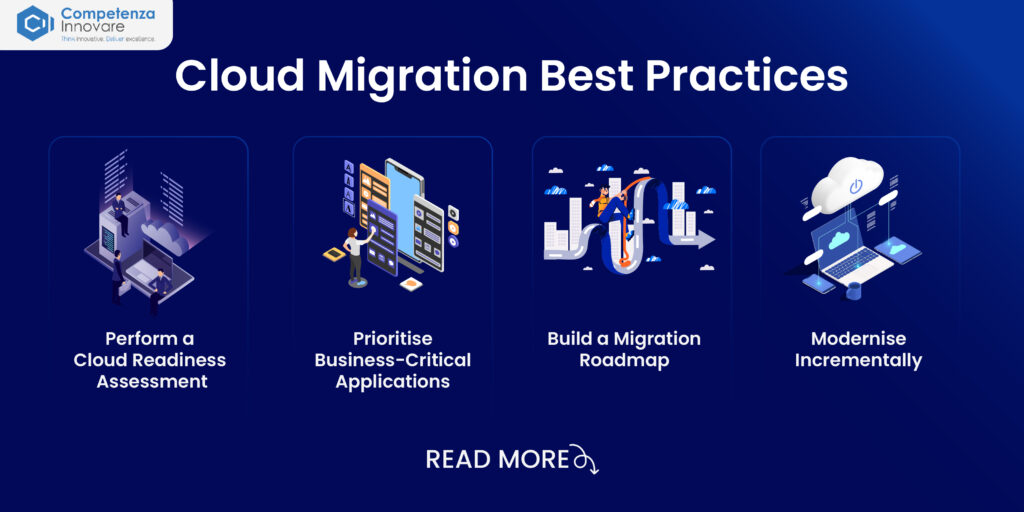
Cloud Migration Best Practices
The fields that clarify whether cloud migration achieves its intended results.
Perform a Cloud Migration Readiness Assessment
Know where you are and then commit to a strategy.
Prior to applying migration strategies to applications, you need to compare them with the dimensions that inform the correct method of technical debt, architecture quality, business criticality, integration complexity, and compliance requirements. There are always better chances of a structured cloud migration planning process based on good assessment than assumed.
Prioritise Business-Critical Applications
Migration of sequences to optimize business value delivery.
The modernization investment is not justified in every application. Rank applications based on which migration provides the most business value, the highest user impact, the largest technical debt cost, and the most material compliance risk, and also rank the less important applications in order of their importance.
Build a Migration Roadmap
Staged delivery eliminates risk and provides value sooner.
A migration roadmap splits the entire program into phases; each phase is of a certain scope, sequencing, dependencies, and success criteria. The gradual delivery method will enable the organization to realize value sooner, develop team capacity over time, and realign every stage through learning.
Modernise Incrementally
Apply the strangler fig pattern to re-architectural high risk.
In scenarios where refactoring can be the appropriate approach, the strangler fig pattern, gradually introducing the new cloud-native services as the legacy system continues to run, decouples the risk more than a big-bang replacement.
Strengthen Security Throughout Migration
Security is an ongoing process, rather than a point in time.
Implement security cloud migration best practices throughout each stage, threat model on design, DevSecOps in the CI/CD pipeline, hardening of the cloud infrastructure, redesign of IAM, and verification of compliance before going to production.
Monitor Performance After Migration
Confirm that migration has brought desired results.
Implement cohesive monitoring since the very first day of production activities, including the use of application performance, infrastructure cost, security posture, and user experience metrics. The post-migration monitoring proves the business case and brings about the concerns before they impact the users greatly.
Optimise Cloud Costs Continuously
Cloud cost management is a continuous practice.
Right-sizing, reserved instance planning, auto-scaling configuration, and storage tier optimization are all post-migration tasks that make the difference between realizing the anticipated savings in cloud costs. Introduce FinOps as a part of the program instead of considering cost optimization as an after-launch activity.

Common Cloud Migration Mistakes to Avoid
The trends that continually sabotage migration programs.
- Selecting an incorrect strategy: Using rehosting of an application that really requires refactoring results in a cloud-based legacy system that still limits the business. When an application that would more have been served by replatforming is refactored, the budget is wasted. -Equal opportunity to match the strategy with the application.
- Disregarding technical debt: Rehosting an application that has high technical debt transports that debt to the cloud platform. The technical debt becomes no less expensive to service by the cloud, except that the interest is provided elsewhere.
- Underestimating migration expenses: Discovery is always more complicated than first glance would suggest. Introduce purposeful contingency in migration budgets, especially in replatforming and refactoring programs where the complexity of the application is strong.
- Missing performance testing: Applications that have performed well locally might not behave similarly in clouds, especially in network latency, I/O response, and database connectivity. Testing of performance in the cloud environment prior to cutover to production is not negotiable.
- Weak data migration planning: Data migration is the riskiest part of the majority of migration programs. Problems such as the quality of the data, the incompatibility of the schemas, and differences in the encoding are all costly problems that are not easy to correct once they occur. Migrate plan data as an independent, overt workstream.
- Absence of governance: Migration programs without formal governance at the helm in the shape of committees, success measures, and frequent review of progress become a wayward drift. Scopes increase, schedules lengthen, costs mount, and unless procedures are commercial, programs remain on track with business objectives.
Conclusion
Rehost vs replatform vs refactor is not an all-purpose decision. Every cloud migration strategy provides a dissimilar value at varying prices and hazards, and the correct option to use with a single application is determined by a genuine evaluation of what that single application’s requirements are, what can be commercially equalized by the business, and what the long-term strategic goals of the migration program are.
Rehosting has speed and initial cost advantages. Replatforming is a balance between the gains of modernization and investment and risk. The best long-term payoff is found in refactoring when the applications deal with cloud-native architecture that realistically alters the capability of that product and the development process.
Give each application a different strategy due to its unique characteristics rather than one strategy to the whole portfolio. Possess extensive cloud-preparedness evaluation prior to making resolutions on strategy. At Competenza, develop migration path maps that rank applications by business importance and risk. See the migration to the cloud as a journey rather than a destination, which becomes a program of continuous improvement as the application portfolio and the cloud platform progress.
Frequently Asked Questions
What is the difference between rehosting and replatforming and refactoring?
Rehosting, replatforming, and refactoring are approaches that migrate applications to the cloud with few alterations and limited optimizations to take advantage of cloud service providers and redesign the application to specifically be cloud-native architecture.
What is the quickest cloud migration strategy?
The process of rehosting, or lift-and-shift, is the quickest since it involves a couple of changes in code.
When is replatforming the right option over rehosting?
Select replatforming when your application can take advantage of being managed on the cloud, more optimal performance, and cost savings.
Does refactoring cost more than rehosting?
Yes, refactoring involves important code rewriting and architectural re-engineering and is relatively costlier in the short term but usually more scalable and provides a higher ROI in the long term.
What is the most appropriate strategy for the migration of legacy applications?
The optimal approach is based on the objectives of business, technical debt, cost, and timeframe. Applications that have few problems can be rehosted, and applications that require scalability in the long term can be refactored.
Does refactoring enhance the performance of clouds?
Yes, refactoring will enable the application to leverage the cloud-native features such as microservices, containers, autoscaling, and managed services to increase performance and resiliency.
Can you combine different types of cloud migration strategies?
Yes, a typical trend in most businesses is any given gradual migration, whereby some applications are migrated to score speed but others are migrated or refactored to suit the importance of a business.
Which is the right way of cloud migration?
Analyze your application architecture, technical debt, business goals, compliance requirements, and budget and the future scalability requirements prior to choosing