

Artificial intelligence has swept through and changed the way businesses automate, create content, analyze, and enhance customer experiences. The focus of this change is the models of language, which are the artificial intelligence systems that are trained to comprehend and produce human language. As Large Language Models (LLMs) have gotten all the attention because of the amazing power of the models, another type of small model has recently emerged called Small Language Models (SLMs), and the latter are becoming more popular among companies that want to find quicker and cheaper solutions to their problems with the help of AI.
The small language models vs. large language models debate is gaining more significance as companies seek the appropriate compromise between performance, cost, privacy, and scalability. In most cases, large may not necessarily be great.
This guide addresses the full small-language-model-vs.-large-language-model comparison and is able to explain what the small language models are and why they have benefits and constraints, and assists businesses in understanding when they should rely on small language models over larger language models.
Understanding Language Models
Language models are AI systems that are trained on large volumes of textual information to generate, understand, and predict human language.
These models can:
- Answer questions
- Generate content
- Summarize documents
- Translate languages
- Write code
- Analyze data
- Support decision-making
Transformer architecture language models allow machines to reason about context and word relationships far better than traditional natural language processing systems and do so more effectively. With the rise of AI, organizations now have a decision to make between implementing large generalized models or smaller specialized options.
What Are Small Language Models (SLMs)?
Small language models (SLMs) are AI language models that contain much fewer parameters compared to large language models.
Most SLMs have a few million to several billion parameters, whereas the numbers of parameters in LLMs can be in hundreds of billions, or even trillions.
Key Characteristics of Small Language Models
- Compact architecture
- Faster inference times
- Lower hardware requirements
- Reduced energy consumption
- Easier deployment
- Lower operational costs
- Better suitability for edge devices
Small Language Models Examples
Popular small language models (SLMs) are:
- Microsoft’s Phi series
- Google’s Gemma models
- Mistral 7B
- TinyLlama
- MobileBERT
- DistilBERT
- Alpaca-based lightweight models
A number of these models are focused on specific business activities as opposed to general intelligence.
What Are Large Language Models (LLMs)?
Large language model Developments are sophisticated AI systems that are trained on large-scale datasets with enormous amounts of computational resources.
Core Features of LLMs
- Massive parameter counts
- Extensive knowledge coverage
- Strong reasoning abilities
- Long-context understanding
- Multi-domain expertise
- Advanced content generation
This enables LLMs to carry out tasks obviously outside of what they were ever directly trained for; hence, they are very versatile.
Examples include:
- OpenAI GPT models
- Anthropic Claude
- Google Gemini
- Meta Llama 4
- xAI Grok
These models are also meant to carry out a wide variety of work without much specialization.
SLM vs. LLM: Key Differences at a Glance
| Feature | Small Language Models (SLMs) | Large Language Models (LLMs) |
| Parameters | Millions to billions | Tens of billions to trillions |
| Hardware Requirements | Low | Very High |
| Deployment Cost | Low | High |
| Inference Speed | Fast | Slower |
| Energy Consumption | Lower | Higher |
| Accuracy | Task-Specific | Broad Generalization |
| Edge Deployment | Excellent | Limited |
| Privacy Control | Better | More Complex |
| Fine-Tuning | Easier | More Expensive |
| Maintenance | Simpler | More Complex |
The table is indicative of the key distinctions in the SLM vs LLM comparison.
Advantages of Small Language Models
Small Language Models (SLMs) have been associated with increasing popularity since they can be used to solve numerous real-world business problems.
Lower Operational Costs
The infrastructure costs of SLM deployment are much lower, and, thus, AI adoption is affordable and accessible to start-ups and middle-size enterprises.
Faster Deployment
SLMs are simpler to implement, test and optimize since they are smaller. This allows companies to be able to transfer the proof of concept to production faster.
Enhanced Privacy
SLMs are more popular with organizations that handle sensitive information since they can be installed locally. This reduces the use of third-party cloud platforms and serves to enhance data protection and privacy.
Edge AI Capabilities
SLMs can run directly on:
- Smartphones
- Tablets
- IoT devices
- Industrial equipment
- Embedded systems
Large language models prove to be significantly more difficult to run in such environments.
Reduced Energy Consumption
Sustainability is an increasing business objective, and as such, SLMs are a more energy-efficient and green way of AI implementation.
Advantages of Large Language Models
Although the advantages of SLMs are difficult to deny, the choice of large language models (LLMs) is still in place in the case of most advanced applications of AI.
Superior Knowledge Base
All of them feed LLMs with numerous datasets featuring features of different industries, subjects, or even languages and give them a lot of knowledge and understanding.
Advanced Reasoning
LLMs have advanced reasoning capabilities, which prove valuable in addressing such complicated problems and decision-making.
Better Content Generation
Large language models are adept at generating:
- Long-form articles
- Marketing copy
- Technical documentation
- Research summaries
- Creative writing
Greater Flexibility
LLMs are capable of doing a wider set of tasks without having such intensive retraining or customization.
Stronger Generalization
A major strength of LLMs lies in their capability to transfer knowledge in one area to completely different tasks and applications.
Limitations of Small Language Models
Small Language Models (SLMs) have a number of limitations despite their advantages when it comes to comparing SLM vs LLM solutions. They are efficient and cost-effective but might not be able to compete with large language models on complex tasks.
Limited Knowledge
Since the SLMs are trained with smaller data sets and are not as many-parameter, they cannot encode or decode as much data as the LLMs can. This is able to affect performance in special or knowledge-intensive subjects.
Reduced Reasoning Performance
Many day-to-day tasks can be solved by small language models, yet more intricate problem-solving and advanced thought processes tend to be stronger points of large language models.
Smaller Context Windows
Long documents, a long conversation or large quantities of information simultaneously are more difficult to process due to many SLMs having limited context windows.
Lower Adaptability
Certain SLMs are very good in certain applications but can be poor at other activities not within their training area. This is one of the distinctions between small language models and large language models: LLMs are more flexible and designed to be utilized in a larger number of applications.
Also Read: Regulatory Compliance for LLMs
Limitations of Large Language Models
Large Language Models (LLMs) are very powerful but still have several challenges that organizations should not fail to recognize in any SLM vs LLM comparison. They are not as practical in other applications because they may be costly, demand more infrastructure and take longer to install.
High Costs
Cost is one of the largest constraints of LLMs. Running large language models, tuning, and training are very computationally intensive, which may raise costs of running a business.
Infrastructure Requirements
Many LLMs, unlike small language models, demand powerful infrastructure to provide high efficiency. This usually comes with high-performance GPUs, massive memory allocation, and dedicated AI hardware, which complicates and increases the cost of deployment.
Latency Issues
LLMs are able to produce lower response times due to their size and the complexity of their computations. This may be a challenge to those applications that require real-time processing or low-latency responsiveness.
Privacy Risks
Cloud-hosted LLMs are used by many organizations and may present privacy and compliance risks when dealing with sensitive data. This is a consideration about small and large language models in businesses where there are strict regulations.
Understanding the Trade-Off
In the choice of an SLM vs LLM solution, the organization should balance both performance and cost and deployment needs. Whereas LLM makes more effective arguments and has overall knowledge and flexibility, SLM may have benefits in efficiency, privacy and operational cost.
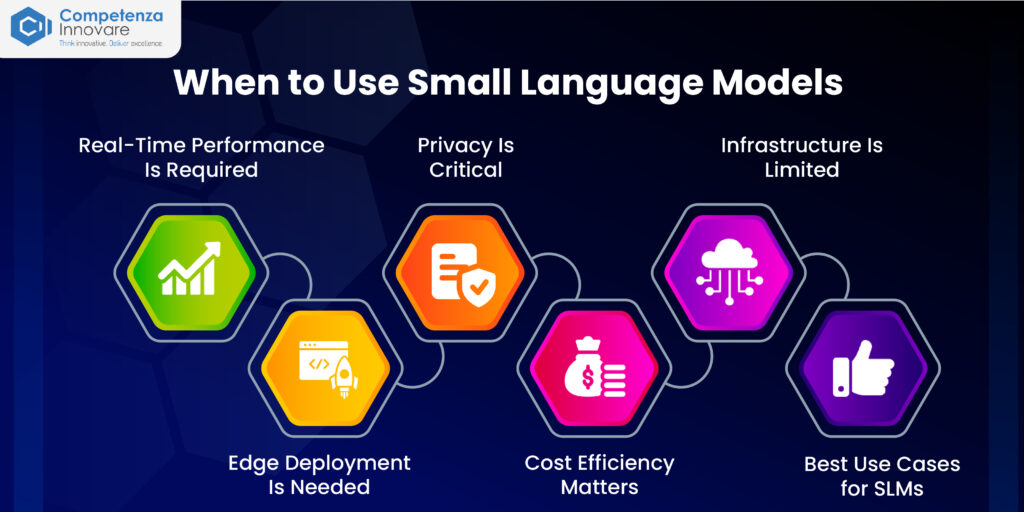
When to Use Small Language Models
When to use small language models is an important fact to know when choosing the right AI solution and making the investment most efficient. SLMs are also usually preferable in an SLM vs LLM debate when time-saving, efficiency, privacy, and cost-effectiveness have the utmost importance.
Real-Time Performance Is Required
Small language models can be expected to work well in applications with low latency and high response times. Lightweight design enables them to infer faster; hence, they are best suited to customer support chatbots, virtual assistants, and real-time business applications.
Privacy Is Critical
The organizations that deal with sensitive information mostly use SLMs, as they can be deployed either on-premises or on the internal infrastructure. It is also useful in reducing exposure to data, and it helps with the compliance requirements of various industries such as healthcare, finances, and the government.
Infrastructure Is Limited
SLMs also do not demand large amounts of computing resources to be effective, unlike large language models. Small language models can be deployed much more easily by businesses that do not have access to a large cluster of GPUs or special AI hardware.
Edge Deployment Is Needed
SLMs are a robust option when the model is needed to execute at the edge and the device requires the model to be directly embedded in it. The efficiency and low resource needs of small language models can be used in smartphones, IoT applications, industrial applications, and embedded systems.
Cost Efficiency Matters
SLMs also provide a good alternative to companies that seek to scale up AI programs without impacting the cost of running the business. They are cheap in terms of infrastructure, energy and deployment costs, and this reason makes them the choice of enterprises looking to embrace AI at low costs.
Best Use Cases for SLMs
Customer service automation, on-device AI assistants, internal business applications, IoT applications, edge computing environments, and other applications where speed, privacy, and cost efficiency are of more significance than sophisticated reasoning or comprehensive knowledge coverage are common uses of small language models.
Choose the right AI model for your business—partner with The Competenza for smarter AI solutions and strategies.
Industry Use Cases: SLMs vs. LLMs
The Small Language Models (SLMs) allocation or Large Language Models (LLMs) could concern the needs of the industry, their performance expectations, privacy needs, or the availability of accessible infrastructures. Learning of the application of AI in various industries can enable organizations to decide the correct way in the current SLM vs. LLM debate.
- Healthcare: SLMs facilitate the use of healthcare documentation, patient support, and on-premises deployments, privately. LLMs assist in medical research, clinical understanding, and analysis of intricate healthcare information.
- Finance: SLMs are generally required in customer support, fraud detecting and document processing. LLMs will support financial analysis and risk assessment and will create detailed reports.
- E-commerce and Retail: SLMs are used to drive chatbots and product recommendations as well as inventory management. The LLLMs enhance customer experience by delivering personalized content, using virtual assistants and marketing content creation.
- Manufacturing: SLMs can be used to monitor equipment and are applicable to edge AI in factories. LLMs are useful in streamlining operations, production data analysis, and creating technical documentation.
- Education: SLMs complement learning assistants and educational tools. LLM boosts research, content generation, and customized learning experiences.
- Logistics and Supply Chain: SLMs assist in automating shipment and warehouse management. LLMs aid in the demand forecasting, supply chain planning, and operational decision-making.
Conclusion
Small language models vs large language models The question of which side of the debate is correct is not whether there is a universal winner. Rather, it is a matter of getting the right tool to the right job.
Small language models provide strong benefits to organizations that are interested in speed, privacy, efficiency and cost minimization. At competenza, considering when to use small language models are frequently in a situation where SLMs can offer adequate performance with massive infrastructure savings.
At the same time, large language models remain the leaders in high-level reasoning, general knowledge and generation of complex content.
With the rise in the pace of AI adoption, the most successful organizations will not decide to adopt one of the technologies over the other; instead, they will position both technologies to enhance value, performance and scalability.
Frequently Asked Questions (FAQs)
What is the difference between SLMs and LLMs?
The main difference between Small Language Models (SLMs) and Large Language Models (LLMs) is their size, resource requirements, and capabilities. SLMs are designed to be efficient, cost-effective and fast-performing, whereas LLMs are more well-knowledge-based and more reasoning and flexible in a large set of tasks.
Are SLMs cheaper than LLMs?
Yes. The benefit of lower operational cost is one of the largest of SLMs. They use less energy, consume less computing power, and in many cases can be run on standard hardware, making them a low-cost solution in many business applications.
Are SLMs a replacement for LLMs?
Not all situations. The use of SLMs is optimal when the tasks applied are high-speed, confidential, and efficient. But LLMs are still more suitable when it comes to higher-level reasoning, content generation at scale, and knowledge-intensive use. The ideal variant is based on the usage.
What industries are most benefiting from SLMs?
SLMs are usually useful in industries like healthcare, finance, retailing, manufacturing, education and logistics. They can be useful in organizations that must have stringent privacy or performance because they can be run locally, have edge deployment support features, and are less costly to deploy.
Are the LLMs more enterprise application-friendly?
It varies depending on the usage. Enterprise LLDs are commonly well-suited to applications of complex analysis, research, decision support, and content generation. Nevertheless, a lot of businesses prefer SLMs for customer service, automation, and internal tools in which efficiency and cost-saving are more significant.
How do SLMs improve data privacy?
The SLMs can be implemented on local servers or private infrastructure or edge devices, which do not have to transmit sensitive data to external clouds. This helps businesses to gain more control of their information and remain in line with the regulation standards.
What are the deployment policies of SLMs and LLMs?
SLMs can usually be executed with minimal hardware and even utilize common servers, laptops, smartphones, and IoT devices. The deployment of LLMs can be more resource-intensive, as they often demand high-performance GPUs and large memory allocations and need a particular AI infrastructure.
Is it possible to combine SLMs and LLMs in businesses?
Yes, many organizations use a hybrid method of AI combining SLMs with LLMs. Matured and high volumes of work are best suited to using an SLM, as compared to advanced reasoning, analytics and highly knowledgeable workloads in LLM. The approach helps the businesses strike a balance of performance, cost and scalability.