

Large language models (LLMs) are reshaping the process of automating workflows, improving customer experiences, and coming up with insights at scale in organizations. Nonetheless, with the increasing tempo of the uptake of generative AI, the issues of transparency, accountability, the protection of data, and risk management are growing. These issues have put the focus of enterprise AI strategies on LLM compliance and AI regulatory compliance.
The user-friendly and industry-oriented framework, the EU AI Act, the first global comprehensive policy regarding artificial intelligence, creates new liability for organizations producing or implementing general-use AI predictions and other AI systems. Due to the requirements of technical documentation and transparency, the continuous work with AI and monitoring as well as risk assessment activities, businesses have to prove that their AI products work responsibly and in accordance with the expectations of the regulations.
Meanwhile, companies operating in highly regulated sectors like the financial services and healthcare sectors need to take into consideration both sector-specific regulations and wider AI compliance regulations. To manage risks, ensure trust and promote responsible use of AI, it is thus important to construct an efficient AI governance framework.
This guide examines the essential provisions of the EU AI Act, the compliance burden of the use of LLMs, and the management practices that organizations can adopt to achieve balance between new regulatory requirements and remain innovative with AI.
Why LLM Compliance Has Become a Business Priority
With the trend towards larger language models (LLMs) in organizations, compliance with AI is an urgent requirement. As much as more productive and automated processes can be implemented, the risks of the use of LLMs are also expected to affect business functions and legal expectations.
Unique Compliance Risks of LLMs
Inaccurate information called “hallucinations” can be generated by LLDMs, potentially resulting in making poor decisions or bad information. They are also able to generate biased outputs, casting doubt on fairness and discrimination. Intellectual property challenges, risks to data privacy, and security risks and low explainability are other challenges, and it is hard to comprehend how some of the outputs are created.
Regulatory Pressure Is Increasing
New regulations to regulate the AI systems are being implemented by governments and regulators. Regulations in AI with rules such as the EU AI Act are increasing the standard of AI regulatory compliance with organizations establishing rules, risk management and oversight practices. It is also anticipated that businesses should comply with changing legal requirements from AI and report the manner in which they apply and monitor their AI systems.
Business Consequences of Non-Compliance
Lack of compliance may lead to regulatory fines, legal issues, and loss of reputation. There is also a risk that organizations lose customer trust and their operations may be disrupted in case AI systems generate perilous or unreliable results. Responsible AI compliance practices can mitigate these risks and provide for the safe use of LLMs.
Also Read: SLM vs LLM: When to Use Small Language Models
Understanding How the EU AI Act Applies to LLMs
The EU AI Act is proposing new regulations of advanced AI systems, including large language models (LLMs). Its prerequisites are based on the nature of the AI model and its application.
What Are General-Purpose AI Models?
The general-purpose AI models (GPAI) are AI models that are applicable to a wide variety of tasks and can be applied in many applications. Many of these models are known as foundation models due to the ability to customize them to applications.
Examples include:
- GPT models
- Claude
- Gemini
Their wide-ranging abilities mean that these models are prone to particular foundation model rules under the EU AI Act.
Key EU AI Act Requirements for LLM Compliance
To ensure compliance with LLMs, companies are advised to pay attention to the following:
- Technical documentation outlining model capabilities, intended use, and limitations
- Transparency requirements, such as informing users when content is AI-generated
- Copyright and data governance practices related to training data and legal compliance
- Risk management processes, including ongoing monitoring and risk mitigation
High-Risk AI Systems and LLM Deployments
An LLM can be included in a risky AI system in the domain of sensitive subjects where their decisions can make a lot of difference to others.
Examples include:
- Hiring and recruitment
- Healthcare and medical support
- Financial services, such as loan or credit assessments
Organizations with a higher number of controls, oversight, and written documentation might be necessary in such settings to meet the EU requirements regarding AI Acts.
Building an AI Governance Framework for LLM Compliance
A well-realized AI governance structure will come in handy to make sure that companies deploy LLMs in a respectable manner and meet regulatory and business standards. It offers definite control, responsibility and AI systems lifecycle management procedures.
Establishing Governance Structures
Good governance is the first element that is started with executive control and roles and responsibilities. Several organizations form cross-functional teams comprising legal compliance, security, and business stakeholders to manage AI activities and aid in enterprise AI governance.
Creating AI Policies and Controls
Organizations ought to come up with policies regarding the ways in which AI systems can be used, cases to which human review is necessary, and how third-party AI vendors can be vetted. The use of clear approval processes can contribute to making sure that new AI applications are evaluated prior to their implementation and to adopting an AI accountability system.
AI Documentation and Recordkeeping
Documentation is crucial in compliance. This is in the form of documentation maintenance of AI systems, risk assessment, compliance operations, and audit trails. Good documentation and observance of the best practices of AI governance facilitate transparency.
AI Risk Management Practices
In order to provide the management of AI risks, the identification of potential risks, the observation of the operation of the system, and the resolution of arising problems have to be done. Regular reviews and testing as well as auditing the compliance of AI help organizations to reduce the risks and maintenance of the trust of their AI solutions.
AI Risk Management and Compliance Monitoring for LLMs
Procedural AI risk management can be useful in helping organizations to identify and address risks post-LLM deployments and help to adhere to regulations.
- Conducting AI Risk Assessment: An AI risk assessment should take a look into the aspects that are high risks (e.g., privacy risks), which include security vulnerabilities, fairness concerns and reliability concerns. Routine assessments can help companies understand potential risks and install the appropriate firewalls.
- Continuous Monitoring Controls: It is advisable to continuously monitor the LLMs once implemented. This involves making checks on AI outputs and testing the model performance as well as determining the process of incident management to resolve problems within a short time and in an efficient manner.
- Red Teaming and Stress Testing: Organizations can improve AI security by subjecting models to possible vulnerabilities. This can involve the adversarial testing, prompt injection testing, and misuse detection to detect the vulnerability and mitigate risk.
- Audit Logging and Traceability: Tracing of interactions with the system, decisions and compliance activities allows to increase accountability and transparency. Such practices assist in monitoring compliance by AI and assist the organizations in showing compliance as required by regulatory guidelines.
Sector-Specific Compliance Requirements for LLMs
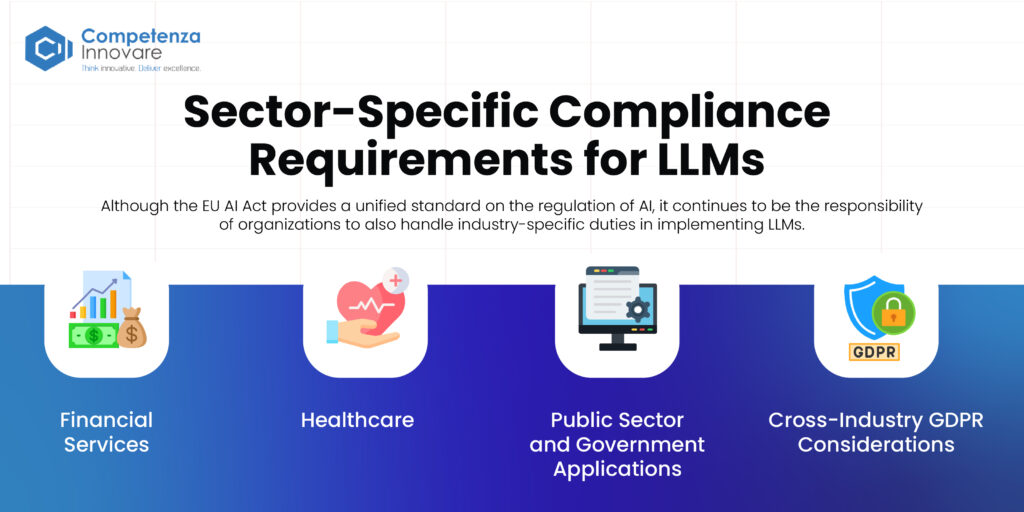
Although the EU AI Act provides a unified standard on the regulation of AI, it continues to be the responsibility of organizations to also handle industry-specific duties in implementing LLMs. Priorities regarding compliance may change depending on the industry, the nature of data under processing, and the possible impact of the outputs of AI.
Financial Services
Financial institutions are starting to leverage LLMs in enhancing customer experiences and efficiency. Common applications include:
- Customer service assistants
- Fraud investigations
- Internal research and knowledge support
Since the use cases have the potential to impact financial choices and customer performance, organizations need to focus on the following:
- Explainability of AI outputs
- Auditability and recordkeeping
- Human oversight for critical decisions
- Model risk management
- Compliance with relevant financial sector AI regulations
Healthcare
To simplify the administrative workload and aid medical research, healthcare organizations are embracing the use of LLMs. Typical applications involve the following:
- Clinical documentation
- Patient communication
- Research assistance
Due to the sensitivity of healthcare data, compliance priorities should include:
- Accuracy validation of AI-generated information
- Protection of patient privacy
- Human review of medical recommendations
- Alignment with healthcare AI compliance requirements
Public Sector and Government Applications
The government could apply some of the applications of the LLM to enhance its services to the citizens, automate services, and facilitate interaction with citizens. Organizations are recommended to focus on: To retain the trust of the people, organizations ought to focus on the following:
- AI use transparency.
- End transparent responsibility and supervision.
- Maintaining public trust
- Addressing policy and governance needs.
Cross-Industry GDPR Considerations
The GDPR and AI compliance in handling personal information with the use of the LLMs should be understood in all industries. Important considerations include:
- Legal handling of personal information.
- Data minimization practices
- Cross-border transfer of data needs.
- Data subject rights protection.
- Continuous watch on privacy threats.
Addressing industry-specific policies and more universal data protection requirements, organizations will be able to reduce the risk of compliance and allow responsible use of LLMs.
Practical LLM Compliance Checklist for Enterprises
An AI compliance checklist should be structured in a way that it assists the organization to evaluate its compliance with the requirements in governance, transparency, risk management, and regulatory requirements of its llm development.
- Governance: To govern AI initiatives, organizations are recommended to create a governance committee that manages AI activities and adherence to internal policies and regulatory requirements. Roles and responsibilities must be well stipulated such that accountability in AI systems, risk management and decision-making are put on the right teams.
- Documentation: It is important to maintain proper documentation to ensure compliance and transparency. Organizations are advised to maintain a catalog of current AI models and applications and to prepare the technical documentation that provides details on the capabilities of the models and planned application scenarios and constraints and risks.
- Transparency: Companies should assess the way AI systems relate to users and their need to disclose or not. To enhance transparency, build trust, and facilitate regulatory compliance, user awareness measures could be used, as well as AI-generated content labeling.
- Risk Management: Enable the regular risk assessment to detect the problems associated with accuracy, bias, privacy, security and misuse. Organizations also need to have in place monitoring controls that would trace the performance of the models and mitigate any expected compliance issues by undertaking dedicated continual follow-ups.
- Religious Readiness: Organizations need to look into the relevant obligations under the EU AI Act, analyze the industry-specific requirements, and analyze its integration with GDPR and other appropriate regulations. It is possible to have regular compliance reviews to make sure that the investigations of LLM deployments for compliance are in line with any changes in regulatory expectations.
Ensure Your LLMs Meet EU AI Act Requirements—Talk to Our AI Compliance Experts Today.
Conclusion
Regulatory compliance is emerging as a key aspect of successful AI adoption as large language models continue to revolutionize business operations. Companies need to know how new regulations like the EU AI Act can impact LLMs and adopt governance, transparency, documentation, and risk management practices to address emerging compliance standards.
No matter the sector of business activity (financial services, healthcare, the public sector, etc.), the business establishment must actively tackle the threat of AI-related risks. Through sound governance systems, periodic risk management and continuous surveillance and compliance, companies can use AI in a responsible manner and gain customer, regulatory and stakeholder confidence.
As new regulations on AI continue to evolve, organizations that strategize toward compliance to date will have a better position to expand AI endeavors without hesitation and uncertainty later. In The Competenza, we help companies find their way out of AI governance uncertainties, regulatory conformity, and responsible AI adoption to ensure that they can be creative and stay current with the new legal and market requirements.
FAQs
What is the compliance of LLMs?
LLM compliance is the procedures, controls, and governance actions taken by organizations to make sure that large language models are run based on regulatory, legal, and ethical standards. It encompasses various risk management, visibility, documentation, and continuous monitoring.
What does the EU AI Act mean to large language models?
The EU AI Act sets the providers and users of advanced AI systems, such as general-purpose AI models, into obligations. Things can be in the form of technical documentation, transparency, risk management practices, and compliance monitoring.
What are General-Purpose AI Models (GPAI)?
General-purpose AI models are AI systems that are capable of undertaking a diversity of tasks in a variety of applications. They include GPT models, Claude, and Gemini, which are capable of adjusting to customer support, content generation, research and other applications.
What are the major requirements in the EU AI Act for LLMs?
Some of the chief requirements of the EU AI Act are keeping technical documentation, transparency, risk management, copyright requirements, and lifecycle monitoring of AI systems.
When is an LLM considered to be a high-risk AI system?
Any LLM can be incorporated into a high-risk AI system because using it in a sensitive field may affect hiring, healthcare, education, law enforcement, or financial services, and the choices or disagreements about the choices can have a major effect on people.
What is the significance of an AI governance framework to LLM compliance?
An AI governance framework assists organizations to institute accountability, identify the role of oversight, deal with risks, and deploy AI systems responsibly and as per the regulations.
What would an AI risk assessment consist of?
The risks to be considered through an AI risk assessment must include privacy risks, security weaknesses, fairness, reliability, and the business impact. Frequent evaluations assist companies to identify and avert risks, which are likely to become compliance issues.
What is the impact of GDPR on the use of LLM?
When LLMs process personal information, it means that GDPR and AI compliance are very much related. Organizations should consider legal data processing, data reduction, data subjects’ rights, and the international data transfer needs.
Which industries have the most demanding compliance on LLMs?
The more rigorous compliance requirements of AI in these areas tend to apply to industries like financial services, healthcare, insurance, and the public sector since AI systems in these areas may have implications for the financial performance, patient care, privacy, and the confidence of the populace.
What should organizations do to cope with changing AI regulations?
A properly designed governance framework, documentation, regular risk assessment, compliance regulation, and continuous monitoring of the recent AI regulatory frameworks and industry standards allow companies to become more regulatorily prepared.