

A successful SaaS product does not happen by just having a brilliant idea; there is a clear strategy to pursue, appropriate technology, and a planned way to go about it. Since companies still consider cloud-based software flexible, scalable, and an appealing business model that depends on subscriptions, SaaS application development has proved to grow rapidly and become one of the most innovative areas of software development. Regardless of whether you are starting a new business or expanding on an already formed company, a developed SaaS application plan that is based on a structure will greatly enhance your chances of having a product that is both responsive to the needs of the market and an instrument that helps you grow long-term.
In the case of founders, they will jump into the development without validation of an idea, a product roadmap, and proper planning of the correct architecture. In some cases, this can result in expensive errors. A strategic SaaS product development plan can assist you in concept validation, creating a minimum viable product (MVP), selecting scalable cloud architecture, and readying you to launch a successful product. It also provides the foundation in terms of constant improvements as your users increase.
In this guide, we will tour all phases of SaaS startup development, including idea validation and MVP planning to the development of this system, deployment, launch, and scaling after launch. You will also learn how The Competenza, a well-established SaaS application development company, assists startups and businesses in creating secure, scalable, and high-performance cloud SaaS applications that can help accelerate a business’s growth.
What Is SaaS Application Development?
The development of SaaS applications is the process of creating cloud-based programs that users can utilize with a web browser or mobile application without necessarily installing them on devices. This model can also be referred to as “Software as a Service” (SaaS); this is software that is delivered online through a subscription. This is easy to use, update, and maintain.
Unlike the old-fashioned software use where one has to install a program and update manually/physically, cloud SaaS development has enabled programs to operate safely in the cloud. This allows users access everywhere, businesses gain access to low maintenance and automatic updates, and it provides improved scalability.
An effective product development cycle of SaaS involves planning, design, development, testing, and launching a scalable application. Most businesses today are dependent on SaaS platform development in formulating solutions like CRM systems, project management, HR applications, accounting applications, and collaboration applications since they are flexible, cheap, and can be scaled readily.
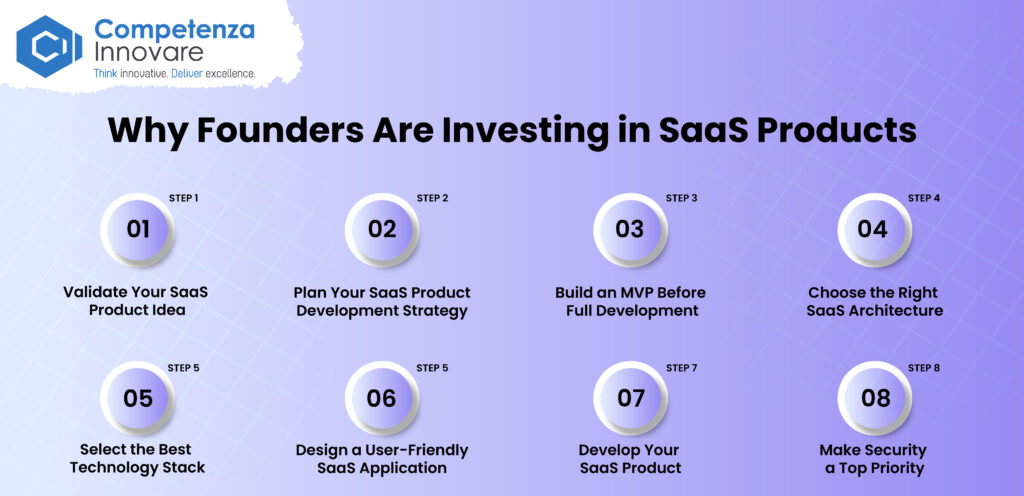
Why Founders Are Investing in SaaS Products
SaaS startup development is becoming the preferred development mode among more entrepreneurs since it provides businesses with a flexible, scalable, cost-effective way of developing software businesses. An effective SaaS product development plan will assist the founders to launch quicker, penetrate more customers, and develop sustainably.
- Recurrent Revenue: SaaS services are based on a subscription fee, which gives you a predictable monthly/yearly revenue.
- Global Access: The application was usable globally by the customers at any time and in any location through any internet-enabled device.
- Rapid Customer Acquisition: Founders can release an MVP fast and collect user feedback and enhance the product according to the true needs of the customers.
- Reduction in infrastructure costs: Cloud hosting saves the expensive servers and current hardware maintenance.
- Simple Updates and Maintenance: Additions and corrections in code, as well as security enhancements, can be done automatically without the need for software updates by the user.
- High Scalability: As the business scales, SaaS applications can readily accommodate additional users, data, and features without significant alterations to the system.
The benefits of SaaS product development are an excellent alternative among the founders that aim to establish a secure, scalable, and long-term software business.
Step 1 – Validate Your SaaS Product Idea
The initial move towards successful SaaS product validation is ensuring that your idea is addressing an actual customer problem. There are several steps to be taken before the development is made, and they include: researching the market, researching competition, interviewing potential users, and determining their most significant pain areas. This will assist you in defining your target market, developing a solid value proposition, and constructing an organization of the SaaS product roadmap. Early validation minimizes risk and helps you to be working on a product that people actually need.
Founder Tip: Never build before you can validate. A proven concept is time and money and development time savings.
Step 2 – Plan Your SaaS Product Development Strategy
After having a validated idea, develop a structured SaaS development process. Determine your business objectives, identify the features that are most valuable, determine your budget, and draw a feasible plan. By selecting an appropriate development team and using an agile approach, you will be able to deliver the product quicker and adapt to customer feedback. An effective SaaS development lifecycle helps to keep the project in check from the beginning till its release.
Step 3 – Build an MVP Before Full Development
SaaS MVP development lets founders introduce an early form of their development with only the essentials. Rather than developing the full solution all at once, an MVP shows how your idea works with real users and uses those insights to gather valuable feedback and refine the product based on real customer needs. This will cut down the cost of development and business risks and accelerate your product launch.
Step 4 – Choose the Right SaaS Architecture
The success of any SaaS architecture selection is important in the long term. Whereas in single-tenant architecture each customer has a distinct environment, in multi-tenant SaaS architecture, several customers are allowed to share a single application, but their data remains confidential. It helps reduce operating expenses, eases the process of updating, and allows expanding your application along with your business, so it is the right choice among the majority of current SaaS applications.
Also Read: How to Evaluate a Software Development Partner
Step 5 – Select the Best Technology Stack
Selection of the appropriate technology stack is an important aspect of cloud SaaS development. Your technology stack comprises the frontend, backend, database, cloud, APIs, and DevOps tools that drive your application. It is also required to provide safe authentication and CI/CD pipelines to update quicker. A good stack will improve the performance, simplify the maintenance, and enable your SaaS platform construction to scale with the business.
Step 6 – Design a User-Friendly SaaS Application
A good product is not merely a strong one but also simple to operate. In the case of custom SaaS applications development, it is possible to pay attention to the development of a clean UI, a seamless UX, and a simplified onboarding process. Using an effective dashboard, mobile responsive design, and user-friendly interface, users get to accomplish tasks within a small amount of time and enhance customer satisfaction, resulting in enhanced retention.
Step 7 – Develop Your SaaS Product
Having done planning and design, SaaS application development is now in view. Tiny agile sprints are the front-end, backend, database, APIs, and third-party integrations developed by the development team. Managing SaaS development, there is a constant testing, code review, and quality test that will help in the creation of reliable, secure and launch ready applications.
Step 8 – Make Security a Top Priority
Security cannot be considered when the program is released but when it is being developed. To ensure best practices in SaaS security, it is essential to safeguard the user information by using secure authentication, role-based access control, encryption of data, and secure APIs. Regular security testing, backup, monitoring, and disaster recovery planning will keep your application reliable, compliant, and user trusted.
Step 9 – Test Before Launch
Before launching your product, make sure that all functions are tested to ensure that it works. A complete SaaS development life cycle would include functional testing, performance testing, load testing, security testing, cross-browser testing, mobile testing, and user acceptance testing (UAT). Early detection and correction of problems prior to launching is useful to provide a stable user experience and also minimizes the maintenance aspect in the future.
Step 10 – Launch Your SaaS Product Successfully
Launching a successful SaaS product cannot only be achieved through deploying your application. Create a well-defined SaaS deployment plan, including the environment, deploying to the cloud, monitoring performance, tracking analytics, mitigating any initial problems, and providing customer support. A successful marketing plan and a helpful onboarding are good enough to attract and retain your first users.
Step 11 – Scale Your SaaS Application After Launch
You have just begun with the launching of your product. As your business expands, then it is advisable to scale up the SaaS application to support more users and workloads. Cloud SaaS development allows using caching, microservices, optimizing the database, and auto-scaling to enhance performance. Gradually testing your app and getting customer feedback will allow you to add new features and maintain your SaaS product’s competitiveness.
Common Mistakes Founders Should Avoid
To create an effective SaaS product, it is not only enough to have a good idea but also to recognize the pitfalls that can impede the growth or result in the failure of the product. Early awareness of these challenges can assist you in saving time and minimize cost and develop a superior experience on the part of your users.
- Omitting market testing: Introduction of a product without comprehending customer requirements may lead to low demand. You should research the market and test your idea by doing research before developing it.
- Overloading: When you first try to put everything on your product, it will be too long before you can get it out of the product. The first thing to do is to focus on the most important features and then improve your product according to the feedback provided by the users.
- Lack of UI and UX: When it is hard to use your application, customers can abandon it even when it has useful features. Maintain a clean, user-friendly design.
- The scalability and security: Your application must be scalable as your business expands and at the same time store the user data securely. Initial scalability and security planning can help avoid expensive change requests in the future.
- Failure to gather customer feedback: By listening to users, you can know what is working, what is going wrong, and what comes next in the list of features of the product.
- Selecting the wrong development partner: Collaborating with an advanced SaaS development firm can aid you in preventing technical problems, teaching best practices, and releasing a trustworthy product.
- Releasing untested: Before releasing your application, you can test your application and ensure that you release it fully. Do a good test prior to the launch to provide an enjoyable user experience.
Why Work with a SaaS Application Development Company?
Proper selection of a SaaS application development company can assist you in creating a successful product and save time and minimize the risk in developing the product. A seasoned partner offers the technical expertise and knowledge in the industry that is required to turn your business concept into a scalable SaaS solution.
Benefits of Partnering with the Right Team
An established SaaS software development company has a highly skilled developer base, cloud implementation expertise, and a security-focused attitude to assist in developing a high-quality, future-proof application. They also come in handy to help you determine the right product approach, build a scalable system, and reduce software development costs, and they also provide continued support and upkeep as your business continues to grow.
When you use the SaaS application development services offered by The Competenza, you also receive end-to-end services, such as developing a product plan and creating the MVP. deploying to the cloud, and optimizing it over time to launch and scale your SaaS product successfully.
Read our SaaS application development guide to turn your idea into a scalable product and launch it confidently.
Why Choose The Competenza for SaaS Application Development?
Choosing the right development partner is as important as having a great SaaS idea. The Competenza is an experienced SaaS application development company that supports founders to bring ideas to life by developing secure, scaled, and user-friendly SaaS applications.
End-to-End SaaS Development Services
Our SaaS development services encompass all phases of the development process, including product discovery and MVP creation, UI/UX design, custom SaaS development, cloud hosting, API integration, and support. Our other activities are to develop scalable multi-tenant SaaS application architecture and optimize application performance to enable future growth.
The Competenza has the skills you need to build a new SaaS product or enhance an existing product to launch with confidence. Get to know our SaaS application development services and find out how we can help you get your idea working.
Conclusion
A successful SaaS product is not created on a single piece of code but on the correct decision made at each stage of the process. With the confirmation of your idea and product strategy planning, the development of MVP, the selection of the right architecture, and launching with security, every step will be considered a better basis for long-term success.
Security, performance, scalability, and post-launch continuous improvement are also considered well within a well-planned SaaS application development process. A well-planned course of action, along with listening to the needs of customers, will help founders minimize risks, create value that is tangible, and create products that can expand with the business.
When you are willing to convert your idea into a winning SaaS, a successful development partner can assist you in creating a secure, scalable, and future-proofed solution with the confidence that it will work.
FAQs
What is SaaS application development?
SaaS application development means the creation of software in the cloud, which is accessed by using a web browser or a mobile application. The differences between traditional software and SaaS applications are such that, unlike conventional software, SaaS web apps run on clouds and offer businesses automatic updates, better scalability, and access by the user anywhere.
What is the time frame of developing SaaS applications?
This timeline of development is based on the complexity, features, and business needs of the project. The simplest MVP could be created in a matter of months, whereas a more complex SaaS service with new features and integrations might require more time to develop and test.
What is SaaS MVP development?
The development of a SaaS MVP revolves around developing the first version of a product that has the essential features. The strategy assists founders in testing their idea, gathering customer feedback, and enhancing the application prior to investing in the full-scale development.
What is the cost of the SaaS applicant development?
The SaaS application development does not have a specific cost, as all of the projects have different requirements. Design, features, technology stack, integrations, security requirements, and development time are some of the factors that affect the total budget. Initially, MVP can be the most economical way to go.
What does multi-tenant SaaS architecture mean?
Multi-tenant SaaS architecture is a type of computer design to have many customers that share the same software, yet their information is separately and individually secure. It is easily maintainable, cheaper to run, and can easily be expanded as the company grows.
How do you validate a SaaS product idea?
The creators have a chance to validate a SaaS concept by doing market research, competitor analysis, interviewing potential customers, and determining actual business problems. This knowledge of the customer needs prior to development is useful in creating a product that has more demand in the market.
What is the SaaS development lifecycle?
The SaaS development life cycle encompasses all the steps involved in the creation of a SaaS product, such as validation of the idea, planning, UI/UX design, MVP, application development, testing, deployment, release, and improvement of the system post-release.
Which are the best SaaS security practices?
Explicit SaaS security is carried out in a way that it involves a secure authentication process, data encryption, role-based access control, a secure API, frequent security testing, continuous monitoring, and regular backup. These measures help protect customer data and achieve customer confidence.
How do you start a SaaS product?
Efficient launch of a SaaS product begins with the lengthy testing and the well-considered deployment strategy. After its launch, it is essential to follow the performance, collect the feedback of users, quickly react to issues, and constantly evolve the product to a long-term successful result.
Why outsource a SaaS application development firm?
Partnering with an experienced SaaS application development firm will grant founders access to the technical expertise, product strategy and development of the cloud, and ongoing support. The appropriate development partner will reduce the risk, accelerate the development process, and develop an SaaS product that is secure and scalable and capable of supporting further growth.