

Monolithic applications can be appropriate at the initial level of development, but larger and more complicated systems are more difficult to maintain in terms of performance and scalability and speed of development. Sluggish software releases, lack of scalability, increasing technical debt, and increased infrastructure costs are some of the typical issues in many organizations utilizing legacy software.
With the changing customer expectations and faster digital transformation, businesses require software architectures that are more adaptable. This is where monolith to microservices migration turns out to be a very vital aspect of contemporary application planning. Organizations can decouple applications into small, independently deployable services with greater flexibility, scalability, and resilience instead of running one closely knit codebase.
Microservice-based modernization of a legacy application is not defined by simply dividing the code into smaller segments. It needs to have a distinct application modernization strategy, service disaggregation, and stepwise migration path so that the exposure and business continuity can be minimized. Patterns of the strangler fig pattern, containerization, API gateways, and the cloud-native infrastructure are all discussed as important aspects of the successful modernization practices.
Even when your purpose looks at a goal to attain scalability, accelerate deployments, or promote long-term innovation, the notion of adopting monolithic architecture for microservices can open the door to significant business value. In this guide we shall talk about how to make a monolithic application come alive using microservices, how to migrate, some of the considerations, best practices, and step-wise directions to do so in 2026.
What Is a Monolithic Application?
A monolithic application is a classical software architecture in which an application (user interface, business logic, and database) is created by constructing and deploying a single system. All are closely intertwined and operate under a single codebase and hence are easy to develop and deploy during the initial phases of a project. This is effective with small applications since all the features are controlled under one roof.
Nevertheless, a monolithic system becomes more difficult to maintain and scale as the application scales. Even minor updates will mean deploying the entire app, which will slow development and lead to more downtime. This in the long run results in issues such as a decrease in scalability, reduced release time, and non-declining maintenance and technical complexity. Due to these concerns, a growing number of organizations further their application modernization plan, including monolith-to-microservices migration in order to enhance flexibility, scalability, and long-term system performance.
Monolithic Architecture vs Microservices
Monolithic architecture and microservices are the two opposing techniques to develop software applications. Everything in a monolithic system is developed as a single application, and in microservices, the application is separated into small independent services. This disparity affects the way systems are created, implemented, and scaled on a real-life project.
| Factor | Monolithic | Microservices |
| Architecture | Single application | Multiple services |
| Deployment | Entire app | Independent services |
| Scaling | Full system scaling | Service-level scaling |
| Maintenance | Complex | Easier |
The monolithic systems are simple to start with and later become hard to manage as they grow bigger. Microservices are more flexible since each service is able to work and scale independently. This is also why most organizations prefer monolith over microservices migrations as an element of their application modernization plan to enhance performance, control, and sustainability.
Why Modernize a Monolithic Application?
A major step of software modernization, as well as legacy application modernization, involves the modernization of a monolithic application, particularly when the systems begin to slow down, becoming hard to scale and hard to maintain. As business demands go up, traditional monolithic architectures might not support the need to deliver real-time updates, high traffic, and continuous delivery experiences.
- Improve Scalability: Modernization allows breaking the limiting boundaries of monolithic applications, allowing the applications to configure specific components of the system on-demand instead of the whole system.
- Shorter Feature Development Time: It assists development teams to introduce new features faster by reducing their reliance on a massive codebase and launch new features by reducing the number of full-system redeployments.
- Reduce Downtime: Current architectures reduce risks of complete system downtime because the functionality is componentized and, therefore, failures of a system do not occur across the whole application.
- Greater Fault Isolation: Problems in smaller services or modules are isolated, which increases stability of the system, and effects of the system on business in case of failures are local.
- Increase Developer Productivity: Teams can build an autonomous service, resulting in less complexity, more collaborative teams, and accelerated development cycles.
Business-wise, modernization results in enhanced agility, positive customer experience, and reduced long-term maintenance costs. This is the reason why most organizations are focusing on legacy application modernization in order to move on from monolithic systems into more flexible and scalable systems such as microservices to ensure long-term digital expansion and competitiveness.
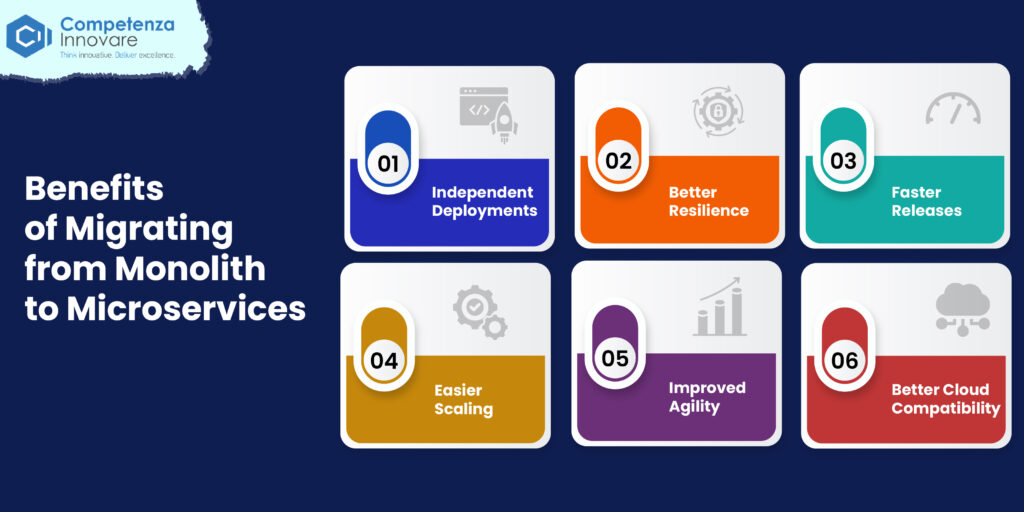
Benefits of Migrating from Monolith to Microservices
The migration is an important component of the modernization of software architecture and can be used to support the scale of microservices as well as cloud-native migration. It assists companies in their transition toward a highly integrated system to a more decoupled and distributed architecture capable of more easily supporting growth, performance, and continuous delivery.
Independent Deployments
Given microservices, an individual service may be developed, tested, and deployed. It means that the teams can correct or upgrade some features without regenerating the entire application and minimizing risk and increasing delivery speed.
Better Resilience
Microservices increase the consistency of the system as failure is limited. The failure of one service will not always affect the whole application, which will help preserve the uptime and user experience.
Faster Releases
The services being independent, development teams are able to make updates more regularly. This enhances the speed of market entry and enables businesses to react fast to consumer demands.
Easier Scaling
Microservices enable scaling of only services that are more in demand, rather than scaling the entire application. This will enhance efficiency and cost effectiveness in the utilization of resources.
Improved Agility
Microservices allow different teams to concurrently develop different services. This concomitant evolution was more productive and quicker in its innovational impact.
Better Cloud Compatibility
Microservices are known to be well suited to the cloud. They can be easily interwoven with containers, CI/CD pipelines, and orchestration tools, and they are thus suitably aligned to cloud-native migration plans.
Large technology companies such as Amazon, Netflix, and Uber have performed admirably using microservices architecture. They use it to handle extensive traffic and maintain high availability and even update regularly and without interruption to the user. Their systems manifest how microservices facilitate scalability, resilience, and fast innovation on a production scale in the real world.
Also Read: How Much Does It Cost to Modernize a Legacy App
Step-by-Step Guide to Migrating a Monolithic Application to Microservices
The movement of a monolithic system to microservices is an orchestrated process that belongs to software modernization and the monolith-to-microservices migration process. It entails careful planning, proper separation of services, as well as a gradual introduction of the services to avoid disruption of the system. However, organizations usually consider a gradual process of gradually rewriting their architecture rather than doing it at once.
Step 1 – Assess Your Existing Monolith
The initial one is to learn the structure of the existing monolithic application. These involve deconstructing the entire architecture, dependencies among modules, and performance bottlenecks and technical debt.
Key questions include:
- Which modules do we have in the existing system?
- What components of the application crash or can hang regularly?
- Where are the main performance bottlenecks?
This step assists in developing a clear image of what requires improvement prior to initiating the migration.
Step 2 – Define Service Boundaries
The step aims at breaking the monolith into small and manageable services. The objective is the appropriate service breakdown according to business functionality and not according to technical layers.
Common approaches include:
- Domain Driven Design (DDD)
- Business capability mapping
Typical service examples:
- Authentication service
- Billing service
- Order management service
- Notification service
This makes every service clearly responsible and work independently.
Step 3 – Choose a Migration Strategy
The choice of the appropriate migration strategy is essential. The Strangler Fig Pattern is the most popular, whereby new microservices are slowly developed around what already exists and old parts are slowly substituted.
Other strategies include:
- Incremental extraction of services
- Complete system rebuild (less recommended for large systems)
Incremental migration is the least risky and, in most cases, enables the system to run during the migration process.
Step 4 – Design Communication Between Services
Once they have defined services, they must be able to communicate effectively. This forms a major aspect of the distributed system architecture and event-driven architecture design.
Common communication methods include:
- REST APIs for synchronous communication
- gRPC for high-performance service calls
- Event-driven messaging for asynchronous workflows
Appropriate communication design is done to obtain scalability and system stability.
Step 5 – Containerize Services
After the decomposition of services, they are frequently packaged into containers, a more recent containerization strategy using systems like Docker and Kubernetes microservices architecture.
Tools used:
- Docker
- Kubernetes
Benefits include:
- Better portability across environments
- Improved scalability
- More efficient deployment process
Step 6 – Implement API Gateway
An API gateway is a significant aspect of API gateway microservices architecture that provides a single point of entry to all microservices.
It helps in:
- Centralized request routing
- Authentication and authorization
- Rate limiting and traffic control
- Improved security management
This simplifies the process of communication to different services with the clients.
Step 7 – Build CI/CD Pipelines
CI/CD in the microservice case necessitates a substantial pipeline of CI/CD to facilitate fast and effective deployments.
Focus areas include:
- Automated testing
- Continuous integration and delivery
- Faster and safer deployment cycles
This enables the teams to be released frequently without disturbing the stability of the system.
Step 8 – Monitor, Optimize, and Scale
Once the system has been implemented, there must be continuous monitoring of the system to check its performance and reliability. Prometheus, Grafana, and ELK stack are the most popular ones.
A major metric that should be monitored:
- Latency
- Uptime
- Error rates
This assists in keeping the system stable, scalable, and optimized to real-life usage.
Ready to modernize your monolithic application? Let Competenza build a scalable microservices architecture for your business.
Common Challenges in Monolith to Microservices Migration
Migrating the monolithic system to microservices is a big part of modernizing the software but is not an easy and risk-free task. Even though it is more scalable, flexible, and performs better, when migrating to the distributed architecture, organizations are often faced with a set of technical and operational challenges even when they are using a tightly coupled architecture in the past.
- Complex System Breakdown: Monolithic applications are highly integrated, and thus it is not easy to know how to draw the right boundaries of the services. A significant issue is to divide them into separate services without losing functionality.
- Data Management Issues: Monolithic systems are based on one common database, whereas microservices demand distributed data management. It can cause a problem in data consistency, synchronization, and handling transactions.
- Greater System Complexity: Under the microservices, it has the distributed system issues (service-to-service interaction), network latency, and inter-service dependency.
- Testing Issues: It complicates testing, since a service needs to be not only tested individually but also in combination with other services and returned in an end-to-end way.
- Deployment and DevOps Overhead: Microservices are not deployed or configured to one deployment pipeline or CI/CD process and monitoring setup as monoliths and add cost to operations.
- Monitoring and debugging: A distributed environment makes it more challenging to locate and resolve problems because a problem could affect many different services that might need more sophisticated observability tools.
These challenges would make most companies apply a gradual migration approach like the Strangler Fig Pattern, where a monolith would be migrated into a microservice because it would be possible to approach the modernization phase in a step-by-step manner with reduced risk and system stability.
Best Practices for Monolith to Microservices Migration
An effective monolith to microservices transformation needs to be planned and gradual. Organizations need to let go of altering everything simultaneously and employ a systematic course of software modernization in order to decrease the chances of risks and provide system stability during the changing process.
Keep Migration Incremental
Do not replace the whole system at a time. Start migrating features or modules one at a time. This makes it simple, and through this, business continuity is possible.
Define Clear Service Boundaries
Divide the monolith using business functions rather than using layers to ensure separation. The proper service breakdown can release dependencies and facilitate service management and scaling.
Use the Strangler Fig Pattern
The Strangler Fig Pattern is a non-harmful migration plan where new microservices are being built on the part of the existing monolith, and components are being swapped out at a very slow rate without evacuating the system.
Keep Services Independent
Each microservice should possess a single responsibility and should be autonomous. This boosts maintainability, scalability, and flexibility in the long run.
Automate CI/CD Pipelines
CI/CD deployments are quicker and less risky. It implies that all the microservices can be tested and implemented, and there are only some errors due to automation.
Focus on Monitoring and Observability
Monitoring tools help in tracking errors and the health of the system within the services. This helps in quickly identifying and fixing faults in a distributed system.
Avoid Over-Engineering Early
Start with simple services first. Excessive early development can make the architecture more expensive and slow the success of migration.
These best practices can be applied to assist organizations in a more streamlined and successful legacy application modernization, system scalability, and cloud-enabled and reliable architecture.
Conclusion
Modernizing a monolithic application to microservices is one of the major software modernization actions toward creating scalable and future-ready systems. With the increasing business needs, a shift from a tightly coupled monolith to a flexible monolith, then a migration process to microservices, would enhance better performance, agility, and system reliability.
Organizations can minimize risk through a gradual approach such as the Strangler Fig Pattern and ensuring adequate service separation as they move to a cloud-native architecture. This strategy allows shorter development cycles, improved scalability, and stability of the system. At The Competenza, we help companies to transition old monolithic applications into new microservices-based systems that enable scalability, performance, and long-term growth in digital capabilities.
FAQs
What is monolith to microservices migration?
Monolith to microservices migration is the procedure of fragmenting one monolithic application into fewer autonomous services. It is under software modernization, which adds to the scalability, flexibility, and system performance. It can be used to assist businesses in migrating off of highly integrated systems and towards a more cloud-native architecture.
What is the motivation behind switching from a monolith to microservices?
Companies migrate to microservices in order to address the drawbacks such as slowness, scaling, and excessive maintenance of the systems. Microservices enable quicker updates, greater scaled responses, and greater agility of systems, which sustain current digital business requirements and continuous delivery.
What is the strangler figure of migration in microservices?
Strangler Figure is a incremental migration plan that encloses the development of new microservices based on a currently present monolith. As time passes, the monolith is replaced in constituents but without discontinuing the system. It reduces risk and ensures smooth legacy application modernization.
Which are the critical issues of microservices migration?
Problematic issues are the definition of service boundaries, distributed data management, service communication, and system complexity. A distributed environment also makes testing and monitoring more challenging due to the existence of multiple services operating on the same environment.
What is the way microservices enhance scalability?
Microservices enhance scalability via separate services being able to scale separately as per request. Only the necessary services are scaled instead of the whole application, as this will be more cost-effective and efficient in using resources.
What are the typically used technologies in microservices architecture?
The common technologies widely used in microservices are Docker, Kubernetes, REST APIs, and event messaging systems. CI/CD pipelines also automate testing and deployments and are delivered faster.
Can microservices architecture be applied to any application?
No, large complex systems are appropriate for microservices. Applications that are small might not require this degree of complexity and can instead rely on monolithic architecture to make it simple and more quickly developed.
How time-consuming is monolith to microservices migration?
The time frame is based on the size and complexity of the application. Small systems can require several months, and big enterprise systems can require more than a year. Reduction of risk is generally performed in phases.
Why do microservices need to be monitored?
Monitoring is crucial as microservices are distributed systems. Such tools as Prometheus, Grafana, and ELK can be used to monitor the performance and highlight problems and ensure the flawless functioning of all services.
What are the business benefits of microservices?
Microservices can assist businesses in becoming more innovative, reducing downtime, and having enhanced scalability. They facilitate cloud-native change and enhance user experience as well as long-term digital expansion.