

Legacy application modernization cost is one of the initial questions all technology heads will ask when one is in the modernization debate that is more theoretical than practical. And it is among the most difficult to answer with no context, as the range really is quite broad. A small rehosting process can be finished within $20,000 if the application is a basic internal application. Re-engineering an enterprise platform with millions of users can cost more than a million dollars. This is not a mere arbitrary difference. It indicates actual variability of application size, architectural complexity, choice of strategy, and the actual scope of work that is needed to deliver a modernize system that addresses current and future business needs.
The cost to modernize a legacy application is never a fixed value but rather a variable of what you are starting with, what you are attempting to accomplish, and the path that you are taking to achieve it. Using the legacy modernization cost estimates, which fail to consider such variables, are not estimates but rather guesswork that tends to cost to implement. It is a guide that offers the context where cost estimation is relevant: a picture of what drives modernization spend; the generally accepted amounts based on project size and strategy; the invisible costs that cause regular cost increases in budgets; and a realistic set of steps to bring legacy app modernization costs down without impacting budget quality.
What Is Legacy Application Modernization?
Modernization of legacy applications is a process of upgrading, restructuring, or substitution of software programs that are unable to support contemporary business functionality. It has a spectrum of interventions, from rehosting applications on current cloud infrastructure with minimal adjustments to code, to full-scale reform of a monolith to cloud-related microservices, to an outdated custom solution with a new commercial one.
Common Modernization Approaches
The three most commonly applied modernization strategies and the ones that most directly determine application modernization cost are rehosting, replatforming, and refactoring. All are at varying degrees of intervention, investment, and long-term payback.
Rehosting (lift and shift): Rehosting relocates the application to the cloud architecture with no code, architecture, or business logic modification. The app operates over virtual machines or containers in the cloud as opposed to on-premise equipment; all the rest remain unchanged. It is the cheapest and quickest legacy modernization cost alternative.
Rehosting Cost: Rehosting is the very cheapest form of modernization. For small- to medium-sized applications, rehosting cost typically ranges from $20,000 to $75,000. With larger enterprise applications, expect to spend between 75,000 and 150,000.
Best for:
- Quick cloud adoption
- Stable legacy applications
- Limited modernization budgets
- Short project timelines
Replatforming: leads to specific optimizations to switch self-managed databases with the managed cloud services, containerize the application, and change cloud auto-scaling without re-architecture of the core system.
Replatforming Cost – Platforming cost in the small- to medium-scale apps is typically between $75,000 and $200,000. Multiple managed service migrations and containerization work uses of enterprise applications are between 200,000 and 400,000.
Great for:
- Improving application performance
- Reducing infrastructure management
- Adopting managed cloud services
- Incremental application modernization
Refactoring (re-architecting): Typically lifts the application to a cloud-native implementation and typically involves disaggregating a monolith into microservices, migrating to Kubernetes, and rewriting on newly managed services.
Refactoring Cost – Refactoring is the most expensive modernization strategy; it is normally three to ten times more expensive than rehosting the same application. Medium-complexity applications can form the category of those with refactoring costs ranging between 200,000 and 500,000. Entered applications with a complete microservices breakdown, migration to Kubernetes, and cloud-native data architecture may cost 500,000 to one million dollars or more.
Best for:
- Enterprise digital transformation
- Applications with high technical debt
- Cloud-native modernization
- AI and data-driven platforms
- Long-term innovation initiatives
Why Businesses Invest in Legacy Application Modernization
There is an annual increase in the software maintenance cost as years pass by on a legacy system, where the stacks of technology and the pools of talent are older, and technical debt is accumulating. Modernization helps organizations cut down on such maintenance costs, enhance performance and scalability of applications, bolster security posture, and mitigate compliance risk, and it speeds up digital transformation agendas that legacy infrastructure always gets in the way of.
According to McKinsey research, 70 percent of software in use by Fortune 500 companies, as of 2026, can be classified as legacy, and legacy software replacement and modernization are two of the biggest categories in enterprise technology investment worldwide.
How Much Does It Cost to Modernize a Legacy App?
The legacy application modernization cost also differs considerably, depending on the size and complexity of the application. These can be the actual market rates of modernization engagements within the US and UK, as well as EU markets in 2026.
Legacy Application Modernization Cost and Strategy Comparison
| Factor | Rehosting | Replatforming | Refactoring |
| Strategy Type | Infrastructure migration only | Targeted platform optimisation | Full cloud-native re-architecture |
| Typical Cost (Small App) | $20,000 – $75,000 | $75,000 – $200,000 | $200,000 – $500,000 |
| Typical Cost (Enterprise) | $75,000 – $150,000 | $200,000 – $400,000 | $500,000 – $1M+ |
| Timeline | Weeks to 2 months | 2 to 6 months | 6 to 18+ months |
| Technical Debt | Preserved | Partially reduced | Eliminated |
| Cloud-Native Capability | Minimal | Partial | Full |
| Long-Term ROI | Lower | Moderate | Highest |
| Risk Level | Low | Medium | High |
| Primary Cost Driver | Infrastructure and tooling | Managed service integration | Re-architecture and testing |
These ranges are based on a mixed onshore/nearshore team structure. Teams that are fully onshore are either in the US or in the UK and will be at the heights of each range. Legacy modernization costs in Eastern Europe, India, and Latin America would be cut 40-60 percent when using a nearshore or offshore engagement model for similar quality, which is why many organizations include hybrid team models in modernization programs.
These are beginning points and not set prices. The real legacy system modernization cost of any given engagement is also determined by the ten factors discussed in the following section.
Major Factors That Influence Legacy Application Modernization Cost
1. Application Size and Complexity
The key drivers of legacy app modernization cost are application size, lines of code, module quantity, functional complexity, and data volume. An internal tool of 5,000 lines is a diametrically opposite experience to a 500,000-line enterprise platform that has decades of years of business logic built upon it. The greater the interconnectedness of the components, the more time is needed to discover and the more likely the occurrence of the unforeseen problems.
2. Existing Technology Stack
Java on mainstream stacks, Java applications, .NET, Python, or JavaScript are cheaper to modernize when compared to proprietary or end-of-life technologies. The Delphi codebases, Oracle Forms, and COBOL systems demand expert skills at a high rate premium. Both technical complexity and talent shortage are reflected in the software upgrade cost.
3. Modernization Strategy: Rehost, Replatform, or Refactor
No other variable than a chosen strategy influences more of the legacy application modernization cost. The cost difference between the same application modernized using rehosting as opposed to full re-architecture can vary five- to tenfold. Mainly, infrastructure is a rehosting cost. Managing servicing integration is added as a replatforming cost. Refactoring cost includes complete cloud-native re-architecture and running side-by-side during transition.
4. Cloud Migration Requirements
Cloud migration costs include architecture design, provisioning infrastructure, network configuration, tooling required to migrate, data transfer, and cutover validation. For multi-region applications, we need to be connected privately (AWS Direct Connect, Azure ExpressRoute) or have a hybrid architecture that would already require meaningful costs to perform simple application modernization.
5. Database Modernization
The processes of migrating legacy self-managed databases to current managed cloud services include schema migration, data remodelling, query layer rewrites, and integrity checking. Database modernization cost may be roughly equal to or even greater than the cost of application modernization in applications whose data models are large or complex.
6. Third-Party Integrations
ERP-based applications that integrate with CRM, payment processing platforms, supply chain platforms, or government APIs. Every integration needs to be evaluated and reformed. One of the most prevalent factors in legacy modernization cost overruns is the complexity of integration since the true level of dependencies is not often documented and only discovered in the discovery process.
7. Security and Compliance Requirements
Applications that are under terms of GDPR, HIPAA, PCI-DSS, or FCA must have extra security architecture, compliance control development, and pre-launch certification. Regulated industries in the US, UK, and EU always face software modernization costs 20 to 40 percent more expensive than unregulated counterparts.
8. UI/UX Redesign
Maintaining a legacy interface because the back-end has been modernized constrains the user experience value that the business case promised. Complete UI/UX redesign, a new design system, an up-to-date frontend framework, and a mobile-responsive version add a lot of cost yet are frequently required to provide the desired business experience.
9. Testing and Quality Assurance
Production-ready testing includes unit, integration, performance, security, regression, and user acceptance testing frequently in both legacy and modernized environments. QA is a considerable portion of annual application modernization cost and needs to be planned with a specific budget and not believed to be part of development estimates.
10. Internal vs. Outsourced Development Team
US and UK in-house senior engineers charge an entire loaded price of $150 to $250 per hour. Eastern European or Latin American nearshore teams cost between $60 and $120 per hour. In India, offshore teams cost between 30 and 80 hours. The variation over a six-month, ten-participant program is huge; hence, a hybrid (in-house architecture and leadership outsourced execution) is the most prevalent for handling legacy system modernization costs without quality assurance.
Cost Comparison: Rehost vs Replatform vs Refactor
The price, schedule, and the most suitable summary of any major modernization strategy.
| Strategy | Typical Cost | Timeline | Best For |
| Rehosting (Lift and Shift) | Low $20K to $100K | Weeks to 2 months | Quick cloud migration, data centre exit |
| Replatforming | Medium $75K to $350K | 2 to 6 months | Incremental modernisation, managed services adoption |
| Refactoring (Re-architecting) | High $250K to $1M+ | 6 to 18+ months | Long-term cloud-native transformation |
| Rebuilding | Very High $500K to $2M+ | 12 to 24+ months | Deeply compromised legacy codebases |
| Replacing | Variable SaaS licence + migration | 1 to 6 months | Generic functionality with mature commercial alternatives |
The rehost vs. refactor cost comparison exemplifies modernization strategy selection in any modernization program, being by far the most commercially important decision. An organization that implements refactoring of an application that would have been satisfactorily addressed by replatforming wastes a high budget. An organization that uses rehosting on an application with a large technical debt that is strangling the business receives the true cost without it being the actual issue.
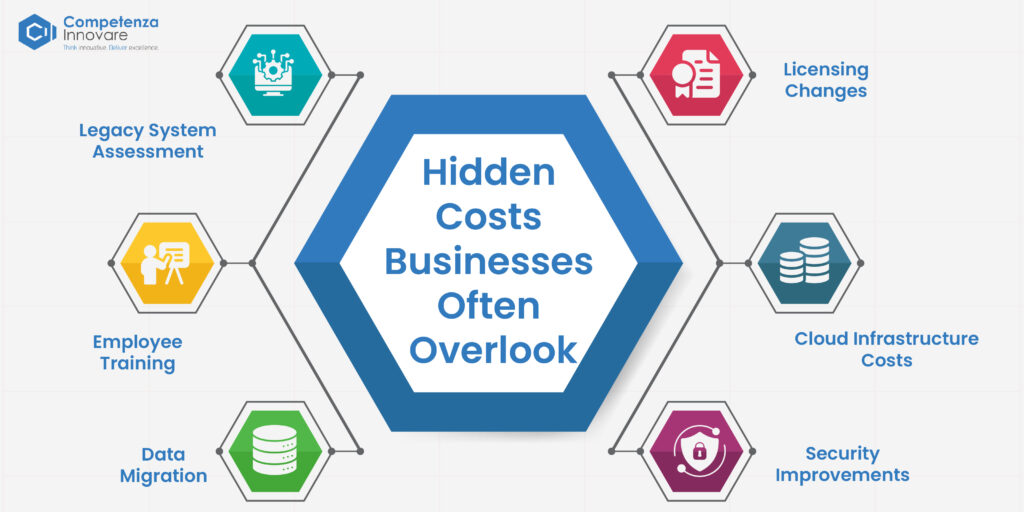
Hidden Costs Businesses Often Overlook
The budget line items that are not captured by most of the early modernization estimates.
Legacy System Assessment
Any reliable legacy modernization cost estimate has a precondition in the form of a thorough application assessment of the code analysis, dependency mapping, architecture review, security audit, and data profiling. A medium-complexity application is around $10,000 to $50,000 to discover. Those organizations that do not take the time to do so will always make estimates that are highly inaccurate in their implementation.
Data Migration
There is a habitual underestimation of data migration during cloud migration costs. All these add real cost, especially to applications with large, complex, or informally documented data models.
Downtime and Business Disruption
Application modernization has cutover and parallel running intervals where the modern system and legacy system run in tandem. The real business costs that should be included in the total legacy application modernization cost include lost transactions, reduced productivity, and customer service interruption during migration windows.
Employee Training
End-user training, administrator training, and support team training must be budgeted explicitly, especially when the modernized application is in a situation where the UI/UX is to be altered significantly or in a situation with the new operation flow. This is a uniform exclusion under first application modernization cost estimations.
Cloud Infrastructure Costs
Post-modernization cloud infrastructure is a repeat OpEx that supersedes on-premise CapEx. The absence of right-sizing, reserved instances, and continuous cloud migration budget control by FinOps practices results in cloud billing of modernized applications constantly surpassing estimates, particularly during the first six to twelve months of production execution.
Licensing Changes
Modernization often involves abandoning the often perpetual license model for subscription models, or an on-premise model with SaaS equivalents, or even merely moving to new cloud provider services. These alterations impact the TCO difference between legacy and modernized states and have to be theorized expressly in the application modernization pricing business case.
Security Improvements
Redesigning IAM, implementing encryption, performing compliance validation, and conducting penetration testing are all real costs of secure legacy application modernization that are often thought to be compensated by other workstreams. These controls increase 20-40 percent to similar software modernization costs where they are needed in regulated sectors such as GDPR, HIPAA, and PCI-DSS.
Ongoing Monitoring and Maintenance
Post-modernization is application maintenance cost that reimburses cloud infrastructure maintenance, security patches, performance monitoring, FinOps, and post-delivery features. development. Modernization usually lowers maintenance costs by 30 to 50 percent compared to the legacy system, and the post-launch cost must be modelled in the modernization ROI calculation and not be assumed away.
Modernization ROI: Is the Cost Worth It?
The returns on the modernization investment in the form of commercial returns.
Modernization ROI is the measure that translates a technology investment into a business case. Successful modernization of legacy applications usually has returns on four fronts:
- Lower maintenance cost: Organizations have always achieved the reduction of maintenance cost by 30-50 percent following modernization due to the removal of specialist legacy talent requirements and reduction in infrastructure cost and technical debt, leading to faster and cheaper development tasks in every subsequent development task.
- High developer productivity: Applications written in modern architectures using automated test suites, automated CI/CD pipelines, and cloud-native deployment generally have two to four times the velocity of a feature delivery compared to their peers in legacy applications, with the commercial value delivered on each sprint.
- Less security and compliance risk: The cost avoided of a single major security incident, breach notification, law enforcement fine, customer damage, and cleanup often exceeds the cost of the modernization program that would have averted it.
- Cloud infrastructure cost optimization: Auto-scaling, managed services, and FinOps-governed, right-sized cloud infrastructure frequently results in a quality 20 to 40 percent reduction in infrastructure cost compared to the on-premise equivalent and directly makes it part of the payback calculation.
To most organizations, the payback period of a properly implemented modernization program is between 2 and 4 years, after which the savings in maintenance, infrastructure, and productivity of the developers is a sustainable competitive cost edge.
How to Reduce Legacy Modernization Costs
It is not about cutting corners to reduce the legacy application modernization cost but about smarter decisions. Such best practices will facilitate management of budgets, and a successful modernization is guaranteed.
Start with an application assessment
Carry out a comprehensive legacy application assessment prior to selecting a strategy to modernize it. Knowledge of the complexity, dependencies, and technical debt of applications aids in making proper cost estimates and avoids future high costs.
Prioritize High-Value Applications
Deliver the most business value through modernization of first applications. Give attention to systems that are incurring high maintenance expenses, have vital functions of the business, or have high levels of technical debt to ensure that ROI is high.
Modernize in Phases
Divide the project into smaller steps, rather than modernizing at once. The gradual method will minimize the risk, distribute costs evenly, and enable you to gauge the outcome and proceed to the next step.
Reuse Existing Components
There should be some important business logic that should be retained. Reusing and exposing old components also reduces development effort and minimizes the legacy modernization costs.
Automate Testing
Automate tests early so that any issues are identified early, reduce the number of manual quality tests, and speed up releases. Test automation is economical in the long run, and the maintenance and software quality are enhanced.
Adopt Cloud-Native Managed Services
Build databases, storage, monitoring, and messaging with managed cloud rather than building and maintaining your own infrastructure. This saves costs of development as well as long-term operations.
Optimize Cloud Resources
Enable monitoring of cloud usage, right-size cloud infrastructure, and auto-scale. Optimization of the cloud can assist in preventing useless post-migration costs.
Partner with an Experienced Modernization Team
A skilled modernization partner can spot the risks, propose the appropriate migration strategy, and prevent expensive errors. They tend to improve the overall application modernization cost and improve the production of the project as well because of their expertise.
Conclusion
The legacy application modernization cost is between $20,000 and more in cases of simple rehosting projects and between $1 million and $5 million in cases of complex enterprise re-architecture programs.
The range represents actual differences in the size of the application, architectural complexity, strategy selection, and team structure.
The best predictors of the overall legacy system modernization cost include the strategy adopted, the level of technical debt, the complexity of third-party integration, and the presence or absence of database modernization and UI/UX redesign as part of the overall architectural work.
How to Choose the Right Modernization Strategy
At Competenza, adhere to the strategy according to the specifics of the application and its business case.
- Rehosting is a good choice when speed and legacy modernization cost minimization are in the spotlight.
- Apply replatforming to managed services where there is clear incremental value without a complete re-architecture.
- Use refactoring when the technical debt is significantly limiting the business and the overall modernization. The ROI of cloud-native architecture warrants the increased initial application modernization cost.
Final Recommendations
Before getting into a budget, invest in a good legacy application assessment. Not the modernization outlay only on the initial outlay in 3-5 years. Make sure to include hidden costs in the application modernization budget planning. Develop a buffer to the discovery risk that legacy complexity generates. The payback of the majority of successful legacy app modernization programs would be two to four years post-initiative, where the benefits of reduced software maintenance expenditure, developer productivity, and reduced cloud infrastructure expense are collected over time.
Frequently Asked Questions
How much does it cost to modernize a legacy application?
Depending on the complexity, modernization strategy, integrations, and compliance needs, expenses can be as low as $20,000 on small-scale applications and as high as $1 million on major enterprise modernization projects.
Which factors influence the cost of modernization of legacy applications?
Some of the key considerations include the size of the application, size of technical debt, cloud infrastructure, database modernization, integrations, security needs, testing, and the location of the development team.
Is rehosting less expensive than refactoring?
Yes. Rehosting is the cheapest among the options since it does not entail much in terms of code changes. Refactoring is most often full-scale architecture and is expensive to do upfront but can be extremely cost-effective in the long term.
What is the duration of modernization of legacy applications?
Small modernization projects can be done in a matter of weeks, whereas more complex enterprise refactoring projects can take several months or longer.
Does modernization include the cost of cloud migration?
Yes, on lots of jobs. This can be at the cost of creating a cloud infrastructure, data migration, and optimization of applications and post-migration tests and monitoring.
What can companies do to reduce the rate of modernization?
Start with assessing an existing application, modernize gradually, automate testing, prioritize applications with the highest priority, and manage cloud services.
Is replacement better than modernization of a legacy application?
In cases where the deployed application is already supporting key business processes and where it has good business logic, it is frequently more economical to modernize the existing application than to replace it entirely.
How does the modernization of legacy applications pay off?
Strategic modernization is able to minimize the costs of maintainability, scale better, enhance the security, deliver features faster, and minimize the long-term operational costs, leading to a substantial ROI in the long term.