

Software product development is facing a new era, where artificial intelligence is playing a decisive role in creating new innovations, efficiency and business development. By 2026, AI stops at the support of software developers in the generation of code; it is changing the way software products are planned, designed, developed, tested, and optimized over their lifecycle.
Many businesses are implementing software development processes and practices based on AI because of the increasing pressure to provide high-quality digital products at accelerated speeds, streamline workflows, enhance decision-making, and shorten time to market. In examining the needs of their customers and prioritizing product features to save time on automating tests and improving the quality of the software, AI is assisting organizations to create smarter products and, at the same time, facilitating the complexities involved in the process of developing them.
The advent of AI software engineering is also transforming the manner in which the product engineering teams operate. The current AI creation tools have the capability of identifying patterns, giving smart suggestions, automating routine work, and assisting in quicker product cycles. This gives the ability to development teams to concentrate on innovation, user experience, and strategic business goals instead of the manual processes that consume valuable time.
Consequently, companies that adopt AI product development and contemporary product engineering are in a better position to develop customer-focused, scalable software that keeps up with the market changes. In this paper, we will discuss how AI will transform software product development in 2026, why it will be beneficial in all phases of the product lifecycle, new trends in the industry, and how companies should act to stay competitive in an AI-led future.
Why AI Is Becoming Essential in Modern Software Product Development
The software products available in the market today are getting more complex and businesses must be able to deal with numerous technologies, integrations, security needs and increasing user requirements. Meanwhile, customers demand even faster updates, seamless experiences, and innovative features, which have an increased burden on the development teams.
Traditional methods of development can easily fail to pace with these expectations particularly when the organizations require launching products promptly without spoiling them. It is at this point that AI is really making its mark. AI enables teams to create and release a better product within a shorter duration by automating repetitive workflows, upholding speed in making decisions, and enhancing the efficiency of the development.
With ongoing progress in AI product development, businesses will be able to innovate faster, cut their development expenses, and become more responsive to market shifts. It is influencing the future of software product development as a form of competitive advantage as speed, agility and continuous improvement are becoming central to the future of software product development.
How AI Is Reshaping Key Stages of Software Product Development
AI is reshaping all software product development phases, enabling teams to decide faster and become more efficient and create products that address customer needs and requirements.
AI-Powered Product Discovery and Market Research
The AI assists organizations to analyze customer comments, market tendencies, competition, and demand. These kinds of insights come in handy when developing AI products, and they allow the product development team to develop products that would appeal to the user expectations and market opportunities.
Smarter Product Planning and Requirement Gathering
Intelligence can be used to make the process of planning easier, as it assists in the prioritization of features, predictive road mapping, resource allocation and risk analysis. This will enable the AI product engineering teams to make prudent decisions and reduce the development risks.
AI-Assisted UX Design and Product Architecture
AI can provide design ideas, enhance user experiences, and aid with architecture planning. AI for software engineering is relevant in providing quality software products by assisting teams to develop user-friendly solutions that are scalable.
How Generative AI Is Accelerating Software Development
Generative AI is among the largest software development trends in 2026 because it could assist teams in developing software faster, maintaining high code quality, and enhancing productivity during the development process.
AI-Powered Code Generation
The modern AI development tools assist developers in writing their code more efficiently by automating repetitive tasks and providing the developers with suggestions on their code.
Key benefits include:
- Faster software development and delivery
- Reduced repetitive coding tasks
- Automatic boilerplate code generation
- Improved developer productivity
- Faster implementation of new features
Popular tools include:
- GitHub Copilot
- ChatGPT
- Cursor
- Amazon Q
With the further development of Generative AI in Software Development, development teams can be redirected to innovation and complex problem-solving and less general code generation.
Intelligent Code Review and Optimization
Intelligence can be used to automatically analyze code and provide recommendations on how to enhance the quality of software.
Key capabilities include:
- Determining code quality problems
- Identifying possible security vulnerabilities.
- Recommending performance improvements
- Maintaining coding standards
- Validation of cleaner and more efficient code.
This will help teams in building trusted software and will save time on manual inspection.
Faster Debugging and Issue Resolution
The system that is based on AI can enable developers to detect and fix problems much faster.
Key advantages include:
- Faster root-cause analysis
- Automated fix recommendations
- Early error prediction
- Reduced troubleshooting time
- Improved software stability and reliability
Using Generative AI to create Software and modern AI to support Software developers, an organization can shorten development cycles and create high-quality code faster and produce improved software products more efficiently.
How AI Is Improving Software Testing and Quality Assurance
The quality of software is very important in delivering quality products and user experiences. Since the AI is used in developing AI-based software, it implies that AI assists groups to enhance the quality of tests and minimize the number of work decreases that are information-intensive and, hence, troubleshoot problems at the initial stages of the development process.
AI enhances testing and quality control by:
- Automated Test Generation – Generates test cases more quickly and comprehensively.
- Regression Testing – Makes certain that new changes do not add functionality that is defective.
- Continuous Testing – Predictable issues in the development cycle.
- Defect Prediction – It predicts any possible bugs before they can affect the users.
- Quick bug discovery – Helps a team to debug bugs and improve the quality of the software.
By offering accelerated and more precise testing, AI can help AI software development teams to deliver quality software products that are more reliable at a lower cost.
AI in Agile Software Development and DevOps
Agile and DevOps teams are becoming more efficient with the assistance of AI helping in better planning, automation, and reliability of systems. AI in Agile Software Development gets rid of the human frame of reference, and it enables organizations to generate software more rapidly without reducing its quality.
Key applications include:
- Sprint Planning Optimization: AI studies project and team resource information to assist in the more efficient planning and task prioritization.
- CI/CD Automated pipelines: Pipelines like code integration, testing and deployment are again automated to facilitate quick release.
- Monitoring Infrastructure: keeps a check on systems and continues to discover the existence of performance problems and resource shortages.
- Predictive Incident Detection: It determines the potential problems and helps to prevent discontinuity of the service.
- Deployment Risk Analysis: Simulated risk in deployment and identified potential places of hiccups before going to market.
Increasing the intensity of Agile and DevOps practices, AI-driven software development will allow teams to improve the pace of software release, increase their operational efficiency, and ensure that products operate predictably.
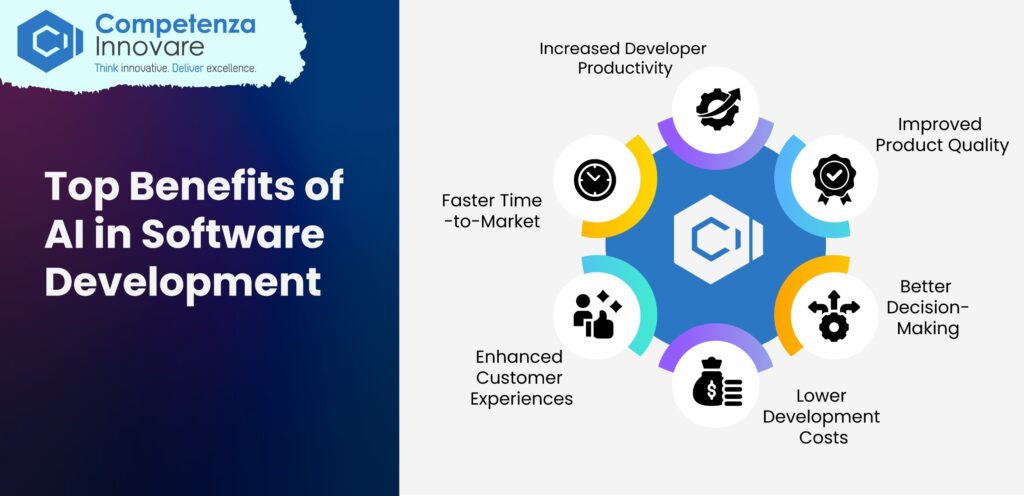
Top Benefits of AI in Software Development
AI can assist businesses in developing software more expeditiously, in enhancing product quality, and in making the process of developing a product better. These benefits unveil the increasing application of AI to the context of the development of a vast majority of modern software products.
Faster Time-to-Market
AI achieves this by automating computer code, computer tests, and computer debugs, and it helps teams release products and updates quicker. roblems.
Improved Product Quality
With the assistance of AI, bugs, security issues, and performance issues are timely identified and lead to more dependable software products.
Better Decision-Making
Based on analyzing user data and market trends, AI reveals insights, which lead teams to prioritize features and make wise decisions regarding the product.
Lower Development Costs
Automation enhances efficiency and also saves time and resources used in the development, testing and maintenance. And How Much Does It Cost to Build a Software Product in 2026?
Enhanced Customer Experiences
AI can assist companies in becoming more user-centered and give them tailored, more personalized, user-friendly software experiences.
Such advantages of AI in software development prove that AI is enhancing efficiency and product quality as well as business results, and it is a significant component of the current approach to software development.
AI Software Development Trends Defining 2026
As AI becomes more advanced, companies are embracing novel technologies and development methods to create smarter software products. The trends in AI software development in 2026 are as follows and will create the future of the industry.
- AI-Native Software Products – Organizations are developing AI-enabled software built starting with AI capabilities and scaling to provide smarter and more personalized and data-driven user experiences.
- Autonomous Development Workflows – AI is automating tasks to encompass coding, testing, deployment and monitoring to help teams to improve efficiency and accelerate software delivery.
- Agentic AI Product Engineering – AI agents can independently perform tasks, analyze information, and assume decision-making, allowing product development teams to focus on innovations and strategy.
- AI-Powered Low-Code Development – AI-enhanced low-code applications allow software coders to make the process of creating applications simpler, reduce the number of lines of code that need to be written manually and are able to release their products in less time.
- Predictive Product Management – The teams must work with the assistance of AI to be more focused on the features and make more informed choices related to products through the analysis of customer behavior, product performance, and market trends.
- Continuous AI Optimization – AI constantly examines applications and identifies performance zones of concern and offers solutions to attain stability, scalability and user experiences.
The trends explain how software product development in 2026 is changing to move beyond automation to innovation, productivity, and business growth over the long run with the help of AI.
Challenges of AI-Powered Software Development
In spite of the key benefits of AI-powered software development, certain problems can be noted that need to be addressed by organizations and bring all the advantages of the technology as well as succeed in its implementation.
AI-Generated Code Quality
The use of code generators Generative AI Software Development tools are capable of generating code more quickly, though AI-generated code may have bugs, security, or workflow issues. Coding reviews and testing are also to be done on a regular basis.
Data Privacy and Security
The conversion to AI software development and protection of confidential business and customer data is growing increasingly important as more companies find it an advantage. There should be sound security and data governance policies.
Regulatory Compliance
To reduce legal and operational risks, businesses are obliged to make sure that AI development processes will not violate regulations of an industry and meet data protection needs.
Integration Complexity
Trying to fit AI into the existing development environments, workflows, and tools may be difficult. Instructions need to be planned properly to achieve an easy adoption and success.
Human Oversight Requirements
Many of the development tasks can be automated through AI, although it cannot substitute human expertise. Strategic decisions, validation, and quality of software still require developers, architects, and product teams.
Automation and human ability: the future of AI-driven software development requires a balance of automation and human understanding. By joining AI power with robust engineering practices, organizations will be able to enhance their productivity and software quality and have higher business performance with minimized risk factors.
Best Practices for Successful AI-Driven Software Product Development
In order to enjoy the advantages of the AI-driven software development, the strategy adopted in organizations needs to be strategic in terms of striking a balance between innovation, quality, and security.
- Develop AI Governance Policies: Applying AI tools to the software development lifecycle, establish explicit policies to verify the consistency, accountability and responsible use.
- Check AI-Generated Outputs: Check AI-generated code, suggestions and content to ensure correctness, quality and adherence to business requirements.
- Insuring Human Oversight: AI can support part of the efforts of the developing forces, but there must be human experience in decision-making, problem-solving, and quality control.
- Invest in the Developer Training: Team up and educate them on how to use AI solutions and how to implement them in the existing development process.
- Think of Security and Compliance: Implement fruitful security practices, and comply with business regulations and standards via AI-mediated procedures.
- Monitor AI performance routinely: Check outputs and system performance and development outcomes of AI on a regular basis to identify possible performance improvement opportunities and to make it reliable.
These best practices allow organizations to deepen the capabilities of AI software engineering, minimize risks, and develop high-quality software products that can generate long-term business value.
Why Businesses Need an AI-Enabled Software Product Development Partner
The businesses would need to identify a partner experienced in AI and product engineering in order to demand the maximum expected out of AI-based software development. A well-established development partner can help with AI integration into workflows, developing scalable software architectures, fast delivery, and maintaining high-quality and security standards.
Competenza is a provider of Software Product Development Services to assist startups, SMEs and enterprises with the creation of innovative, scalable and future-proof software products. Incorporated into the AI-related development practices and agile styles, companies will be in the position to be more efficient and will be able to accelerate the development process and stay afloat in the rapidly evolving digital space.
Conclusion
In 2026, AI will change all phases of software product development, including product discovery and planning, coding, testing, deployment, and optimization. AI is helping enterprises produce high-quality software products faster than ever before and increasing their efficiency, accelerating the development process and assisting in making decisions.
Although technology cannot be successful in its adoption. As the businesses apply AI-based software development, good product engineering, effective security and human resource capability, they will be in a better position to offer innovation and growth over the longer term. With AI ever-evolving, the companies that currently adopt these abilities will be in a better position to establish scalable and digitally ready software products and stay competitive amid a digitalized world.
FAQs
What is AI-powered software development?
Software development AI-powered software development is artificial intelligence software developed to help with software planning, software coding, software testing, software deployment and software maintenance. It assists development teams to work more productively, automate congested operations and achieve online software products more effectively.
What will AI do to software product development in 2026?
AI is revolutionizing the development of software products by assisting in product discovery, requirement collection, code generation, testing, DevOps and optimizing software performance. This will allow companies to create and release software products quicker and with high quality.
What are the advantages of AI in software development?
The critical AI advantages in software development are faster time to market, higher productivity of the developers, higher software quality, reduced cost of development, smarter decisions and improved customer experience.
What is Generative AI in software development?
Generative AI is applied to software development when software development tools are capable of producing code, recommending code improvements, aiding in debugging, and automating development processes. Examples such as GitHub Copilot, ChatGPT, Cursor, and Amazon Q are popular.
What does AI do to enhance software testing and quality assurance?
AI assists in automating the generation of tests, regression testing, continuous testing, prediction of the defects, and detection of the bugs. This will enhance the effectiveness of testing and assist in providing more reliable software products.
What is the use of AI in DevOps and Agile?
AI helps Agile teams and DevOps teams to optimize the sprint plans, analyze the deployment risks, create automatic CI/CD pipelines, monitor infrastructure, anticipate incident occurrence, and cover the deployment risks. This aids in quickly delivering software and also being reliable.
What are the largest trends of AI software development in 2026?
The trends in AI software development by 2026 consist of AI-native software products, autonomous software development workflows, Agentic AI in product engineering, AI-powered low-code development, predictive product management and continuous AI optimization.
Will software developers be replaced by AI?
No, AI is not meant to substitute developers; it is meant to help them. Despite the potential of AI to automate the trivial and make things more efficient, human expertise remains needed in problem-solving, architectural designs, decision-making, and quality assurance.
What are the challenges that businesses investing in AI encounter regarding software development?
Some of the challenges that businesses need to address are code quality generated by AI, privacy and security of data, adherence to regulations, complexity of integrating AI into business processes, and persistent human supervision.
Why should businesses have an AI-enabled software product development partner?
A seasoned software product development partner will assist businesses in connecting AI to the development process, developing scalable software applications, enhancing the efficiency of development processes, upholding the security level, and speeding up innovation and decreasing implem