

The workflows can be automated not only with the help of the rule-based process. It is becoming more available, with more and more workflows and processes and operations being automated by fewer manual programs using workflow automation or with robots with artificial intelligence (RPA) and artificial intelligence agents to automate more complex workflows and processes. Modern automation can be used to analyze information, spot anomalies, assist decision-making, marshal actions across related systems, and continuously be able to enhance the operation of workflows compared to merely routing a task or triggering an approval.
This change is driving a new stage of agentic automation of workflows where AI workflow agents are able to operate towards set objectives, subdivide processes into as many steps as possible, communicate with business applications, and perform actions under a predetermined set of controls. Unlike conventional automation, which relies on fixed-rule automation, AI-based workflow automation can be used in more dynamic scenarios and can facilitate contextual decisions.
RPA still has an important role in this future. It continues to be practical when the repetitive, structured, and rule-based activities are involved and AI agents can provide the reasoning, decision-making, exception handling, and coordination. RPA and AI agents coupled with intelligent process automation can create a larger automation system that can bridge applications, departments, data, and business processes.
In the case of enterprises, the chance is not merely to automate more operations but to create autonomous business workflows. The workflows enhance speed, visibility, accuracy, and scalability and keep human interventions where the prospects of judgment, governance, or approval are needed. This trend is very much related to the current generation of workflow automation software that aims at automating repetitive tasks, management of documents, approvals, system integrations, process optimization, and AI-driven process automation.
With companies leaving the traditional RPA system for AI workflow orchestration, intelligent workflow agents, and autonomous process execution, it has become imperative to know where workflow automation is going. We should expect the future to be less characterized by the replacement of one technology by another but by RPA, AI agents, intelligent automation, and human oversight that will collaborate to develop more adaptive and interconnected business operations.
What Is Workflow Automation in 2026?
Workflow automation helps businesses to realize tasks and processes in an automatic manner in 2026 with the help of workflow software, AI, and system integrations. It is also able to initiate workflows, approvals, and process records; transfer data across systems; issue notifications; and reveal exceptions with reduced effort.
AI-assisted workflow automation can also be used to process information and assist in the making of simple decisions by a business. Using an example, an invoice workflow might take an invoice, process the information within it, submit it to be approved, update the financial system, and automatically notify the correct team.
Competenza aims at automating the repetitive functions, approvals, document routine, notifications, and business activities to lessen manual bottlenecks. This promotes AI-based workflow management, intelligent task automation, and enterprise AI workflow automation towards quicker and more efficient work.
How Workflow Automation Has Evolved
Automation of workflow has transformed manual, repetitive work into smart systems capable of automating complicated business processes. With added speed, accuracy, and flexibility in each stage.
Stage 1 – Manual Workflows
In manual work processes, most of the work is done by the employees. They input information, transfer data across systems, chase approvals, and close-loop processes. Delays and human errors may also be experienced as the workload continues to rise.
Stage 2 – Rule-Based Workflow Automation
The second stage was accompanied by programmed rules and regulations. Simple business systems could be integrated in workflow in the form of automatic workflow notification, approval routing, and task assignment. However, such workflows were mostly adhering to pre-defined guidelines.
Stage 3 – RPA
Bots transported by Robotic Process Automation (RPA) were capable of performing repetitive, programmed tasks, such as information input, information output, and automation of regular system tasks. The use of RPA is still successful in the case of predictable processes but is not necessarily effective in cases where workflows require interpretation and alternative decisions.
Stage 4 – Intelligent Automation
Smart automation is a mixture of AI and automation. It is able to analyze information, make decisions, and find exceptions as well as make processes more optimal. This takes the businesses to the level of intelligent process automation, where workflows have the capability to deal with more complex cases.
Stage 5 – Agentic Workflow Automation
The most recent one is Agentic AI for Workflow Automation. Within set controls, AI workflow agents are able to perceive a goal, plan ahead, apply interconnected tools, and execute actions across business systems. This allows increased autonomy in executing the processes and takes the workflow automation beyond RPA.
The development of the same can be summed up as follows:
Manual Work → Rule-Based Automation → RPA → Intelligent Automation → AI Workflow Agents → Agentic Automation.
The trend can be attributed to the fact that businesses are shifting away from the automation of individual activities to more interconnected workflows and intelligent workflows.
What Is Agentic Workflow Automation?
Combining AI agents and workflow systems, agentic workflow automation automates the business processes in a wiser manner. Other than merely obeying a preset regulation, AI agents are able to comprehend an aim, develop the necessary measures, and execute approved acts across interconnected systems.
How AI Workflow Agents Work
A simple process is:
Goal → Understand → Plan → Decide → Execute → Monitor → Adapt
AI workflow agents can:
- Understand requests and information
- Plan the next steps
- Make decisions based on context
- Complete tasks across connected systems
- Monitor the results
- Flag exceptions for human review
As an example, a customer request can be sent to an AI agent who will examine the data related to the request, update the CRM, and forward the request to the appropriate department.
Smart workflow agents and intelligent agent workflow management can assist companies in automating more complicated processes and retain human control where necessary. This causes agentic workflow automation, a significant advancement in the workflow automation future in 2026.
AI Agents vs Traditional Workflow Automation
Conventional workflow automation is carried out by rules and pre-programmed procedures. The AI agent automation is more adaptable, as it is able to interpret the objective, manipulate various kinds of information, and make a decision based on the predetermined business rules.
| Traditional Automation | AI-Agent Automation |
| Rule-based | Goal-based |
| Fixed workflows | Adaptive workflows |
| Structured data | Structured + unstructured data |
| Predefined decisions | Context-based decisions |
| Single-task execution | Multi-step execution |
| Limited exception handling | Better exception handling |
| More human intervention | Defined level of autonomy |
The AI workflow agents are able to comprehend requests, perform actions, and observe the result. Unlike traditional automation, which is restricted to unchangeable sets of rules, they can respond to the context, handle exceptions, and increase the scale of the issues because of large-scale automation. This will assist companies to abandon RPA in favor of more adaptable and self-sufficient business processes.
RPA vs AI Agents: Are AI Agents Replacing RPA?
RPA is not being fully replaced by AI agents. RPA and AI agents instead can collaborate. RPA can be applied in performing monotonous and procedural tasks, whereas AI agents should be applied in jobs that utilize insight, logic, and unusual decision-making.
What RPA Does Best
RPA is useful for:
- Entry and transfer of data.
- Invoice processing
- Repetitive transactions
- Updating business systems
- Rule-based tasks
- Transfer of data across applications.
What AI Agents Do Best
AI agents can be used in the following ways:
- Understanding unstructured information
- Making context-based decisions
- Handling multi-step workflows
- Managing exceptions
- Coordinating different tasks
- Taking approved actions
Why RPA + AI Agents Work Better Together
Structured tasks can be handled by RPA, and agents of AI can analyze the information and determine what to do next. To illustrate, an AI agent might look at an invoice and decide what to do with it after a robot with RPA might feed the accepted information to a finance system.
In combination, AI agents and RPA can support intelligent automation and business shifting to workflow automation, in addition to RPA, with intelligent orchestration of processes based on the AI.
The Rise of AI Workflow Orchestration
AI workflow orchestration links various automation technologies and business systems to enable them to be integrated into a single process. Orchestration helps to synchronize all the steps, rather than keep AI agents and RPA bots, applications, data, and human approvals separate.
The following may be linked by a current workflow:
AI Agents + RPA + APIs + Applications + Data + Human Approvals
What AI Workflow Orchestration Can Do
- Delegate tasks to the appropriate system, agent, or employee.
- Connection systems such as CRM, ERP, HR and finance.
- Integrate AI agent usage into different workflow processes.
- Use robotics in situations when repetitive work is typical and has rules to follow.
- Control approvals of control.
- Send strange ones to be considered exceptions to processes.
- Follow up on track work progress reports.
- Maintain human oversight for important decisions
As a set of examples, an AI agent may overview a customer request, an RPA bot may make some changes to the CRM, and a human may approve a necessary action, all in the same automated process.
This renders process orchestration with AI an essential component in contemporary enterprise AI process automation. An AI agent orchestration platform can help businesses to coordinate the links between these technologies and handle more complex workflows in a more pragmatic framework with greater insights and oversight.
Top Intelligent Workflow Automation Trends in 2026
By 2026, workflow automation will be smarter, more interconnected, and versatile. Companies are integrating AI agents, RPA, analytics, integrations, and workflow platforms to automate even more complex processes but to retain people whenever necessary.
1. Agentic AI Workflows
Multi-step business tasks can be executed, and not one predefined action, only because agentic AI solutions can work with them. They are able to comprehend a request, strategize actions, utilize interlinking systems, and assess the outcome.
2. Autonomous Business Workflows
Fewer manual intervention workflows are possible. Artificial intelligence is capable of automating daily activities and past activities and coping with minor exceptions without violating the business regulations and authorization boundaries.
3. AI-Powered Decision Making
AI has the capability to process information and give recommendations or approve actions. AI workflow decision-making is especially useful when a process has context, rather than a yes-or-no rule.
4. Hyperautomation
Hyperautomation is a combination of AI, RPA, workflow automation, integrations, analytics, and process mining. It aims at automating whole business processes and not specific processes.
5. Intelligent Process Automation
Making traditional automation more flexible, AI helps workflows to understand the information, identify exceptions, and respond to the existing conditions. This is in favor of smart task automation of other business functions.
6. Human-in-the-Loop Automation
AI does not have to deal with all decisions by itself. Automation takes over simple tasks as people can review sensitive actions, approve significant requests, and handle intricate exceptions.
7. Multimodal Workflow Triggers
The modern workflow is capable of responding to various kinds of inputs, among which are the following:
- Text and emails
- Voice requests
- Documents
- Images
- Forms
- Business events
This will enable companies to initiate work processes on more natural and diversified bases.
8. AI-Powered Process Mining
Process data can be analyzed using AI to identify delays, bottlenecks, redundant work, and areas of improvement. These lessons can assist companies in streamlining the current processes and then delivering further automation.
Collectively, the trends are driving businesses toward intelligent workflow agents, cognitive workflow automation, and self-learning workflow automation, where processes are able to be more adaptive and yet run within a defined set of business rules and human regulation.
How AI Agents Are Changing Business Workflows
To implement more complex workflows, AI agents assist businesses in automating their work and comprehending information, making decisions, and accomplishing tasks within the system in this connection.
For example, an AI agent can:
- Read documents and classify information
- Interpret emails and requests.
- Check the data prior to the processing.
- Approaches the appropriate route.
- Activities on business systems.
- Modify CRM/ERP systems.
- Get outliers to be reviewed by humans.
- Produce reports and summaries.
The above features offer an AI agent business automation of finance, HR, customer service, IT, sales, and marketing. AI workflow agents are capable of handling numerous tasks, and AI workflow management assists in keeping workflows visionary.
It can minimize the repetitive level of work and facilitate quicker autonomous execution of the processes, although the human beings will still be engaged in significant decisions.
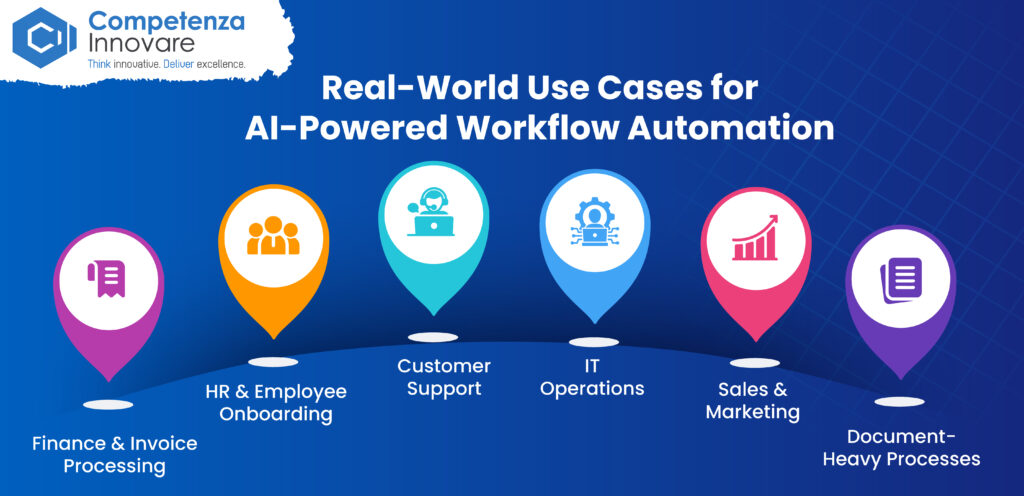
Real-World Use Cases for AI-Powered Workflow Automation
AI-based workflow automation can assist companies with recurring activities, system integration, and manual labor across various departments.
Finance & Invoice Processing
AI can help with:
- Invoice data extraction
- Invoice validation
- Approval routing
- Payment workflows
- Identifying unusual transactions
HR & Employee Onboarding
Automation can support:
- Candidate screening
- Employee onboarding
- Document collection
- Approval workflows
- Employee questions and requests
Customer Support
AI can automate:
- Ticket classification
- Ticket routing
- Response generation
- Escalation
- Customer feedback analysis
IT Operations
AI-based workflows can be useful in:
- Incident classification
- Ticket routing
- Routine issue resolution
- Escalation workflows
- IT service requests
Sales & Marketing
Businesses can automate the following:
- Lead qualification
- CRM updates
- Lead scoring
- Campaign tasks
- Sales and marketing reports
Document-Heavy Processes
AI can streamline the document processes by:
- Data extraction
- Document classification
- Approval routing
- Document processing
- Compliance checks
These applications demonstrate the way that intelligent task automation and AI agents within business automation may assist various departments. In the case of enterprises, AI-based workflow automation can bridge these two processes and design more efficient and scalable business processes.
Self-Learning Workflow Automation: What Comes Next?
Self-learning working automation is the assistance of AI and data and feedback in modifying the working regime with time. It can help businesses in making the decisions of models, make good selections of the make-up of the sounders, and get to know how they can do their usual customary way of doing things more easily.
It can use:
- Past data to acquire understanding of past procedures.
- Response to improve future actions.
- Machine learning to determine trends.
- Locate process delays through process analytics
- Outcome monitoring to measure results
- Exception patterns to discover common problems.
As an example, when a workflow usually asks the incorrect team a request, AI can recognize the pattern and assist in the later improvement of the routing. This strategy facilitates adaptive workflow automation and automobile workflow management based on AI, which helps companies to devise smarter and more efficient processes.
AI Workflow Decision Making and Human Oversight
AI has the potential to automate decision-making but should not go ahead and make all the decisions in a business. Sensitive or complex, high-value situations are still subject to human oversight.
In order to guarantee responsible decision-making in AI workflow, the businesses can set the following:
- AI action boundaries.
- Consideration levels of major decisions.
- Exceptional human intensification.
- Trails on activities to be followed.
- Checking to inspect performance.
- Security controls to protect data
- Compliance measures to meet regulations
- Control of access to manage permissions.
One such thing is the fact that intelligent workflow agents could make workflows and approvals based on routine workflows, whereas employees would inform them about significant financial, human resource, or compliance-related decisions.
As more AI workflows become automated in businesses, AI workflow decision-making and AI agent workflow management will make sure that businesses take advantage of AI without losing control and oversight.
Benefits of AI-Powered Workflow Automation
Automation of workflows is an AI-like business assistant that helps to enhance efficiency, eliminate manual labor, and handle the workflow more efficiently.
- Accelerated Workflow Processing: Automation reduces delays in online expression of workflow tasks, approvals, and information in between the workflow steps.
- Limited Manual Bottlenecks: Manual procedures such as request submissions, notifications, and system updating can be computerized to minimize manual work.
- Higher precision: Automated processes conform to well-laid-down rules and procedures, and this will be helpful in minimizing the mistakes of repetitive duties.
- Faster Decision Making: AI has the potential to process information at a very high rate and respond to the information to help teams to react more quickly.
- Better Scalability: With improved scalability, larger volumes of work can be handled by business without further augmenting manual work.
- Achieving Better Visibility: Workflows with automation provide transparency by registering the status of work and its visibility and making it easier to track the progress and determine the problems.
Through these benefits, organizations are able to develop quicker, more efficient, and scalable business processes.
Challenges of Agentic Workflow Automation
Though agentic workflow automation can have numerous advantages, there are also disadvantages that need to be minded by businesses prior to implementation.
- Reliability with AI: AI agents are not always effective in generating the desired behavior.
- Risks of hallucinations: Sometimes AI may produce false or distorted information.
- Data security: Business-sensitive data should be attended to safely.
- Security: Strong controls are required in the organizations to secure the systems and information.
- Difficulty of integration: It may be difficult to integrate AI agents into existing applications and processes.
- Governance: A code of apparent rules should exist that determines the abilities and the inabilities of AI.
- Compliance: Automation should be in line with industry and regulatory needs
- Cost: Implementation or maintenance of AI-powered solutions might be expensive
- Human control: There is still a possibility of human control and agreement on crucial decisions.
- Selection of processes: Not all workflows can be agentically automated, and identifying processes is crucial.
Through the solution of these challenges, the businesses are able to develop more secure, reliable, and effective workflow automation plans, as well as allow them to maintain control over the key processes.
How Businesses Can Prepare for the Future of Workflow Automation
A practical approach to workflow automation can help businesses prepare to adopt the future of automation.
1. Identify Repetitive Processes
Begin by doing tasks of high volume, which are repetitive and time-consuming. These are processes that can be the quickest to gain the benefit of automation.
2. Map Existing Workflows
Look at the existing processes to target bottlenecks in the workflow, time taken to process, manual movement procedure, and duplication.
3. Start With RPA Where Rules Are Stable
Use RPA to implement process deployment based on the stages to be followed periodically, e.g., data entry, invoice regulation, and system amendments. followed, e.g., data entry, invoice regulation, and system amendments, using RPA.
4. Introduce AI Agents Where Decisions Are Dynamic
AI agents should be applied to tasks that require an interpretation of a workflow, reasoning, making decisions, and exceptions.
5. Connect Systems Through Orchestration
Combine CRM, ERP, HR, finance, and other business systems into a single and highly interconnected system that works together.
6. Establish Governance
Develop best practices in automation, which incorporates the following:
- What AI can decide
- What will the human be approving?
- What data AI has access to.
- How workflow actions are monitored
7. Measure ROI
Monitor the most important metrics, such as
- Processing time
- Error rates
- Manual effort
- Workflow volume
- Approval times
- Cost per process
It is possible to establish a powerful automation base by starting with quantifiable and repeatable workflows and rolling out expansion to more sophisticated AI-enhanced workflow automation.
Transform repetitive processes into intelligent workflows with Competenza's workflow automation solutions. Get started today.
What Will Workflow Automation Look Like by the End of 2026?
Workflow automation currently moves out of the realms of rule-based automation → RPA → intelligent automation → AI agents → autonomous business workflows.
As of 2026, AI agents, automation, and orchestration will be applied collectively by businesses to more effectively handle their workflows. The AI will assist in decision-making and implementation, and repetitive tasks will be automated, but humans will have to remain in control and make critical business decisions. What will come out then will be smarter, quicker, and more interconnected business workflows.
Final Thoughts
Automation of workflow no longer involves automation of tasks. Although RPA is still important when it comes to repetitive and other routine operations, AI agents and intelligent automation are ensuring workflows become more adaptive and efficient. With businesses being more and more connected and autonomous, human management will play a crucial part. The Competenza, being an established workflow automation team, process optimization, and AI-based solutions provider, can help organizations to simplify their workflow and build smarter and scalable business processes.
FAQs
What is in the future of workflow automation in 2026?
The automation of workflow will see the future of AI agents, smart automation, workflow coordination, and RPA working together to automate additional business processes and have humans maintain control over them.
Will RPA be replaced by AI agents?
No, workflow automation is independent of RPA but extends to integrating AI agents. RPA processes tasks that are grounded on repetitions and regulations, and AI agents might assist in the decision-making business process, coordination, and exceptions.
What is agentic workflow automation?
In contrast to step-by-step, predictable rules, agentic job automation involves having AI agents understand the goals, plan activities, and implement them in an interrelated system.
What is AI agent-based automation of business processes?
Business automation AI agents may process information, approvals routing, triggering, updating systems, managing exceptions, and workflow decision support.
What is AI workflow orchestration?
The AI workflow orchestration manages the flow of end-to-end business operations by the coordination of AI agents, RPA bots, applications, data, and human approvals.
Are AI agents able to make workflow decisions?
Yes, AI workflow decision-making enables the AI agents to process the information and prescribe or make approved decisions. Human approval is still needed to make some crucial decisions.
What is the difference between RPA and intelligent automation?
RPA will automate structured and rule-guided activities, whereas intelligent automation is the one that will be used in combination with AI and automation to undertake data interpretation, decision support, and exception handling.
What is the benefit of an AI-based workflow automation?
AI-based workflow automation can make workflows more efficient, reduce manual labor, increase accuracy, decrease approvals, and provide better insight into business processes.
What are the best business processes that can be automated with AI workflow?
Other processes that are common include invoice processing, employee recruitment, customer service, document management, IT processes, and sales processes.
How significant is human control to the processes of AI?
Human oversight in the critical or higher-impact business decisions provides a company with more than merely the ability to make needed decisions but also ensures the security, compliance, governance, and accuracy of decisions.