

The lending sector is experiencing a significant digital transformation in which financial institutions are seeking quicker, smarter, and efficient means to serve borrowers. The operation of traditional loan operations may be slow and time-consuming due to extensive paperwork, a long approval procedure, and the intricate verification process that would affect the customer satisfaction. To address these issues, banks, NBFCs, credit unions, and fintech firms are more and more venturing into digital lending software development to automate and simplify the overall lending process.
Digital lending solutions allow lenders to handle the onboarding of borrowers, KYC checking, credit scoring, the origination of loans, their underwriting, disbursement, repayment tracking, and collections by a single solution. Financial organizations will be able to save on manual resources, expedite the process of loan approvals, enhance compliance, and make better decisions by using automation and artificial intelligence, cloud computing, and data analytics.
Due to increased competition in the financial industry, services in lending software development have become a necessity, in which the organization aims to provide to the customer a smooth digital experience without specifying the security or the regulatory obligations. With AI-driven loan underwriting applications and automated approval workflows, state-of-the-art fraud detection, and loan management systems, future lending platforms can assist financial institutions in increasing their lending activities with greater confidence and efficiency, risk aversion, and operational efficiency.
In this blog, we will examine the main characteristics of digital lending software development, the advantages digital lending software development offers to financial companies, and the enhancement of the lending ecosystem by custom lending platforms contributing to faster, customer-focused, and future-conscious lending platforms among lenders.
What Is Digital Lending Software Development?
Digital lending software development implies the creation of platforms that will assist financial institutions in the process of handling the whole lending process online. The solutions can automate numerous processes such as borrower onboarding, KYC checks, credit checks, loan confirmations, disbursement, loan repayments, and collections. The digital lending platforms enable faster, efficient, and customer-centric lending experiences than the conventional methodology of lending, which is time-consuming and manual, requiring paperwork.
The growing need for digital financial services is propelling the development of bespoke lending software due to varying business and compliance needs. Specialized lending software development services and fintech software development services can provide financial companies with competitive lending and mitigate risk by building secure, scaled, and smart lending platforms to further streamline the functioning of the business in the long term.
Why Financial Companies Are Investing in Digital Lending Platforms
In a move to achieve competitive advantage in the new digital era, financial companies have been investing in digital lending solutions, which would simplify the lending process, enhance customer experiences, and keep in line with the new environment. Contemporary borrowers require the speed of the approvals procedure, the ability to apply online, and to get access to funds quicker, so digital borrowing platforms are indispensable to financial institutions.
Major causes of use of fintech lending software solutions are the following:
- Quick processing and loan approvals.
- Improved customer experience and convenience.
- Reduced manpower in automated processes
- Less adherence to regulation.
- More precise credit and risk rating
- Increased fraud detection and security.
- Lower operational costs
- Simpler control of loan collections.
- Expansive systems to aid the business.
By adopting contemporary lending solutions through financial institutions and fintech lending administration software, an organization would be able to enhance improved efficiency and effectiveness in lending operations and provide a hassle-free and safe lending experience.
How Digital Lending Software Works
Digital lending applications simplify and automate the life cycle of the whole lending process to enable financial organizations to process more applications at a faster rate, with less labor intensity and better customer experiences.
Borrower Registration and Onboarding
The borrowing process starts with registration and onboarding of borrowers. Borrowers can also open the required accounts, submit applications via borrower onboarding software, upload the required documents, and maintain their profiles in a highly guarded online platform. This eradicates paperwork and accelerates the process of application.
KYC and Identity Verification
Once an application is made, a borrower is authenticated by the platform through a KYC integration of lending platforms to verify his/her identity. This can involve carrying out Aadhaar checks, PAN checks, and document checks using the help of OCR checks and AML checks. These mechanisms help the lenders reduce the incidents of fraud and react to regulations.
Credit Evaluation and Underwriting
This system then analyzes the financial data of the candidate, credit report, and risk profile. AI solutions allow automatic credit background checks, help with alternative credit scores, and help lenders make faster and more accurate lending decisions.
Loan Approval and Disbursement
Approval processes will be executed based on programming with lending and the automated loan approval software under successful assessment. With the approval, the funds can be transferred within seconds through the automation software for disbursement of loans, and a loan offer can be developed, reducing the time spent on approving and funding loans.
Loan Servicing and Collections
The system monitors the payment schedule, EMI, and post-disbursement payment reminders or collections. The development of advanced loan servicing software assists the lender in tracking loan performance, enhancing collection efficiency, and offering improved support across the loan lifecycle.
Essential Features of Digital Lending Software
Digital lending software assists financial institutions in automating the loan processes, achieving efficient operations, and enhancing better borrower experiences. The following are important characteristics that will help in creating a secure and scalable lending platform.
Digital Loan Application Portal
A digital loan application portal is one that enables borrowers to apply online and keep track of the application without complications. It assists in lending as a component of the development of an online lending platform and lending platform software development to enable a smooth lending experience.
Key Benefits:
- Online loan applications
- Multi-device accessibility
- Real-time application tracking
Loan Origination Management
The development of loan origination software is helping to speed up the process of loan applications through approval. Together with automating the digital lending workflow, it saves time and effort.
Key Benefits:
- Application intake
- Document verification
- Automated workflows
- Faster approvals
AI-Powered Loan Underwriting
The AIs that are used in loan underwriting help the loan lenders to evaluate borrowers more accurately. Using fintech credit decisioning software and digital lending risk assessment software, lenders can make more intelligent lending decisions.
Key Benefits:
- Automated credit assessment
- Risk analysis
- Alternative credit scoring
- Faster decision-making
Automated Loan Processing
Loan processing automation software automates the lending processes and improves on the efficiency. Loan approval applications will allow faster decisions on loan approval by automating loan approval processes.
Key Benefits:
- Reduced manual work
- Faster processing
- Improved accuracy
- Better productivity
Compliance and Regulatory Management
Compliance software, digital lending software, assists financial institutions in complying with the laws. High-quality KYC implementation in the lending systems guarantees the robust security of customers.
Key Benefits:
- KYC verification
- AML monitoring
- Regulatory reporting
- Audit trails
Fraud Detection and Risk Monitoring
This is the use of fraud detection lending software to identify any suspicious transactions and reduce lending risks.
Key Benefits:
- Fraud prevention
- Transaction monitoring
- Risk management
- Enhanced security
Loan Management and Servicing
Digital loan management software helps lenders to communicate and manage the borrowers’ repayment. Fintech loan management platforms of today enhance efficiency in servicing.
Key Benefits:
- EMI management
- Payment tracking
- Collections management
- Customer support
Cloud-Based Infrastructure
Development of cloud-based lending software facilitates lending activities that are secure and scalable. These are intelligent lending software solutions that favor business expansion in the future.
Key Benefits:
- Scalability
- Data security
- Remote accessibility
- Faster deployment
Key Benefits of Digital Lending Software for Financial Companies
Digital lending software assists the financial institutions to ease the lending business, enhance productivity, and provide quality services to borrowers. Automating key lending operations enables lenders to accurately process loans with great speed, less manual labor, enhanced compliance, and business success.
- Reduced Loan Processing Time: eLending Software streamlines the loan approval, credit checks, and approval process, making lending faster. This not only saves on the processing time but also the customer experience of the borrower.
- Reduced Operational Costs: Paperwork and manual work will be lowered with automation, and the financial institution will save time and improve productivity and minimize the cost of operations.
- Improved Lending Accuracy: Lenders are helped by digital lending software to make a better decision, as computer-based assessments and information are based on data. This will minimize errors and enhance credit analysis.
- Improved Customer Experience: Borrowers are able to apply for loans online (they can even post their documents online, and consumers are able to know the status of their application in real time). This results in a smooth and hassle-free lending process.
- Improved Compliance Management: Embroiled compliance provides financial institutions with the ability to execute KYC checks, regulatory requirements, and reporting functions more efficiently.
- Improved Fraud Prevention: Fraud can be prevented effectively due to enhanced security and verification systems that are able to detect suspicious activity, thereby reducing the chances of fraud that will create a safer lending environment.
- Scalability to Business Growth: Business lending platforms have facilitated the handling of additional volume of loans and the introduction of additional lending products as well as increasing operations as required by the business.
Also Read: Agentic AI In Fintech: Use Cases, Benefits and Implementation
Digital Lending Software Use Cases
Digital lending software is assisting financial institutions in providing more efficient, accelerated, and customer-friendly lending services. Starting with banks and NBFCs and including credit unions and fintech companies, these services make it easier to manage the loans, automate, and enjoy the overall lending experience.
1. Banks
The digital lending platforms help banks administer personal loans and home loans as well as business loans with greater efficiency. To make loaning easier and quicker for customers, automation helps in speeding up the process of applications, credit evaluation, loans, and payment of repayments.
2. NBFCs
NBFC digital lending software facilitates consumer financing, vehicle financing, and lending to SMEs. The platforms assist in minimizing the amount of manual work, enhancing the efficiency of the loan issuance and availing faster lending amounts to the borrowers.
3. Fintech Startups
Contemporary fintech lending software solutions can help a fintech company provide solutions like Buy Now Pay Later (BNPL), embedded lending, or microfinance. Digital channels enable start-ups in the fintech industry to roll out new lending offerings while preserving speed, flexibility, and scalability.
4. Credit Unions
Financial companies utilize credit union lending software to streamline member lending programs and automate the process of loan servicing. These solutions assist in enhancing its efficiency in operations and even make the process that involves borrowing much easier to the members.
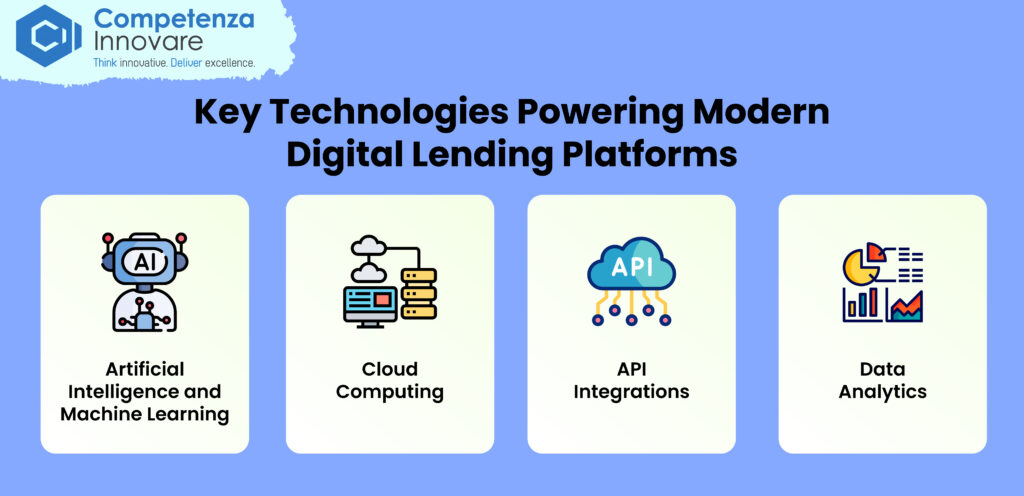
Key Technologies Powering Modern Digital Lending Platforms
The new digital lending platforms rely on sophisticated technologies to automatize the lending processes, as well as enhance decision-making and provide borrowers with a superior experience. These technologies are used to assist financial institutions to become more efficient and risk-averse and manage lending operations more efficiently.
Artificial Intelligence and Machine Learning
Machine learning (ML) and artificial intelligence (AI) enable borrowers to become smarter and quicker in their lending decisions. These technologies examine the data on borrowers, assist in credit scoring, forecast risks, and detect possible fraud prior to the approval of a loan.
Key Uses:
- Credit scoring
- Risk prediction
- Fraud detection
- Automated decision-making
Cloud Computing
Cloud computing offers the flexibility and scalability of the system required in modern lending platforms. It enables finance institutions to safely store the information about loans, facilitate high-loan volumes, and minimize the expenses incurred in the infrastructure.
Key Benefits:
- Scalability
- Cost efficiency
- Secure data management
- Easy system access
API Integrations
The API integrations would join the lending platforms with the external systems, which would benefit lenders to access and expose data and facilitate fast exchanges. The integrations enhance working efficiency and simplify the lending process.
Key Integrations:
- Banking APIs
- Credit bureau integrations
- Payment gateways
- Verification services
Data Analytics
Data analytics assists the lenders in comprehending the behavior of borrowers, tracking their performance on loans, and making sound business decisions. It aids in improved risk management and portfolio optimization as well.
Key Benefits:
- Lending insights
- Portfolio monitoring
- Performance analysis
- Better decision-making
Future Trends in Digital Lending Software Development
Digital lending is in the process of development because financial institutions are implementing new technologies to ensure that the borrowing is quicker, more secure, and more individual. Such trends are defining the future of lending platforms, and they are assisting lenders in making better decisions and achieving efficiency and customer experiences.
AI-Driven Credit Decisions
The AI is making credit evaluation more efficient and data-driven. Lending institutions can utilize the data on the borrowers, create their risk profiles, and help process the credit decisions faster and with fewer human inspections.
Embedded Lending Solutions
Embedded lending enables the provision of loan and financing services by embedding them in non-financial products like e-commerce and business applications. This also comes in handy in making borrowing easier by financing where the customers need and when they need it.
Open Banking Integrations
APIs enable lending platforms to gain access to financial data by open banking integrations with suitable customer permission. This can assist lenders in enhancing income verification, affordability examinations, and credit evaluation.
Alternative Credit Scoring Models
Non-traditional credit scoring involves the use of non-credit items of financial and behavioral data to provide a credit evaluation of borrowers with whom there might be limited credit history. This can assist lenders in making better decisions and increasing access to the appropriate credit.
Hyper-Automated Lending Workflows
Further automation is assisting lenders in linking application processing, verification, underwriting, approval, and disbursement into seamless processes. This minimizes manual processes and assists in enhancing processing speed.
Real-Time Fraud Intelligence
Real-time fraud detection begins with transaction and identity verification and analytics to detect suspicious activity within seconds. It assists financial institutions in minimizing the risks of fraud and makes their digital lending safe.
Transform lending operations with powerful software built for speed, security, and seamless customer experiences.
How to Choose the Right Digital Lending Software Development Partner
The decision of an appropriate technology partner is significant to develop a secure and scalable digital lending platform. seeking experience in fintech, deep understanding of compliance, safe practices in development, and understanding of building custom lending software, AI-led lending, and financial integrations.
By providing credible fintech software development services and lending software development services, The Competenza assists financial institutions to develop a contemporary lending platform that streamlines working, enhances customer borrower experiences, and expands business opportunities.
Conclusion
The digital lending software is transforming the operations of financial companies to accomplish their loan lifecycle processes, including borrower onboarding and processing the application, as well as approval, disbursement, and repayment. Through automation and AI, secure integrations, and digital workflows, lenders can streamline lending and make it easier and more efficient.
With banks, NBFCs, and fintechs, custom digital lending software will help reduce the cost of doing business, increase compliance, improve risk management, and offer better experiences to borrowers. The right technology and development partner can enable financial institutions to build secure and scalable lending platforms, which would help them grow and meet new customer requirements in the long term.
FAQs
What is software for digital lending?
Digital lending software is a type of software that allows the financial institutions to completely computerize the loan process. It can onboard borrowers, check their KYCs, conduct credit checks, approve loans, disburse funds, and collect payments and repayments all under one central system.
Why is digital lending software important?
Its major attributes include digital loan application, loan onboarding, KYC, loan origination, automated underwriting, credit evaluation, loan approval, disbursal, repayment monitoring, fraud detection, compliance, and analytics.
What are the benefits of online lending software to banks?
Digital lending software assists financial institutions to cut down on manual work, expedite loans, enhance lending precision, enhance compliance, cut down operational expenses, and offer a seamless experience to a borrower. It also facilitates the handling of increasing amounts of loans.
What can AI do to enhance digital lending?
AI is applicable to lenders to analyze information about borrowers; assist in credit scoring, risk evaluation, and suspicious behavior detection; and automate the lending decisions. The AI-based loan underwriting software can cut down on human reviews and enable loan decision-makers to be faster and more data-driven.
Can NBFCs use digital lending software?
Yes, NBFC digital-lending software can be utilized in promoting consumer lending, vehicle lending, SME lending, and any other lending products. It can automate the onboarding, monitoring, credit evaluation and authorizations, disbursal, and loan servicing.
Is it compatible with payment solutions and banking systems?
Yes, the digital lending application can be able to connect with the banking APIs and payment gateways, credit bureaus, and identity-checking services, among other financial arrangements. With such integrations the lending process becomes automated and streamlined.
How is digital lending software helpful in terms of KYC and compliance?
Digital lending solutions can be introduced into digital lending platforms to verify borrower information using KYC and identity verification solutions. They are also capable of facilitating the AML checks, compliance tasks, reporting, and audit trails to guide financial institutions to handle regulatory demands.
What does digital lending software do to prevent fraud?
Identity verification, transaction monitoring, risk assessment, analytics, and AI-based fraud detection can identify suspicious applications or activities, which can be used by the digital lending platform. These tools are used to minimize the risk of frauds and to guard confidential financial data of the lenders.
What is custom lending software development?
Custom lending software development encompasses developing a lending platform based on products, workflow, compliance, integrations, and business objectives of a company. It is more flexible compared to a lending system that fits everyone.
What is the time required to develop a digital lending platform?
The development time will be dependent on the features, integrations, security needs, stack of technology, and platform customization. A less-technological lending platform can be completed faster than a massive platform with artificial intelligence, lots of integration, complex processes, and sophisticated compliance.