

The fintech industry is rapidly evolving, and transactions are rapid; more security, improved customer experiences, and smarter decision-making are demanded. Conventional automation and artificial intelligence solutions have enhanced the fiscal functions, and numerous systems are based on predetermined rules and human intervention. It is at this point that Agentic AI is altering the game.
In contrast to classical AI, agentic AI in fintech can process data, decide, and act as well as optimize realized results with human participation to a minimum. This renders it very useful in the context of current financial service where speed, accuracy, and risk control are vital.
Examples of agentic AI in fintech include fraud detection and loan processing, AI compliance automation, and customer onboarding, which are rapidly growing. These smart systems are being embraced by financial institutions to minimize risk, enhance efficiency, and provide more personalized services. With further fintech becoming more data-driven, agentic AI in financial services is becoming a potent technology to create smarter, faster, and scalable financial systems.
This blog will dwell on the best agentic AI use cases, advantages, and plans to implement in fintech.
What Is Agentic AI in Fintech?
Fintech Agentic AI involves intelligent AI systems able to process fintech data, decide, act, and constantly optimize workflows without significant human involvement. In contrast to the traditional AI models, which tend to offer predictions or pieces of advice, agentic AI in fintech is capable of performing and responding to changing real-world factors in real time. This causes it to become a significant breakthrough in fintech AI applications, where accuracy, speed, and automation are necessary.
Examples of agentic AI related to financial services include fraud detection, AI risk management, loan processing and compliance automation, and customer onboarding. As an example, an agentic AI development, rather than a system only flagging suspicious transactions can recognize an abnormal activity, investigate the threat, and grant warnings and instant action. Financial Services: A world of ever-evolving fintech Agentic AI is helping organizations develop smarter, faster, and more scalable financial systems.
How Agentic AI Differs from Traditional Fintech Automation
Traditional fintech AI applications may be used to automate such functions as payment processing, operation trace, and fraud detection. The majority of systems are, though, rule-based and reactive; i.e., they are responding to events on the basis of pre-defined workflows and human input. Fintech AGI is even a step further, as it allows data to be taken and decisions to be made and actions to be made with a minimum of human input. It effectively renders agentic AI in the financial services sector more efficient and effective in complex tasks like AI risk management, loan processing, and compliance automation.
| Traditional Fintech AI | Agentic AI in Fintech |
| Reactive | Proactive |
| Rule-based | Goal-driven |
| Human-triggered | Autonomous action |
| Static workflows | Adaptive workflows |
Conventional AI is used to analyze data. The even more advanced agentic AI is one that makes decisions and takes action in real-time to support smarter and even more scalable fintech operations.
Top Use Cases of Agentic AI in Fintech
Learn the hottest agentic AI uses cases in fintech and the ways autonomous AI systems are changing fraud detection, lending, compliance, and customer experience with financial services.
1. Fraud Detection and Investigation Agents
One of the most impactful and valuable applications of agentic AI in fintech is in detecting fraud. With the trend that digital banking and the use of online transactions are increasing, fraud attacks are taking an advanced form that can hardly be identified by traditional systems. Intelligent monitoring, quicker detection, and automatic response enhance anti-fraud measures through agentic AI.
Real-Time Transaction Monitoring
The agentic AI is constantly tracking operations of transactions, the payment pattern, user transactions, and device feedback. In contrast to the traditional systems that operate under fixed rules, these AI systems substantially examine numerous risk factors in real time to discern suspicious activity. This assists fintech companies to avert fraud even before significant financial losses are experienced.
Fraud Pattern Detection
Conventional fraud systems may not be effective in identifying new fraud methods. Control agentic AI is based on transaction history and real-time behavior indicators to identify abnormalities, deviant behavior, and hidden fraud patterns. This boosts the ability to eliminate fraud in the long run and strengthens security operations.
Automated Investigation Workflows
In case of suspicion, agentic AI can automatically raise an alarm, indicate suspicious transactions, and begin investigation processes. This will eliminate the need to do manual work by the fraud teams and enhance quicker response times along with operational efficiency.
2. AI-Powered Loan Processing Agents
Loan processing has long been one of the most time-consuming processes in financial services. The approvals can be slowed down by risk analysis and manual inspection of documents, and operational costs can also be increased by underwriting. The agentic AI applied to the fintech sector helps the lending process become automated, improving the decision-making speed, accuracy, and precision. This will enable fintech development company to process loan applications faster besides reducing the amounts of manual work and improving customer experience.
Document Verification
Bank statements, identity documents, financial documents, and income statements can be automatically checked by agentic AI with high precision. This minimizes the manual tasks and reduces human error in the verification process. The quicker document validation facilitates loan disbursements and increases the efficiency of the operation.
Credit Risk Assessment
The conventional approach of credit assessment uses fixed scores and previous history. At Agentic AI, this process is enhanced by examining more general financial trends, behavior patterns of transactions, their repayment history, and other data sources. This facilitates more intelligent and precise risk assessment.
Underwriting Support
Underwriting systems powered by AI assist lenders to speed up and make more reliable decisions of rejection. The agentic AI works with real-time data on the analysis of multiple financial variables and provides approval recommendations. This enhances the quality of loans and minimizes delays in processing.
3. KYC and Customer Onboarding Agents
Customer onboarding is an essential part of the work of a fintech. Poor verification increases compliance risks, and a slow process of onboarding can lower conversion rates. The idea of agentic AI in fintech allows the fintech sector to expedite the process of onboarding, making it faster, safer, and more compliant. This will offer a more comfortable level of customer experience and will improve the risk management.
Identity Verification
To check the identity, agentic AI automates document checking, facial recognition, and biometrics. These systems are capable of verifying users in a short period and accurately as well as minimizing friction during onboarding. This improves both speed and security.
AML Screening
Regulatory compliance in financial services would not be complete without AML screening. The AIG agentic AI constantly compares the profile of the customer with the list of sanctions and watchlists and anti-compliance databases. This assists fintech businesses to define high-risk users in a better fashion.
Automated Customer Onboarding
Using agentic AI with fintech workflow automation, verifying and activating an account can be streamlined. It minimizes manual operation and enhances onboarding effectiveness. This assists in effecting faster onboarding of customers by the businesses without the reduction of compliance.
4. Wealth Management Agents
Digital investing and customized financial advisory services are rapidly increasing throughout the fintech domain. AI wealth management empowers smarter portfolio management, improved financial planning, and enhanced customer interaction. The wealth platforms can rely on agentic AI to provide investment planning at scale and represent individuals.
Portfolio Analysis
The agentic AI assesses the risk exposure, market forces, and portfolio performance on a real-time basis. This aids investors to acquire a greater understanding of their financial interests. The better the portfolio insights, the better the decision that is made in regard to the investment decisions.
Investment Recommendations
AI financial advisors offer individualized advice on the basis of investor objectives, market factors, and risk tolerance. These rules are fine-tuned to the market conditions. This enhances the investment strategy and customer satisfaction.
Automated Portfolio Rebalancing
Agentic AI observes the performance and market trends of assets at any time. AI can provide automatic rebalancing of investments when their portfolio allocations are out of their range. This assists in optimal portfolio performance as well as managing risk.
5. Regulatory Compliance Agents
Regulations are considered one of the most inadequate and the most expensive questions in fintech. Manual compliance processes cannot be suited to scale as regulatory requirements are constantly changing. With AI compliance automation, fintech firms can become more efficient in a variety of regulatory operations and decrease operational overhead and compliance-related risks.
AML Monitoring
Agency AI can be used to monitor financial transactions and activities of clients, and by doing that, suspicious activity can be identified. This enhances compliance transparency and bolsters fraud prevention initiatives. Monitoring in real-time is considered to minimize financial and regulatory risks.
Regulatory Reporting
Creating compliance reports is a complex time-consuming and resource-demanding task. Reporting Agentic AI follows the capabilities of automation in reporting, as it collects information, complies with mandated regulations, and provides accurate reports. This promotes reporting efficiency and speed.
Audit Preparation
It is against this background that agentic AI encourages better audit preparedness by automating the process of documenting and compliance checks. These systems will help in maintaining well-organized records and also alleviating the work of audits. This cuts down on the amount of manual work as well as enhancing regulatory preparedness.
6. Customer Support and Banking Assistants
The demand of the modern fintech clients require quick, relevant, and 24/7 assistance. Time taken on responding may adversely affect customer loyalty and retention. The fintech companies can gain better customer service with Agentic AI by automating the process of support and offering personalized help.
24/7 Customer Assistance
AI banking assistants, whose work is agentic, can assist 24/7 with payment problems, account questions, and transactional issues. The customers get quicker responses as they will not have to wait till the human agents respond. This enhances the availability of services and customer satisfaction.
Smart Financial Guidance
Artificially intelligent assistants are able to give individual spending responses, budgeting tips and suggestions, and financial advice. These systems have more relevant and useful support because of examining the behavior of the users. This enhances customer experience and interaction.
Faster Resolution
The agentic AI can be used to handle routine customer support tasks that can be automated. This simplifies the workloads of support and helps to overcome the issues more easily. Increased speed enhances customer satisfaction and reduces operations, minimizing costs.
7. Risk Management Agents
Every fintech business revolves around the risk management process. Financial institutions need to keep on checking market risk, credit exposure, and threats to their operations. In AI risk management, the companies can enhance decision-making with real-time monitoring and predictive intelligence.
Market Risk Analysis
The agentic AI is able to track market trends, economic trends, and financial trends in real time. These systems detect the risk indicators promptly and give actionable insights. This assists businesses to react more quickly to changes in the market.
Credit Risk Monitoring
Agentic AI monitors the behavior of the borrowers, repayment activity, and financial health in real-time. This will enable the fintech companies to identify the risk variation at elevated features and enhance lending choices. Strengthened risk management is a result of increased visibility.
Predictive Forecasting
Predictive analytics is used by independent financial systems to enhance forecasts and strategic planning. Through processing substantial volumes of data, agentic AI can help companies to predict future challenges and opportunities. This helps to make smarter business decisions.
8. Payment and Transaction Monitoring Agents
Fintech is all about payments, and it is essential that they are fast, secure, and accurate. A minor inefficiency can cause problems in the operation as well as the loss of money. The AI addiction of agency enhances payment systems through smarter monitoring and automated decision-making.
Payment Anomaly Detection
In real-time, agentic AI is used to track payment processes to identify suspicious transaction activity, such as fund transfers, fraud, and other payment anomalies. Discovery at an early stage aids in curbing fraud as well as enhancing security in payment.
Settlement Reconciliation
These manual reconciliation processes may be slow and prone to errors. The agentic AI automates the process of negotiations to reconcile transactions, trying to find discrepancies within the records within a short time frame. This enhances operation efficiency and accuracy in payments.
Chargeback Management
Finetech companies may experience considerable losses due to chargebacks. The use of agentic AI can detect patterns of conflict, streamline an investigation process, and increase the speed of the solution. This minimizes loss and enhances performance on payments.
Benefits of Agentic AI in Fintech
Fintech Agentic AI can help financial companies become faster, more secure, and efficient. In agentic AI, smart automation and real-time decision-making are expected to enhance operations in the financial arena, minimize human labor, and increase the number of desirable customer experiences.
- Faster Decisions: Agentic AI can help fintech organizations to make faster decisions like loan approvals, risk analysis, and payment processing. It boosts speed and accuracy based on real-time analysis of financial data of key workflows.
- Better Fraud Detection: AI fraud detection can be labeled as one of the most significant benefits of agentic AI in fintech. It examines both the transaction and user behavior in real-time so as to detect the suspicious activity and prevent fraud faster.
- Lower Costs of Operation: Agentic AI lowers the level of manual labor by automating operations like onboarding, compliance tests, and monitoring of transactions. This will help fintech firms to optimize cost and improve productivity.
- Improved Customer Experience: The consumers desire their financial services to be fast and hassle-free. The agentic AI also provides the customers with a superior experience that includes numerous customer onboarding updates, instant responses, and financial advice.
- Better Compliance: Agentic AI helps in compliance with regulations by monitoring financial processes and helping to supplement reporting of their regulations. This reduces compliance risks, as well as increases accuracy.
- Scalable Operations: Agentic AI is capable of working with larger workloads even when the fintech companies can grow without having a substantial change in costs. This makes operations more scalable, efficient, and reliable.
Roadmap for Implementing Agentic AI in Fintech
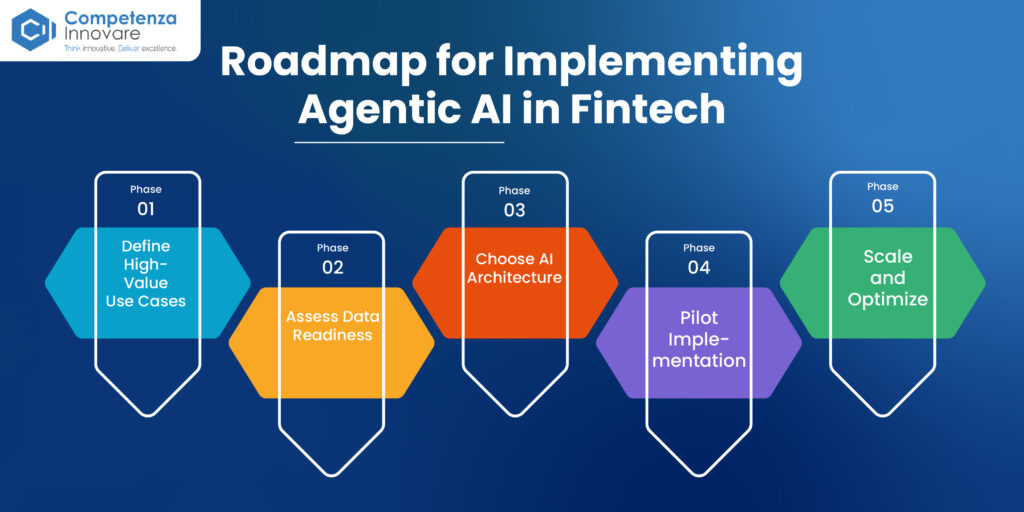
Incorporation of agentic AI within fintech requires a strategy, solid data infrastructure, and proper structure of AI. An organized roadmap assists fintech firms to enhance their adoption, minimize risks, and get maximum ROI on the investments in AI.
Phase 1 – Define High-Value Use Cases
The primary move is to establish high-impact use cases in which agentic AI in fintech can offer maximum value. The firms can target such domains as AI fraud detection, loan processing, customer onboarding, compliance automation, and risk management. The choice of appropriate use cases guarantees quicker business impact and improved long-term outcomes.
Phase 2 – Assess Data Readiness
The agentic AI is reliant on precise and quality financial information. The data quality, infrastructure, security, and governance should be evaluated by fintech companies prior to implementation. Connected and clean data enhance the performance of AI and decision-making as well as the efficiency of operation at large.
Phase 3 – Choose AI Architecture
Selecting an appropriate AI architecture is key to effective deployment. Businesses need AI models and systems, which are compatible with existing fintech systems. The appropriate AI stack allows improving scalability, encouraging the automation of fintech, and ensuring performance over the long term.
Phase 4 – Pilot Implementation
Use a controlled pilot to pilot agentic AI in real-world financial processes. This will help fintech companies estimate the performance, establish gaps, and streamline workflow prior to its full implementation. Pilot program reduces the implementation risk and improves adoption.
Phase 5 – Scale and Optimize
Once the testing is successful, the businesses have the opportunity to roll out agentic AI in various fintech operations. The basis of accuracy, efficiency, and long-term value is ensured by continuous monitoring, optimization, and performance enhancements. This will see agentic AI further providing a better financial service as the business expands.
Also Read: Agentic AI in EdTech
Challenges of Implementing Agentic AI in Fintech
There are significant opportunities for implementing agentic AI in fintech, and significant challenges are also part of it. These obstacles should be overcome by fintech companies to achieve a safe, scalable, and successful launch of AI.
- Data Protection Issues: Agentic AI requires the use of extensive amounts of personal and financial customer information. The rules and safe data handling should be robust so that the information held by the users remains secure and is placed in confidence.
- Security Risks: Fintech AI systems handle major financial transactions involving payments, fraud detection, and monitoring transactions. Cybersecurity should also be good enough to curb any security risks and guard systems against cyber threats.
- Regulatory Compliance: Fintech is a very regulated business. In order to minimize compliance risks, the agentic AI systems should be operated in compliance with the financial regulations, AML, KYC, and data protection requirements.
- AI Governance: AI governance is used to govern autonomous AI systems so their decisions are transparent, fair, and rely on facts. In the case of AI-based finances, it is necessary to have human supervision and effective surveillance.
- Development of integration: The second concern that can be encountered upon integrating agentic AI with the existing fintech infrastructure is the complexity of the latter. The difficulties involved in the implementation process that can become problematic include legacy systems and data silos, as well as the workflow complexity.
These problems demonstrate the importance of good government, safe infrastructure, and unending optimization in agentic AI implementation.
CTA: Ready to Transform Fintech with Agentic AI? Build Smarter, Faster, Secure Financial Solutions Today.
Future of Agentic AI in Financial Services
The AI agentic approach to the future of financial services modifies how business is conducted through fintech, how fintech automates business processes, and how fintech offers experiences to customers. With the increasingly fast adoption of AI, agentic AI will drive significant innovation, efficiency, and smart decision-making throughout the financial industry.
Autonomous Digital Banking
Agentic AI will play a major role in the evolution of digital banking. Autonomous AI will become an increasingly common way of how financial institutions enter and serve their customers; handle their payments; identify fraud; and provide customer support. This will assist in enhancing speed, security, and efficiency in general banking.
AI-Native Financial Platforms
Further evolution of fintech platforms will be AI-first infrastructure. AI-native financial applications will involve agentic AI automating basic financial processes, improving operational efficiency, and increasing smarter business decisions. This will assist fintech firms in growing at a quicker pace and working more effectively.
Hyper-Personalized Financial Services
Financial services customer expectations are changing very quickly. By drawing insights into customer behavior in real-time and looking at past financial history and the patterns of their spending, agentic AI will support highly personalized financial experiences. This will enhance lending and investment recommendations as well as wealth management services.
Intelligent Risk Management
Agency AI will drive risk management to a higher level. Autonomous AI systems will enable financial institutions to constantly track risks, analyze the market conditions, and enhance financial forecasting. This will assist businesses to make quicker and precision-based decisions in risk-based approaches.
As a new component of the modern fintech infrastructure, agency AI assists in crafting more intelligent, more efficient, and more effective financial services.
Conclusion
Fintech Agentic AI is changing financial services by automating processes with greater intelligence and quicker decisions, as well as operating intelligently. Contrary to conventional automation, agentic AI is able to process data, make a decision, and act without the intervention of a human being. This assists the fintech companies in enhancing speed, efficiency, and security as well as scaling. Agentic AI can be used to cut down cost, improve fraud detection, and enhance customer experiences through fraud detection and loan processing, compliance automation, risk management, etc. With the ever-changing nature of fintech, agentic AI emerges as a driving force of innovation and development. The Competenza assists businesses in embracing AI-based solutions to create smarter, secure, and future-ready financial systems.
FAQs
What is agentic AI in fintech?
Financial agentic AI means the existence of intelligent AI systems capable of processing financial data, making decisions, acting, and optimizing results with only limited human intervention. Contrary to traditional automation, agentic AI can assist fintech companies to automate more intricate workflows, including creative automation of fraud detection, loan product processing, customer registration, and AI risk management.
What are the differences between agentic AI and traditional fintech automation?
The conventional fintech automation is predominantly prescriptive and reacts to certain triggers. The agentic AI in financial services is further developed towards autonomous decision-making, adaptation to changing environments, and proactive actions with differing conditions in real time. This makes fintech automation smarter, faster, and more scalable.
Which are the best applications of agentic AI in fintech?
Among the most insightful applications of agentic AI in fintech, there are AI fraud detection, automated loan handling, KYC and AML compliance, customer onboarding, wealth management, payment monitoring, AI compliance automation, and AI risk management. These applications are used in increasing efficiency, security, and decision-making.
What is the benefit of agentic AI in the detection of fraud in fintech?
Against AI fraud, agentic AI enhances transaction, payment, and user fraud detection by utilizing real-time monitoring of behavior, transaction, and payment trends. It detects suspicious activity earlier, is more precise in identifying patterns of fraud, and is also capable of setting up automatic investigation procedures to recover losses in fraud.
Can agentic AI help with loan processing?
Indeed, agentic AI in financial technology will enormously enhance the processing of AI loans by document verification, credit risk evaluation, and underwriting boosting. This will save on the manpower, enhance faster approvals, and enhance accuracy in lending.
What is the role of agentic AI in financial services compliance?
The agentic AI supports AI compliance automation through transaction tracking and screening of customer actions and gives automatic compliance reporting. It helps fintechs to improve AML monitoring, reduce compliance risks, and increase regulatory preparedness.
What does agentic AI in fintech do to its benefit?
The enhanced benefits of agentic AI in fintech are faster decision-making, better fraud detection, reduced operations costs, oversight of the customer experience, better compliance, and scaleability of operations. These advantages assist fintech firms to enhance operations and lead to an increase in business.
What are the drawbacks of applying agentic AI to fintech?
Such pitfalls are usually in data privacy, security, regulatory compliance, governing AI, and the complexity of integration. A successful implementation of fintech requires good governance, sound infrastructure, and quality data.
What is the time required to apply agentic AI in fintech?
Timelines of implementation rely on the complexity of the project, use case, and availability of infrastructure. Smaller pilot projects to use AI for detecting fraud or onboarding customers can be done in a few months, whereas global agentic AI implementation can take 1224 months at the enterprise.
How will agentic AI in financial services become relevant?
The future of agentic AI in financial services can be thought of as autonomous digital banking, AI-native financial platforms, hyper-personalized financial services, and intelligent risk management. Agency AI will form part of financial infrastructure as the fintech market develops.