

As an ecommerce business continues to expand, a straightforward or prototype platform may become more and more challenging to scale to large product lines, new order volumes, challenging inventory needs, and changing demands on the customer. The businesses may also need multiple payment and shipping options, ERP, CRM, inventory, and more direct control of their shopping experience. Such needs can elevate a scalable and flexible platform to a higher level of importance. However, the development of custom ecommerce platforms enables businesses to create features and workflows based on their operations rather than using the standard functionality of the platform. Customized ecommerce platform capabilities include product management, high-end search and filtering features, custom checkout, inventory and order management, payment integration, analytics, and API integrations to enable businesses to ensure their immediate demands are met and allow expansion in the future.
The aim of an online store for an expanding company is not just to create an online store but to create a scalable ecommerce platform that can expand with the growth in products, customers, orders, and business needs. This renders customization, integration, performance, and scalability significant factors when deciding on an ecommerce development approach.
What Is Custom Ecommerce Platform Development?
Custom ecommerce platform development is the process of creating an ecommerce platform based on the requirements of a business-specific product, customers, workflow, and expansion. Business-specific functionality such as product management, inventory operations, custom checkout, custom price operations, advanced search, and custom customer experiences that are unavailable in an off-the-shelf solution, which contains a fixed number of features, can be integrated into a custom solution based on e-commerce.
Flexible architecture, individual integrations, additional data, and workflow control are also linked with a custom platform. APIs enable companies to connect payment gateways, ERP, CRM, shipping avenues, inventory, analysis, and so on. Such custom eCommerce software development is scalable and may be expanded as the business grows, which may help build a scaling model that can be modified to accommodate variation in business activities and needs of customers.
Why Growing Businesses Need a Custom Ecommerce Platform
The case of an ecommerce business whereby customers, products, orders, and sales start to grow might lead to the emergence of the new operation and technical requirements. The common platforms may be flexible enough, and the firms with unique processes are prone to need greater adaptability, integrations, and control. Ecommerce solutions, tailored to the needs of developing businesses, can be developed in a way that would support their current operations and enable further expansion.
Handle Increasing Traffic and Orders
An expanding business should have a platform that can sustain increased traffic to the websites and orders without causing a bad shopping experience. The development of a scalable ecommerce platform can offer an architecture that is ready to handle the growing customer base, transactions, and peak sales season.
Manage Expanding Product Catalogs
With the increase of product ranges, it may be more complicated to handle categories, variants, pricing, and SKUs as well as inventory. Product management workflows tailored to the business can be offered on a custom ecommerce platform to grow businesses, and it will be easier to organize and maintain a larger catalog.
Support Complex Business Workflows
Expanding businesses might need to comply with special pricing, approvals, promotions, order fulfillments, returns, or even managing the customers. These workflows can be developed as custom functionality within the platform rather than making teams fully rely on standard processes.
Integrate With Existing Business Systems
The ecommerce system is often needed to interface with a range of other services, such as ERP software integration, CRM, payment gateways, inventory management systems, shipping systems, and analytics systems. These systems can be networked with each other using specially constructed integrations and APIs in order to keep vital business information and operations up to date.
Improve Customer Shopping Experiences
Customers have increased demands with the emergence of businesses associated with e-commerce. Shopping can be simpler with the opportunities to speed up checkout, enhance searching and filtering, personalized suggestions, a variety of payment methods, and mobile services. These ecommerce platform scalability capabilities aid organizations in sustaining the existing client base as well as expandable future growth.
Key Features of a Custom Ecommerce Platform
Growing businesses need to have more than simple online selling with the help of a custom ecommerce platform. It must be able to offer the flexibility to handle products, customers, orders, inventory, payments, integrations, and data as the business is able to scale.
1. Custom Product Catalog and Product Management
Custom ecommerce product management helps companies to organize and populate a huge product catalog, or a complex one.
- Develop and maintain product classes and subclasses.
- Manage SKUs, product variants, attributes, and pricing.
- Add and edit product descriptions, images, and specifications
- Back-up mass product modifications to conserve management time.
- Form category structures on the basis of business needs.
- Ensure consistent product information flow through the sales channels.
2. Advanced Search and Product Filtering
Enhanced product discovery enables the customers to find relevant products much quicker, particularly where a business has a huge listing.
- Keyword-based product search.
- Autocomplete and suggestions.
- Filters for price, size, brand, category, availability, and other attributes.
- Product sorting by price, popularity, relevance, or newest products.
- Category-based navigation.
- Mobile-friendly search and filtering
- Search functionality that can be improved as the product catalog grows
3. Custom Shopping Cart and Checkout
A flexible checkout can be done based on the purchasing process associated with a business.
- Custom shopping cart functionality.
- Guest and registered customer checkout.
- Address management and saved addresses.
- Multiple payment options.
- Prior transparent review of orders and payment.
- Mobile-friendly checkout experience.
- Promotion of business-related checkout regulations.
- Less wasteful procedures to establish a more convenient buying process.
4. Flexible Payment Gateway Integration
The growing company may be forced to accept diverse ways of payment based on its customers and the target market.
- A combination with the several payment gateways.
- Bank and credit card checks.
- Electronic wallets and other electronic payment systems.
- Bank and local payment methods.
- Payment status tracking.
- Failed-payment handling.
- Cancellation and refund processes
- Safe interaction between e-commerce sites and payment services.
5. Custom Inventory Management
Increased volume of products and order activity means more importance in good inventory management.
- Inventory visibility on a real-time or near-real-time basis.
- SKU-level stock tracking.
- Low-stock alerts.
- Channel synchronization of inventory.
- Multi-location or multiple warehouse support.
- Stock is maintained on the basis of orders and returns.
- Stocking supplies for the customers.
- Integration with external inventory or warehouse systems.
The capabilities can be used to assist businesses to minimize inventory inconsistencies and enhance visibility throughout their operations. Another area of competency that is captured in Competenza through e-commerce offerings is real-time tracking, inventory management, and inventory synchronization.
6. Custom Order Management
A well-organized order management system assists companies with order management from purchasing to delivery.
- Centralized order processing.
- Order status tracking.
- Fulfillment management.
- Shipping and delivery updates.
- Returns and cancellation management.
- Customer order notifications.
- Order history and records.
- Integration with inventory and logistics systems.
It is particularly helpful when the volumes of orders are high and more than one system or a team is to be engaged in fulfillment.
7. Third-Party and API Integrations
Integrations enable an ecommerce platform to interact with the systems that a business has in place.
- ERP integration.
- CRM software integration.
- Payment gateway integration.
- Integration of shipping and logistics.
- Integration of inventory and warehouse system.
- Accounting software integration.
- Marketing platform integration.
- Customer support integration.
- System-to-system data exchange using an API.
Loose integration of workflows can be reduced by means of custom ecommerce platform integration, and flexibility in integrating new services can be developed by means of ecommerce platform API integration followed by adjustment of business requirements.
8. Scalable Ecommerce Architecture
A growing company needs an ecommerce application that can withstand an increasing demand.
- Provision towards boosting traffic on the site.
- Capacity to deal with larger volumes.
- Promotion of expansion of product lines.
- Flexible infrastructure.
- Interlacing design to add new features.
- Optimization of performance during peak times.
- Ability to accommodate more integrations and sale channels.
- Architecture is able to develop in response to business needs.
Scalable ecommerce platform development is steered towards preparing the platform to cope with future expansion rather than being a service to meet current requirements only.
9. Ecommerce Security Features
Security constitutes a big element in securing customer information, business details, and e-commerce.
- Secure customer authentication.
- Role-based access controls.
- Data protection
- Secure payment processing
- API security.
- Monitoring and security controls
- Regular security updates.
- Security and performance testing.
A custom platform must be developed and maintained with security in mind, and not in the end, but security must be considered through its development.
10. Analytics and Reporting
Analytics will assist the business in knowing what transpires in the various activities of the e-business.
- Sales and revenue reporting.
- Product performance analysis.
- Customer behavior insights.
- Conversion tracking.
- Order performance data.
- Inventory insights.
- Customer and product trends.
- Custom business dashboards.
- Key performance indicator tracking.
The following ecommerce platform analytics capabilities would enable the teams to utilize business data to make superior decisions and leverage opportunities.
11. Personalization and Customer Experience
Custom functionality has the potential to enable businesses to make experiences in various groups of customers more relevant.
- Personalized product recommendations.
- Customer profiles.
- Purchase history.
- Saved preferences and wishlists.
- Personalized offers.
- Relevant product suggestions.
- Customer segmentation.
- Personalized search and product discovery
- Consistent experiences across devices and channels.
In the case of growing ecommerce companies, personalization is able to make the shopping experience more personal and be more open-minded to meet the diverse customer demands.
Custom Ecommerce Platform vs Standard Ecommerce Platform
A generic ecommerce system would be an appropriate one where the company has simple and common requirements. However, other organizations that experience growth may need more flexibility, customization, and control. A specialized e-commerce platform can be developed based on the business processes, integrations, and business development targets.
| Feature | Standard Ecommerce Platform | Custom Ecommerce Platform |
| Functionality | Uses predefined features | Built around business needs |
| Product Management | Standard workflows | Custom product workflows |
| Checkout | Predefined checkout options | Flexible custom checkout |
| Integrations | Available connectors | Custom API integrations |
| Inventory | Standard inventory tools | Business-specific inventory management |
| Scalability | Depends on platform capabilities | Designed around future growth |
| User Experience | Uses standard templates | Tailored customer experience |
| Analytics | Standard reports | Custom reports and dashboards |
In a case where business needs are unique, unique ecommerce functionality is required to provide a level of flexibility to build the platform as business needs change. These applications can also be applied to connecting operations, improving customer experiences, and long-term scalability through the different custom ecommerce platform features and custom ecommerce solutions for growing businesses.
Also Read: Agentic AI in Ecommerce: Use Cases, Benefits and Implementation
How Custom Ecommerce Features Support Business Growth
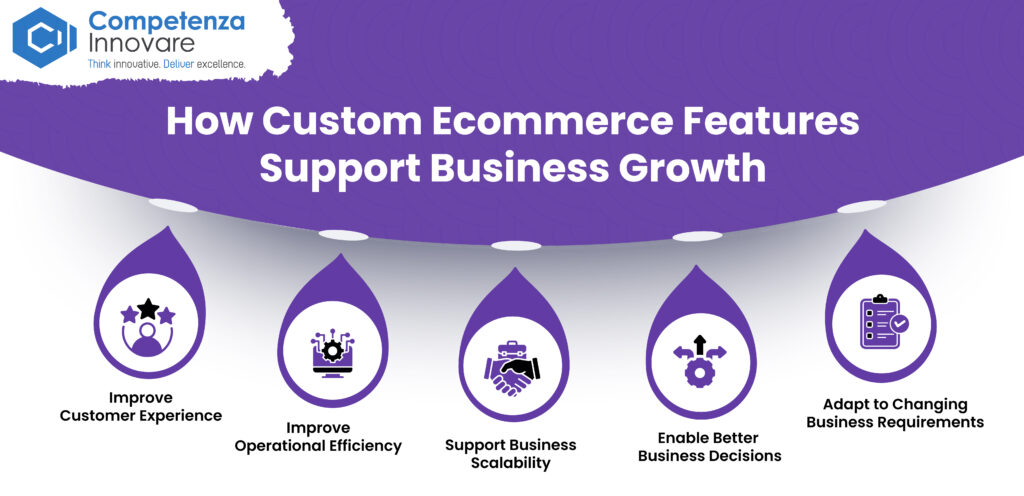
Among the advantages of tailored ecommerce solutions is that they will enable the expanding companies to optimize their day-to-day operations and allow their platforms to handle the prospects of next-generation needs. The ability to select the best combination of functionality can fulfill better customer experiences, an efficient operation, and more flexible business operations.
Improve Customer Experience
Such features like advanced search, filtering of products, easy checkout, and personalization allow customers to more easily find products and make purchases. Smoothening out the shopping process can also help businesses to keep abreast of the changing customer needs.
Improve Operational Efficiency
Critical ecommerce processes have the potential of being linked together through inventory management, order management, and system integrations. This will minimize lost workflows, enhance data visibility, and simplify how teams handle products, orders, and inventory.
Support Business Scalability
The development of scalable ecommerce platforms enables the capacity to scale the platform when there is an increase in the number of products, customers, traffic of the websites, and number of orders. Businesses can also add new features and integrations as their requirements grow.
Enable Better Business Decisions
Analytics and reporting provide analysis of sales, products, customers, orders, and inventory. The insights have the potential to inform businesses on the identification of trends, monitoring performance, and improved decision-making.
Adapt to Changing Business Requirements
Any business in the process of evolving can develop new requirements and processes. Company-made ecommerce functionality Imagine ecommerce companies have the ability to extend functionality on top of the functionality or add new features and customize workflows without being restricted to particular platform functionality.
When Should a Business Consider Custom Ecommerce Development?
A business that is unable to meet its business needs or expansion plans with the help of the existing e-commerce platform may consider the development of custom ecommerce platforms. Flexibility can be acquired more in custom development where standard features and workflows are inadequate.
Look to a custom ecommerce system to grow businesses when:
- Available systems cannot provide the functionality that is desired
- Business activities are becoming complex.
- Its product listing is growing at an alarming rate.
- Managing inventory is becoming challenging.
- Various subsystems require being interconnected.
- They have to use custom functionality to accomplish the checkout process.
- The company should have greater management of the customer experience.
- The traffic on the sites and the number of orders are growing.
- The company requires tailor-made reporting or analytics.
- It must be able to scale to long-term growth and functions.
In the case of businesses with such issues, tailored ecommerce platforms to grow businesses can give them the flexibility to develop features to meet specific requirements and scale them out as those requirements change.
Build a scalable custom ecommerce platform to streamline operations, boost sales, and drive long-term business growth.
How to Choose the Right Custom Ecommerce Development Partner
Selecting an appropriate partner is a crucial factor in developing a purpose-made ecommerce system to support business development. Seek ecommerce experience, scalable architecture, API applications, security, user interface/user experience, testing, deployment, and support. The partner must also have to know your business needs and be able to build personalized ecommerce functionality based on your needs.
The Competenza offers services in software development of e-commerce, committed to unusual solutions, integration, sustainability, and protection as well as to the customer experience. Its development methodology encompasses the main phases of development, which include discovery, architecture development, development, testing, deployment, and continuous support, which assists companies in creating ecommerce sites that would evolve with their needs as their needs expand.
Final Takeaway
A custom ecommerce platform is more than a unique online store. It must serve the contemporary needs of the business and offer the ability to scale to handle products, inventory, orders, checkout, integrations, analytics, and customer experience to scale with the business.
Using the correct custom ecommerce platform development strategy, companies can create a highly adjustable solution that can evolve with the needs of the business and other potential changes in the future. Looking forward to creating an ecommerce site with your business requirements? Inquire about the services of Explore Competenza in developing ecommerce software.
FAQs
What is custom ecommerce platform development?
The development of custom ecommerce platforms is the creation of an ecommerce platform supporting business-specific products, business operations, business customer bases, integrations, and business expansion needs. This is unlike a normal platform, which can only be tailored to the needs of businesses to add features like custom product management, checkout, inventory, order management, analytics, and integrations.
What are the main characteristics of a custom ecommerce platform?
Major custom ecommerce platform features such as product catalog management, custom checkout, product search and search options, inventory management, personalization, and order management as well as API integrations, analytics, security, and personalization. The right features are determined by the business model, the customers, the products, and the growth plans.
Why would an expanding business select a tailor-made ecommerce platform?
A growing company could have a custom-made e-commerce platform, whereas its generic one could not allow it to expand without difficulty to new amounts of merchandise, consumers, and work as well as combinations of traffic and more complex processes. Custom development can be more flexible to make amendments to the platform when business requirements evolve.
How does a custom ecommerce platform contribute to the scale of business?
The idea behind scalability of ecommerce platform development is to develop an architecture that will be able to deal with increased traffic on the site, product catalogs, customers, orders, and integrations. New functionality can also be added to businesses as the business grows to allow the platform to continue to be viable as the business’s requirements change.
What can be integrated into a custom ecommerce platform?
The systems that can be connected with a custom ecommerce platform are ERP, customer relations management systems, payment gateways, inventory and warehouse systems, shipping systems, accounting systems, marketing systems, and customer support systems. API-based integrations can be used to support the process of sharing the necessary data between different systems and support those workflows that are connected.
What does custom ecommerce inventory management mean?
Designed ecommerce inventory management can help companies manage stock according to their business requirements. These include the common tasks like SKU tracking, stock level monitoring, warning when stock is low, synchronization of inventory, warehouse support, and updating inventory across all channels of sales.
Is it possible to customize the checkout process?
Yes, a bespoke e-commerce checkout can be developed based upon the purchasing process of the business. It is able to assist with guest checkout, saved addresses, different payment options, viewing orders, mobile-friendly and business-specific checkout policies, and can assist in cutting avoidable steps.
What is the difference between a custom ecommerce platform and a regular ecommerce platform?
A typical ecommerce platform tends to be well-defined in functionality and workflows, with a tailor-made ecommerce platform potentially being designed and customized towards a certain business requirement. The custom development can provide additional functionality, integrations, product management, checkout, inventory, analytics, customer experience, and scale.
What can analytics do to aid e-commerce business decisions?
The characteristics of e-commerce platform analytics can provide insights into sales, products, customers, orders, conversions, and inventory. The insights enable businesses to track performance, customer trends, and customer behavior and make better operational and sales decisions.
What should I do to choose a customized ecommerce development partner?
Select a partner with experience in ecommerce development, knowledge of scalable architecture, API integration, practice of security, knowledge of UI/UX, and testing and QA and deployment and support experience. Competenza has provided ecommerce software development solutions that are customer-oriented, custom-integration, scalable, secure, and customer-experience-focused.