

A lot of businesses continue to use old applications that are constructed using old technologies, infrastructure, and business needs. These systems are getting more difficult to maintain, scale, integrate, and secure, and moving them to the cloud might not help address the root issues. Companies frequently require a more strategic architecture that considers old architecture, technical debt, performance of the applications, and business demand changes. Modernization of cloud-native applications extends beyond the plain deployment of applications onto the cloud but instead rewrites the applications in ways that are more effective at making use of new capabilities presented by the modern cloud. This may involve, but is not limited to, application re-engineering, re-architecting, microservices, containerization, API modernization, DevOps culture, and cloud-native services, depending on the state of a particular application and the business objectives. The correct path can assist organizations in developing more scalable, maintainable, and adaptable software besides increasing the value of applications in place.
The application reengineering services enable businesses to evaluate available applications, consider possibilities to modernize them, and select a suitable strategy that will meet their technical and operational needs. The goal of a legacy application cloud modernization plan may assist in establishing a more resilient base on scalability, integration, performance, and long-term expansion to support application modernization.
What Is Cloud-Native Application Modernization?
Cloud-native application modernization is the creation of existing applications or old applications to make them take advantage of new cloud features in a better way. It has the ability to assist companies to be more scalable, perform better, flexible, secure, and reliable and allows easier maintenance of applications.
Moving to the cloud is not equal to cloud-native modernization. Migration can merely take up an existing application along with it to cloud infrastructure, and modernization enhances its architecture, code, integrations, and also deployment method in an attempt to overcome constraints within the existing system.
To implement cloud-native modernization of legacy applications, businesses can apply application re-engineering, microservices, containers, API modernization, and DevOps depending on their application and business needs. The aim is to build a more scalable, maintainable, and future-forward application and to maintain the value critical current functionality.
Why Businesses Need to Modernize Legacy Applications
The legacy apps might be difficult to maintain, scale, and integrate as the business needs change. Migrate existing applications to the cloud to enhance performance, flexibilities, and long-term maintainability without losing existing helpful functionalities.
Outdated Technology and Technical Debt
There are also old systems, repositories, databases, and infrastructure that might add to the work on maintenance and complicate the upgrade of an application. The migration of the old applications into the cloud keeps up with the old aspects and minimizes the technological shortage.
Limited Scalability
The conventional applications might not work well as the user base, transactions, and workloads grow. Cloud-native architecture enables companies to more easily add or remove the resources or components of applications as the demand varies.
Slow Development and Release Cycles
The legacy systems are potentially slow in testing, updates, and deployments. New practices like CI/CD and automated testing can assist teams to provide application changes in a more efficient manner.
Integration Challenges
Due to the older applications, they could be relying on tightly integrated systems or interfaces with old-fashioned interfaces. Modernization of APIs and structure may facilitate the integration of old applications on new platforms, services, and business systems.
On the whole, legacy application cloud-native modernization can assist businesses in establishing more adaptable and future-proof applications without overthrowing everything simultaneously.
Cloud-Native Application Modernization vs. Cloud Migration
Modernization of cloud-native applications and cloud migration are related notions that do not mean each other yet. Cloud application migration services are mainly interested in migrating the application to the cloud; modernization could be considered the enhancement of the application itself to exploit the cloud facilities further.
| Cloud Migration | Cloud-Native Modernization |
| Moves an application to cloud infrastructure | Improves the application for cloud-native capabilities |
| May require limited code changes | Can involve architecture and code changes |
| Existing architecture may remain | Architecture can be redesigned |
| Often provides a faster transition | Focuses on long-term flexibility and scalability |
| Existing technical debt may remain | Can help reduce technical debt |
| Mainly focuses on infrastructure | Covers application, architecture, and operations |
Key Approaches to Cloud-Native Application Modernization
Each legacy application possesses unique technical and business requirements, and therefore there is no one method of modernization that fits all systems. There are approaches that can be adopted by a business, depending on the state of the application, scalability requirements, technical debt, integrations, and long-term objectives.
- Rehost: Rehosting is the transfer of an existing application to the cloud infrastructure with a minimal number of modifications. It may be a viable option in situations where a more expedited transition to the cloud is needed, with little or no overall change in the application architecture.
- Replatform: Replatforming relocates the application to the cloud and performs some selected improvements. An example of which managed cloud services might be used by businesses or parts of the infrastructure updated to enhance the performance and operational efficiency without overhauling the application is
- Refactor: Refactoring entails adjusting the application code to enhance performance, maintainability, and even cloud compatibility. When the existing application has value yet the required elements are to be enhanced, it may come in handy.
- Re-architect: Re-architecting is an operation of making a deeper change to the application structure to eliminate some of the limitations in the application, like poor scalability, tightly coupled parts, or hard integrations. Cloud-native application re-architecture can use microservices, APIs, containers, or other novel patterns of architecture.
- Rebuild or Replace: In cases where an application is very outdated or costly to support, it can prove to be more viable to rebuild or replace a few of the components rather than to alter the current system. This solution can offer a more environmentally friendly base for the contemporary cloud environments.
The appropriate path is determined by the current architecture of the application, business needs, technology constraints, and modernization objectives. The combination of various methods can also be implemented in cases when companies want to design a realistic and gradual strategy of modernization.
Modernizing Legacy Applications With Microservices
Even the legacy applications are monolithic applications, in which different business functions are tightly interwoven within a single application. With the growth of these systems, a change may become more challenging, as well as scaling individual functions or adding new services.
Microservices application modernization services will be useful in overcoming these issues by decomposing appropriate application functions into smaller deployable services. Every service is able to specialize in a business capability and is able to be developed, updated, and expanded when necessary.
Benefits of Microservices Modernization
- Independent deployment: Teams are not required to redeploy the whole application.
- Selective scaling: Only high-demand services can be scaled but not the whole application.
- Easy maintenance: Smaller services may be easier to understand and run.
- Increased service isolation: Service issues can be contained more.
- Faster maturity: The teams can concurrently work on other services.
- Flexible integrations: An API may aid services that are combined with other apps and services.
However, not every monolithic application will demand microservices. Monitoring, security, deployment, and service communication are some of the areas where they can cause complexity. Businesses must evaluate their use initially and upgrade monolithic applications to microservices solely when it offers evident value.
Cloud-Native Application Re-Architecture
Cloud-native application re-architecture is the process of modifying the very architecture of an existing application to enhance its scalability, flexibility, performance, and maintainability. Re-architecture is different than just shifting an application into new infrastructure but is concerned with the way that an application is created and the interactions between the components.
Modernization can be determined by business requirements:
- Microservices to isolate business operations.
- Homogenous application deployment containers.
- APIs to simplify the integration of systems.
- A responsive, loosely coupled service architecture.
- Managed cloud services in order to cut infrastructure management.
- Modern DevOps practices such as automated deployment.
- Placed in distributed databases where they can be needed by the application.
- Tracking application performance and problems through monitoring and observability.
When Re-Architecture Makes Sense
Re-architecture of legacy applications can be viewed when:
- Scaling of the application is inefficient.
- Elements are closely interconnected.
- Each release entails the deployment of the whole application.
- It is hard to integrate with the new systems.
- There are rising infrastructure or maintenance expenses.
- Technical debt is a slowdown in development.
- There are evolved business requirements.
The intention is not to adopt all the modern technologies but to develop an architecture that supports the application to meet its present needs and future development.
Cloud-Native Architecture for Legacy Applications
The cloud-native architecture of the legacy applications specializes in modifying the architecture of the application to be in a position to accommodate the present-day business requirements. The architecture would be grounded on requirements of the application, current constraints, scale requirements, and objectives.
Key characteristics may include:
- Modular components – Application functions can be easily separated and updated.
- API-first integrations – Build an interface between applications and services based on scalable APIs.
- Containerized workloads – Bundle applications Are packaged to be deployed.
- Automated CI/CD pipelines – Automate testing and deploy to support faster releases
- Elastic infrastructure – Resilience capacity on the basis of application.
- Centralized logging – Collect application and system logs in one place.
- Application monitoring – monitor performance, availability, and problem notifications.
- Automated testing – Detect problems early and improve the quality of releases.
- Inbuilt security – Use security measures in deployment and development.
Cloud-native application modernization is not aimed at leveraging all available cloud technologies. It is to design a scalable, maintainable, secure, and flexible architecture that will support the business needs of the application.
Legacy Application Modernization With Containers
Containerized legacy application modernization is about wrapping an application and its dependencies in a standardized, isolated execution environment. This may ensure that legacy applications are easily deployed and moved in cloud, development, and testing environments.
Key Benefits of Containers
- Consistent dependencies – Applications can be used in any of the environments and still have the same dependencies.
- Simpler to deploy – Containerised applications can be packed and deployed in a more consistent manner.
- Improved portability – The uses of applications can transition between compatible infrastructure and clouds more easily.
- Simple provisioning – In many deployment cases, servers are needed to support deployments, and this can be done with ease using containers.
- Orchestration support – Kubernetes and other platforms can be used to manage, scale, and monitor workloads of containers.
- Containers could also prove useful when updating certain characteristics of an existing app.
Containerization will, however, not turn an application cloud-native. It would need to be coupled with proper architecture, security, monitoring, and deployment practices depending on the needs of the application.
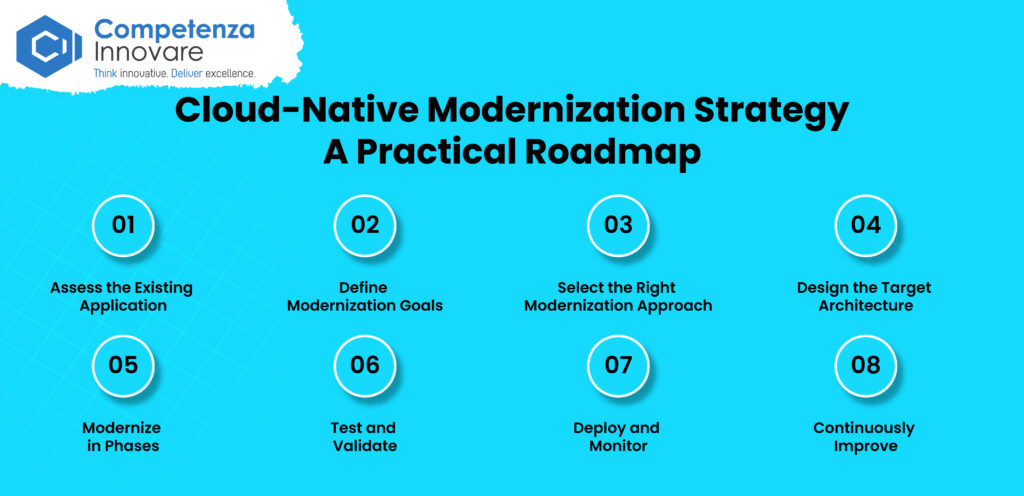
Cloud-Native Modernization Strategy: A Practical Roadmap
There is a clear cloud-native modernization strategy that can assist businesses in updating legacy applications in an organized manner. Rather than overhauling the entire system, the teams can evaluate the current system, select the proper model, and modernize according to the business priorities.
1. Assess the Existing Application
Start with the testing of the architecture, the codebase, dependencies, databases, APIs, infrastructure, security, performance, and technical debt of the application. It helps in identifying the factors, dependencies, risks, and features outlived, which need to be changed.
2. Define Modernization Goals
Develop certain goals in accordance with business requirements, e.g.,
- Better scalability
- Lower maintenance effort
- Faster releases
- Improved performance
- Easier integrations
- Stronger security
- Greater application resilience
3. Select the Right Modernization Approach
The type of approach to be used tends to vary depending on application:
- Rehost – Move the application with minimal modification.
- Replatform – Implementing improvements on the cloud.
- Refactor – Improve parts of the application code.
- Re-architect – Re-simplify the structure of the application.
- Rebuild – Recycle you have chosen elements with recent technologies.
- Replace – When rebuilding is not feasible, now go to an appropriate modern solution.
4. Design the Target Architecture
Specify the functionality of the modernized application, such as its architecture, APIs, integrations, cloud services, deployment model, security controls, and data strategy. The design must accommodate the needs at a particular time yet offer usability in the future.
5. Modernize in Phases
It is best not to do a wholesale change of the application. Address parts of high value or high risk and upgrade in stages that are manageable. It is possible to minimize the amount of disruption and to easily measure progress.
6. Test and Validate
Functionality, performance, knowledge, and interface of every phase of modernization. Automated testing allows detection of problems earlier and release with confidence.
7. Deploy and Monitor
The new application can be implemented and monitored using CI/CD, logging, monitoring, and observability. The constant observation will be of use to the teams as it will enable them to detect the issues of post-deployment performance, malfunctions, and resource requirements, among others.
8. Continuously Improve
There is no end to modernization once the deployment has been made. As the business and technology needs change, the teams are expected to further enhance performance, security, scalability, and usage of infrastructure and applications.
An effective modernization roadmap can assist enterprises in evolving to future-ready, maintainable, secure, and scalable applications instead of making changes to technology unnecessarily.
Also Read: How AI Is Transforming Application Modernization
Cloud-Native Application Modernization Roadmap
The cloud-native application modernization roadmap is a convenient and orderly method of updating old applications. It aids companies in making transitions step-by-step to keep the business and technical objectives at hand as minimal inconvenience is induced.
Assess → Plan → Prioritize → Re-Architect → Modernize → Test → Deploy → Monitor → Optimize
- Test – Test the architecture, code, dependencies, performance, security, and technical debt of the application.
- Plan – Develop a roadmap of the modernization objectives, resources, time, and risks.
- Prioritize – It should also be ascertained which applications/components have to be upgraded first.
- Re-architect – optimize those things that limit scalability, performance, or integration.
- Modernize – Utilize the contemporary practices, e.g., refactoring, APIs, microservices, or containers.
- Test check, performance, security, and integrations.
- Deploy – Publish the updated application relying on appropriate cloud and CI/CD practices.
- Monitor – Provide monitoring of performance, availability, security, and resource utilization.
- Optimize – Continued optimization of the application due to variation in business and technology needs.
A clear legacy application modernization roadmap helps companies to upgrade to more scalable, maintainable, secure, and future-proof applications with the help of current technologies.
Best Practices for Cloud-Native Modernization
Compliance with the cloud-native modernization best practices may help enterprises to effectively and manageably modernize the legacy applications. The emphasis has to be more on finding answers to actual business and application issues rather than embracing the technology just because it is more recent.
1. Start With Business Goals
Consider what the modernization will achieve, e.g., more scalability, more performance, more security, more frequent releases, or less maintenance. However, do not update an application just because it has outdated technology.
2. Assess Before Re-Architecting
Given that there are big changes, take into account the application architecture, dependencies, integrations, performance, security, and technical debt before making any big changes. This assists groups in making the right choice of modernization strategy.
3. Modernize Incrementally
Most of the upgrades of applications or systems are accomplished in small, manageable chunks. Rank the areas based on the business importance, technical risks, complexities, and modernization requirements.
4. Avoid Unnecessary Complexity
Never adopt microservices, containers, and other technologies unless they bring actual benefit. The architecture should be as simple as it can be, based on the requirements of the application.
5. Build Security Into the Process
Factors which entail the consideration of security at the development and testing and deployment stages as well as operation. In the case of modernized applications, access controls, data protection, safe APIs, and continuous security monitoring must be considered.
6. Automate Testing and Deployment
Automated testing and CI/CD should help to better predict when things are ready to be released and detect problems with deployments faster, but not to use so much manual deployment.
7. Monitor Application Performance
Monitoring and observability Monitor resource usage, availability, and errors of the track application and pinpoint user-impacting problems. This aids the teams to discover issues and keep on enhancing the modernized application.
Adherence to these best practices can aid businesses in creating a scalable, reliable, supportable, and future-capable application while keeping modernization in line with the real business requirements.
Benefits of Future-Ready Application Modernization
Application modernization Future-Ready is designed to assist businesses in enhancing their current applications to better meet the changing workloads, technologies, and business needs. These advantages are based on the starting point of the application and the modernization strategy adopted.
- Better scalability – The applications are in a position to deal better with the fluctuating workload or increasing user demand.
- Faster performance – Modernized architecture and streamlined components are able to enhance responsiveness and efficiency of applications.
- Quicker software delivery – CI/CD and auto-tests have the potential to simplify the process of developing, testing, and releasing changes
- Less complex integrations – The present-day APIs and modules have a chance to simplify the interaction with additional services and programs.
- Reduced technical debt – Technical debt is also more easily maintained and can be extended as time goes by, as certain antique aspects of applications are more brought up to date.
- Increased resilience – The modern architectures can help applications cope with failures and peak workloads significantly better.
- Increased maintainability – The modular and well-structured applications can be easier to manage by the development teams.
- Higher development agility – The teams can implement a variation and add new features more effectively.
- Greater flexibility of infrastructure – Cloud-native applications have more access to scalable cloud resources and services.
- Assistance in adapting to business requirements – A new application will provide a superior foundation to implement new integrations, functions, and developing technology.
In a nutshell, future-ready application modernization is all about having a more scalable, maintainable, flexible, and adaptive software environment that can survive the business as its needs evolve.
Also Read: How to Choose an Application Modernization Partner
When Should You Consider Application Re-engineering Services?
Application reengineering services can assist the businesses in modernizing old applications that are no longer relevant in terms of the needs of the business or the technology. Re-engineering is aimed at enhancing the application, and where feasible, valuable functionality is maintained.
Consider application re-engineering when your application:
- Is difficult or costly to maintain
- Uses outdated technologies or frameworks
- Has tightly coupled components
- Struggles with growing users or workloads
- Has recurring performance issues
- Is difficult to connect with modern systems
- Has slow development and release cycles
- Has increasing technical debt
- Requires frequent maintenance
- Cannot easily support new business requirements
Re-engineering can also involve application architecture modernization, code modernization, API modernization, cloud migration, microservices, containerization, performance enhancement, and supporting infrastructure updating depending on the state of the application.
Modernize legacy applications with Competenza and build scalable, cloud-native software for future business growth.
Why Choose Competenza for Application Modernization?
The Competenza assists businesses with the modernization of prior applications according to the current technology, business, and future needs. Its reengineering services, such as application reengineering, can help modernize applications to be cloud-native, reengineering of applications for cloud migration, architecture reengineering, API updates, microservices, and performance where needed. It is all about developing a scalable, maintainable, secure, and future-ready application without creating undue complexity or substituting the whole system where such is unnecessary.
Conclusion
Relocating a legacy application to the cloud is just one of the aspects of modernization. Modernization of cloud-native applications may also entail re-engineering application architecture, APIs, appropriate use of microservices or containers, and development and deployment practices. The correct solution will be based on the existing technology of the application, the objectives of the business, and future needs.
In the case of application reengineering services, it assists companies to adopt a more pragmatic strategy of upgrading existing applications and developing a more scalable, maintainable, adaptable, and future-ready software base.
FAQs
What does cloud-native application modernization mean?
Cloud-native application modernization refers to the instance of optimizing old applications in a manner that they can more fully exploit current cloud features of scalability, flexibility, automation, performance, and resilience.
What is the difference between cloud migration and application modernization?
Migration to the cloud mainly transfers an application to cloud infrastructure. The architecture of the application, the code, APIs, integrations, deployment, and operations can also be improved by application modernization.
What is the best way to modernize legacy applications on the cloud?
Some of the methods that businesses can employ include rehosting, replatforming, refactoring, re-architecting, rebuilding, or replacing components depending on their application and business needs.
Would all legacy applications be transformed to microservices?
No. Microservices are applicable whenever they address certain scalability, deployment, maintenance, or integration issues. They may also introduce complexity to the operation, and thus the strategy must be founded on the real needs.
How do containers help with legacy application modernization?
Containers bundle an application and its dependencies and give them a stable environment. This is able to enable portability, consistency in deployment, quicker provisioning, and current cloud deployment practices.
When does a business need to consider application re-engineering?
Re-engineering can be appropriate when an application is hard to maintain, hard to scale, out-of-date, poorly integrated, or as a result of increasing technical debt.
What is cloud-native application re-architecture?
This may include re-engineering the back-end application architecture in order to exploit technologies and methods such as microservices, application protocols (APIs), containers, event-driven architecture, controlled cloud hosting, and automated deployment where appropriate.
What is a roadmap of modernization of cloud-native applications?
Cloud-native application roadmap to modernize. This provides a systemic way to modernize: Assess → Plan → Prioritize → Re-Architect → Modernize → Test → Deploy → Monitor → Optimize.
Why is it beneficial to upgrade old applications?
Its efforts can include modernization to enable it to increase scalability, performance, and maintainability; integrate; provide agility in development; and be responsive and adaptable to business requirements.
How can Competenza help in the modernization of applications?
Competenza provides application reengineering solutions, which focus on updating the existing applications based on their architecture, technical challenges, business goals, and cloud requirements. Modernization of the architecture, modernization of the API, moving to the cloud, microservices, and performance optimization where required can all be part of the methodology.