

Cloud migration is a strategic emphasis by organizations that aim to attain agility, scalability, and efficiency in business processes. Nevertheless, the conventional migration projects can be complicated in many cases, and they presuppose lots of planning, hand evaluation of the process, mapping of the applications’ trends, and several migrations of the data. These issues are bound to increase costs, the length of migration process, insecurity, and unexpected releases.
To address these challenges, companies are increasingly resorting to AI-based solutions to migrate to the cloud. Being integrated with artificial intelligence, machine learning, and automation, organizations are able to simplify the migration processes, obtain a more in-depth insight into their IT environment, and make faster and data-driven decisions. Through artificial intelligence, workloads can be examined automatically, dependencies determined, the degree of migration preparedness was checked, and the most efficient migration plan was suggested to eliminate time-consuming manual operations.
New cloud migration automation systems are changing each phase of the migration process, including assessment and planning, execution, and optimization of post-migration. These intelligent features assist companies to speed up deployments, enhance the accuracy of migrations, reduce disruptions, and optimize the usage of clouds. As companies strive to upgrade traditional systems and processes as well as migrate towards hybrid and multi-cloud experiences, AI cloud migration emerges as one of the major drivers of successful digital transformation initiatives.
We will discuss in this blog how AI-powered cloud migration is transforming the game, automation is helping in simplifying complex migration projects, intelligent cloud migration solutions are being developed, and what businesses gain by using these technologies to realize quicker, more secure, and lower-cost cloud transformation results.
What Is AI-Powered Cloud Migration?
AI-powered cloud migration is a method by which cloud migration can be made easier by the use of artificial intelligence and automation to relocate applications, data, and workloads to the cloud. It helps enterprises to plan the migrations more effectively, reduces human effort, and enhances the effectiveness of migrations in general.
Understanding AI in Cloud Migration
In AI-assisted migration to the cloud, the artificial intelligence technologies are utilized to automate migration by use of migration tools to carry out assessment, planning, implementation, and optimization.
AI enhances cloud migration by:
- Workload and infrastructure evaluation automation.
- Identifying application dependencies
- Helping to make migration decisions faster.
- Real-time monitoring of performance.
- Making the most of cloud resources post-migration.
In comparison to the old-fashioned migration that should be manual-based, the AI cloud migration adopts smart information and automation to minimize complexities, threats, and delays.
Key Technologies Behind AI Cloud Migration
Machine Learning Algorithms
Compare infrastructure and workload information to suggest an optimal migration strategy.
Predictive Analytics
Pre-deployment predicts potential risk, resources, and the outcome of migration.
Intelligent Automation
Automates tedious tasks such as finding and analyzing as well as moving workloads.
Natural Language Processing (NLP)
Assemble information about report analysis, documentation, and logs analysis on migration to make decisions.
AI-Driven Monitoring and Optimization Tools
Supervise migration conditions and troubleshoot and optimize cloud application migration services performance.
Why Businesses Are Adopting AI for Cloud Migration
Faster Migration Timelines
The automation will be quick in terms of planning and implementation since it helps the organizations to migrate more quickly.
Reduced Manual Effort
AI can lower the amounts of repetitive processes, allowing IT teams to focus on more valuable processes.
Improved Decision-Making
Real-time insights contribute to making informed migration and cloud management decisions by the business.
Better Scalability and Operational Efficiency
AI is able to make better use of cloud resources and encourage scalable and efficient cloud environments.
Intelligence and automation AI-powered cloud migration enables organizations to grow faster, more reliably, and cost-effectively in the process of cloud transformation.
Challenges of Traditional Cloud Migration
Cloud migration time and again is carried out manually, and therefore, traditional cloud migration is more complicated, consumes more time, and tends to be error-prone. These challenges have the potential to affect migration speed and the cost of migration as well as success, as organizations increasingly move larger workloads and important applications to the cloud.
- Manual Assessment and Planning: Organizations have to assess their current infrastructure and applications, as well as workloads, before migration starts. In traditional migration projects, this is a manual procedure to a great extent.
- Slow Infrastructure Discovery: IT teams require a lot of time to identify servers, databases, applications, and workloads that should be moved.
- Difficulty in finding an application dependency: there are many applications that are dependent on other systems and services. Their absence can cause difficulties in the course of migration and can also impact performance.
- Risk of Incomplete Migration Planning: The use of manual assessment can miss critical workloads and can result in delays and hidden costs of cloud migration as well as setbacks in the migration process.
- Complexities of Data Migration: Data is among the most strategic business assets, and transferring it to the cloud may not be an easy task.
- Massive Data Volumes: Massive data volumes are also very common in organizations and may de-accelerate migration projects and make them more complex.
- Data Integrity Problems: The companies need to ensure that the data used is correct, full, and accessible in the migration process.
- Security and Compliance Requirements: Sensitive data should be secured during migration and be compliant with the industry standards and regulations.
- Downtime and Performance Risks: This is also a pertinent issue in cloud migration projects, which has to do with business continuity.
- Service Interruptions: There will be disruptive interruptions, leading to business disruption and customer experiences.
- Problems in compatibility with applications: The old applications are not going to be compatible with all the amendments and will be modified to run in the cloud.
- Unexpected Migration Failures: Manually operated migration activities add to the potential of configuration issues, workload blocking, and performance issue surfacing.
- Resource and Cost: The more traditional systems of migration could be resource-heavy, resource-wise, as well as expertise-wise.
- High Labor Costs: Manual planning, testing, and migration processes can contribute to high costs of projects.
- Demand Special Knowledge: To survive complex migrations, the organization will need cloud architects, migration experts, and IT consultants.
- Long Project Timelines: Migration projects can also take weeks or even months in the absence of automation to be completed, hence delaying the advent of business change and adoption of clouds.
These challenges are indicative of why many businesses are migrating to AI-based cloud migration and cloud migration automation tools that simplify cloud migration processes, reduce risks, and accelerate the cloud transformation.
How Cloud Migration Automation Is Transforming the Process
The automation of cloud migration is transforming how organizations migrate applications, data, and workloads to perform cloud migration. Integration of AI with automation will help businesses with complex migration tasks, lower manual labor, enhance accuracy, and speed up the transformation of clouds. Flexible in terms of assessment and planning, migration and optimization, and automation, it enhances efficiency throughout the migration process.
Automated Discovery and Assessment
The first large problem in the traditional migration is familiarity with the current IT environment. The discovery and assessment are automated using AI-powered tools that allow obtaining faster and more accurate insights.
AI Automatically Maps Workloads and Infrastructure
AI scanners scan servers, databases, applications, and workloads to provide a complete picture of the current environment. It is also helpful in assisting the organization to determine what to migrate and the interconnection of different systems.
Identifies Migration Readiness
The AI analyses the workloads and applications in such a manner that determines their fitness to be working in the cloud. This will enable the companies to anticipate the potential issues and be poised for a more comfortable transition.
Detects Application Dependencies and Risks
There are a number of systems and services that are used by different business applications. AI automatically recognizes such dependencies and describes some potential risks of migrations should they occur that could make teams avoid disruptions and unexpected difficulties.
Intelligent Migration Planning
Successful migration to the cloud is a matter of planning. The AI can use data-driven insights, making it easier to create smarter migration strategies and make more effective decisions.
AI Recommends Optimal Migration Paths
With consideration of the application requirements, infrastructure deployment, and business targets, AI will recommend the most reasonable migration process, whether rehosting, replatforming, or application modernization.
Prioritizes Workloads Based on Business Impact
AI assists the organizations to identify important workloads and prioritize them based on their importance to the business and how little disruptive they are to the necessary operations.
Creates Data-Driven Migration Roadmaps
Analyzing infrastructure and workload data, AI creates structured migration plans to enhance the visibility of the project, decrease complexity, and enable its successful implementation.
Automated Data and Application Migration
One of the most time-consuming aspects of cloud adoption can be the migration of the large amounts of data and applications. This can be simplified through automation, thus making it more reliable.
Streamlines Data Transfers
Migration tools are automated and are used to easily migrate data and are also useful in ensuring accuracy, consistency, and security during the migration process.
Automates Workload Movement
AI-based automation helps organizations to move applications, databases, and workloads in a quick and easy manner with limited human assessment.
Reduces Human Intervention and Errors
Through automation of the repetitive processes, business organizations will be in a position to minimize configuration errors, enhance accuracy in the migration process, and diminish the chances of making expensive mistakes.
Continuous Monitoring and Optimization
When workloads are moved, cloud migration cannot be complete. Continuous monitoring is to ensure that the systems are optimized and performing effectively in the cloud environment.
Real-Time Performance Tracking
AI continuously monitors the performance and health of applications, the well-being of the infrastructure, and usage of resources and provides real-time insight into cloud activities.
Automated Issue Detection
Things that are out of the norm, performance points of congestion, and potential failures are easily identified by smart monitoring tools, and teams can respond to them before they can lead to business work.
Dynamic Resource Allocation
AI processes the scaling of the cloud to match the requirements of the workloads automatically, which the organizations can leverage to drive the scalability, cost efficiency, and high performance of the cloud.
Cloud migration automation and AI-driven cloud migration can ensure that organizations can reduce the complexity of the migration process, streamline their operations, decrease risks, and reach a more successful and quicker result of their cloud transformation.
Also Read: Cloud Migration Readiness Assessment: A Step-by-Step Checklist
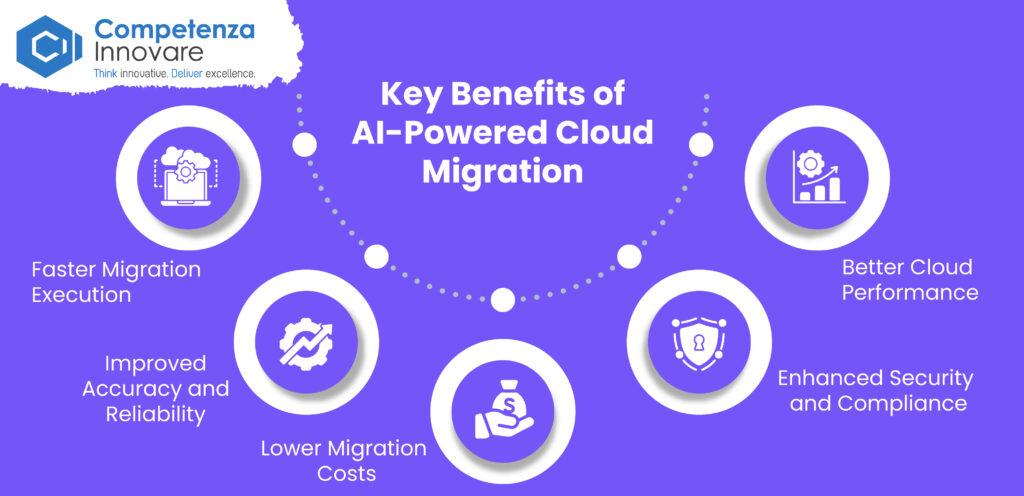
Key Benefits of AI-Powered Cloud Migration
AI-assisted cloud migration can assist companies in moving applications, data, and workloads to the cloud with greater efficiency. With artificial intelligence and automation, the businesses are set to make their process more simplified, enhance the migration results, and speed up the process of cloud transformation.
Faster Migration Execution
AI automates numerous migration processes, such as assessments, planning, and the analysis of workloads. This accelerates the deployment process and assists organizations to complete migration projects within a shorter period of time.
Improved Accuracy and Reliability
Errors and delays can be experienced during manual migration processes. AI reduces the amount of human interactions, streamlines the procedure, and turns the process of moving a lot more reliable.
Lower Migration Costs
Automation would reduce the level of manual workload that would be required, and the business would be able to reduce the running costs and use resources far better in the migration project.
Enhanced Security and Compliance
AI helps in identifying potential security weaknesses, facilitates activating conformity requirements, and constantly monitors cloud eras to guarantee protection of business statistics during as well as after migration.
Better Cloud Performance
AI can be used to optimize the use of cloud resources by the organization in response to workload requirements; thus, organizations can enhance their application performance, scalability, and overall operations efficiency following the migration process.
By using AI-powered cloud migration, companies will be able to do cloud migration much faster, minimize risks, control costs, and create a safer and higher-performing cloud stack.
The Role of Intelligent Cloud Migration in Enterprise Transformation
Smart cloud migration will help organizations to modernize their IT infrastructure and guide them towards long-term digital transformation. Businesses can more easily move to the cloud with AI and automation, increase flexibility, and position themselves to expand in their future.
Supporting Digital Transformation Goals
Smart cloud migration aids companies in upgrading their old systems and in substituting old infrastructure with scalable cloud infrastructure. It also facilitates innovation because it will enable the adoption of new technologies faster and increase business agility in general.
Enabling Scalable Cloud Adoption
Cloud environments must expand as the business demands. Smart cloud migration is friendly to both environments, hybrid and multi-cloud, as well as enabling organizations to easily scale resources and underpin future growth without significant hiccups.
Improving Business Continuity
AI-based migration contributes to the minimization of downtime on a cloud transition and supports the inclusion of essential applications. Disaster recovery also becomes easier under cloud-based environments and enables organizations to secure and retain the data and save business processes in case of unforeseen circumstances.
Intelligent cloud migration allows businesses to expedite the process of digital transformation and enhance scalability, as well as develop a more robust and resilient future-ready cloud environment.
AI Use Cases Across the Cloud Migration Lifecycle
AI facilitates all the operations involved in cloud migration and thus assists the organization in migrating more quickly, minimizing risks and efficiently. AI can be used in the assessment process and in post-migration management to make good predictions and automation.
- Infrastructure Assessment: AI is applied to scan the current infrastructure, which includes servers, applications, and workloads. It also maps the dependencies of applications, which assists organizations in understanding the interdependence within systems before migration of systems.
- Application Modernization: AI detects applications requiring updates or modernization prior to transitioning to the cloud. It also does the analysis on migration suitability and provides the migration strategy that is most appropriate in each application.
- Data Migration Optimization: AI supports data migration by automatic classification of data and arranging data to be migrated. The intelligent scheduling assists in transferring data with ease, and it is less disruptive to a business operation.
- Post-Migration Management: After the migration process, AI manages the dynamics of the cloud environments, improving the performance and efficiency. It provides optimization of costs, isolates possible issues in time, and provides predictive maintenance to ensure seamless operations of systems.
The application of AI in the cloud migration lifecycle may enhance success in future migration, minimize convolutedness, and ensure the full advantages of cloud utilization.
Essential Features to Look for in Cloud Migration Solutions
The choice of the suitable cloud migration solution can help simplify, speed up, and make the process of migration more secure. The current AI-enhanced cloud migration solutions have features that enable firms to automate processes, minimize risks, and enhance migration responses.
AI-Driven Assessment Tools
The workloads, applications, and infrastructure are analyzed automatically using premigration AI-powered assessment tools. This aids organizations in being aware of their cloud preparedness and any risked challenges in the migration process early.
Migration Automation Capabilities
Moving automation aspects benefits the removal of manual labor. Automation of workflow and automation of application migration assist in shifting workloads more effectively and enhance accuracy and uniformity.
Real-Time Monitoring and Analytics
Real-time monitoring will give an overview of migration and performance of the cloud. The analytics and dashboards assist the organization in monitoring the workloads and determining the problems and making informed decisions during the migration.
Security and Compliance Controls
Cloud migration solutions must have security and compliance provisions to safeguard business data. Compliance monitoring helps in meeting the needs of regulation and governance, and vulnerabilities are identified through the assistance of the risk assessment tools.
Multi-Cloud and Hybrid Cloud Support
There are numerous organizations with many cloud environments. Multi-cloud and hybrid cloud-supported solutions offer flexibility, and a business can control migrations between various cloud environments through a single environment.
With these features, a selected cloud migration solution can enhance efficiency, minimize the risk of migration, and promote long-term cloud success.
Business Benefits of AI-Powered Cloud Migration
The AI-based cloud migration assists organizations to simplify migration efforts, increase performance, and maximize investments in the cloud. This is made possible by artificial intelligence and automation that will help businesses to reduce the complexity, increase the decision-making process, and improve the effectiveness of migration.
| Business Area | AI-Powered Impact |
| Migration Planning | Faster infrastructure assessment, dependency mapping, and workload analysis for more effective migration planning. |
| Data Migration | Better data accuracy, fewer errors when transferring data, and lower risks when moving data. |
| Operations | Automation, which will lessen the amount of manual work, hence leading to better operations and productivity. |
| Security | Continuous monitoring aided the detection of risk and compliance checks over critical data. |
| Cost Management | Automated use and implementation of the cloud to reduce unnecessary expenditure and increase cost-efficiency. |
| Performance | Enhanced application reliability, scalability, and overall cloud performance after migration |
By migrating to the cloud using AI, organizations can accelerate the process of cloud adoption, alleviate risk, optimize business operations, and establish a more high-performing and scalable cloud environment.
Also Read: Top Cloud Migration Mistakes and How to Avoid Them
Best Practices for Successful Enterprise Cloud Migration
The planning, automation, and monitoring are effective in the enterprise cloud migration. These best practices can enable organizations to reduce risks, improve efficiency, and experience improved migration.
Define Clear Migration Objectives
Start by setting goals for your cloud migration project. It could be better performance or cost reduction or scaled up, but with clear goals, it serves as a guide on the migration strategy and contributes to achieving better business results.
Assess Existing Infrastructure Thoroughly
Make sure to assess your existing applications, workloads, and infrastructure before migration. Knowledge of system dependencies and the risks allow avoiding disruption and provide a smoother migration process.
Prioritize Automation Opportunities
Automate as much as possible, and enhance efficiency. Automation can be used to save time and reduce errors, such as the use of assessments, workload discovery, and data migration.
Maintain Data Governance and Security
Security of business data must be accorded priority during the migration process. Make sure that there are adequate security measures and adherence to industry regulations and governance standards.
Continuously Monitor and Optimize
Measure cloud performance prior to, during, and post migration. Performed periodically, optimization can enhance the utilization of the resources and only allow control of costs and also make sure that the applications remain efficient in the cloud.
These best practices also allow organizations to streamline the process of cloud migration, enhance operational efficiency, and optimize the potential of AI-powered cloud migration and cloud transformation.
Transform cloud migration with AI automation that reduces costs, minimizes risks, and accelerates business growth.
Future Trends in AI Cloud Migration
Cloud migration is also becoming smarter, smoother, and automated as AI technologies evolve. It is anticipated that the trends listed below will define the future of AI-assisted cloud migration and enable organizations to derive higher value with their investments in the cloud.
- Independent Cloud Migration: AI-driven programs will be used to automate the process of assessing and planning migration, executing it, and optimizing it with a minimum of human intervention, and this would assist organizations to simplify the process and speed up cloud migration.
- Predictive Migration Intelligence: AI-based systems will analyze infrastructure and workloads to predict the risk of migration, identify any potential issues, and predict what will happen with the migration process prior to project initiation.
- Generative AI in Cloud Operations: Complex generative AI will provide recommendations, generative feedback, and onboarding and operational-wise intelligence, which will help IT executives operate more efficiently in the cloud.
- AI Multi-Cloud Management: AI will be used to optimize the workload across multiple cloud systems to optimize performance, scale, resource usage, and costs.
- Dynamic Cloud Optimization: AI will monitor the cloud resources in real-time and continuously optimize the resources so as to maximize performance and efficiency.
- Smart Security and Compliance Management: Intelligent devices featuring AI capabilities will improve cloud security through ongoing surveillance, threat monitoring, and compliance monitoring.
With the further evolution of these technologies, AI will help in the simplification of the cloud migration process and operational efficiency, as well as supporting digital transformation efforts over time.
Conclusion
The AI-based cloud migration is reshaping how organizations are relocating applications, data, and workloads to the cloud. AI can be used in conjunction with cloud migration automation to simplify the operations of a business, speed up the process, enhance cloud security, and maximize performance. With the ongoing migration to the cloud, smart migration solutions will assist organizations in attaining faster, more efficient, and scalable cloud migration.
We are The Competenza, and we help businesses to employ AI-enabled cloud migration strategies to implement the process of cloud adoption easier, faster, and more successful over the long term along the way towards the process of digital transformation.
FAQs
What is AI-powered cloud migration?
The AI-powered cloud migration has created an artificial intelligence that automates the procedure of transferring applications, data objects, and workloads to the cloud. It helps organizations to improve the speed, accuracy, and efficiency of migration and reduce human input.
What does AI do to enhance cloud migration projects?
The AI performs the automation of the key migration functions, including the infrastructure assessment, dependency mapping, migration planning, and performance monitoring. This helps organizations to make better decisions, become a threat, and achieve migrations faster.
What are the effects of automating cloud migration?
Automation is used in cloud migration to minimize manual efforts, enhance accuracy, speed up the process, reduce costs, and simplify the process of migration. It reduces the chances of mistakes in the migration also.
Will AI minimize the risk of cloud migrations?
Yes, AI may help define the dependencies of an application, identify any anticipated challenges, estimate risks to security, and provide recommendations before starting the migration process. This assists the organizations to prevent disruptions and enhance successful migration.
What is the application of AI in the migration of applications?
AI helps to identify cloud preparedness and recommends the most appropriate way to move applications. It also has the ability to script some of the migration process and help organizations to migrate applications.
What is intelligent cloud migration?
The interaction of AI, machine learning, and automation to automate cloud migrations can be considered smart cloud migration. It enables a smarter planning approach, automation of the process of execution, and constant optimization throughout the migration cycle.
Can AI-enhanced cloud migration be more applicable to enterprises?
Yes, the relevance of AI to cloud migration is warranted, particularly when an organization has a complex set of infrastructure, extensive data storage, and numerous applications. It helps it to augment its scalability, efficiency, and performance.
What are the cost-saving effects of automation in cloud migration?
Automation eliminates manual work, shortens the time frame in a project, and enhances the use of resources. This assists the organizations to reduce the cost of operating and gain higher returns on cloud investments.
What are the characteristics that businesses should seek in cloud migration solutions?
The companies must seek AI-based assessment tools, automation of migration capabilities, real-time monitoring, security and compliance features, and multi-cloud and hybrid environment support.
How will AI-based cloud transformation evolve?
The future of AI-based cloud transformation is autonomous cloud migration, predictive migration intelligence, generative AI cloud operations, and AI-based multi-cloud management. Such innovations will assist organizations to migrate faster, optimize their cloud environments, and enhance business agility.