

The mortgage lending business is undergoing a massive digital transformation, where the financial institutions are embracing smarter technologies to increase speed, accuracy, and consumer experience in all parts of the world. In 2026, lenders worldwide, including in the United States, are seeking better ways of streamlining complex operational processes, reducing operational costs, managing risk, and providing borrowers with faster loan experiences.
Mortgage lending AI is also assisting organizations to streamline their traditional lending processes and automate the time-consuming tasks and financial data analysis to assist organizations in making more accurate decisions. In addition to the process of improving loan reviews and facilitating the application, artificial intelligence is helping lenders to develop more efficient and scalable mortgage operations by improving risk management.
As AI mortgage lending solutions evolve, banks, fintech, and mortgage providers are shifting towards AI-based systems capable of automating the underwriting process, document processing, compliance-related controls, and customer interactions. To adequately deploy these high-tech capabilities, most organizations are engaging fintech software development services providers to come up with secure, scalable, and AI-enabled lending solutions that fulfill contemporary business needs.
With mortgage markets becoming more competitive in the USA and other parts of the world, implementing AI-based lending technologies is becoming a necessity among the organizations that seek to take their processing quicker, make decisions better, and offer better borrowing experiences to their borrowers. We are going to discuss the best AI use cases in mortgage lending in 2026 and the ways intelligent solutions can change the future of digital mortgage operations in this blog.
Why AI Is Becoming Essential in Mortgage Lending
The conventional mortgage lending procedures usually involve a lot of manual processes, such as the examination of financial details, checking of the borrower details, and handling numerous lines of booking approvals. These processes are time-consuming and may drive sluggish loan decisions, high costs of operation, and difficulties in ensuring compliance. Moreover, the risks of fraud are growing, and lenders find it harder to obtain the correct and safe results of lending.
AI plays a key role in assisting mortgage providers to address these issues by bringing automation and smart data analysis into lending processes. With the help of AI-powered mortgage processing, lenders can optimize the processing of documents, accelerate review processes of applications, and deliver more precise decisions. Digital mortgage automation technology and mortgage automation software are some of the technologies that allow financial institutions to automate business processes, ease manual labor, and design quicker and more efficient mortgage experiences for the borrowers.
The Evolution of Mortgage Lending in 2026
The world of mortgage lending is changing at a very fast pace, where mortgage lenders are embracing the powerful AI solutions to enhance efficiency, accuracy, and the experiences of borrowers. Some of the trends such as agentic AI, predictive analytics, and intelligent automation in 2026 are assisting financial institutions in processing data more quickly, automating more complicated processes, and providing smarter loan decisions.
With tailored borrower experiences and real-time lending engines gaining more and more popularity, lenders are migrating to AI-mediated lending platforms and fintech mortgage solutions. Such types of intelligent systems enable automation of mortgage operations, enhance risk management, and allow offering customers in the global market quicker and simpler operations in mortgaging.
Top AI Use Cases in Mortgage Lending in 2026
AI is changing the mortgage lending industry by enabling financial institutions to automate activities, enhance accuracy, save on processing time, and provide customers with enhanced borrower experiences. Underwriting and document processing as well as fraud detection and compliance are just a few of the ways AI is becoming a critical technology in lending processes of today.
Mortgage Underwriting Automation
Underwriting of mortgages involves examination of information provided by the borrower, his or her financial history, and other risk factors before loan approval. Mortgage underwriting automation assists the lenders in streamlining this process through AI-enabled analysis.
Key capabilities include:
- Automated salary and job check
- Borrower history and credit analysis.
- Debt-to-income ratio evaluation
- Risk scoring and decision support using AI.
Benefits:
- Reduced procurement time of loans.
- Reduced manual underwriting efforts
- Greater consistency and accuracy of lending decisions.
At the point of the AI risk measure on mortgage lending, the borrowers are better positioned to talk about the borrower risks and make intelligent selections on lending.
AI Loan Origination Systems
Loan origination refers to the process through which a loan is originated until approval. They are automated using AI loan origination systems that can streamline lending and make the processes smoother.
Key capabilities include:
- Automated borrower onboarding
- Faster data collection and validation
- Automated eligibility checks
- Intelligent application routing
Benefits:
- Faster loan processing
- Improved borrower experience
- Reduced operational workload for lending teams
Banking institutions can improve on their digital lending practices whereby AI-based lending solutions are deployed to create more efficient and scalable processes.
AI Mortgage Document Processing
The reviews of the mortgage applications involve going through lots of paperwork, both financial and personal. AI mortgage document processing assists lenders to automatically extract and verify key information.
Key capabilities include:
- OCR-based document scanning
- NLP-powered data extraction
- Automated document validation
- Information processing from:
- Pay stubs
- Tax returns
- Bank statements
- Employment records
Benefits:
- Reduced document processing time
- Improved data accuracy
- Fewer manual verification errors
Through AI-based mortgage processing, lenders could easily process a large number of applications.
AI Risk Assessment for Mortgage Lending
Mortgage providers are very keen and concerned with risk assessment. AI assists lenders in analyzing financial data and predicting possible risks to make a lending decision.
Key capabilities include:
- Predictive analytics for borrower risk analysis
- Alternative credit scoring models
- Behavioral and financial pattern analysis
Benefits:
- Better lending decisions
- Reduced default risks
- Improved portfolio management
Lenders are able to transcend traditional methods of assessment with the aid of the AI-based risk assessment to make riskier decisions.
Mortgage Fraud Detection AI
Mortgage fraud has been a significant problem for financial institutions. Both patterns and anomaly behavior are investigated with the help of AI that will point to suspicious activities.
Common fraud risks include:
- Identity theft
- Income misrepresentation
- Synthetic identities
- Document tampering
How AI helps:
- Pattern recognition across large datasets
- Real-time anomaly detection
- Continuous transaction and application monitoring
Benefits:
- Faster fraud identification
- Improved security
- Reduced financial losses
Mortgage Fraud Detection AI assists lenders to build safer and more reliable environments to lend.
Mortgage Workflow Automation
Workflow processes of mortgage transactions have various teams, approvals, and communications. Mortgage workflow automation is useful in streamlining day-to-day operations and saving delays.
Key automation areas include:
- Loan status updates
- Internal approval workflows
- Task assignments
- Borrower communications
Benefits:
- Higher team productivity
- Reduced operational bottlenecks
- Faster loan completion
The mortgage automation software can enable lenders to become efficient by providing better service in the mortgage process.
AI Compliance Automation for Mortgage Lenders
Mortgage lending compliance is an essential aspect, whereby the lenders are expected to adhere to the rules and regulations and keep proper records.
AI helps manage:
- Fair lending compliance
- Anti-money laundering (AML) requirements
- Data privacy regulations
- Audit preparation and reporting
Benefits:
- Reduced compliance risks
- Faster regulatory reporting
- Improved transparency and accountability
Compliance automation with mortgage lenders can help financial institutions guarantee continued compliance and improve productivity.
Intelligent Mortgage Platforms and Virtual Assistants
It can also enhance the interaction of lenders and borrowers through the application of AI and virtual assistants. The solutions will assist in hastening service and bespoke encounters.
AI assistants help:
- Borrowers with application guidance
- Loan officers with workflow support
- Customer service teams with instant responses
Key functions include:
- Answering borrower questions
- Guiding loan applications
- Providing real-time loan status updates
The intelligent mortgage platforms and AI mortgage lending solutions allow lenders to create more customized, efficient, and customer-oriented mortgage experiences.
Also Read: Agentic AI in Logistics
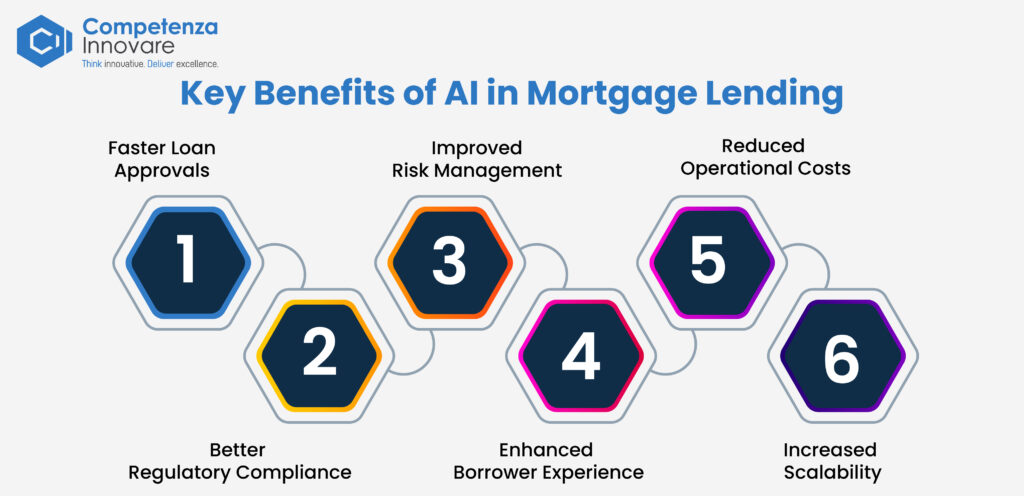
Key Benefits of AI in Mortgage Lending
AI is transforming the mortgage lending industry as it helps financial organizations to achieve the goals of process automation, better decision-making, and coming up with faster digital lending services. With such high-tech solutions as automation, predictive analytics, and intelligent data processing, lenders can become more efficient in their operations and deliver more to the borrowers.
Faster Loan Approvals
The process of giving mortgages can be accelerated through AI since it automates the verification of the borrowers and checking of the documents and eligibility. The use of AI in processing mortgage applications can help lenders reduce delays, improve accuracy, and process loans faster.
Reduced Operational Costs
Paper-based mortgage operations are very time and resource-intensive. Mortgage automation software assists in automating tedious activities of a company, like handling of documents, workflow, and processing of applications, enabling the lender to save money and also enhance productivity.
Improved Risk Management
AI will enable lenders to utilize more information about borrowers, their finance habits, and market data better. AI risk assessment can assist financial institutions in their mortgage lending by identifying the potential risks, making superior credit judgments, and reducing the potential risk of loans going bad.
Enhanced Borrower Experience
The AI-powered products simplify the mortgage procedure by making communication faster and focused on an individual basis and simplifying the application steps. AI mortgage lending solutions help mortgage lenders to offer a more convenient and customer-friendly lending experience.
Better Regulatory Compliance
Mortgage providers are bound to provide strict regulations on financial and data security. Automated compliance checking: AI can help in compliance tracking, correct records, and help in reporting, which can help lenders to increase transparency and reduce the risk of compliance.
Increased Scalability
AI will enable lenders to process an expanding volume of applications without raising the complexity of operations. Implementing fintech mortgage solutions and smart lending technologies, financial institutions are able to create scalable mortgage solutions that enable long-lasting growth and innovation.
Challenges Mortgage Lenders Must Address When Implementing AI
Although AI is transforming the mortgage lending process, there are significant issues, which lenders need to address in order to make the process successful. The development of secure, accurate, and reliable AI systems is largely dependent on proper planning, management, and compliance.
- Data Quality Concerns: AI is only able to decide on lending reliably when it has access to high-quality data. The quality or the lack of completeness of the information about the borrower can influence AI performance and risk analysis.
- Integration of Legacy Systems: A lot of the lenders are currently operating on age-old systems, which they can not easily integrate with the new AI systems. There is a need to smartly incorporate AI solutions into the current mortgage platforms.
- Legal Compliance: Mortgage providers should provide AI systems that do not only comply with the financial regulations, data privacy policies, and fair lending policies but should also be transparent.
- Model Transparency: AI should have an open form of decision-making, more so when it comes to credit analysis and risk mitigation. Certain AI mechanisms make lenders instill trust and accountability.
- Security and Privacy Risk: AI systems will be used with confidential data of the borrowers, and it is necessary to ensure the safety of information. Protecting against illegal access and data leakage should be done vigorously.
- Human Oversight Requirements: AI should not be used to take away the role of individuals but support them in their decision-making. Human control helps lenders to process complex cases and avoid responsible financial implementation of AI mortgage lending solutions.
Through their management, lenders can create safe and efficient fintech products in mortgages that will improve their efficiency and ensure trust and compliance.
How Fintech Companies Are Building AI-Powered Mortgage Platforms
Fintechs are using AI, cloud technology, and automation to develop more efficient, effective, and smarter mortgage lending services. These solutions assist lenders in better operations, increased experience of borrowers, and competitiveness in a fast-changing environment.
Custom Mortgage Lending Software Development
Mortgage lending software development is one that helps the lenders to develop tailor-made or customized solutions, which can assist in their business needs, unique lending procedures, and expansion interests.
AI Integration into Existing Lending Systems
Mortgage platforms are being adapted and are fitting AI to enhance the underwriting, document processing, risk analysis, and management of borrowers without interfering with the current functions.
Cloud-Based Mortgage Platforms
The cloud technology offers the scalability, flexibility, and security required to handle growing volumes of loans and to facilitate digital lending.
API-Driven Lending Ecosystems
APIs bridge mortgage sites and credit bureaus, banking systems, verification tools, and third-party applications to facilitate easy sharing of data and make decisions quicker.
Intelligent Workflow Automation
AI-enabled automation helps streamline approvals, review of documents, communications with customers, and more and helps lenders work in a more efficient manner and customers wait less.
The emulation of AI-driven lending platforms and modern fintech mortgage solutions helps lenders to develop trustworthy, scalable, and future-proof mortgage operations.
Future Trends Shaping AI in Mortgage Lending Beyond 2026
As AI technology is further developed, it has been suggested that mortgage lenders will become smarter and more computerized to enhance their effectiveness, decision-making, and borrower experience.
- The agentic AI development in lending will empower AI systems to conduct the intricate lending operation, make suggestions, and provide mortgage procedures with a minimum of human involvement.
- Autonomous Loan Processing will also automate additional steps of the mortgage lifecycle, assisting lenders in shortening the process of their operations and enhancing their efficiency.
- Generative AI in borrower engagement will be a personalized communication tool, respond to customer queries, and lead the borrowers through the mortgage application process.
- Real-time risk analysis will enable lenders to access borrower information in real time and recognize potential risks within a shorter time period, as well as to make more intelligent lending decisions.
- Explainable AI for compliance will enhance transparency, as it will assist the lenders to understand and reason about the AI-based decisions as well as the compliance with the regulatory aspects.
- Borrowing experiences that are hyper-personalized will enable lenders to provide personalized loan offerings, personalized financial advice, and more personalized interactions with borrowers.
Such innovations will further enhance AI mortgage lending solutions and assist financial institutions in developing smarter, faster, and more customer-oriented mortgage lending practices.
Explore AI solutions to streamline mortgage lending, reduce costs, and accelerate smarter business decisions today.
Why Mortgage Lenders Need AI-Powered Fintech Solutions
Lenders of mortgages today require quicker, smarter, and more efficient means of controlling their loaning process. AI mortgage lending systems assist in automating workflows, enhancing decision-making, reducing risks, and improving experiences for the borrowers, thus allowing lenders to handle loans better and remain competitive.
Having experience in the lending software development services, Competenza assists the lenders in the upgrade of their lending platforms with AI-based automation and bespoke mortgage software platforms. These fintech mortgage applications enhance accelerated operations, enhanced customer satisfaction, and long-term business development.
Conclusion
AI is transforming the mortgage lending business, as the processes now become quicker, more precise, and efficient. Underwriting, document verification, fraud, and compliance AI solutions assist lenders to enhance efficiency and provide better customer experiences to the borrowers. Digital lending is a constantly changing type of business; however, by implementing new AI-based technologies, organizations will be in a better position to remain competitive and respond to emerging customer needs. Lenders can collaborate with an established fintech software development firm to create secure and scalable and future-driven mortgage platforms.
Frequently Asked Questions (FAQs)
What is the AI application in mortgage lending?
Among the items that can be automated by AI in domains like loan underwriting, document verification, risk assessment, fraud detection, and compliance monitoring. This assists the lenders to be efficient and make prompt lending decisions.
What are the advantages of AI in mortgage lending?
AI prevents the need to do work manually; lenders expedite the process of loan approvals, minimize errors, enhance the risk mitigation process, and give borrowers a more enjoyable experience during all the stages of lending.
Will AI be able to advance mortgage underwriting?
Yes. AI can compute and verify the information of the borrowers, scrutinize their earnings, determine their creditworthiness, and identify risk factors at a quicker rate than the primitive manual underwriting methods and help lenders to arrive at more consistent decisions.
What is the role of AI in detecting mortgage fraud?
AI is able to recognize suspicious behavior, recognize suspicious activities, authenticate documents, and alert about possible fraud risks, including identity theft, misrepresentation of income, and document manipulation.
What is AI mortgage document processing?
AI mortgage document processing is a technology that scans, authenticates, and structures the data in the mortgage documents, such as pay stubs, tax returns, bank statements, work history, and technologies such as OCR and machine learning.
What are the issues lenders need to consider prior to implementing AI?
To achieve successful and responsible AI adoption, lenders should have data quality, regulatory compliance, integration of systems, security and protection of privacy, and human oversight.
What do the fintech companies do to promote AI-based mortgage lending?
The solution creates efficient, scalable, futuristic mortgage platforms by supporting developers of lenders to create custom software, automate workflow, use cloud technologies, and integrate AI.