

Artificial intelligence is contributing significantly to the future of the fintech industry, which is growing at an unprecedented pace. With the rise in digital payments, online banking, and financial applications, the challenges associated with fraud, customer validation, and regulation are becoming more complicated among the fintech companies. Conventional systems tend to be slow-paced and cannot meet the pace and the sophistication of the current financial dealings.
This is the reason why AI in fintech is a necessity in 2026. AI assists financial institutions with identification of suspicious behavior in real time, customer onboarding that is automated, and compliance procedures. AI can help businesses to work more securely and efficiently, since the system can detect fraudulent transactions, as well as efficiently assist in the faster verification of identities.
To improve customer experiences, lower operational expenses and make smarter decisions based on real-time data, many organizations are also investing in AI-driven financial services. Meanwhile, available fintech software development is simplifying the need to incorporate AI-powered fraud detection, KYC verification, and compliance software into financial software.
With the ongoing changes in financial regulations and the increased sophistication of cyber threats, AI is aiding fintech companies to develop secure, compliant, and scalable solutions. The enhancement of financial operations is not the only way AI will be enhancing the work of the fintech industry in 2026; it is changing the way the fintech industry handles fraud, KYC, and compliance.
Why AI Is Becoming a Core Technology in Fintech
The rise of digital payment methods, online banking, and fintech applications has heightened the requirement of enhanced security, speed, and enhanced compliance. In the same breath, financial institutions experience an increase in fraud risk and cyber threats, as well as evolving regulations. That is why AI in fintech will be a must-have technology in 2026.
Fine tech businesses can use AI to analyze large amounts of data, detecting suspicious transactions and automating standard activities, as well as making faster decisions. Consequently, organizations are able to enhance security, cut costs of operations, and provide superior customer experience.
The Rise of Intelligent Financial Systems
Large-scale financial platforms are carrying out thousands of transactions daily. This information can be analyzed by AI in real-time to determine that something is not normal, find fraud, and evaluate risks more precisely.
Predictive analytics is also aided by consumer AI in avoiding fraud occurrences and AI risk management in banking. This will allow the fintech companies to labor in greater synergy simultaneously, increasing the degree of customer trust.
Benefits of AI-Powered Financial Systems
- Real-time fraud detection
- Faster risk assessment
- Improved security
- Better compliance management
- Enhanced customer experience
From Traditional Processes to AI-Driven Operations
Legacy financial procedures tend to be based on hand scrutiny and hard-and-fast rules, are prone to take longer, and have a diminished ability to fight contemporary scams.
Tasks performed by AI-powered systems include customer checks, transaction monitoring, and compliance. This assists the fintech organizations to enhance precision, lessen the taskload, and offer more effective AI-driven financial solutions.
| Traditional Processes | AI-Driven Operations |
| Manual reviews | Automated analysis |
| Rule-based systems | Machine learning models |
| Slow onboarding | Faster onboarding |
| Periodic monitoring | Real-time monitoring |
As fintech continues to develop, AI is helping industries to develop more intelligent, secure, and efficient financial services.
AI-Powered Fraud Detection Is Redefining Financial Security
Due to the increase in digital transactions, financial fraud is evolving to be more sophisticated and difficult to spot. Conventional fraud detection systems are based on predetermined rules and usually fail to recognize new patterns of fraud. This can be translated into ignoring the threats and the false and unnecessary notifications, which affect the businesses and customers.
How AI Detects Fraud in Real Time
AI fraud detection in fintech would assist financial institutions to track transactions as they occur and detect irregularities in real-time. Through observed transaction information, customer affairs, and expenditure, AI can identify suspicious behaviors, which can be a sign of fraud. It is based on behavioral analytics, pattern recognition, and anomaly detection to predict dangers prior to causing major financial harm.
Machine Learning for Fraud Prevention
One of the main benefits of machine learning fraud detection lies in its ability to be trained on both historical and live transaction information. Unlike the traditional systems, machine learning models are constantly becoming more precise with the availability of new data. This assists financial institutions in identifying new fraud patterns more quickly and bolsters AI risk management in banking.
Benefits of AI Fraud Detection in Fintech
Fraud prevention worksheet AI helps financial technology firms detect fraud at a faster rate, minimize financial losses, and increase detection accuracy. It also reduces the occurrence of false alerts, thus enabling security personnel to deal with real threats. With the help of AI, the creation of more effective financial crime prevention allows building a safer online financial environment and fostering customer confidence.
Also Read: How to Rescue a Failing Software Development Project
AI-Powered KYC Verification Is Transforming Customer Onboarding
FiniTech companies are actively growing their digital offerings, requiring quicker and safer methods of customer verification. The conventional KYC procedures are usually associated with manual checks of the documents, and it can hamper the process of onboarding and raise the expense of operations. That can be automated by using AI-powered KYC verification, and customers can be onboarded more quickly, more accurately, and safely.
What Is AI-Powered KYC Verification?
AI-driven KYC leverages the best technologies to authenticate the identity of the customer, including:
- Automated document verification
- Identity authentication
- Biometric verification
- Facial recognition
The tools ensure customers can be verified by fintech firms in a few minutes and adhere to compliance needs.
The Role of Digital Identity Verification
The digital identity verification assists financial institutions to avoid fraud in the onboarding process by:
- Detecting fake IDs and forged documents
- Preventing identity theft
- Reducing account fraud risks
- Supporting stronger financial security
This enables the businesses to check the identity of real customers and to deter suspicious applications.
Benefits of Automated KYC Processes
- Faster customer onboarding
- Improved regulatory compliance
- Better customer experience
- Reduced operational costs
- Stronger financial crime prevention
With the ongoing expansion of digital banking and fintech services, AI-based KYC verification enables businesses to provide secure, compliant, and user-friendly onboarding experiences and establish higher customer trust.
Smarter Compliance Through AI and RegTech Solutions
Regulatory compliance has become complicated as digital services of fintech companies continue to expand. Financial institutions need to adhere to the guidelines of AML, KYC checks, data security, and international transactions. Conventionally, compliance processes may be sluggish and impractical to handle, particularly as fraudulent transactions increase in numbers.
Fintech compliance automation can simplify such procedures where businesses use artificial intelligence to track transactions, detect risks, and enhance the accuracy of regulatory procedures. The AI has the potential to examine financial data in real-time, assist organizations in detecting suspicious transactions, and ensure compliance more effectively.
How AI Compliance Solutions Improve Regulatory Processes
AI compliance solutions are used to automate compliance monitoring, risk assessment, reporting, audit tracking, etc. AI will help fintechs to react to potential risks quicker and preserve greater regulatory control by cutting down on the level of manual effort.
The Role of RegTech Solutions in 2026
RegTech solutions are assisting fintech organizations in navigating through shifting regulations better. Status updates anytime, elimination of functional issues, and augmentation of the level of general security—now companies can do it, thanks to AI tracking and automation.
With evolving principles governing the fintech field, AI and RegTech will have a critical role to play to achieve safe, compliant, and functioning financial systems.
AI for AML Compliance and Financial Crime Prevention
Due to the increase in the popularity of electronic money transactions and financial products, nowadays, it is difficult to prevent money laundering and financial offenses. Traditional AML offers are grounded on a few rules and manual verification, and they might not detect new forms of fraud and deal in large volumes of transactions. Traditional AML offers are grounded on few rules and manual verification, and they might not detect new forms of fraud and deal in large volumes of transactions. This is the reason why fintech organizations are accepting AI for AML compliance to enhance monitoring and risk detection and regulatory procedures.
Why Traditional AML Systems Are No Longer Enough
The growing volume of online transactions presents a challenge to traditional AML systems in detecting sophisticated finance crime activities. Rules might identify the established risks but tend to fall short in the realization of emergent and novel threats.
How AI Strengthens AML Compliance
AI compliance solutions involve machine learning and data analysis to enhance the monitoring of AML. Using AI, it is possible to study the behavior of customers, their transactions, and risk factors to detect any unusual activity and aid quicker investigations.
AI helps strengthen AML compliance through:
- Real-time transaction screening
- Suspicious activity detection
- Risk assessment based on customer behavior
- Automated alerts for potential threats
The capabilities enable the financial institutions to detect risks sooner, enhance response times, and even improve compliance.
Benefits of AI for AML Compliance
AI-based AML technology assists companies in enhancing accuracy, lessening human compliance, and accelerating investigations. AI also facilitates the creation of more secure financial systems through enhanced monitoring and detection of financial crimes, which in turn ensure their protection by fintech entities.
The Role of Fintech Software Development in AI Adoption
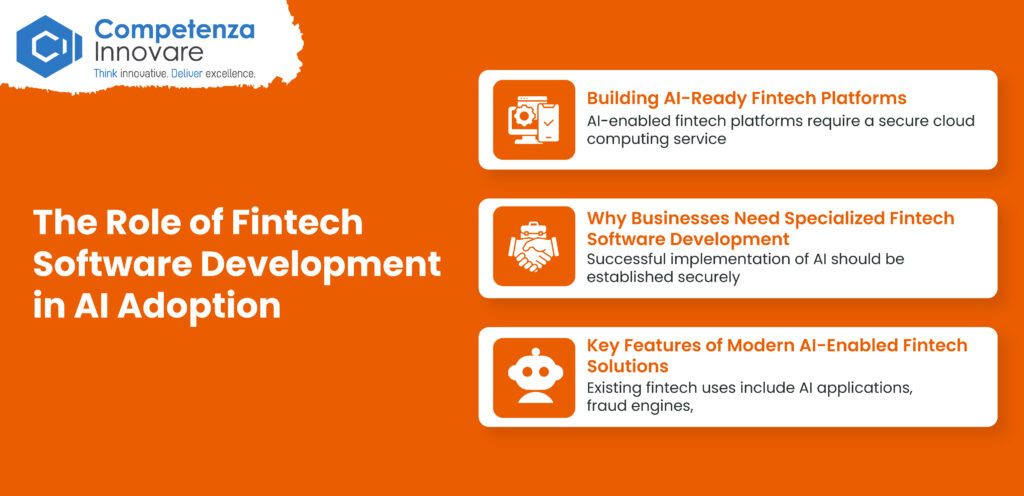
The transformation of financial services by AI is being realized, but companies require the appropriate technology base to be in the application of AI. Fintech software development is useful in assisting companies to create safe, highly scalable frameworks to assist AI-controlled fraud identification, automated compliance, client validation, and smarter decision-making.
Building AI-Ready Fintech Platforms
AI-enabled fintech platforms require a secure cloud computing service, reliable APIs, smooth combinations of information, and scalable systems. These technologies might help financial institutions to operate large amounts of data, increase efficiency, and have real-time financial solutions.
Key Features of Modern AI-Enabled Fintech Solutions
Existing fintech uses include AI applications, fraud engines, automated KYC engines, compliance management engines, and risk monitoring dashboards. The solutions will help companies identify threats faster, achieve greater security, and provide AI-powered financial services of superior quality.
Why Businesses Need Specialized Fintech Software Development
Successful implementation of AI should be established securely, regulated, and incorporated with the technology. With advanced fintech software development, companies are able to build trusted platforms, further AI risk management within the banking industry, and create safe financial experiences with customers.
Emerging AI Trends Shaping Fintech in 2026
The second generation of fintech technology is AI that is also getting into deeper automation, security, and customer experiences. As the financial services are becoming more and more digitalized, agentic AI in fintech helps businesses address risk management, streamline their processes, and offer smarter solutions.
- Financial Operations Agentic AI: Agentic AI is a fintech solution that helps other companies to automate more complex business operations such as compliance, financial investigations, and customer support. It enables faster operations and effective decision-making as it reduces the manual effort involved in it.
- Predictive Risk Intelligence: Predictive analytics that are AI-based can be used to assist financial institutions to predict the occurrence of a risk-related situation in advance. Resting on the behavior of customers and their transactional patterns, AI will be used to predict fraud and enhance AI risk management in banking.
- Explainable AI in Financial Services: Explainable AI (EAI) is used to help companies learn more about how JAIs make decisions in fraud detection and compliance and risk assessment. Such transparency instills trust in the consumers and authorities.
- Hyper-Personalized Financial Experience: AI provided by analyzing customer needs and financial activity provides fintech companies with a similar opportunity to provide customers with a personal banking and lending experience. This helps the firms in providing superior services that are applicable, as well as increased consumer satisfaction.
As AI-driven financial services continue to evolve, AI will remain the future of fintech, as it makes financial platforms more secure, more intelligent, and customer-centered.
Benefits of AI in Fintech at a Glance
Fintech companies are benefiting from AI to enhance security and automate operations and provide enhanced financial experiences. AI facilitates quicker decisions, risk minimization, and efficient service delivery for the business compared to the previously used fraud detection to compliance management.
| Area | AI Impact |
| Fraud Detection | Through analyzing patterns, customer behavior, and transaction data, AI contributes to a better prevention of fraud by recognizing suspicious transactions in real-time. |
| KYC Verification | KYC solutions involving AI automatically check or verify identities, enabling businesses to more quickly onboard customers without compromising security or compliance. |
| AML Compliance | AI can also assist with suspicious transactions, monitoring suspicious transactions around the clock and notifying of suspicious financial crimes to aid in their prevention. |
| Compliance Management | AI is used to automate the compliance reporting and monitoring process and minimize the number of individuals involved to enhance accuracy. |
| Risk Management | AI enhances decision-making since it has the capability to perform data analysis, anticipate risks, and expand AI risk management in banking. |
| Customer Experience | AI enables personalized banking services, smarter recommendations, and faster support to improve customer satisfaction. |
AI-powered financial services are helping fintech firms to develop more customer-centric and intelligent as well as safe financial services by refining automation and protection as well as decision-making.
Explore AI-powered fintech fraud detection and KYC solutions to strengthen compliance, security, and risk management.
Preparing for the Future of AI-Driven Fintech
Given that AI is already impacting fintech, businesses must be in a position to acquire stable and secure technology that will support them later on. Investment in highly developed AI infrastructure, information safety, and compliance-related development can help the organizations in the creation of stable financial platforms.
RegTech and AI compliance solutions can help in the risk management process and streamline the regulatory process in fintech businesses. Companies like The Competenza can be partners in providing more secure, scalable, and efficient AI-driven financial services in the future by collaborating with experienced fintech software development providers.
Conclusion
The AIs are changing the face of fintech and enhancing fraud detection methods, automating KYC checks, reinforcing AML monitoring, and handling compliance processes more easily. Implementing AI-driven financial services and the latest fintech software development solutions would help businesses mitigate risks, enhance customer experiences, and create a more secure financial platform.
In a world where fintech will be in its early years in 2026, AI will be instrumental in assisting organizations to comply with regulatory demands, increase efficiency, and provide smarter financial services.
FAQs
What will AI do to the fintech sector in 2026?
AI is changing fintech by enhancing fraud detection, automation of customer verification, compliance, and even allowing smarter financial decision-making. Fintech AI also assists companies in analyzing a substantial amount of data, mitigating risks, and providing more intense and secure financial services.
How does AI fraud detection work in fintech?
Fintech fraud detection Fintech fraud is machine learning and real-time data analysis in order to identify suspicious activity and customer action. It helps financial institutions to detect fraud trends faster, purge fraud warnings, and prevent financial losses.
What is the benefit of an AI-based KYC check?
The KYC verification using AI provides full automation of identity checks through the analysis of documents, customer data, and biometric data. It aids fintech companies to accelerate onboarding, deliver better verification, and decrease fraud risks as well as deliver a better customer experience.
What role does AI play in AML compliance in fintech?
At any moment, the analysis of different transactions, recognition of suspicious activity, and evaluation of risk profile will help you implement AI to monitor compliance with AML. It allows faster investigation, enhances accuracy on compliance, and assists in enhancing financial crime prevention.
What are RegTech solutions, and how do they assist fintech firms?
The RegTech solutions are also based on artificial intelligence and automation and simplify the regulatory compliance process. They assist fintech companies in processing lines of transactions, reporting and controlling changes in laws, and determining and enforcing compliance with ever-evolving financial law.
Why is fintech compliance automation important?
Automation of fintech compliance helps organizations to reduce the cost of performing mechanical compliance tasks, improve precision, and manage more intricate regulatory requirements. It enables the financial institutions to track the risks in real-time and implement more robust compliance.
What does AI do to enhance banking risk management?
AI risk management in banking can assist financial institutions in envisaging any possible risks based on the data of transactions, customer behavior, and market trends. This allows more active fraud prevention, smarter decision making and improved financial protection.
What will be the key trends in AI in the fintech sector in 2026?
The most significant AI tendencies in the fintech sector are agentic AI to conduct automatic financial processes, predictive risk intelligence, explainable AI to create transparent decisions, and customized financial experiences. Such innovations are assisting companies in creating smarter and secure AI-financial services.
Why is AI-powered software development necessary for fintech companies?
Contemporary fintech software development assists companies in encompassing AI potential in identifying fraudsters, automating the KYC verification, inspecting foul play, and building assessment platforms within the confines of safe networks. It offers the basis that can be used to develop scalable and future-ready financial solutions.