

The agentic AI is transforming the way business automation works, decision-making, and operational efficiency. In contrast to the traditional AI systems, where the key roles include responding to the user input, agentic AI is capable of analyzing information, making decisions, and executing tasks with the minimum of human intervention. AI security risks by implementing agentic AI solutions, organizations will be able to simplify complicated processes as well as open additional growth opportunities as they move on.
Nonetheless, there are new security challenges brought about by increased autonomy. AI services usually log into business systems, sensitive information, and related applications, which pose a potential threat in case of the absence of appropriate protection. These agentic AI security threats may impact business, compliance, and customer beliefs, such as access to data that is unauthorized and data privacy.
Organizations should adopt an agentic AI security proactive strategy to maximize the benefits of AI-driven automation. It can be achieved through the implementation of proper governance, access controls and constant monitoring that allow firms to mitigate risks to provide a safe platform of AI implementation. This blog shall discuss the most important threats posed by agentic AI and the most prudent measures that organizations can apply to avert them.
What Is Agentic AI and Why Does Security Matter?
The term agentic AI is used to refer to the high-level AI-based systems that are able to process information and make decisions as well as execute tasks with minimum human supervision. In contrast to conventional AI tools that primarily react to search queries, AI agents may perform multi-step processes, integrate with applications, retrieve data and perform actions to accomplish certain goals. Companies are shifting their operations to agentic AI Solutions deployment in customer service, IT applications, financial services, and supply chain operations to enhance productivity, minimize human input, and hasten decision-making.
The more autonomous AI agents are and have access to the enterprise systems, the more security matters. These agents tend to access sensitive business information, internal applications, cloud systems, and third-party solutions, which pose additional security risks when they are not adequately protected. The fundamental AI agent security approaches aim to address unauthorized access, information exposure, and operational risks, whereas the autonomous AI security approach and enterprise AI security approach ensure that AI agents act within the set limits. Governance, access controls, and continuous monitoring combined help organizations move safely to AI use without jeopardizing security, compliance, and trust.
Understanding the Growing Attack Surface of Agentic AI
The agents of agentic AI depend on the workflow and several systems to carry out tasks and automate them. In order to work, they tend to connect with the databases, APIs, internal applications, clouds and third-party software. Such links allow AI agents to gain access to information, execute activities, and enhance business performance. Respectively, any integration results in a possible security risk that organizations should deal with.
The more the AI agents are interconnected, the more there is the probability of a security concern. Weak access control, an unsecured application, or a weak API can give an opportunity to an attacker to access sensitive data or business systems. Organizations must be aware of:
- Connected systems and integrations produce attack vectors.
- Risks of the exposure of data on sensitive business information.
- Illegal possibilities of access by inappropriate permission management.
This is why AI workflow security is important when implementing agentic AI. Enterprise agentic AI security can be enhanced, and secure AI automation facilitated at the cost of mitigating possible risks by implementing integrations, tracking agent actions, and applying appropriate access controls.
Top Agentic AI Security Risks Enterprises Must Address
Security is a key issue as organizations implement agentic AI in their business activities. Since the AI agents have access to systems, process information and can take action unassisted, companies need to know the most prominent risks that may affect security, compliance, and the stability of operations.
Unauthorized Access and Privilege Escalation
AI agents may need to have access to business applications, databases and workflows in order to execute tasks efficiently. Regardless, too much permission may pose a significant security threat. An AI agent development services can make unauthorized transactions, alter important data or have access to classified information in case it has unnecessary access.
Key risks include:
- Excessive privileges beyond assigned responsibilities
- Unauthorized transactions or system changes
- Access to sensitive business and customer information
Strong AI Agent Access Control, AI Agent Authorization, and AI Agent Authentication are some of the measures that can be implemented to make sure that an agent only accesses the resources needed to complete his or her work.
Sensitive Data Exposure
AI agents often process extensive amounts of business data to make decisions and automate business processes. This may include:
- Customer data
- Financial records
- Employee information
- Intellectual property
In absence of appropriate protection, confidential data could be disclosed or could fall in the wrong hands. This may result in data breaches, regulatory fines, and bad publicity. Good Agentic AI Data Protection practices are necessary to answer security and Agentic AI Compliance needs.
Prompt Injection Attacks
Prompt injection attacks are when malicious instructions are executed to alter the behavior of an AI agent. The hackers may also wish to hack in an agent in order to evade security policies, reveal some confidential information, or do something (actions) that the agent was not devised to do.
Common examples include:
- Bypassing safety controls
- Revealing sensitive data
- Triggering unauthorized actions
Organizations need to have solid AI security controls to mitigate exposure to these now common forms of agentic AI security risk.
Autonomous Decision-Making Errors
Although agentic AI is able to make its evaluation on its own, it is not flawless. The errors may be a result of incompleteness of information, erroneous data, hallucinated models, or flawed reasoning. The effects of such issues might be:
- Financial losses
- Poor customer experiences
- Operational disruptions
To mitigate the effect of mistakes in making decisions, AI risk management measures and mindfulness of responsible agentic AI can be available to organizations.
Third-Party Integration Vulnerabilities
Many AI agents rely on outside technology to get things done and automate labor procedures. Such integrations usually entail:
- SaaS platforms
- APIs
- Cloud services
Any connected system that is vulnerable may pose more security threats to the whole AI ecosystem. To ensure secure AI automation, it is necessary to strengthen AI workflow security and ensure that integrations are secure.
Lack of Transparency and Accountability
The more autonomous AI agents are, the harder it can be to figure how the decisions are made and actions are performed. Invisibility can be an issue of governance, compliance, and risk management.
Common concerns include:
- Limited visibility into AI decisions
- Difficult auditing and investigation processes
- Compliance and regulatory challenges
By continuously updating AI Agent Audit Trails and investing in stable, regular Agentic AI monitoring, we can make ourselves more accountable and ensure the organizations are committed to their AI systems.
Recommended to Read: Agentic AI in EdTech
Business Impact of Poor Agentic AI Security
Lack of agentic AI security can pose severe organizational problems. Security breaches expose loss of money, potential business failures, regulatory challenges, and reputational damages as AI agents become people who gain entry into business systems, business data, and their business operations. That is why the crucial role of a strong enterprise AI security practice is that businesses embracing AI-based automation need to have one.
- Financial Risks: Fraud, unauthorized spending, and expensive recovery can be caused by the security vulnerabilities. A corrupted AI agent can do unauthorized operations directly affecting business finances.
- Rotational risks: AI security concerns may cause disruption of automated processes, postponing important operations and productivity. A minor mistake can impact various related systems and business operations.
- Regulatory Risks: In case of failure in protecting sensitive information by the organizations, they are subject to GDPR violations, HIPAA, and additional compliance issues. It is critical to ensure the use of agentic AI compliance to prevent legal and regulatory sanctions.
- Reputational Risks: The unauthorized AI activities or data breaches can lead to a decrease in customer trust and a bad reputation for a company. The development of robust security can assist businesses in safeguarding their brand as well as ensure that the stakeholders have confidence in them.
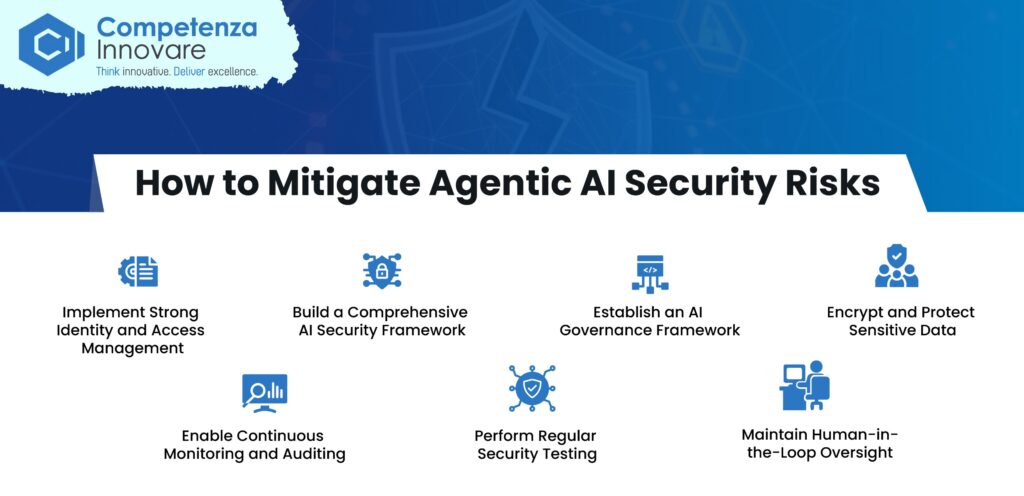
How to Mitigate Agentic AI Security Risks
Since organizations are being agentic with AI, they will need to consider security across all phases of application. Proaction will simplify the efforts to mitigate risks and protect sensitive information, as well as ensure the safe and responsible actions of AI agents.
Implement Strong Identity and Access Management
The system and data that the AI agent needs to perform its tasks should be limited to what it needs to perform the specified task. To improve security within organizations, multi-factor authentication (MFA), role-based access control (RBAC), and the philosophy of the least privilege can be implemented. AI agent authentication, AI authorization, and AI agent access control help in alleviating and reducing unauthorized access and users, reducing security risks.
Build a Comprehensive AI Security Framework
An effective AI security framework is a framework that offers specifications for the protection of AI systems throughout the organization. It must contain security policies, risk management procedures, governance procedures, and the incident response plans. The adherence to recommended AI security best practices assists organizations in predicting potential threats and reacting to any security-related incident.
Establish an AI Governance Framework
The implementation of AI is made possible only through effective government. A proper AI governance framework ought to establish accountability, human controls, ethical use of AI, and compliance. Good Agentic AI Governance The AI agents must be run in alignment with business goals, regulatory requirements, and business policy.
Encrypt and Protect Sensitive Data
As AI agents tend to handle valuable business data, maintaining data security is essential. Companies need to adopt data encryption, tokenization, secure storage, and monitoring of access to maintain sensitive data. Strong agentic AI data protection and AI security controls help to reduce the risk of leaked and exposed information.
Enable Continuous Monitoring and Auditing
It is critical to be able to access AI operations any time in ensuring security. Tracking of agent activity, access logs, workflow actions, and system actions should be observed to detect odd behavior by businesses. The use of effective agentic AI monitoring and detailed AI agent audit trails assists in threat detection, accountability enhancement, and compliance.
Perform Regular Security Testing
Security testing assists companies to find out the weak areas before their victimization by attackers. Frequent penetration testing, red teaming, timely injection testing, and vulnerability testing offer great information regarding potential vulnerabilities. Monitoring of AI threat activities is an effective aspect of AI security practices.
Maintain Human-in-the-Loop Oversight
Although agentic AIs can operate on their own, they require human oversight because of risky endeavors. Business entities must insist on human verification of financial transactions. decisions on compliance, and other crucial functions. This philosophy promotes responsible agentic AI practices and enhances the overall enterprise AI security by getting key decisions properly reviewed.
Recommended to Read: Agentic AI in Logistics
Emerging Regulatory Challenges for Agentic AI
Transforming regulations regarding the security of AI and its transparency and properly responsible use are increasing in importance as businesses continue to embrace the use of agentic AI solutions. In contrast to classic AI and the systems, agentic AI is able to study information, draw conclusions, and execute operations on the systems of business independently. This level of freedom presents novel compliance, privacy, and responsibility issues.
Companies should develop effective agentic AI governance frameworks to make sure that the AI agents operate safely and within the bounds of a business. Open governance may assist companies in mitigating the agentic AI security risks, monitoring AI practices, and retaining control over automated decision-making.
Ensuring Transparency and Accountability
Among agentic AI, one of the biggest problems is the way AI agents think and how they accomplish their tasks. AI operations should also have proper visibility to the businesses to ensure accountable usage and compliance requirements.
Audit traces of the Baby AI Agent Audit Trails, the auditing of agent operations, and the logging of AI processes could help organizations to trace the decisions made, identify potential issues, and improve accountability. The practices also encourage the adoption of responsible agentic AI, in the sense that human supervision is provided where necessary.
Protecting Data Privacy and Security
Frequently, agentic AI systems touch on sensitive business data, customer data, and internal software. The organizations can be left defenseless to a plethora of unauthorized intrusions and disclosure of information unless stringent security measures are put in place.
The data protection systems (such as secure data handling, access blocks, and 24/7 surveillance) of businesses should be strong AI-driven agentic data protection. Practices such as access control and AI authentication can ensure that AI agents are in a position to utilize the information they are given to execute a particular task and nothing more.
Adapting to Future AI Regulations
A system of AI control is being constantly refined as the use of autonomous systems by organizations grows. To be able to comply with upcoming regulations, businesses should be able to assess AI risks regularly and enhance security procedures.
Implementing the AI Governance Framework, AI Risk Assessment (as agentic), and adherence to AI security best practices will help organizations to establish secure and compliance-based AI environments. With the proactive strategy, the businesses can be confident in implementing agentic AI as well as alleviate the security, legal, and operational risks.
The Role of Zero-Trust Security in Agentic AI
As the security of AI agents might be tricky to achieve, the security of AI agents has been on the increase with organizations implementing agentic AI solutions to automate business operations and increase their decision-making. The security models that were designed traditionally with an exclusive emphasis on securing network limits are insufficient since AI agents may have access to applications, databases, APIs, and other sensitive business data. A security attack on an AI agent may lead to unauthorized access, exposing data, or erroneous automated actions.
Zero-Trust Security is more powerful as it adheres to the principle of never trust, always verify. This implies that all the AI agent requests should be authenticated prior to access to business resources. To minimize the possible threats of security risks, the organizations should guarantee the AI agents are authenticated, authorized, and monitored.
Improving AI Agent Access Control
Zero-trust can assist organizations in regulating the permissions of the AI agents by making sure that the agents access systems and data only when they need it to accomplish their duties. There is the presence of strong AI agent access control and authentication and authorization procedures, which prevents unauthorized actions and minimizes chances of excessive permissions.
Resisting the use of agentic AI by access control and continuous monitoring of AI agent activities helps businesses to improve agentic AI security and to protect important enterprise resources.
Monitoring AI Agent Activities
The agentic AI can execute tasks without supervision, and, therefore, there is a need to monitor at all times to ensure security and accountability. Organizations are advised to monitor AI agent behavior, workflow activities, and system activities to detect abnormal behavior.
With agentic AI monitoring and AI agent audit trails, businesses can identify possible threats and investigate incidents and enjoy increased control over autonomous AI activities.
Strengthening Enterprise AI Security
Zero-trust security also assists in securing connected business systems by regulating the interactions of AI agents with applications, APIs, and cloud platforms. Limiting the extraneous access among the systems helps decrease the security threats and enhance AI workflow security.
An integration of zero-trust practices, AI security controls, agentic AI governance, and ongoing risk management would allow organizations to establish a safe base for AI adoption with sensitive data protection and certain confidence in AI automation.
Future Security Trends in Agentic AI
Since organizations are ever-evolving, better security solutions will be required to secure autonomous AI systems as the agentic AI solutions continue to develop. The existence of AI agents is allowing them to gain access to business systems, handle sensitive information, and carry out tasks with minimal human intervention. Such free will leads to the necessity of agentic AI security to mitigate the risk and guarantee safe AI implementation.
Future security strategies will be centered on proactive protection, constant monitoring, and enhanced control of the AI-driven operations. To mitigate threats and risks and ensure a secure AI environment, organizations will implement advanced technologies.
Future trends in agentic AI security include the following:
- AI-enabled threat detection: Intelligent security devices will monitor AI agent actions and detect suspect behavior and possible threats in real-time to enhance protection within an enterprise.
- Existent security agents: AI security agents will contribute to system monitoring and vulnerable areas and respond to security concerns at a faster rate and automate the use of AI without jeopardizing security.
- AI agent behavior Observability: To control AI behavior, AI workflows and actions should be monitored continuously so that the organization can detect unanticipated behavior, ensure it is not abused, and enhance agentic AI monitoring.
- Explainable AI Security Models: Organizations will mitigate transparency, accountability, and responsible agentic AI actions by learning about AI decisions and actions.
- On-the-fly AI governance platforms: Advanced AI governance frameworks will assist the businesses in monitoring AI practices, enforcing rules, and providing compliance with new AI governance.
- Adaptive risk management systems: Risk assessment and mitigation dynamism will facilitate the dynamism of the risk exposure of an organization to constantly reconsider the AI risks and change security controls with risk.
- Automated compliance checking: Automated solutions will help in tracking AI activities, keep audit logs, and support agentic AI compliance requirements.
Enterprise AI Security, as well as AI governance and a secure foundation upon which AI-driven automation can take place, can be enhanced by organizations through these new security capabilities. Such practices will enable the businesses to minimize their security risks and, without fear, achieve increased use of agentic AI technologies.
Best Practices for Secure Agentic AI Deployment
The application of agentic AI is safe and necessitates both technology and governance, as well as continuous monitoring. The best practices of AI security might help organizations to reduce risks and guarantee long-term success:
- Establish a security-first culture by taking into account security requirements during the early phases of an AI implementation process.
- Register the least privilege access such that AI agents have access to only the systems and data they need in order to fulfill their task.
- Real-time track the activities of agent monitors to be informed about unusual behavior, policy violations, or possible security threats.
- Protect all integrations and APIs to minimize the vulnerability across the interconnected systems and third-party services.
- Included are governing principles of governance that are sufficient to specify accountability, acceptable standards of AI application, and security.
- Routine risk assessment to learn about the weaknesses and enhance security as AI systems evolve.
- Be compliance friendly: ensure that AI activities align with legislations and data privacy.
- Hand control of high-risk decisions and sensitive transactions and important business processes.
- Keep a highly detailed audit trail to improve transparency, ease investigations and comply.
By implementing these practices, organizations will not only be capable of creating Secure Agentic AI environments but also improve enterprise agentic AI security and expand AI-driven automation with a sense of certainty and minimum security and compliance risks.
Secure your AI future with expert Agentic AI solutions, governance, monitoring, and risk mitigation today.
Why Businesses Need Secure Agentic AI Solutions
Through the increased integration of agentic AI into business nature, businesses need solutions that put both the spirit of innovation and protection on the same level of importance. Secure deployment will reduce security threats, protect confidential information, maintain compliance and make AI agents accountable. The lack of proper safeguards in businesses may deprive these organizations of the full benefits of the automation facilitated by AI.
Competenza agentic AI solutions assist companies to develop safe AI workflows, to enforce good governance practices, to monitor their agent activities, and to safeguard enterprise data. This enables companies to embrace guarded agentic AI without hesitation, bolstering enterprise AI security and promoting scalable growth.
Conclusion
The agentic AI is changing how companies automate their operations, enhance decision-making, and boost their efficiency. Nonetheless, further along the line of AI agents attaining autonomy, organizations need to face the priority of agentic AI security. Risks of unauthorized access, data exposure, and compliance problems. To secure efficient AI systems, a safe base should be established so that systems can provide the long-term benefits.
By engaging in agentic AI security, stringent governance, access control, continuous monitoring, and risk management, organizations can reduce threats or risks and protect sensitive assets. Organizations that invest in trusted agentic AI practices and trusted agentic AI solutions—these organizations can develop innovation with confidence because they retain enterprise AI security, compliance, and customer confidence.
FAQs
What are the biggest Agentic AI security risks?
Unauthorized access, sensitive information leakage, prompt injection attacks, third-party integration, errors in the decision-making process of AI, and compliance are typically the most common AI security risks. To mitigate such risks, organizations ought to think of formulating suitable security control and governance policies.
What is the importance of Agentic AI security to business?
Business systems agentic AI agents are capable of accessing and managing data related to sensitive data and critical workflows. Companies with improper security measures might suffer data breaches, operational distortion, and compliance breaches, and their image might be damaged. Powerful agentic AI security helps companies to safeguard resources and persons to retain trust.
What can organizations do to secure AI agents?
Role-based access control (RBAC), multi-factor authentication (MFA), ongoing monitoring, data encryption, the establishment of governance structures, and regular testing of AI Agents are some of the ways through which businesses can improve the security of the AI Agents. Such steps will prevent unauthorized access and minimize possible vulnerabilities.
How does governance play in Agentic AI?
AI governance involves agentic AI being responsible, ethical, and compliant with the businesses and their policies and regulations. A governance system introduces accountability, human supervision, risk management processes and security demands of AI deployments.
What is the impact of prompt injection on Agentic AI systems?
Prompt injection attacks are attacks whereby verbal AI agent commands are compromised. They are able to use AI agents to defy security policies or to betray sensitive data or perform unauthorized functions. The threats are solvable with the help of AI Security Controls and testing.
What is Enterprise AI Security?
Enterprise AI security may be described as policy, technology and process-level measures that strive to assure AI systems, data and processes are secure in an organization. It is geared towards achieving AI agent security, control access checks, activity tracking, and compliance in enterprise settings.
What is the benefit of continuous monitoring in Agentic AI security?
The continuous monitoring is used to monitor the activities of the AI agent, access logs, workflow activities, and system modifications by an organization in real-time. This enhances threat identification, aids compliance initiatives and assists in detecting abnormal activity prior to its realization on business operations.
What are the ways businesses can apply Secure Agentic AI solutions?
Secure Agentic AI can be implemented in the form of security-first in business settings, namely by securing integrations and APIs, enforcing least-privilege access, human oversight, and regular risk assessment. A combination of these practices with good governance can be used to drive safe and scalable adoption of AI.