

Artificial intelligence has progressed further than simply being a system to make materials and can now plan, reason, and make decisions and then even take actions upon them. The second step of AI innovation is called “agentic AI” and is transforming the way companies automate their processes, expand their production, and grow their enterprises. In comparison with the traditional AI models, which must be managed by people, autonomous AI agents are able to read targets, interact and communicate with other systems, and adjust to the outcomes.
As the level of complexity of operations rises, along with consumer expectations and the pressure to optimize performance, agentic AI solutions are now a strategic decision given the rising complexity of operations in the enterprises. Through sales and marketing, customer service and IT processes, enterprise AI agents are helping companies automate workflows consisting of multiple steps and provide faster and better-informed decisions.
In 2026, it will not just be the time to introduce chatbots or content-generating tools in the process of implementing AI. Firms need a well-defined AI agent strategy, which will correspond with intelligent robotization and corporate goals. Through an effective agentic AI strategy, businesses will be able to discover high-value use cases and operations, enhance customer experiences, and scale innovation across the enterprise.
This guide provides a definition of agentic AI, explains its functionality, and discusses the importance of investing in agentic AI solutions in enterprises in order to ensure that an organization is competitive in the growing AI-driven business environment. You will also get to know the advantages, applications, and issues of the implementation of AI agents and the main steps that you need to follow to implement an AI agent implementation road-map successfully in 2026 and beyond.
What Is Agentic AI?
An agentic AI is a type of AI system capable of comprehending goals, making decisions, acting, and modifying itself in response to consequences. In contrast to the conventional type of AI models, which eye only one task to accomplish or depend heavily on human interaction to operate, autonomous AI agents are capable of handling complicated, multi-step work processes with limited or no supervision at all.
Traditional AI is meant to work based on existing rules and perform certain tasks, e.g., data analysis or recognizing patterns. Generative AI goes an extra mile to generate content such as text, pictures, and code, as well as reports, after a user asks. Nevertheless, it generally depends on the human directions to conduct all activities.
On the contrary, agentic AI is a blend of intelligence, reasoning, and action. It is able to know what purpose to achieve, create a plan, perform the tasks, analyze the results, and modify its existence to reach the target result. This renders it very useful to companies that seek to streamline business processes and enhance efficiency by enterprise AI agents.
How Agentic AI Works
The agentic AI solutions have the strength of responding not only in a limited manner but also completing tasks independently, beginning to end. The AI agents, instead of being given instructions at all times, can learn the goals, develop courses of action, make choices, perform duties, and continuously enhance themselves.
Here is a step-by-step look at how Agentic AI works:
Step 1: Understand Goals
The initial thing is the comprehension of the goal. The AI agent is introduced with a task and analyzes the need and determines what should be accomplished.
For instance, a customer support AI agent is able to understand the request given to the customer, identify the issue, and extract the required information to provide the correct solution.
Step 2: Planning
Upon understanding its aim, the AI agent creates a step-by-step procedure for the task. It determines the measures required to be taken and which measure will be the most effective.
It is planning that allows enterprise AI agents to work on complex workflows as opposed to workflows with one task.
Step 3: Decision-Making
Based on the information available, which is evaluated by the AI agent, and business rules and real-time data, analysis of different options and selection of the best action are performed.
This will help business AI agents make faster decisions and provide more accurate responses to the complex cases.
Step 4: Action Execution
After deciding, the AI agent executes actions based on linked tools, applications, and business systems. By using an appropriate AI agent implementation, businesses will be able to automate their repetitive processes and enhance the efficiency of the workflow.
To take an example, an AI agent has access to customer records and can update information, notify, or even create support requests automatically.
Step 5: Continuous Learning
Although automated agents can notice, remember, and consult past experiences and conclusions, this becomes one of the most significant advantages of the so-called Agentic AI. The artificial intelligence agent evaluates the outcomes and enhances its performance in the course of time.
As the AI agent development is ongoing, companies can produce smarter agents to provide more precise responses and achieve more effective automation outcomes.
Using a combination of goal knowledge, planning, decision-making, and execution, along with learning, Agentic AI Solutions allow enterprises to automate end-to-end processes, add productivity, and develop more efficient AI-driven operations.
Agentic AI vs Generative AI
Due to the constantly changing state of AI technology, the generations of AI content are already well-known in numerous organizations, providing them with content, questions, and research aid. Nevertheless, Agentic AI is the next phase in the development of AI as it goes beyond the trend of content creation and allows a person to act independently.
Although both technologies employ complex AI models, they have various purposes. General AI will aim to deliver quick responses to request made by the user; however, agentic AI is capable of seeing the objectives and making moves, achieving something, and even running entire mechanisms with minimal human input.
This difference is critical to enterprises that are planning their AI adoption strategy.
Agentic AI vs Generative AI Comparison
| Feature | Generative AI | Agentic AI |
| Creates Content | Yes | Yes |
| Makes Decisions | Limited | Yes |
| Plans Tasks | No | Yes |
| Takes Action | No | Yes |
| Learns From Outcomes | Limited | Yes |
| Handles Multi-Step Workflows | Limited | Yes |
Why Enterprises Need an AI Agent Strategy in 2026
The operations, customer interaction, and data management are becoming more and more challenging as business is becoming more digital. In order to remain competitive, organizations should not merely depend on standard automation but instead develop a specific AI agent plan that would assist them in adopting AI effectively throughout the business.
- Rising Business Complexity: The modern-day business is linked to a lot of data, multiple systems, and system workflows. Business AI agents can conduct automated operations, automate daily activities, optimize workflow, and support successful team functioning.
- Increasing Customer Expectations: Customers require being served fast, on a personal basis, and at full time. Enterprise Agentic AI assists companies to serve more customers by querying, supporting, and responding promptly in media.
- Enhanced Operational Efficiency: A lot of operations in the business operations still involve a lot of manual work. A good AI agent strategy has the capability of automating routine processes and minimizing errors and enabling employees to concentrate on work, adding more value to the company.
- Automation and Scalability: With the growth of companies, operation management becomes harder. Business AI agents have the ability to scale across departments and assist organizations in managing the rising workloads without incurring much in terms of cost.
- Competitive Advantage: Businesses founded on Enterprise Agentic AI will be able to become more productive, make faster decisions, and respond to the changes in the market even faster. This establishes a good competitive edge in an ever-AI-sensitive business world.
Organizations that do not have a strong AI agent approach can find it challenging to then stay at the same level as their competitors, who are already deploying autonomous AI systems to make workflows more productive and efficient as well as to spur innovation. In 2026, the use of AI agents in business evolution and digitalization will be important.
Also Read: Agentic AI in EdTech
Key Benefits of Agentic AI for Enterprises
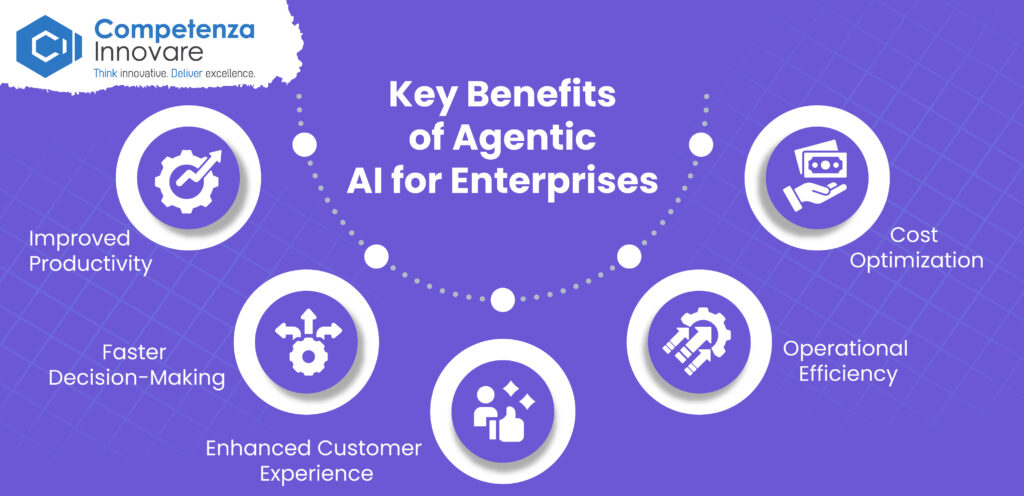
Enterprise agentic AI applications enable businesses to streamline operations and make smarter and efficient decisions. Enterprise AI agents can enable organizations to automate business, enhance customer experiences, and support business formation.
Improved Productivity
Business AI agents can transform routine and manual labor, such as data manipulation, report generation, appointment setting, and customer service. This enables the employees to save time and emphasize more relevant work.
Faster Decision-Making
There is a lot of data that businesses produce on a daily basis. Enterprise AI agents are able to analyze data and spot trends in a relatively small amount of time and can suggest helpful information to enable teams to make informed decisions faster.
Enhanced Customer Experience
The customers require personalized and fast service. The agentic AI could provide businesses with instant reactions, individualized suggestions, and 24/7 services and help to make customers satisfied.
Operational Efficiency
Enterprise agentic AI solutions can automate business at the department level and reduce manual work and cross-functional collaboration. This contributes to easier and effective business.
Cost Optimization
Automated operations can reduce operational expenses and save businesses time by improving the efficiency with which they utilize available resources by reducing the number of manual operations. This helps in improving productivity and reduces costs.
With the growing use of AI in business, enterprise AI agents are an increasing necessity towards efficiency, scalability, and competitiveness. Companies investing in Agentic AI would be able to streamline operations, have improved customer experiences, and realize long-term business development.
Enterprise Use Cases of Agentic AI
Enterprise AI agents are assisting organizations to automate complex processes, enhance efficiency, and achieve improved business results. Under Agentic AI Solutions, companies are able to automate their workflows and data analytics and do less manual work across departments.
Customer Service
The AI-assisted support agents will be able to process customer inquiries, respond instantly, and help 24/7. They can understand the customer needs, access relevant information, fix simple issues, and delegate complex issues to relevant levels.
Benefits:
- Swift response of customer support.
- Personalized customer interactions
- Less support for teamwork.
Sales and Marketing
The agentic AI can also be more helpful in sales and marketing, reaching the customer; the process of lead handling and campaigns is automated, thus making the work easier.
AI agents can:
- Qualify leads
- Analyze customer behavior
- Create personalized campaigns
- Support sales decisions
HR and Recruitment
AI can be used to automate HR processes, including conducting repetitive tasks on recruitment.
They can:
- Screen resumes
- Identify suitable candidates
- Schedule interviews
- Help on staff questions.
IT Operations
Enterprise artificial intelligence provides agents that assist IT teams in monitoring systems as well as repairing problems quicker.
They can:
- Track system performance
- Detect problems
- Assistance in solving incidents
- Automate common IT processes
Supply Chain Management
To plan and optimize the supply chain orchestrations, businesses hire the services of agentic AI.
AI agents can:
- Forecast inventory needs
- Predict demand
- Optimize processes
- Support better decisions
In customer service, IT, and supply chain management, agentic AI solutions assist enterprises to automate business processes, cut manual labor, and enhance enterprise performance. With the increase in the usage of AI, agency AI will be instrumental in shaping organizations that are more effective and intelligent.
Common Challenges in Agentic AI Adoption
Although agentic AI solutions can assist firms to automate processes and enhance efficiency, there are also drawbacks of adopting agentic AI solutions. The successful implementation of AI-based systems in businesses requires proper planning, security, and management.
- Data Privacy and Data Safety: AI agents would be working with significant volumes of business data, and, therefore, the organization must be very safe to ensure sensitive data, and there would be no doubts about safety when using the data.
- Inerting with Original Systems: AI agents should be able to communicate with the other tools and applications that already exist in the business. The first step is creating AI agents that are as acceptable as they can be so that the enterprise systems and workflow can integrate.
- Governance and Compliance: To regulate the AI decisions, companies should possess clear rules and regulations to manage transparency and comply with industry regulations.
- Consistency and Accuracy: AI agents are supposed to be reliable regarding consistency and accuracy. Consecutive testing and corrections contribute to sound AI functionality.
- Change Management: Employees will need to learn new AI systems and interface with them to achieve successful implementation of AI. Implementing agentic AI in business can also be implemented largely fluidly through the support of appropriate training and planning.
An effective AI agent implementation needs a good plan, powerful security, and administration. Overcoming these obstacles, the enterprises will feel confident in utilizing agentic AI solutions and attain better automation and business performance.
Also Read: Agentic AI In Fintech
How to Build an Effective AI Agent Strategy
Developing an effective AI agent strategy can enable companies to find the appropriate opportunities, adopt AI solutions successfully, and deliver tangible business outcomes. A clear road-map will guarantee the positioning of AI agent development and AI agent implementation towards business goals, security requirements, and long-term development strategies.
Here are the key steps to build an effective AI Agent Strategy:
1. Define Business Objectives
The first intervention will be to identify business goals and areas that AI agents can most likely be of value. Firms should be striving to address opportunities of high impact, such as automating the monotonous task, improving customer support, or simplifying the internal processes.
2. Assess Existing Infrastructure
Before implementing AI agents, corporations ought to improve the position of the existing systems, data, and processes. Existing technology infrastructure knowledge may be available to help ease a smooth integration and better AI performance.
3. Prioritize Use Cases
AI use cases in organizations need to begin with one providing easily measurable outcomes. The choice of the appropriate processes assists businesses in producing quicker results and establishing a robust footing towards future implementation of AI.
4. Develop and Test AI Agents
The second step involves designing and implementing AI agents within actual businesses. With proper AI agent development, business organizations can develop solutions to comprehend tasks, do things, and enhance workflows before the implementation might reach large scale.
5. Establish Governance
Achievement of AI implementation of agents entails effective governance. To achieve a safe and responsible usage of AI agents, businesses need to design security policies, compliance regulations, and monitoring.
6. Scale Across the Enterprise
Successful testing would enable organizations to expand AI agents to various departmental areas of the business. Scaling tested AI solutions enables businesses to boost productivity, automate additional processes, and gain the fullest usage of agentic AI solutions.
With an effective agentic AI strategy, a business can overcome its challenges in adopting agentic AI, enhance operational efficiency, and create a scalable AI-based enterprise environment in 2026 and beyond.
Explore how agentic AI and enterprise AI agents can transform strategy, automation, and business decision-making.
Future Trends in Agentic AI for 2026 and Beyond
Helping businesses automate their operations and optimize decision-making and further enhance productivity, agentic AI will serve as a critical element of the digital transformation of enterprises.
- Multi-agent systems: AIs will work together to achieve complex business tasks.
- Automation based on AI: AI agents will allow the business to regulate the workflow and improve its effectiveness.
- Human-AI Cooperation: Human-AI agents and employees will become involved in cooperation to achieve better results.
- Autonomous Operations: Businesses will engage autonomous AI agents to carry out very repetitive tasks without fighting with people.
- Industry-Specific AI Agents: Customized AI agents will be used by the businesses according to their needs.
As Enterprise Agentic AI continues to expand, organizations will be able to keep leveraging intelligent AI agents to create smarter, faster, and more efficient operations in 2026 or beyond.
Conclusion
The agentic AI solutions now transform the way businesses utilize AI by allowing systems to generate information and plan, make decisions, and act on them. Through the proper AI agent strategy, businesses can enhance the efficiency levels, automate operations, and improve business results.
Implementing enterprise AI agents, organizations are able to create smarter business processes, improve their productivity, and look forward to future expansions. The Competenza can enable businesses to seize the opportunity of leveraging Agentic AI to pioneer innovation and effective digital transformation in 2026 and beyond.
FAQs
What is Agentic AI?
The idea of agentic AI is the ability of an AI system to perceive objectives, be able to make choices, undertake action, and gain knowledge through experience with minimal human intervention. Unlike the conventional AI tools, autonomous AI agents can solve complex tasks and workflows independently.
What is the difference between agentic and generative AI?
Generative AI is more concerned with the creation of content (e.g., text, images, or code) when provided with input data. Agents and AIs even further lay plans, make decisions, link systems, and take action to achieve specific business goals.
Why do we need an AI agent strategy within businesses?
An effective AI agent approach would help the business to identify the right processes that could be automated, to make more efficiencies in the operations, and to efficiently use AI. It allows businesses to more smartly decide on AI agents and the long-term development.
Why are agentic AI solutions beneficial?
The agentic AI solutions help companies to automate repetitive tasks, enhance productivity, reduce manual work, enhance customer experiences, and enable faster business decisions through intelligent automation.
Which industries offer the greatest opportunity to enterprise AI agents?
Industries that can be advanced with enterprise AI agents include healthcare, finance, retail and manufacturing, customer service, technology, and logistics through workflow automation and providing quality customer experiences.
What strategies can businesses adopt in the implementation of Agentic AI?
The data security, system integration, governance, compliance, and AI reliability are among the threats that businesses should take into account. To be successful, the adoption and planning of AI agents are needed.
How do you start developing an AI agent strategy?
The place where organizations are beginning includes identifying business goals, the instances of high-value use, the analysis of existing systems, developing and testing AI agents, and the development of governance systems. An unambiguous road-map can empower organizations to successfully roll out agentic AI applications and scale them all across an enterprise.