

AI is changing the way organizations develop and improve digital products. However, currently, even companies that already utilize apps can develop their software solutions by switching to AI-powered ones instead of redefining their products completely. One of them is knowledge on how to incorporate AI into the existing software to make the businesses more efficient, automate the tasks, and create a more intimate experience for the users.
The capabilities of the modern AI (intelligent chatbots and automation processes, predictive insights, and personal experiences) can help make software products smarter and more flexible. Through the adoption of AI, organizations will be able to gain additional features but will use their existing technology investments.
As customer requirements keep evolving, Software Product Development Services is exploring the use of AI features within software in an effort to improve ease of use, simplify, and stay competitive. Nonetheless, effective AI implementation can be achieved through proper planning, such as familiarity with the intended use of products, knowledge of existing systems, and the selection of an appropriate implementation strategy.
The guide provides the critical considerations to be made when making AI in existing applications, what forms of AI talent that companies should have in mind, and how AI-enhanced software can be used to modify existing products in smarter, scalable, and future-resistant ways.
Why Businesses Should Add AI Features to Existing Software Products
Since the expectations of technology have been on the rise, businesses are in need of software products that can evolve and enhance further to value users. Companies can upgrade their departments rather than substitute the existing systems with smart functionalities that can streamline their operations, automate business processes, and provide superior user experiences. The application of AI to upgrade current software can enable businesses to modernize their product and make better utilization of their current investments in technology.
With the use of software products’ modernization through AI, organizations have a chance at incorporating advanced functionality that allows for business growth and improved operational efficiency and assists products with keeping pace in an ever-changing digital environment.
1. Improve User Experience with Intelligent Features
The expectation of the user is constantly evolving, and the current software products should offer quicker, more customized, and smooth experiences. AI assists corporations in comprehending the behavior of users and provides smarter interaction.
Artificial intelligence features like personalized recommendations have the potential to provide prompt recommendations of products, content, or services based on customer preferences and prior actions. Smart search capabilities allow individuals to be able to search more quickly as to the context of interests and the purpose of the search and not just based on conventional searches by keywords.
Engagement can be enhanced too with the assistance of AI assistants and virtual support tools that offer their immediate answers, lead users through processes, and assist them in performing tasks more effectively.
2. Automate Repetitive Processes and Improve Efficiency
A lot of time is wasted in most businesses as manual processes are handled that can be automated using AI. The ability to add automation features to the already established software products enables teams to concentrate on activities that give a higher value to the company besides enhancing productivity.
AI can facilitate the automation of workflows by handling menial tasks, cutting down on human labor, and enhancing precision in operations. Document processing software may be used to source, categorize, and process data presented by big numbers of files, whereas AI-driven customer service automation could yield quicker service and enhance service quality.
Automation of such activities will enable businesses to develop more effective software systems and lessen the complexity of their operations.
3. Generate Better Business Insights Through Data
Modern software products accumulate valuable information that is large, yet the businesses require efficient methods of comprehending and utilizing such information. AI allows organizations to better analyze data and discern valuable insights.
Predictive analytics has the potential of assisting businesses to recognize prospective trends, predict demand, and make proactive decisions. Data analysis enabled by AI can indicate the behavior of customers in different ways and allow companies to learn about user needs and how to advance their products to meet them.
When businesses make decisions that are supported by smarter insights, they get to support better strategies, enrich the performance, and create a more customer-focused experience.
4. Increase Product Competitiveness and Long-Term Value
The need to include AI capabilities can assist businesses with differentiating their software products in the competitive market. Contemporary users understand more and more that what they desire are intelligent, personalized, and efficient applications.
Companies are able to add modern AI functionality, maximizing product functionality, customer satisfaction, and retention. Improvements powered by AI can also generate new opportunities to be innovative and assist businesses in offering features that create more value to users.
The AI improvement will enable current software products to develop according to the market needs and be applicable in the future.
Popular AI Features You Can Add to an Existing Software Product
The implementation of artificial intelligence can be applied to a current software product to assist businesses to enhance functionality, make complex tasks easier, and enhance user experiences. The appropriate AI characteristics, however, are determined by the purpose of the product and user expectations coupled with business goals. When companies define the spheres in which AI can generate the most value, they will be able to implement improvements and develop their applications without replacing their whole software infrastructure.
Everything can be supported with the help of modern AI features for software products, either interacting with customers and automating or analyzing data and creating personal experiences. These features aid companies in building smarter applications that are more efficient, responsive, and flexible to changing user requirements.
AI Chatbots and Virtual Assistants
One of the most viable methods to improve an existing software product is to use AI chatbots and virtual assistants. They enable users to engage with the applications in a kind of natural conversation and assist the businesses in reducing the responsiveness and service quality.
In the case of customer-facing software, AI chatbots can process regular support requests, respond to frequently asked questions, and lead users through various procedures. Employers can use external AI assistants to enable employees to rapidly access knowledge, documents, and operational information of the company.
By creating a conversational user experience, businesses can not only make their software easy to use but also provide more personalized (and quicker) customer support.
Common applications include:
- Automated customer support
- Employee knowledge assistants
- In-app tutorials and user support.
AI Recommendation Systems
Personalization is a significant element of the current software experiences. The recommendation systems based on AI examine user behavior, likes and dislikes, and previous experiences to provide valuable suggestions.
They are mechanisms that help businesses to understand the behavior of users and what users want to see, purchase, or use on an individual basis. This improves user experience, consumer satisfaction, and convenience of accessing information required by the consumers.
Examples include:
- Systems of e-commerce to prescribe products based on customer interests.
- SaaS applications will have hints on useful features or workflows.
- Content platforms that offer tailored articles, videos, or resources.
Generative AI Features
Generative AI development has increased opportunities available to businesses that seek to enhance their productivity and user experience. Software via generative AI integration allows companies to introduce intelligent features that allow users to create, analyze, and manage information with greater efficiency.
The generative AI capabilities could help the end-user in the creation of content, analyzing documents, summarizing, and daily routines. These are particularly useful when working with software products where users frequently handle a lot of information.
Common generative AI applications include:
- AI-powered content generation
- Automatic document and report summaries.
- Vision AI copilots, which help in workflow processes.
- Smart suggestions and work support.
Predictive Analytics and Machine Learning Features
The use of AI-powered analytics could assist companies in realizing greater value out of the already gathered information by their software products. Machine learning models are capable of pattern recognition, future projections, and aiding more intelligent decisions.
The predictive skills enable organizations to come out of simple reporting duties to allow them to understand customer behavior more, business performance in more detailed ways, and risky situations as well as possible.
Examples include:
- Demand and sales forecasting.
- Customer behavior analysis
- Risk identification and prevention.
- Automated decision support
The features will allow companies to make informed decisions in addition to enhancing the overall efficiency of their software solutions.
Intelligent Search and Data Processing
Traditional methods of search may not necessarily give optimum results as the software products continue to contain larger amounts of information. The use of artificial intelligence in search enhances better information retrieval by having the capability to analyze the intent of the user instead of using only the exact keywords.
The software applications can deliver more correct results and render simple access of complex information by using technologies like semantic search and natural language processing.
Common applications include:
- Natural language questions to search documents.
- Efficiently extracting meaningful data in big data.
- Enhancing enterprise knowledge management.
- Automatic data classification and processing.
Through the combination of these AI capabilities, businesses are able to convert the existing applications into a smarter and more efficient platform. The ability of AI to improve user satisfaction, streamline operations, and aid a product with an emphasis on long-term growth, as well as building a more robust platform to drive future innovation, can be achieved through the use of the right mix of features within AI.
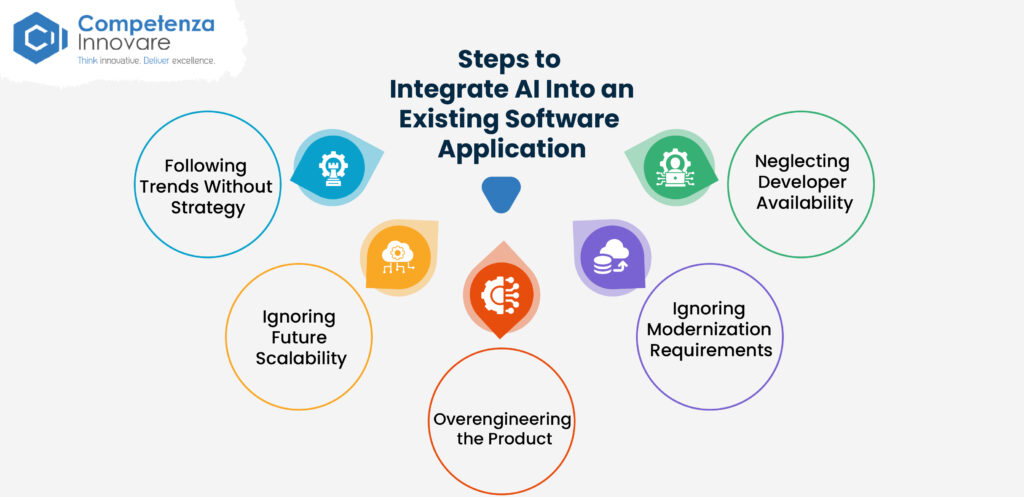
Steps to Integrate AI Into an Existing Software Application
The integration of AI in a software product must have a definite plan and approach. Businesses ought to aim at selecting AI functions in resolving practical issues, user experience enhancement, and value generation that can be calculated. An effective AI engagement in the current software plan is likely to assist corporations in order to augment their apps and not interrupt ongoing operations.
Step 1: Identify the Right AI Use Case
Start with the intelligence of the business goals and the user needs. Select AI capabilities that will address certain challenges; examples are automation of operations, better customer experiences, or individual experiences.
Step 2: Analyze Existing Software Architecture
Before ensuring the induction of AI into your business or project, you should review the current software architecture, technology stack, databases, APIs, security requirements, and scalability requirements. This is useful in helping to integrate in an easy manner and improve performance.
Step 3: Select the Right AI Technologies
Steep application of the appropriate technologies will make implementation effective. As AI software products, machine learning models, natural language processing, generative AI, computer vision, or AI APIs can be utilized by businesses depending on their needs.
Step 4: Develop and Test AI Features
Build AI possibilities through prototypes, test functionality, connect with end-users, and refine accurateness prior to the deployment of their complete functionalities.
Step 5: Deploy and Optimize AI Features
To implement, keep an alert eye on the AI activity, update models, and enhance user experience and expand capabilities as business needs increase.
These measures will help companies to make sure that AI is highly incorporated within current apps and to come up with more intelligent and effective software products. To know more about How Much Does It Cost to Build a Software Product
Challenges of Adding AI Features to Existing Software
Enhancing efficiency and user experience through the introduction of AI capabilities to an existing software product may be the right choice, although companies will likely face a few issues in the implementation process. An effective AI upgrade of current software needs proper planning, data, and a safe strategy.
- Data Quality and Availability: The AI applications are founded on the quality of data and properly organized files. The businesses may need to clean, organize, and prepare their available data in order to make AI models come up with credible results.
- Integration complexity: The current software might prove challenging to integrate AI in terms of connecting AI models with existing applications, databases, and APIs. Technical planning would assist in ensuring that minimal change in functionality would be incorporated to integrate well.
- Security and Privacy Problems: Artificial Intelligence-based features tend to use business and customer information. Data security and privacy protection, coupled with the careful use of AI, will help to develop safe and reliable software solutions.
- Performance and Scalability: AI characteristics may expand the system needs when the usage expands. To expand AI capabilities, businesses require scalable infrastructure that will support increases in the performance, speed, and reliability of software as it grows.
These challenges can be overcome to make businesses successfully modernize software products and develop efficient, secure, and AI-powered apps.
Best Practices for Successful AI Integration Into Software Products
Implementation of AI should not only come with new features to be successful. It requires businesses to have a clear roadmap that puts an emphasis on the needs of the user, data security, and long-term product objectives. The correct approach can be utilized to develop trustworthy AI-based software solutions that will create real value.
Start with Small AI Initiatives
Start with easy AI features, features that are either business or user problems. Smaller-scale projects related to AI testing can help businesses to understand the impacts it has prior to trying to scale it out throughout the entire software product.
Focus on User Needs
The characteristics of AI should maximize user experience and solve actual problems. To be innovative, companies need to identify tasks that AI can help solve with an easier, faster, or more efficient solution than by merely applying AI.
Ensure Data Security
It requires the security of data management when it comes to using AI. When gathering and processing data, businesses ought to ensure that the privacy of user information remains intact, and they are guided by safe standards in their practices.
Choose Scalable AI Architecture
An active architecture is flexible and scalable, allowing software products to cope with scaling. An appropriate choice of AI technologies and infrastructure allows the growth of AI capabilities in response to the growing user needs.
Continuously Improve AI Models
The AI systems need periodic upgrades and enhancement. Monitoring of performance, collection of feedback, and model refining of AI are good for maintaining accuracy and effectiveness in the long term.
Monitor Business Outcomes
The relevance of AI characteristics to the business can be traced by such metrics as user interest, productivity, and overall product performance. This aids in making AI investments meaningful to business goals.
With such practices, businesses will be able to successfully modernize software products with AI and develop smarter, better-scaled, and future-oriented software solutions.
How Software Product Development Experts Help With AI Integration
The appropriate strategy, technical skills, and development method are the keys to successfully integrating the AI features into an existing software product. Experts in software development assist businesses in discovering the most useful AI, selecting the appropriate technologies, and creating solutions that will contribute to long-run growth.
As AI software product developers, the team can assist companies to assess their requirements and establish product architecture that is AI-friendly, as well as add intelligent capabilities to the current applications.
Ready to modernize your software? Partner with Competenza to build scalable AI-powered features today.
Evaluate AI Opportunities
Professionals understand business objectives and user needs to pinpoint the areas where AI can be most useful, including automation, personalization, or a superior decision-making process.
Design AI-Powered Product Architecture
Having a robust architecture is to have features of AI integrate well with the already existing systems and allow future expansion and scaling.
Integrate and Improve Existing Applications
Development teams assist in the addition of AI capabilities and software performance, as well as in enhancing user experiences without interfering with the current operations.
Build Scalable Solutions
Professional software product development services assist businesses in developing resilient, scalable, and adaptable AI-powered products that can respond to the evolving demands.
Expert software product development services can be used by companies to develop scalable and AI-ready applications to see the modernization of their applications.
Conclusion
Integrating AI functionalities into an already existing software product assists companies in enhancing efficiency and user experiences and unlocking new opportunities without entirely redesigning their applications. With intelligent automation and personalized experiences, more sophisticated analytics, and smarter workflows, AI can turn the standard software into something more than powerful and versatile solutions.
Nevertheless, effective use of AI should be based on a correct strategy, technical prowess, and solid product objective awareness. Companies must have a stable method of discovering AI opportunities that can be valuable, implementing the appropriate technologies, and making sure that their applications are scalable and safe.
The Competenza software product development expertise allows businesses the opportunity to modernize their current applications and develop AI-ready software solutions to facilitate their long-term development. With software engineering and AI innovation, companies will be able to design smarter products and provide better user experiences and sustainable business value.
Frequently Asked Questions (FAQs)
Is it possible to add AI features to an existing software product?
Yes, the AI capabilities can be added to the existing software without necessarily re-creating the application. Some of the AI features that businesses can incorporate to meet their products’ needs include chatbots, recommendation systems, predictive analytics, intelligent search, and automation.
What is the reason why businesses need to add AI to existing software?
The inclusion of AI functions assists companies in enhancing user experience, automating routine software to perform tasks, and deriving a deeper meaning of the information as well as adding value to products. Existing software can be modernized with AI integration, enabling companies to use their invested technology even with AI integration.
What are features of AI that can be added to current software products?
Depending on its purpose, businesses can incorporate various AI capabilities, such as the following:
- chatbots and virtual assistants AI.
- Personalized recommendation systems
- Generative AI features
- Predictive analytics
- Advanced data mining and searching.
The functions contribute towards smartening and empowering software experiences.
How do you incorporate AI into an already existing app?
The first steps that a business should implement to add AI to their existing applications are to find the appropriate use case, analyze the existing software architecture, choose appropriate AI technologies, create AI features, and test and optimize additional performance after implementation.
What are some of the difficulties of incorporating AI into existing software?
Among the typical pitfalls are the preparation of quality data, the fusion of AI with existing systems, its adherence to security and privacy, and the ability to support the higher performance needs. These problems can be made out with proper planning.
What role does AI play in developing software products?
AI can assist in the development of software products by allowing software automation, intelligent decisions, personalized usability, and data analytics. It enables the businesses to develop more scale and intelligent digital products.
Can all software products be incorporated with AI?
The range of AI integration applications is quite numerous and must be implemented in various forms according to business goals, user demands, available data, and technical aspects. An explicit strategy will help comprehend what qualities of AI will be the most useful.
What can The Competenza do to help integrate AI into software products?
The Competenza supports companies to evolve their software products in terms of professional software development methods, such as finding and recognizing AI opportunities, scalable architecture development, intelligent feature integration, and the development of solutions that are future-ready.