

Healthcare organizations nowadays deal with an increasing number of administrative, clinical, and operational processes. Many of these can be seen in patient registration and appointments, medical records, billing, insurance checks, and compliance reporting and include manual efforts. With the emergence of growing expectations on patients and the growing complexity of regulatory needs, healthcare providers are increasingly pressured to provide quicker, more effective, and superior care. It is here that workflow automation in healthcare is exerting a considerable effect. Through administering repetition and process rule automation, healthcare organizations can strive for the reduction of administrative burden, eliminating any manual error, enhancing staff operational efficiency, and creating conditionally better patient and staff experiences. Instead of using fragmented systems and paper-based processes, automating healthcare workflows allows information to flow easily in and out of departments so that important processes are properly done and in time.
Automated workflows to schedule patients and electronic health record (EHR) workflow automation, automation of healthcare documents, and claims processing are only some ways automation is changing the way hospitals, clinics, and medical workers operate. The current solutions are capable of automatically directing documents, making notifications, updating records, managing approvals, and connecting with the existing healthcare systems to ensure organizations save more time and enhance the delivery of services.
These abilities are further expanding with the advent of AI workflow automation in healthcare. The AI-based systems have the capability of analyzing and using patient data, simplifying decision-making processes, anticipating scheduling to avoid congesting the workflow, detecting workflow bottlenecks, and computing complex administrative functions that in the past used to take a lot of time and human participation. That way, healthcare professionals can waste less time on documentation and devote more time to patient care.
This guide will cover the most significant advantages of workflow automation in healthcare, the real-life examples of healthcare workflow automation, and the ways in which hospitals and healthcare organizations can utilize automation to enhance efficiency, increase compliance, and positively impact patient outcomes. Whether you need to streamline the administrative processes or digitalize the clinical workflows, the knowledge about the automation of all healthcare processes is the initial measure to go towards creating a more agile and efficient healthcare organization.
What Is Workflow Automation in Healthcare?
“Workflow automation software” is the term in healthcare that refers to the management of repetitive operations and actions to be automated with the help of software and digital tools in healthcare organizations. It helps hospitals, clinics, and other health care professionals to reduce the amount of manual work, improve effectiveness and efficiency, and ensure that crucial activities are done at the appropriate place and at the appropriate moment.
Instead of handling paper-based processes, manual data entry, emails, and making calls, automation of healthcare workflow creates digital workflows, which automatically transfer information, send notifications, update records, and trigger an activity where required. This will assist the medical staff to save time, minimize mistakes, and concentrate more on the patients.
Some common examples of healthcare workflow automation include:
- Automated patient appointment scheduling and reminders
- Electronic health record (EHR) updates
- Insurance verification workflows
- Claims and billing automation
- Patient intake and registration processes
- Compliance reporting workflows
- Healthcare document workflow automation
Healthcare process automation removes bottlenecks, assists in enhancing interdepartmental interactions, and ensures that patients and healthcare professionals have a streamlined experience through automation of routine processes of administration and operation. Consequently, it will allow healthcare organizations to work much more efficiently and provide quicker and more efficient care.
Why Healthcare Organizations Are Investing in Workflow Automation
The healthcare organizations are experiencing more challenges such as a rise in patient demands and staff shortages, an increase in the cost of operations, and a high level of compliance. Negotiating these difficulties through manual operations may slow operations and create extra pressure on healthcare teams.
In order to address these challenges, healthcare providers, numerous hospitals, and clinics are making investments in healthcare workflow automation. Automation of routine tasks and processes can enhance efficiency and minimize errors and offer patients better experiences within organizations.
Reducing Administrative Burden
Healthcare workers devote much of their time to administration, including making appointments and checking documents, insurance, and billing data. Automation of these repetitive operations assists in lessening manual operations and enables the staff to concentrate more on patient care.
Improving Patient Experience
Patients demand rapid and convenient and smooth healthcare services. Workflows can be automated, facilitate the improvement of communication, reduce wait times, request appointment reminders, and facilitate patient registration, which makes the experience more valuable in general.
Increasing Operational Efficiency
Manual processes are likely to be associated with delays and inefficiencies. The automation of the healthcare workflow can help optimize the process, improve interaction between various departments, and ensure that the processes are more accurate and efficient to do.
Supporting Digital Transformation
Digital technologies are becoming more popular in healthcare organizations to streamline their operations. Workflow automation is beneficial to connect systems and standard processes and enhance data management, enabling healthcare services to be more efficient and potentially expanding in the future.
Key Benefits of Workflow Automation in Healthcare
Workflow automation in healthcare assists an organization to make operations more streamlined, enhance productivity, and provide customers with excellent patient experiences. Automation of repetitive clinical and administrative tasks can also allow healthcare providers to reduce inefficiencies and focus on delivering quality care.
Improved Efficiency and Productivity
A number of healthcare processes consist of routine operations like data entry, appointment bookings, document control, and workflow approvals. The automation of such activities also lowers the number of man hours that are spent on such tasks and enables teams to finish their tasks in a shorter time.
Key benefits include:
- Faster process completion
- Reduced administrative workload
- Better use of staff resources
- Improved operational efficiency
- Increased productivity across departments
This means that healthcare providers will have less time to waste on routine duties and more time working with patients.
Reduced Human Errors
The manual processes can also result in errors that can be quite common and affect patient care and operations performance. Efforts such as inappropriate data entry, misplaced documents, billing errors, and time differences have the potential to create time wastage and unnecessary work.
By automating the healthcare workflow, such risks may be reduced by setting up tasks in accordance with the current regulations and standard workflows.
Automation can help prevent some common errors, such as:
- Data entry mistakes
- Incomplete or missing documentation.
- False billing and claims
- Scheduling conflicts
- Team-team communication differences.
This increases accuracy and consistency in health care processes.
Faster Patient Care Delivery
Prompt information availability in healthcare is important. Time-saving of automated workflows may help both healthcare workers who have access to patient information and coordinating care and those who have access to task management.
Examples of patient workflow automation incorporate the following:
- Automated patient check-in and entry.
- Management of the referral and approval.
- Clinical documentation workflows
- Care coordination processes
- Reminders and scheduling of appointments.
By reducing delays and handovers, healthcare providers are able to offer quicker and more efficient patient care.
Better Regulatory Compliance
The healthcare organizations need to adhere to stringent rules and the privacy of data. The manual approach to compliance management may also be time-consuming, and it may also lead to mistakes.
Automating healthcare compliance workflow is beneficial as it assists organizations to sustain regular operations, monitor operations, and generate elaborate audit trails.
Benefits include:
- Improved regulatory compliance
- Standardized workflows and approvals
- Better data security and governance
- Easier audit preparation
- Enhanced transparency and accountability
This assists medical professionals to fulfill the compliance need and has made the administration easier.
Lower Operational Costs
Administration and inefficiencies may push up healthcare expenses in the long run. The automation of workflows assists organizations in cutting the needless cost of operations through automobile of the usual processes and enhancement of resource use.
Organizations can lower costs through:
- Reduced paperwork and manual processing
- Fewer administrative errors
- Faster claims and billing cycles
- Improved workforce efficiency
- Reduced process delays and bottlenecks
With the help of robotization, healthcare organizations could perform their activities more efficiently and enhance financial outcomes and the quality of the provided service to patients.
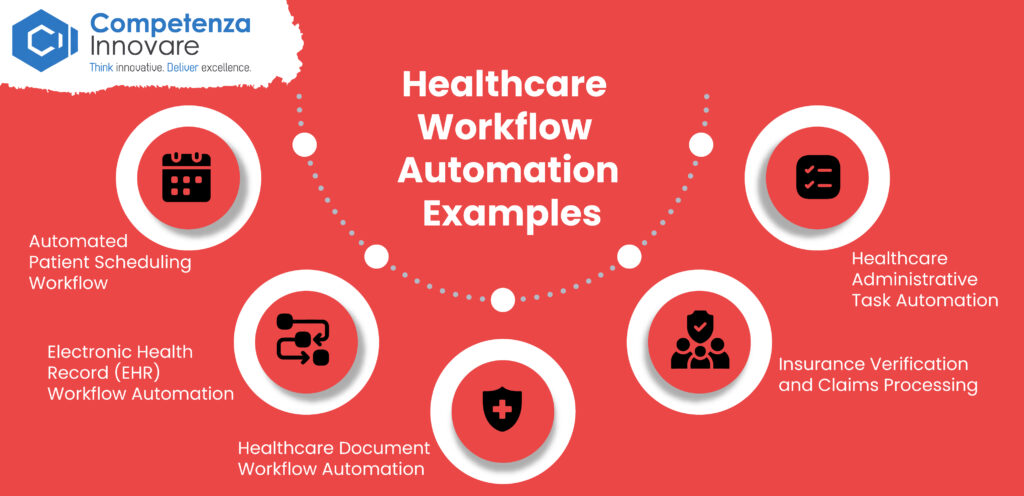
Healthcare Workflow Automation Examples
Workflow automation in healthcare organizations can be applied to optimize daily operations, minimize paperwork, and provide a better patient experience. By automating routine operations, providers will be able to save on time, improve accuracy, and generate more operational efficiency.
Automated Patient Scheduling Workflow
The problem of appointment scheduling can be considered one of the most common healthcare workflow automation applications. Manual booking of appointments can bring in conflicts when it comes to schedules of appointments and absences from appointments, and administratively, it would lead to more work.
Automated workflow of the patient scheduling can
- Schedule appointments automatically
- Send appointment reminders
- Cancellation and rescheduling.
- Reduce no-show rates
- Improve patient communication
This will help healthcare providers in delivering a less stressful patient experience and reduce the workload on leadership teams.
Electronic Health Record (EHR) Workflow Automation
Electronic health record (EHR) workflow automation tracks patient data and helps the healthcare organizations to work more effectively. Rather than having to manually update records across the systems, automated workflows guarantee the update and sharing of information in real time.
The typical EHR automation activities encompass:
- Patient record updates
- Data synchronization
- Clinical information sharing
- Medical history access
- Secure document storage
This improves the quality of the data, reduces repetition, and guarantees better coordination of care.
Healthcare Document Workflow Automation
Patient records, consent forms, insurance documents, referrals, and compliance documents are just a few of the volumes of documents that healthcare providers need to handle daily.
Healthcare document workflow automation helps:
- Collect and organize documents
- Route documents to the right departments
- Manage approvals and reviews
- Store records securely
- Simplify document retrieval
The paperwork, time, and compliance can be enhanced through the automation of document management.
Insurance Verification and Claims Processing
An insurance check and an insurance claim are usually complicated procedures that use up time. The manual processes will lead to delays, billing errors, and claim rejection.
Workflow automation can streamline:
- Insurance eligibility verification
- Claims submission
- Claims tracking
- Payment processing
- Error detection
This assists healthcare organizations in expediting reimbursements, as well as enhancing financial operations.
Healthcare Administrative Task Automation
Automation can also be applied to many of the internal administrative processes. The automation of these activities can assist healthcare companies in enhancing their productivity and ensuring the regularity of their operations.
Common examples include:
- Employee onboarding
- Staff scheduling
- Payroll approvals
- Procurement requests
- Vendor management
- Internal approval workflows
Healthcare administrative task automation helps the staff to give more attention to operational and patient-related duties by minimizing repetitive manual tasks.
These illustrations demonstrate the way in which healthcare workflow-based automation can enhance efficiency in both clinical and administrative areas. It is in making appointments or managing patient records, documents, or internal processes; automation in healthcare organizations provides improved services and minimizes complexity with operations.
AI Workflow Automation in Healthcare
In healthcare, AI workflow automation can also be used to improve the use of artificial intelligence to automate tasks, partnering with workflow automation. It allows medical practitioners to analyze data more efficiently and swiftly and make superior decisions using data.
Compared to traditional automation, AI can respond to large data volumes, draw trends, and spur more complex operations. This helps in reducing manual labor in the healthcare organizations; quality and speed of operation increase.
AI-powered automation can:
- Analyze patient data
- Estimate scheduling and staffing requirements.
- Automate document processing
- Support clinical decision-making
- Identify workflow bottlenecks
- Generate operational insights
Artificial intelligence can be used to prioritize a patient request, deal with medical records, and provide insights that can enable healthcare teams to work more effectively. It can also assist organizations to recognize areas where they can streamline processes.
Workflow Automation for Hospitals
There are numerous processes running daily at hospitals that deal with many departments, medical professionals, and administrative staff. These processes can lead to delays, communication hiccups, and ineffective procedures when performed manually.
Workflow automation in hospitals helps to streamline the daily life of hospitals, improve the cooperation between various hospital departments, and ensure that the most crucial operations can be performed as quickly and as accurately as possible. Automation of repetitive workflows can also enable hospitals to achieve greater productivity in the operating room and enhance patient care and safety.
The typical procedures of work in a hospital that can be automated are some of the following:
- Emergency department workflows
- Admission and discharging of patients.
- Laboratory reports and testing.
- Care coordination and referral.
- Allocation of resources and beds.
- Scheduling and shift management of staff.
Using automated workflows as an example, this can also be used to guide patient data to the relevant departments, notify personnel of any urgent changes, and monitor tasks in real-time as well. This saves the labor and will assist in ensuring smooth operations throughout the hospital.
Choosing the Right Healthcare Workflow Management Software
Choosing the appropriate healthcare workflow management software can help enhance efficiency, streamline processes, and promote long-term growth. As each healthcare facility has its specific procedures and needs, it is necessary to select the solution that will be able to speed up the workflows and integrate with the current systems.
The following are the factors to be considered when assessing the healthcare workflow automation software:
Integration Capabilities
In healthcare organizations, various systems tend to be deployed in the management of patient care as well as day-to-day tasks. The workflow automation system must be easily connected with the current tools and enable them to generate a smooth flow of data and remove information siloing.
Look for integration with:
- Electronic Health Record (EHR) systems
- Practice management software
- Billing and claims systems
- CRM platforms
- Third-party healthcare applications
Close integration facilitates better productivity and facilitates the ability to look at the operations in one way.
Security and Compliance
One of the priorities in healthcare is to protect patient data. The software should support and have strong security functions and be able to meet industry compliance.
Key features to look for include:
- HIPAA compliance
- Role-based access control
- Audit trails and activity logs
- Data encryption
- Secure document management
The above features can help medical institutions to store information safely and in line with laws.
Scalability
Some workflows of healthcare organizations get complicated as they expand. The appropriate healthcare workflow management software must be capable of managing the growing patient volumes, more users, and changing operational needs without any impact to performance.
An upscaling solution will ensure that the automation of the workflow will remain relevant to the business development and the transforming healthcare requirements.
Custom Workflow Design
Each hospital, clinic, and healthcare provider has various processes. A workflow automation solution must be flexible to enable organizations to develop and tailor workflows to their unique needs.
Custom workflow capabilities can help automate:
- Patient intake processes
- Appointment scheduling workflows
- Document approval processes
- Insurance verification workflows
- Administrative and operational tasks
This can be flexible and thus enable healthcare organizations to make the most use of workflows without necessarily having to create extensive development or systems modification.
With the right healthcare workflow management software, healthcare providers can become more productive and compliant, streamline their patients’ and administrative processes, and create a more efficient healthcare operation.
Challenges of Healthcare Workflow Automation
Although healthcare workflow automation has numerous positive aspects, it might not be implemented without some issues. To be successful in a transition, healthcare organizations are likely to face technical, operation, and organizational barriers.
Some common challenges include:
- Integrating automation with legacy systems
- Managing organizational change
- Training staff on new tools and processes
- Migrating data from existing systems
- Meeting regulatory and compliance requirements
To illustrate this, old health systems might fail to integrate well with new automation systems, and new employees might have to take time to learn new working patterns. Moreover, healthcare organizations should make sure automated operations are in line with data privacy and security laws.
Transform Healthcare Operations with Intelligent Workflow Automation for Better Patient Outcomes Today.
How The Competenza Helps Healthcare Organizations Automate Workflows
The healthcare organizations require effective mechanisms of handling patient care, administration, and processes. The Competenza assists healthcare providers to automate workflows and manual work and enhance efficiency overall by developing tailored workflow automation solutions.
Through automation of repetitive work and connectivity between healthcare systems, organizations are able to streamline operations, reduce delays, and enhance productivity in the various departments.
The workflow automation solutions of the Competenza assist healthcare givers:
- Automate repetitive processes
- Streamline patient workflows
- Integrate healthcare systems
- Improve compliance management
- Enhance operational visibility
- Scale healthcare operations efficiently
The Competenza creates solutions that are diverse to the requirements of the healthcare organizations, whether they are to automate the patient scheduling, document management, approvals, or administrative operations.
When the appropriate healthcare workflow architectural plan is established, the healthcare provider will have the chance to minimize administration, enhance operational efficiency, and pay more attention to the provision of high-quality care to the patient.
Conclusion
Workflow automation in healthcare is changing the way healthcare providers handle clinical, administrative, and operational tasks. Organizations are automating their patient scheduling processes and electronic health records and automating the healthcare process through AI tools to enhance efficiency, minimize errors, and improve patient experiences.
With the ongoing changes in healthcare systems, investment in scalable healthcare workflow automation systems will become a necessity to organizations aiming to pursue operational excellence, regulatory compliance, and improved patient outcomes.
FAQs
What is workflow automation in healthcare?
Healthcare workflow automation is the process of automating repetitive clinical, administrative, and operational procedures by computer software and digital tools. It assists medical institutions to become more efficient and less manual as well as purify their operations, including scheduling, document handling, and revision of patient records.
What are the advantages of automation of workflow in healthcare?
Healthcare workflow automation assists organizations to decrease administrative workloads and increase productivity, decrease errors, enhance patient experiences, enhance compliance, and decrease operational expenses. It also enables medical practitioners to attend more to the patients as opposed to the routine duties.
What role does healthcare workflow automation play in enhancing patient care?
Remote automation reduces delays and enhances coordination by automating the process of collecting appointment information, patient intake and referrals, and records in providers’ systems, thereby reducing delays and improving coordination. This allows serving patients quicker and easier.
What are typical examples of healthcare workflow automation?
Common examples include:
- Automated booking and patient reminders
- Electronic Health Record (EHR) alterations.
- Insurance verification workflows
- Claims processing automation
- Healthcare document management
- Compliance reporting workflows
What is AI automation of healthcare workflow?
AI workflow automation is an artificial intelligence and workflow automation that are employed to automate more complex issues. Patient data may be analyzed with the help of AI, documents may be processed automatically, workflow bottlenecks may be identified, and insights may be provided that will help healthcare organizations to make more efficient decisions.
How important is workflow automation in hospitals?
Hospital workflow automation simplifies hospital work and improves patient-relevant work related to patient admissions, discharging, laboratory work, personnel scheduling, referrals, and resource management. This improves the cross-departmental efficiency and coordination.
What is electronic health records (EHRs) workflow automation?
Mechanization of EHR through automation of EHR workflows assists in updating and harmonizing data information, securing documents, and enhancing the access to patient information. This enhances the quality of data and coordination of care.
Can automation of workflows in healthcare be safe?
Indeed, modern healthcare workflow automation applications are not devoid of security tools, such as data encryption, role-based access control, logs, and support to meet the regulations, e.g., HIPAA. These attributes aid in guarding confidential patient data.
What do healthcare organizations seek in workflow automation software?
Some of the capabilities that organizations should seek in software include system integration, security, compliance, and scalability; the ability to work with custom workflows; as well as healthcare-specific processes and requirements.
What can healthcare organizations do to initiate workflow automation?
The initial point of action is to establish automatable and time-wasting processes that can be automated. It should be followed by the healthcare organizations analyzing their current systems and establishing the automation objectives and s