
Selecting the appropriate SaaS application development firm may prove to have a significant effect on the success of your SaaS product. In contrast to a simple web or mobile app, SaaS products must support numerous users, safeguard data of their users, support other systems and be dependable as the number of users increases. Multi-tenant architecture, scalability, security and continuous enhancement of the products must thus be a fact to take into account initially.
Cost and delivery time are not the only factors that should be looked at before a SaaS development partner is hired. Verify their experience in developing SaaS products, technical capabilities, SaaS development technology stack, and development practices of security, integration, and post-launch support. A robust partner is capable of creating a safe and scalable product and molding the solution to fit your business’s needs.
This guide will address the most important tips to keep in mind when selecting SaaS application development services, questions to ask before engaging, red flags to watch out for and a realistic SaaS development checklist to ensure you make a fair decision.
What Does a SaaS Application Development Company Actually Do?
A SaaS application development firm assists businesses in strategizing, developing, rolling out, and supporting software solutions on the cloud. Its output can consist of product strategy, custom development, cloud architecture, integrations, testing, deployment, and continual support.
SaaS Product Strategy and Discovery
The team must know before the development begins:
- Target users and their needs
- Business model and subscription plans
- Core workflows and key features
- MVP requirements for the first release
- User roles and access levels
- Product roadmap for future features
- Integration requirements with existing systems
This assists in making a definite plan of the development and preventing unnecessary features or expenses.
Custom SaaS Application Development
A specific business requirement is tailor-made software that a custom SaaS development company creates. What is in practice known as ‘custom development’ may be necessary when standard solutions are not able to accommodate unique workflows, integrations, user experience or industry-specific features.
Cloud-Native SaaS Development
A SaaS application should have a powerful cloud backbone to enable expansion. The development partner ought to target the following:
- Cloud infrastructure
- Scalability
- High availability
- Deployment
- Performance
- Application monitoring
This aids in ensuring the product is dependable with an increase in the number of users and workloads.
SaaS Integration and API Development
SaaS applications are often obligatory to connect with other platforms. Common integrations include:
- CRM and ERP systems
- Payment gateways
- Analytics tools
- Authentication systems
- Third-party APIs
API and integration capabilities allow businesses to combine their SaaS offering with existing products and create an easier customer experience.
10 Things to Look for Before Hiring a SaaS Application Development Company
Choosing a SaaS development partner should not focus on the price and portfolio alone. You need to take into account their experience, technological capability, security, development strategy and capacity to keep your product after it has been released in the market. The most important factors are the following ones.
1. Proven SaaS Development Experience
Identify a SaaS product development company that has worked on developing real SaaS products and not alternate software applications.
Determine whether the company has done:
- SaaS platforms
- Cloud applications
- Multi-tenant products
- Subscription-based software
- Enterprise SaaS solutions
Research relevant case studies, product experience and customer results to understand what they undergo.
2. Strong Technical Expertise and the Right SaaS Technology Stack
The technical skills needed in your particular product should be available in the development team. Do not select a company just because it enumerates a lot of technologies.
Check its experience with:
- Front-end and back-end.
- Databases and APIs
- Cloud systems, which include AWS, Azure, or GCP
- DevOps and containerization
- AI/ML, when required
How to choose the right tech stack for your software product must be in a position to meet requirements today as well as enable the product to be scalable.
3. Multi-Tenant SaaS Architecture Experience
Three multi-tenant SaaS developments enable numerous customers to use the same application and preserve the data and access in the proper division.
Ask the development company how it handles:
- Tenant data isolation
- User roles and permissions
- Shared or separate databases
- Tenant-specific settings
- Resource management
- Scalability
An appropriate provider must be able to tell you why this or that architecture is appropriate to your product.
4. Scalability and Performance Capabilities
Your SaaS must be capable of supporting a growing number of users, traffic and data without having to be completely rebuilt.
Look for experience with:
- Cloud scalability
- Database optimization
- Caching
- Load management
- Performance monitoring
- High availability
Good scalable SaaS development practices are useful in ensuring that the application is always reliable as the business expands.
5. Security, Compliance, and Data Protection
Security should be thought through during the initial development. Your provider must have a definite way of securing application and customer data.
Check for:
- Data encryption
- Secure APIs
- Authentication and authorization
- Role-based access
- Security testing
- Backup and recovery
- Compliance requirements
Such requirements might be GDPR, CCPA, HIPAA, SOC 2 or PCI DSS depending on your industry.
6. SaaS Integration and API Capabilities
Perhaps you need your SaaS solution to be interconnected with its third-party service, and even other business applications.
Evaluate the company’s experience with:
- CRM and ERP integrations
- Payment gateways
- Third-party APIs
- Identity providers
- Analytics platforms
- Webhooks
With reliable integrations, the integration of your product into an existing developed system becomes simple, and it’s easy to incorporate new features as the business expands.
7. Product Design and User Experience Expertise
The customers should find a SaaS application intuitive to use. Do not judge a development company by the quality of its codes.
Check whether the team can create:
- Simple onboarding
- Intuitive dashboards
- Clear user workflows
- Role-based interfaces
- Responsive designs
- Self-service account features
Good UX is able to improve conversion, interaction, and retention.
8. A Clear SaaS Application Development Process
A stable SaaS application development process must have a defined schedule and deliverables. An example procedure may comprise:
Discovery → Strategy → Architecture → UI/UX → Development → Integration → Testing → Deployment → Optimization
Ask about the requirement management, testing, feedback, change and deployment of the companies’ processes. A precise process will help keep the project in order and reduce any emergencies.
9. Transparent Pricing, Scope, and Communication
Become knowledgeable of what is involved in the project, then sign an agreement.
Clarify:
- Project scope and deliverables
- Development milestones
- Pricing model
- Estimated timeline
- Change requests
- Source code and IP ownership
- Communication process
- Project management
Do not select any provider because it has the cheapest price. Having a clear proposal that stipulates the responsibilities would protect unwarranted expenditures in the future.
10. Post-Launch Support and SaaS Optimization
The development of SaaS does not cease once the application has been launched. The changes in users and requirements will demand updates, monitoring, improvements, and support of your product.
Check whether the provider offers:
- Bug fixes
- Security updates
- Performance monitoring
- Cloud optimization
- Feature enhancements
- Technical support
- Scalability improvements
- Continuous development
It can be a long-term development partner rather than an insignificant one-time vendor with a company that provides long-term support of SaaS and performance optimization.
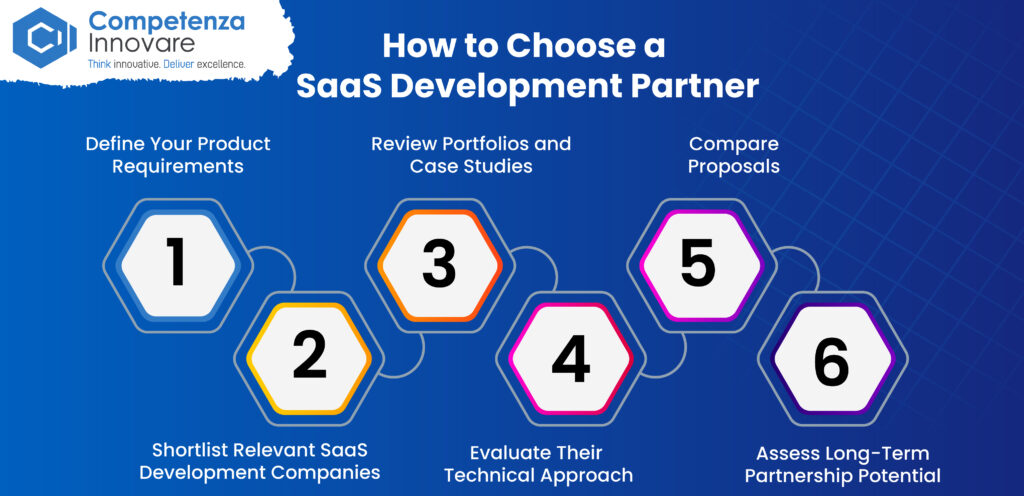
How to Choose a SaaS Development Partner
The right SaaS development company can assist you in developing a product that can be considered safe, scalable and with long-term growth potential. Instead of settling with a company simply due to its expense or advertising claims, follow a simple assessment process.
Define Your Product Requirements
Start by knowing what it is that you wish to build. Identify your users, business model, core functionality, integrations needed, security requirements and MVP scope. Having a clear requirement will also help you have a development partner that will fit your objectives in your project.
Shortlist Relevant SaaS Development Companies
Determine the number of firms that have experience in SaaS development. A comprehensive set of SaaS services, cloud-based applications and subscription platforms can well be valued at a high rating in search or a gorgeous site.
Review Portfolios and Case Studies
Check on previous projects to find out whether the company has carried out an activity on a product similar to yours. Find experience in related industries, business needs, integrations, and the complexity of applications. Case studies may also demonstrate the outcome they provided to the clients.
Evaluate Their Technical Approach
A trusted SaaS development company must also articulate the way in which it will develop your application. Ask about the technology stack, construction, multi-tenancy/single-tenancy, security, scaling strategy and its deployment methods. Their responses can assist you in evaluating their technical skills.
Compare Proposals
The price is not a reason to select a company as the lowest. Assess the scope of the project, technical plan, staff knowledge, schedule, services, and cost. An elaborate offer can be of good value compared to a lower offer that has an uncertain output.
Assess Long-Term Partnership Potential
A SaaS product is one that keeps on developing. Think of whether the company is capable of providing continued support, updates, performance enhancements, and developing future features. It is the capacity to sustain your product that makes a service provider become a SaaS development partner.
Through these steps, you will be able to make a better decision and select a development partner that will be able to develop and maintain a successful SaaS application.
SaaS Development Company Selection Checklist
With a proper evaluation structure, it is more likely to get the right SaaS application development company. Rather than solely aiming at the price or the size of the company, evaluate each vendor by its SaaS experience, technical skills, security and development life cycle, and long-life support. This SaaS development company selection checklist may allow comparing potential partners and making better decisions.
| Evaluation Area | What to Check |
| SaaS Experience | Relevant SaaS products, cloud applications, and proven case studies. |
| Technical Expertise | Frontend, backend, database, cloud, API, and DevOps functionality. |
| Multi-Tenancy | Safety in tenant architecture, data isolation and user access. |
| Scalability | Scalability to allow extended usage, scalability and workload. |
| Security | Access control and compliance, data encryption, and authentication. |
| Integrations | APIs, CRM applications, ERP, payment gateways and third-party applications. |
| UX/UI | Easy to use interface, easy to use design and effective on boarding. |
| Development Process | Intense discovery and planning to deploy and support. |
| Communication | Open project management, frequent updates and teamwork. |
| Pricing | Adequate scope, deliverables, timelines and price. |
| Support | Maintenance, monitoring and updates, and optimization post-launch |
| References | Client testimonials, reviews, and verifiable project success stories. |
The more a company succeeds in all of these domains, the more likely it is to be a trusted SaaS development partner and provide a safe, scalable, and high-quality SaaS product to help you achieve your long-term business objectives.
Questions to Ask Before Hiring a SaaS Development Company
The proper questions will also assist you when selecting an SaaS development partner that aligns with your goals as a business and your product needs. The questions below will help assess the experience, technical expertise, development process, and long-term support of the company before deciding on its purchase.
- What SaaS products have you built before?
- Does it have any case studies or projects to refer to?
- What are your designs of multi-tenant SaaS applications?
- Which technology stack would you recommend to use in our project?
- What are you going to do to make the application scalable?
- What do you do about security and compliance needs?
- What are some of the integrations that your team supports?
- What did your development process of SaaS look like?
- Who is the owner of the source code and intellectual property?
- What on-the-job assistance do you provide?
- How do you go about changes in project requirements?
- How do you communicate project progress and updates?
These questions can assist you in obtaining an SaaS application development company that has the appropriate experience, technical expertise, and services to offer to your project.
Red Flags to Watch for When Hiring a SaaS Development Company
Not all development companies are suitable to your SaaS project. When comparing providers, look out for the following red flags, which might result in delays, increased costs, or lower quality of the software product development.
- Absence of a Relevant SaaS Portfolio: A company is supposed to show examples of SaaS products that have been developed by the company. Unless it can comprehend the idiosyncratic requirements of the SaaS applications, based on appropriate SaaS experience or case studies, it might not fully understand them.
- Bad Technical Answer: A good team will give a sketch of its plans to construct its application, security, and scaling. General or loose answers may translate to lack of technical knowledge.
- Lack of a Defined Multi-Tenant Strategy: Multiple consumers are provided with a single platform with many SaaS products. In the case the company is unable to justify its approach to multi-tenancy and data separation, the company might not be the best option.
- Unrealistically Low Pricing: Sometimes, very low pricing can imply that the proposal lacks key services like testing, security, or support. Consider value and not only cost.
- Promises Before Understanding Requirements: Suspect companies who make promises of particular costs as well as times before they are willing to investigate your requirements. Before committing themselves to your project, a professional team will first learn about it.
- Weak Security Approach: Each security product cannot be deprived of security. The company should possess a clearly defined policy on data protection, accessibility, and security tests.
- Absence of a Well-structured Development Process: A formal development process will help in keeping the projects on track and on schedule. The company may create unnecessary risks in case they fail to inform them of how they manage projects.
- Poor Communication: It is important to update and communicate effectively on the project. This can be postponed and unintelligible because of slow responses to different messages or be undefined.
- No Post-Launch Maintenance: SaaS is going to require updates, maintenance, and improvements after the launch. A non-sustainable organization in the long term may not be a proper combination.
- No Ownership or IP Clarity: It is important to ensure that ownership and intellectual property of the source code are clarified before participating in a contract. This will prevent later conflicts and save your business.
Awareness of these red flags would help you in choosing your SaaS development partner as a person who has made it through tough times, is reliable, and can champion the long-term success of your product.
SaaS Development Agency vs. In-House Team: Which Should You Choose?
The developing organizations may look at hiring a SaaS development company or constructing a group of developers. They are both good, and you will choose the right one depending on your budget, time period, and your business aims.
| Factor | SaaS Development Agency | In-House Team |
| Initial Hiring | Faster | Slower |
| Specialized Expertise | Accessible immediately | Must build internally |
| Scalability | Easier to expand team | Requires additional hiring |
| Product Knowledge | Builds over-engagement | Strong internal ownership |
| Cost Structure | Project/team-based | Salaries + infrastructure |
| Long-Term Control | Depends on agreement | Full internal control |
When you need SaaS professionals, faster development, and are not required to build an entire internal unit, an agency specialising in SaaS development would be a better option. An agency might have the necessary expertise to be able to transform an idea into a successful SaaS product, especially in the case when the business wants to begin within a short period of time and expand effectively.
When Should You Hire SaaS Developers Instead of a Full Development Company?
When your project will only need a few updates or a similar support endeavour in order to finish with the development, it may also be reasonable to rent SaaS developers. It can be a low-cost alternative to retaining or updating a current SaaS product.
However, in case of a new SaaS application creation or planning, design, development, integrations, security concerns, and deployments, a full-service development company is the best to consider. Other companies, like The Competenza, do provide complete SaaS development solutions end-to-end to help businesses create and scale their products more effectively.
Why The Competenza Is a SaaS Application Development Partner
The Competenza helps the companies to develop, launch, and grow the SaaS solutions with consideration for quality, scale, and ultimate success. Its team offers end-to-end development services and provides clients with lifecycle support of their products.
Key capabilities include:
- Custom SaaS application development
- Cloud-native SaaS development
- AI & ML-powered SaaS solutions
- SaaS integrations and API development
- Multi-tenant SaaS platform development
- SaaS support and optimization
- End-to-end product development
- Agile development approach
The Competenza has a history of providing software solutions in sectors such as fintech, healthcare, education, and enabling businesses to develop and produce secure and scaled SaaS products.
Ready to build scalable SaaS solutions? Partner with experienced developers to turn your innovative idea into reality.
Final SaaS Development Checklist Before You Sign
This SaaS development checklist should be considered before settling on a development partner in a few minutes. It can assist you in obtaining and ascertaining that the company possesses experience, technical capacities, and support to construct and sustain an effective SaaS commodity.
Relevant SaaS experience and proven case studies
Strong technical team with SaaS expertise
Clear SaaS architecture strategy
Multi-tenant development experience
Scalable cloud infrastructure capabilities
Security and compliance expertise
Integration and API development experience
Well-defined SaaS development process
Transparent pricing, scope, and ownership terms
Post-launch support and maintenance services
When one company is certain to address these needs, chances are higher that the company is a trusted partner in SaaS development that has the capacity to enable your product to grow and be successful in the long run.
Conclusion
Selecting the appropriate SaaS application development firm is not all about identifying a team capable of developing software. The right partner should be able to understand your vision of the product, whom you will target, business goals, security requirements, integrations, and scaling requirements as well as your roadmap.
With an intelligent reflection about experience, technical expertise, development processes, communication techniques, and post-sales services, the business will end up making a more confident hiring decision. Spending time to select an appropriate development partner may aid risk mitigation, enhance product quality, and provide a greater basis to grow SaaS going forward.
Frequently Asked Questions (FAQs)
What is a SaaS application development company?
A SaaS application development firm assists companies in planning, designing, developing, deploying, and maintaining cloud-based software products. Its services could consist of product strategy, UI/UX design, development, integrations, testing, security, cloud deployment, and support.
What is the selection of a SaaS development partner?
Begin by reviewing the SaaS experience of the company, technical experience, how it develops its products, its approach to security, and its support services. The case, client reviews, and past SaaS can also aid you in making a better decision.
What should I expect in a SaaS company development?
Ask for experience in established SaaS, excellent technical skills, multi-tenant knowledge and scale, security skills, integration know-how, and that after-launch open communication and support.
How much do SaaS applications cost to develop?
SaaS application development is priced based on specificity, features, integration, and requirements of the technology and based on the team size. Even a basic MVP may be cheaper than a big business SaaS with advanced functionality.
How long does it take to build a SaaS application?
The time to be developed depends on the scope of the project. A very basic MVP can also be constructed within a few months, but a full-fledged SaaS product may take quite a considerable amount of time to design, develop, test, and release.
Which is the best technology stack to use in SaaS development?
The technology stack is best based on the needs of the product. The most frequent frontend options are React or Next.js; the backend is powered by Node.js or Python; and the respectable cloud infrastructure is AWS, Azure, or Google Cloud.
What is a multi-tenant SaaS development?
Development of multi-tenant SaaS enables the use of the same application by more than one customer and keeps their data different and protected. This has aided in enhancing scalability, efficiency, and resource use.
How will I understand whether a SaaS development company is safe?
Some of the best practices that a secure SaaS development company should adhere to include encryption of data, authentication, access control, secure APIs, frequent security testing, and similarity with the applicable industry standards wherever necessary.
Can I employ SaaS developers or a full SaaS development firm?
Individual developer hiring can be effective when the project required is small or its enhancement is necessary. A full SaaS specializing company would be a viable solution, usually with bigger projects where this level of planning, architecture, design, development, security, and follow-up services is needed.
What is the significance of scalability in developing SaaS applications?
Scalability enables a SaaS application to manage the growing number of users, data, and workloads without compromising performance. Making the product already scalable at the beginning of its development aids future development and at the same time mitigates the necessity of such a significant shift in the architecture in the future.