

Regulations in the fintech sector are getting more and more attention as KYC, AML, fraud prevention, and data protection requirements keep on changing. Compliance with these regulations may take time, be expensive, and be error-prone in the manual process and thus poses a challenge to growing fintech businesses. To overcome these hurdles, several companies are implementing fintech compliance software with artificial intelligence. AI contributes to automating compliance activities, real-time transaction monitoring, verifying customer identities, and identifying suspicious activities more precisely. This will enable companies to enhance compliance and lessen working loads.
Today, having integrated AI-based KYC verification, AML observation, and fraud detection into one platform enables fintech companies to simplify the process of regulations and enforce security. The tools based on AI also contribute to quicker customer onboarding, more efficient risk management, and more efficient operation.
With increasingly complex compliance requirements, fintech software development firms like The Competenza assist businesses in developing secure, scalable, and AI-driven compliance platforms, which allow the management of regulatory controls to be simplified and enable businesses to grow over the long term.
What Is Fintech Compliance Software?
Fintech compliance software is developed so that financial institutions and fintech corporations can do business in a more efficient way concerning compliance regulations. It offers crucial compliance solutions, including KYC checking, AML detecting, fraud, risk, and regulatory reporting services in one product. Combining with fintech apps, it may help companies to track the actions of their customers, authenticate them, and implement the regulations of the industry.
These systems even have the ability to produce a detailed audit trail, simplify the process of tracking compliance measures, and predict the occurrence of regulatory audits. Due to the increasingly common nature of digital payments, fraudulent risks and regulatory burdens on fintech companies are on the increase. In manual processes, scaling is not done frequently and is normally postponed, or it makes errors. The fintech compliance software helps in automating compliance operations, improving precision, and improving security stability as well as supporting the ever-growing requirements of the current financial company.
Why Compliance Is a Major Challenge for Fintech Companies
With the rise of fintech businesses, they increasingly face the pressure to comply with financial standards and protect consumers against fraud and financial abuse. The changing regulations, increasing volumes of transactions, and increased security risks have made it more difficult to manage compliance.
Increasing Regulatory Requirements
The Fintech companies have to adhere to the rules regarding KYC verification, AML compliance, data privacy, and financial security. Businesses that use the market of various regions usually have to fulfill a number of regulations, which complicates compliance.
Limitations of Traditional Compliance Systems
World-based conventional compliance procedures tend to be manual document reviews and rule-based checks. Such processes can be very time-consuming, costly, and prone to error. They also can delay the process of customer onboarding and might not manage to efficiently handle an increasing number of transactions.
The Need for Intelligent Compliance Automation
There are more intelligent ways to deal with modern compliance problems. Compliance tools powered by the AI have the potential to automate verification efforts and track transactions in real-time, as well as detect suspicious activities more quickly. It will assist in minimizing manual work, enhance accuracy, enhance security, and develop a superior customer experience.
How AI Is Transforming Fintech Compliance
Anticipated AI impacts are that AI is assisting fintech firms to automate some of their compliance processes, make them more accurate, and detect risks more quickly. AI helps businesses monitor compliance at an even cheaper rate and in real time address the threat rather than have to manually verify it.
The Rise of AI Compliance Software
The current AI compliance applications employ intelligent automation and machine learning to handle customer and transaction data. It can detect any compliance risks and suspicious activity and facilitates fast decisions.
Benefits of Fintech Compliance Automation
- Swift customer check and compliance check.
- Ability to be more accurate and have less manual error.
- Less compliance and operational costs.
- More visibility of possible risks and suspicious activities.
AI’s Role in Modern Regulatory Compliance Software
AI enables monitoring transactions, automatic reporting, and making processes of compliance easier. It also assists the businesses to concentrate on the high-risk operations by risk-based compliance management, enhancing security and regulatory compliance.
Also Read: Agentic AI in EdTech
AI-Powered KYC Verification: Faster and Smarter Customer Onboarding
KYC (Know Your Customer) checking is an important part of financial technology compliance that helps companies to check their customers and reduce the risk of financial fraud. The traditional KYC processes could involve a manual-based reviewing procedure that impedes the onboarding procedure and can increase the cost of conducting operations. AI-based solutions are capable of making the process more precise, quicker, and safe.
What Is AI-Powered KYC Verification?
AI-based KYC verification provides high-tech technologies to automate identity verification and customer registration. The solutions will be able to authenticate information of customers using the following:
- Automated identity verification
- OCR-based document validation
- Facial recognition technology
- Biometric authentication
Automating these processes will allow the businesses to onboard customers more effectively with compliance requirements.
The Role of Digital Identity Verification
Digital identity verification assists financial technology firms to verify that customers are who they say they are. AI-powered systems can:
- Verify customer identities quickly
- Detect fake or altered documents
- Prevent identity fraud
- Support secure customer onboarding
This will contribute to the minimization of risks and the development of an easier onboarding process.
Benefits of KYC Automation Software
The implementation of KYC automation software can be beneficial in the following ways:
- Reduced customer onboarding time
- Higher verification accuracy
- Improved customer experience
- Lower operational costs
These advantages assist fintech businesses to strike a balance between compliance and customer expectations.
How AI Detects Suspicious Identity Activities
Continuous data and behavior analysis of the customers through AI will allow detecting potential risks. It uses:
- Behaviour analysis
- Identity matching
- Risk scoring systems
- Anomaly detection
The capabilities enable businesses to identify suspicious activities in their early stage, empower fraud prevention, and enhance the overall compliance management.
AI and AML Compliance Software: Strengthening Financial Crime Prevention
Fintechs are now more exposed to money laundering and other financial crime due to the increase in digital transactions. Compliance management of AML may be challenging, particularly in cases where firms are required to track large amounts of transactions and where the regulations are very stringent. AI is assisting fintech firms to enhance AML compliance by monitoring it quicker and more effectively.
Understanding AML Compliance Challenges
Fintech businesses have to contend with the problem of rising financial crime, new AML rules, and larger volumes of transactions. The conventional AML systems are also known to release false alerts, which can then make compliance teams work harder in order to concentrate on the real risks.
How AML Monitoring Software Uses AI
The modern AML monitoring software is based on AI to examine transactions, recognize the abnormality of their patterns, and determine risk levels of customers. It assists companies to identify suspicious activities faster and enhance the accuracy of monitoring.
AI-Powered Financial Crime Prevention Software
To detect possible money laundering, AI-powered solutions are able to constantly track customer transactions and actions. They are able to identify suspicious activity automatically and warn compliance teams about the need to investigate that activity.
Benefits of AI in AML Compliance
The AI can minimize fake alerts, accelerate the investigation process, and better adhere to compliance. It also enhances risk regulation and enables fintech corporations to remain within compliance as well as safeguards their websites against financial crime.
AI Fraud Detection in Fintech: Stopping Fraud Before It Happens
Since the increasing flow of digital transactions, the use of AI fraud detection in fintech has proven necessary to safeguard both businesses and customers against financial risks. Through AI, unlike classic systems, a lot of transaction data can be studied in real-time to assist a company in fintech to find and prevent the fraud before it becomes too late.
Why Traditional Fraud Detection Is No Longer Enough
Traditional methods of fraud detection also are likely to possess several limitations:
- Rule based systems are only able to identify known patterns of fraud.
- Advanced fraud types are more difficult to detect.
- Financial risks can be enhanced by late detection.
- Response time is slowed down with manual reviews.
How AI Fraud Detection Works
The use of modern AI fraud detection in fintech applies more precise technologies to detect suspicious actions:
- Real-time transaction analysis
- Pattern recognition using machine learning algorithms.
- Monitoring behaviour of customers.
- Wrong activity to be detected.
Fraud Prevention Software for Fintech Businesses
Fintech fraud detection applications can help to improve security by:
- Payment fraud prevention
- Account takeover detection
- Identity fraud protection
- Transaction risk scoring
These capabilities can help businesses identify threats in real-time and reduce fraud on the Internet.
Key Benefits of AI Fraud Detection in Fintech
Fintech fraud prevention software helps to improve security by:
- Faster fraud identification
- Reduced financial losses
- Improved customer trust and confidence.
- Improved operational efficiency
- Stronger risk management
An AI-assisted fraud detection and an intelligent control and automation system may allow fintech companies to be safer and ensure that their customers are not in their databases with currently existing types of fraud.
The Growing Importance of RegTech Software Solutions
Faster compliance management is also a must of fintech companies because regulations continue to evolve. RegTech software solutions can help companies to automate compliance operations, reduce manpower, and ensure they keep up with the regulations.
What Is RegTech?
RegTech (Regulatory Technology) refers to software, which helps financial institutions be more effective in dealing with compliance. It brings together the technology and regulatory process that facilitates simplification of the compliance work and reduces risks.
How RegTech Software Solutions Improve Compliance
RegTech platforms can enable businesses to enhance compliance by:
- Automated regulatory updates
- Real-time compliance monitoring
- Automated reporting processes
- Risk assessment and management tools
The features assist fintech companies to remain compliant, saving time and resources.
AI-Powered Compliance Management Software
Modern Compliance Management Software relies on AI to help make compliance more efficient by:
- Workflow automation
- Compliance tracking
- Audit management
- Regulatory reporting
With AI and RegTech in tandem, companies have the potential to enhance accuracy in compliance, reinforce risk management, and streamline the regulatory mechanism.
Also Read: Agentic AI In Fintech
AI Risk Monitoring in Fintech: Proactive Compliance Management
Fintech companies need more effective risk identification and management methods as the number of digital transactions is increasing. AI risk monitoring in fintech will assist businesses in identifying the risks in their early stage, enhance compliance, and enhance security with the continuous monitoring and analysis.
Understanding Risk Monitoring
Risk monitoring can assist fintech companies in recognizing and addressing various kinds of risks, such as
- Operational risks
- Fraud risks
- Compliance risks
- Customer risks
Monitoring of these risks is vital in ensuring safe and compliant financial operations.
How AI Improves Risk Detection
AI assists businesses in detecting the risks more quickly and precisely by:
- Predictive analytics
- Continuous monitoring
- Behavioural analysis
- Automated alerts
These features enable businesses to act swiftly in response to any ambiguous event and possible risk of non-compliance.
Benefits of AI Risk Monitoring in Fintech
AI-enhanced risk monitoring has a number of benefits:
- Early threat detection
- Better decision-making
- Improved compliance readiness
- Reduced financial exposure
With the help of AI-based risk monitoring, fintech firms will be able to enhance their compliance, enhance their security, and minimize business risks.
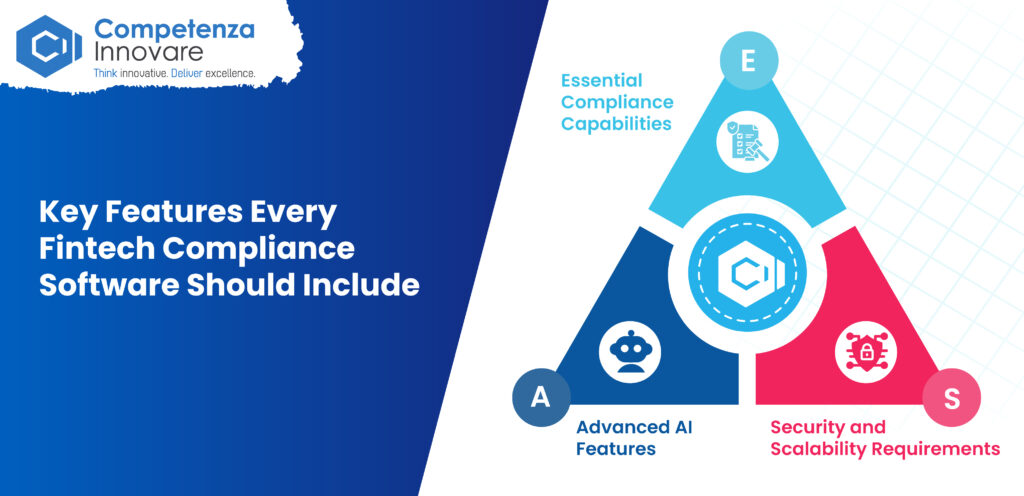
Key Features Every Fintech Compliance Software Should Include
The procedure of selecting the fintech compliance software is essential in regulating the regulatory framework, reducing risks, and improving the effectiveness of the functioning. The modern solutions of compliance should be based on the automation of compliance (AI) applications) and powerful security systems to help fintech businesses develop further.
Essential Compliance Capabilities
Some of the main characteristics that need to be included with each compliance platform are as follows:
- KYC verification powered by AI to onboard customers more quickly.
- Anti-money laundering software to detect suspicious transactions.
- Financial fraud prevention fraud detection systems.
- Risk management tools to evaluate and track compliance risks.
The features help in the compliance of companies and increase security and efficiency.
Advanced AI Features
The following modern compliance solutions will also have to employ AI to improve decision-making and automation.
- Machine learning models
- Predictive analytics
- Automated reporting
- Intelligent workflow automation
The capabilities can guide compliance staff in executing their policies more efficiently and responding to threats in a faster way.
Security and Scalability Requirements
Their compliance solutions are to be secure and scalable as fintech enterprises grow. Important requirements include:
- Protection of sensitive information by encryption of data.
- Fintech applications and third-party integration APIs.
- Scalability of clouds to take care of levels of rising transactions.
- Regulatory contribution in the modification of the industry needs.
These features will consist of compliance, AI, security, and scaling to guarantee that such fintech companies will be capable of guaranteeing effective compliance management and will be able to facilitate further expansion.
Future Trends in AI-Powered Fintech Compliance
As compliance requirements get more complicated, AI will never be unhelpful in aiding fintech firms to reduce risks, prevent financial crime, and improve regulatory compliance. The new technologies have smartened compliance systems and made them proactive and efficient.
The future of AI-powered fintech compliance will be shaped by key trends such as:
- Agentic AI to compliance functions: It is capable of performing autonomous compliance surveillance, supportive intelligent investigations, and supporting compliance staff with automated decision-making.
- Explainable AI in Financial Compliance: that provides greater transparency to the AI-based decisions and helps organizations to establish regulatory trust and promote auditability.
- Real-Time Compliance Intelligence: That enables continuous risk examination, real-time fraud warnings, and dynamically sensitive compliance structures that can respond to the developing risks in real time.
- Predictive Financial Crime Prevention: Predictive is an analytics-based solution that forecasts suspicious activity, the emergence of threats, and advanced compliance management.
As these technologies keep changing and evolving, fintech companies can enhance compliance, develop more risk management, and better secure financial ecosystems as well as ease the burden of manual compliance work.
Discover how AI-powered fintech compliance software simplifies KYC, AML, fraud detection, and regulatory risk management.
The Role of Fintech Software Development in Building Compliance-Ready Platforms
Current fintech implementations would benefit greatly by having solutions that are robust and scalable to perform KYC checks, AML actions, fraud detection, and reporting. Fintech software development helps companies to develop compliance-based solutions that adhere to regulatory requirements and can facilitate business growth. With specific business needs, specialized compliance platforms can be created, which would have more flexibility and grow in accordance with more transactions. The main ones are secure architecture, development with a strong emphasis on compliance, integration of AI, and real-time data processing. An existing fintech software development firm to partner with provides industry and regulatory expertise, as well. Firms such as The Competenza support businesses with the development of AI-based compliance tools, the integration of KYC and AML solutions, and the creation of reliable platforms facilitating the easier handling of compliance and the optimization of workflow.
Conclusion
As regulatory needs are changing, fintech firms require smarter and more efficient means to handle compliance. AI is shifting the compliance in the fintech sector as it enhances KYC verification, AML monitoring, fraud detection, and risk management to allow firms to avoid the manual nature of their compliance duties and better react to risks. Fintech compliance software today allows more rapid customer onboarding, enhanced security, and improved compliance with regulations along with supporting business growth. Investments in AI compliance software and RegTech software solutions can enable organizations to develop more efficient and scalable and future-ready compliance operations. With the help of a suitable vendor of fintech software, organizations are capable of implementing safe and AI-based compliance solutions that help simplify regulatory compliance and gain customer trust.
FAQs
What is fintech compliance software?
Fintech compliance software is a solution that helps financial organizations to manage their compliance process and automate their compliance, as well as reduce risks in the process of compliance management. It usually involves such features as KYC checking, AML monitoring, fraud detection, risk management, and regulatory reporting.
What are the advantages of AI with fintech compliance?
The reason is that AI promotes fintech compliance by automating repetitive processes, transaction tracking, detecting suspicious behavior, and reducing false alarms. This helps companies to elevate compliance effectiveness along with security and risk management.
What is KYC verification powered by AI?
Efforts The AI-driven KYC verification relies on document verification, OCR, facial recognition, and biometric authentication technologies to authenticate customer identities in a short amount of time and with high precision. It assists the fintech companies with the onboarding of the customers with the compliance requirements.
Why is KYC important for fintech companies?
KYC assists fintech firms to confirm the identity of their customers and to thwart identity fraud and minimize the risk of financial crimes as well as to meet the demands of regulatory authorities. Having a robust KYC also helps in supporting safe and smooth customer onboarding.
How does AML monitoring software work?
The AML monitoring software monitors the transactions and behaviors of the customers through a continuous analysis of the transactions in order to determine suspicious activities that can be a sign of money laundering. Pattern recognition, behavioral analytics, and risk scoring are used with AI-powered systems to enhance detection accuracy.
How is AI preventing financial crime?
AI helps in deterring financial crime through real-time operations and finding unusual patterns of activities that are risky as well as warning signs of suspicious activities.
What is RegTech software?
RegTech software solutions are software that is developed to facilitate regulatory compliance through automation. They help companies to monitor compliance, risk management, and reporting and modify regulatory requirements in a more efficient way.
What are the advantages of AI detection of fraud in fintech?
Fintech AI fraud detection can assist companies in detecting fraudulent transactions sooner, minimize financial losses, enhance client confidence, and enhance the degree of security. It is also in a position of picking new patterns of fraud execution that may be overlooked by conventional rule-based systems.
What are the characteristics of the new fintech compliance platform?
The elements of a modern fintech compliance platform should encompass AI-based KYC authentication, AML supervision software, anti-fraud measures, risk management, compliance reporting, audit trails, and compliance automation.
What is the potential of fintech software development to aid compliance management?
Fintech development is a phenomenon that businesses use to develop inner, safe, and expandable accommodation options, including compliance tools and regulations. Risk monitoring is complemented to suit the evolving compliance requirements. This provides more efficient and future-proof architecture of compliance.