

Retailers need more than mere reports in order to stay abreast with the evolving customer demand and market trends. As products travel between stores, warehouses, and the Internet, it is now crucial to have real-time information on inventory and sales. Here is where a retail AI dashboards can enable a company to transform massive amounts of data into actionable data insights.
Other retailers have problems of stockouts, overstocking, non-integrated information systems, and poor forecasting. Such difficulties may result in missed sales, increased costs of operation, and bad customer experiences. With real-time retail analytics, it is possible to monitor the level of inventory, sales performance, and trends within the business in real-time and make quicker and better decisions by the teams involved.
An AI dashboard in retail pulls multiple types of data together: inventory, sales, and operations data. Use with Retail Inventory Intelligence and Retail Sales Intelligence Software retailers are able to enhance demand forecasting, optimize stock levels, and improve their knowledge of customer buying behavior. Consequently, companies are able to be more efficient and profitable and react better to the fluctuating market environments.
This blog will discuss the ways AI-powered dashboards are reshaping the designation of inventory and sales intelligence to enable retailers to make smarter decisions and construct more data-guided businesses.
What Is a Retail AI Dashboard?
Retail companies generate information about sales, stock, and customers and their day-to-day activities. All of this information is united into one area via a retail AI dashboard and utilizes artificial intelligence to provide real-time insight. It helps retailers to track their performance, improve on inventory management, and make timely and informed decisions on the basis of the data.
Understanding AI-Powered Retail Analytics
A retail AI dashboard gathers the information of systems including POS software, inventory websites, and online stores. This data is then processed and analyzed by AI in order to understand the trends, sing out opportunities, and help in making smarter decisions.
However, unlike the old-fashioned reporting instruments, which primarily reflect the past data, AI dashboards in retail give real-time opportunities and predictive analysis, enabling retailers to act in response to the fluctuating demand and business circumstances.
Core Components of an AI Dashboard for Retail
- Sales Tracking: Monitoring the revenues, sales plans, and most sold-out products in real-time.
- Inventory Tracking: It is the process of keeping watch of the counts of stocks at each location to minimize the inventory in order to minimize inventory and stockouts.
- Customer Insight: Learn customer preferences and buying patterns so as to enhance the relationship and purchase.
- Demand Forecasting: AI is able to predict demand in the future and make better inventory decisions.
- Performance Analytics: Index the most important business metrics and obtain insights that can be used to enhance the overall performance of retailers.
A retail AI dashboard can enable retailers to work more effectively and use the data collected in the retail data platform to make informed business decisions, combining sales, inventory, and customer data.
Why Retailers Need Real-Time Retail Analytics
The retail companies require prompt availability of correct data to be at par with the fluctuating customer demand and market trends. Real-time retail analytics assists retailers in monitoring the entire sales, inventory, and performance in real-time and making quicker and smarter decisions.
The Shift from Historical Reports to Real-Time Intelligence
Conventional reports revolve around historical information, and sometimes they are manually updated. The real-time analytics offer immediate information, which ensures a quick response by the retailers to changes in inventory and sales patterns and needs of customers.
Advantages of real-time intelligence:
- Faster decision-making
- Live business visibility
- Reduced reporting delays
- Better operational control
Benefits of Real-Time Retail Analytics
A retail data analytics dashboard can assist retailers in transforming live data into actionable information.
Key benefits include:
- Quick Response to the Market: Perceive the patterns and market changes.
- Enhanced Inventory Visibility: Monitor inventory and reduce stockouts.
- Improved Sales: Keep track of sales and most popular products
- Improved Customer Experience: Have products in stock and fulfill customer expectations
The real-time insight can help a retailer to be more efficient, enhance inventory, and make decisions about the business more effectively.
How AI Retail Analytics Platforms Improve Inventory Management
Good inventory control is key to successful retailing. AI-based analytics can assist the retailer in having more meaningful control of their stock quantities, enhancing planning, and creating more informed inventory choices. Through real-time data and smart prediction, businesses will be able to minimize unproductiveness and have products ready when the customers need them.
Real-Time Inventory Visibility
Retail inventory intelligence gives merchants an insight into the stock situation in stores and warehouses as well as in sales channels. Rather than maintaining stock records by hand, companies are able to have real-time monitoring of inventory and easily locate shortages or irregularities in inventory. This enhanced visibility enables the retailers to have the correct inventory levels and to react to demand more quickly.
Predictive Inventory Forecasting
The AI predicts demand based on customer purchasing patterns, information, past sales history, and trends in the market. This enables retailers to plan the inventory better and strategize against the seasonal fluctuations or alterations in the buying behavior. By forecasting, it becomes possible to make smarter choices about the purchases of businesses and plan the inventory better.
Reducing Stockouts and Overstock Situations
The latest AI inventory management retail systems assist retailers in keeping the appropriate inventory level. Using trend demand reports and inventory flows, AI will suggest the best stock levels and the optimal stock replenishment in a given fixed time frame. This can mitigate the problem of stockouts, which results in wasted sales, and also avoid overstocking, which adds to storage expenses and capital binding.
Through real-time visibility and predictive analytics, AI retail analytics systems enable retailers to enhance the accuracy of inventory and stock levels and establish more efficient retail operations.
Driving Smarter Sales Decisions with Retail Sales Intelligence Software
One of the most valuable resources of retailers is sales data. With the help of retail sales intelligence software, companies can better understand the demands, performance of the product, and revenue trend of the business. This aids the retailers to make wiser decisions to aid growth and profitability.
Tracking Sales Performance in Real Time
Live sales monitoring can assist retailers in knowing what sells and how various products are doing. Retailers are able to rapidly determine the best-selling products and trends in sales and will be able to make decisions about pricing, promotion, and stocproducts and
AI-Powered Revenue Forecasting
Artificial intelligence processes generate forecasts of future revenue based on the sales reports and trends related to the market. The insights can assist retailers in anticipating fluctuations in demand, enhancing planning, and determining those areas that have high growth potential.
Customer Purchase Behaviour Analysis
Customer buying behavior involves the importance of understanding to maximize sales. AI is able to determine buying trends, trendy goods, and the interests of customers. This enables retailers to develop personalized promotions and product recommendations, which enhance the customer engagement and generate additional sales.
All these insights are collected in a single dashboard, and a retail performance dashboard allows retailers to monitor the performance, spot opportunities, and use the data to drive sales.
Key Features of a Modern Retail Business Intelligence Dashboard
The Astute Retail Business Intelligence Dashboard assists retailers to structure information, monitor performance, and make informed choices. Since retailers can store critical business data in a single place, they are able to improve their view of their selling and quickly respond to changes in the business requirements.
Unified Data Integration
The dashboard will connect the data of the different retail systems, which include:
- POS (Point of Sale) systems.
- ERP platforms
- CRM software
- eCommerce stores
This is operational, inventory, sales, and customer views.
Automated Reporting and Visualisation
A data analytics dashboard is a method to automatically convert data into reports and visual data that is understandable.
- Holistic dashboards to serve various business requirements.
- Real-time KPI tracking
- Interactive reports and charts.
- Quick access to business data.
AI-Based Recommendations
AI processes data collected on retail and converts it into knowledge that can help in transforming it into usable data.
- Inventory optimisation recommendations
- Pricing improvement suggestions
- Sales growth opportunities
- Demand forecasting insights
The benefits of combining associated information through the help of AI-based suggestions and automated reporting are the ability to increase efficiency and make more appropriate business decisions.
The Role of AI in Logistics and Retail Operations
Logistics and operations need to be efficient to deliver the products timely and hold the appropriate stock levels. AI in logistics assists retailers to enhance the perceived visibility of their supply chains, optimize inventory flow, and streamline day-to-day operations using real-time data and intelligent ideas.
Smarter Supply Chain Visibility
AI offers more supply chain visibility as it monitors products in warehouses and stores and from customers.
- Real-time shipment tracking
- Better monitoring of warehouse performance
- Faster identification of supply chain issues
- Improved inventory movement visibility
Demand Planning and Inventory Replenishment
AI will analyze sales and demand patterns to help the retailer plan the inventory in a more appropriate manner.
- AI-driven demand forecasting
- Automated inventory replenishment
- Better stock availability
- Reduced inventory shortages
Improving Operational Efficiency
The AI assists retailers in efficiencies of logistics processes and overall performance.
- Reduced delivery delays
- Lower logistics and transportation costs
- Faster order fulfilment
- More efficient supply chain operations
Through AI in logistics, retailers will be able to perform more efficiently in their supply chains, have better inventory management, and develop more efficient retail processes.
Essential Metrics Every Retail AI Dashboard Should Track
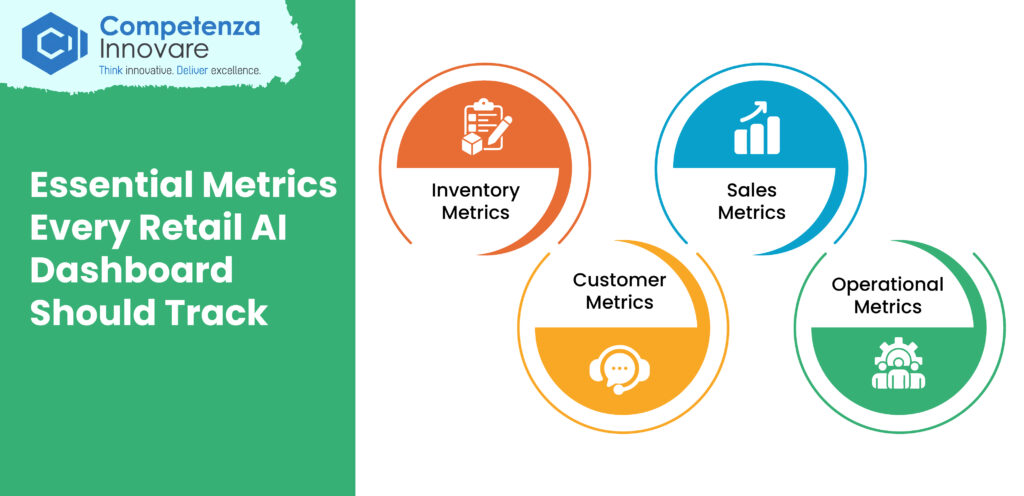
A retail AI dashboard will assist retailers in tracking the most important data to business development. Follow-ups on the key inventory, sales, customer, and operational metrics enable the retailers to have a real-time understanding of the crucial metrics and make superior decisions using relevant data.
Inventory Metrics
The inventory performance is the starting point of Retail Inventory Intelligence. The amount of stock available enables the retailers to always have stock on hand to sell to customers, and the inventory turnover indicates the level of efficiency by which the stock is being sold and replaced. Tracking of stockout rates assists the businesses in knowing about the gaps of inventory, which may result in missing sales and customer dissatisfaction.
Sales Metrics
Sales indicators are effective in giving insights on the performance of the business. Revenue assists retailers to evaluate the overall sales performance, whereas average order value indicates the amount that customers utilize per sale. Measuring sales development assists enterprises in determining trends and performance levels and detecting unexploited opportunities to boost revenue.
Customer Metrics
Customer information will be fundamental to comprehending the purchasing behavior and enhancing customer loyalty. Customer retention is the scrutiny of the rate of the procurement of customers by a business; it is how well the business is able to retain the customers, whereas repeat purchase rate is the query of how many times customers come back to make another purchase. purchase. Customer lifetime value assists the retailers to comprehend the long-term contribution of every customer to business development.
Operational Metrics
Operation efficiency is also monitored through a modern retail performance dashboard. Fulfillment efficiency is the speed at which they receive orders and deliver them, whereas supply chain performance can show the movements of inventory and the logistics. Delivery accuracy can be deployed to ensure that the right products are delivered in time, which helps in the entire shopping process.
By monitoring these metrics using a retail data analytics dashboard, retailers will be able to turn real-time insights into desired customer experiences by being able to better track inventories, make smarter business decisions, and optimize sales strategies.
Business Benefits of Implementing AI Retail Analytics Platforms
An AI retail analytics system helps retailers to put business data into action. These platforms allow businesses to be smarter and more efficient because they will get real-time access to inventory, sales, behavior of customers, or operations.
| Business Area | AI Dashboard Impact |
| Inventory Management | Improved stock visibility and inventory control |
| Sales Intelligence | Better forecasting and revenue growth |
| Customer Experience | More personalised shopping experiences |
| Operations | Increased efficiency and process automation |
| Logistics | Faster and more accurate order fulfilment |
| Decision-Making | Real-time insights for smarter business decisions |
Based on an AI retail analytics solution, retailers will be able to optimize their daily activities, maximize customer satisfaction, and produce green business.
Emerging Trends in Retail AI Dashboards for 2026
Retail technology is developing at a very rapid pace, and AI dashboards used in retail are learning more new capabilities and skills. Data will also be utilized by retailers; however, in 2026, retailers will use it to forecast trends, automate their operations, and provide customers with better experiences, rather than just tracking data.
Predictive Retail Intelligence
Nowadays AI technology can examine the trends in sales and the demand of the customers to predict the future trends. This aids the retailers to improve on planning of inventories, reduce stocking issues, and make viable business decisions.
Agentic AI for Retail Operations
Automated routines to be executed by an agentic AI comprise sales analysis and monitoring inventory. This assists retailers to save time, enhance effectiveness, and react quicker to business modifications.
Hyper-Personalised Retail Experiences
AI helps retailers to get to know what a customer likes and how he or she shops. The insights can be leveraged to provide customer-specific product recommendations and offers that enhance customer interaction.
Unified Retail Intelligence Platforms
An AI retail analytics platform is a modern system that consolidates inventory, sales, customer, and operational data into a single system. This provides the retailers with an overview of their business and enables them to make better choices based on real-time insight.
Retail AI dashboards will enable businesses to enhance their performance by being efficient, optimizing inventory management, and contributing to higher sales performance as AI keeps developing.
Turn retail data into smarter decisions with AI dashboards built for real-time growth and efficiency.
How Retailers Can Successfully Implement AI Dashboard Solutions
A retail AI dashboard will permit retailers to better manage their inventory and sales performance and make smart decisions. To reach the most optimal results, businesses must consider certain simple steps:
- Imbue Particular Goals: Indicate what you wish to accomplish, e.g., you wish to have better inventory management, better sales performance, or smoother operations.
- Link Relevant Systems: Co-locate information within POS, ERP, CRM, eCommerce, and inventory systems to create an overall image about the company.
- Make right data: A dashboard will not perform better than the data it is fed. The proper keeping of the inventory, sales, and consumer details is helpful in establishing credible information.
- Deliver Retail Analytics in Real Time: Retailers have the ability to operate with the real-time data to track the stock amounts and sales trends and react to the demand variations on time.
- Choose a Scalable Solution: Find an existing AI dashboard that is already in use in the retail sector capable of being scaled to the business to support it in satisfying its future analytics needs.
- Action on Insights: Inventory optimization, sales strategies, and customer experiences: With the help of dashboard insights, it is possible to take action.
When paired with quality data, the interrelated systems, and real-time knowledge, retailers could reap maximum advantages of their retail AI dashboard and enhance overall business performance.
Conclusion
AI-powered dashboards that transform the retailer are the future of retail inventory management, sales, and business decision-making. Real-time knowledge enables retailers to have enhanced visibility of stock, better forecasts of demand, and the ability to respond more swiftly to the growing demands of consumers.
An existing retail AI dashboard can help businesses engage in displaying inventory, sales, and operational data in one place, which helps businesses improve efficiency and spur growth. With the increase in retail competitiveness, insights offered by AI will be essential in making smarter and faster decisions.
We are The Competenza, and we assist retailers in creating smart retail solutions, which enhance the efficiency of their inventory management, sales, and operations. Operating in a fast-changing market, using AI and real-time analytics, businesses are able to develop more nimble, data-intensive retail operations and outpace their rivals.
FAQs
What is a retail AI dashboard?
A retail AI dashboard is software that processes a store’s data and presents in real-time the inventory, sales, customer behavior, and business performance in terms of artificial intelligence. It assists retailers to make decisions better and in a shorter period of time.
What is the value of AI in inventory management in retail?
AI enhances inventory control by monitoring the real-time inventory and predicting demand and trends in inventory. This will assist retailers to have optimum inventory and minimize inventory problems.
What is Retail Inventory Intelligence?
Retail inventory intelligence can be defined as a type of application of AI and analytics to track, control, and optimize inventory. It also provides some insights that can be used by the retailers to enable them to increase the visibility of their stocks, minimize waste, and improve product availability.
How does retail sales intelligence software work?
Retail sales intelligence software is software used to collect and analyze sales data to determine trends, measure product performance, and predict future sales. These lessons enable retailers to enhance their sales tactics and increase their revenues.
What is the importance of retail analytics in real-time?
Real-time retail analytics offers sales, inventory, and operational data in real-time. This gives the retailers a quick response to the changing customer demand, market trends, and inventory issues.
What are the measures that a retail AI dashboard needs to measure?
In order to ensure more efficient decision-making, the key metrics that a retail AI dashboard needs to monitor include availability of stocks, inventory turnover, revenues, sales improvements, customer retention, fulfillment efficiency, and delivery accuracy.
What role can AI play in lowering stockouts and overstocking?
It is an AI which uses old sales records, demand rates, and inventories to provide future needs. This assists the retailers in ensuring appropriate stocks are kept and prevents shortages and oversupply of inventory.
What is the value of AI in retail logistics?
Patient AI in logistics enhances supply chain visibility, aids in demand forecasting, real-time tracking of a specific shipment, and optimization of inventory replenishment. This causes efficient retailing and speeds up delivery.
Is it possible that small retailers are beneficiaries of AI retail analytics platforms?
Yes. The small retailers can also achieve a higher visibility of the inventory and sales data, enhanced forecasting, less operational inefficiency, and data-driven decision-making through AI retail analytics platforms without using large teams.
What will be the future of retail AI dashboards?
Predictive retail intelligence, agentic AI to operate retail outlets, hyper-personalized customer experiences, and integrated AI retail analytics platforms, which integrate inventory, sales, and operational analytics into one dashboard, are anticipated trends in the future.