

A single AI assistant is quickly losing favor in businesses that need to perform individual tasks. Now they are embracing multi-agent systems; multi-autonomous AI agents collaborate to plan, analyze, make decisions, and execute tasks as a team. Each agent is able to perform only a designated role, as opposed to having one AI model apply to all steps, thus addressing complex business processes much faster and with greater precisionThis is a collaborative method that is revolutionizing AI automation of workflows. AI-driven autonomous agents have the ability to communicate, exchange information, and manage activities in real-time, enabling organizations to automate end-to-end operations more efficiently. Businesses are working towards applying multi-agent AI to ease the workload of customers and finance to supply chain management and IT operations to produce more decisions and react faster to the evolving requirements of the business.
With increasingly complex enterprise operations, agentic AI solutions are becoming the next business automation. With the coordination of several intelligent AI agents, cleaning up the workflows, augmenting productivity, and creating scalable and intelligent systems, the solutions assist organizations to facilitate smooth workflows, enhance productivity, and create intelligent systems able to carry out business processes over time. Learning the principles of multi-agent system operations is the initial step to unlock the potential of AI-based business processes.
What Are Multi-Agent Systems?
Multi-agent systems are AI models in which several autonomous AI agents collaborate to accomplish a common task. Each agent performs a certain task, e.g., gathering data, processing information, decision-making, or performing actions, instead of an AI performing all tasks.
In contrast to an individual AI agent (that operates without several agents), there is a multi-agent AI where multiple special agents are allowed to communicate, exchange information, and coordinate their efforts. This AI agent partnership will assist companies to achieve more complex workflows with increased speed, accuracy, and efficiency.
With distributed intelligence, the individual agents employ their own expertise but have the same goal. This renders enterprise AI agents perfect in automating customer care, finance, operations, and other business processes to enhance productivity and conduct smarter business automation.
How Multi-Agent Systems Work
Multi-agent systems break down work into smaller units and delegate work to specialist AI agents. They have each one of the agents specializing in a certain duty, and all the agents are able to communicate and collaborate in order to achieve the overall procedure efficiently.
Task Assignment
A workflow starts as a single AI agent is deployed with an objective, like a customer request or a business report. It divides the task into smaller steps and gives the individual step to the suitable AI agent.
Specialized AI Agents
Each agent in the workflow plays a specified role:
- Planning Agent – This is a planner of the steps and process of work.
- Research Agent – Collects the relevant information and data.
- Data Analysis Agent – Analyzes and comes up with conclusions.
- Decision Agent – Interprets results based on which optimal course of action is advised.
- Execution Agent – performs the task approved.
- Monitoring Agent – Monitors the progress and performance and reveals problems.
Agent Collaboration
Successful cooperation between AI agents involves constant contact between the agents. They exchange knowledge and guarantee that the outcome of the other is right, make plans with each other, and monitor the progress of one another. Through collaboration, these smart AI agents have the ability to automate the complex AI business processes with greater speed, precision, and less human involvement.
Why Businesses Are Adopting Multi-Agent AI
Businesses are applying multi-agent AI to simplify complex processes, increase efficiency, and boost decision-making. When applied to the business sphere, the AI agent applications will allow organizations to automate and minimize repetitive work and establish an effective workflow.
- More Rapid Decision Making: Multiple AI agents will communicate to search for data and information and give actions in real time. This helps the businesses to make more informed and quicker decisions.
- Reduced human involvement: Enterprise AI agents enable the automation of manual data entry and document processing, as well as customer service, allowing an employee to work on other more important things.
- Enhanced Accuracy: All AI agents are dedicated to a specific job and reduce errors and increase the business outcomes.
- 24/7 Workflow Automation: AI agents are able to work 24/7, unlike human teams. Constant automation of AI keeps the business processes without breaks.
- Higher Scalability: With the expanded business demands, organizations have an option to add additional AI agents in order to serve higher workloads without necessarily raising the resources or expenses.
- Reduction of Operation Costs: By automating routine operations, the time taken to execute its operations will be reduced, and the costly mistakes will be minimized, assisting the businesses in enhancing efficiency besides reducing operating costs.
Real-World Business Workflow Examples
AI agents in business are being utilized in various industries to automate the business. When implementing AI business workflows, several AI agent development services collaborate to enhance efficiency, accuracy, and decision-making based on autonomous workflow automation.
Customer Support Automation
The customer request goes to a planning agent, where relevant information is accessed by a research agent, and an execution agent gives the response. This cooperation comes with quicker responses and customer satisfaction.
Sales & Lead Qualification
The lead collector gathers lead information, the customer intent agent scores and analyzes customer intent, and the decision agent ranks and scores the leads. Qualified leads can be sent to sales teams at a fast rate and improve the conversion rate.
HR Recruitment
The AI agents search through the resumes against the job requirements, then allocate interviews based on the skills of the applicants. This not only speeds up the process of hiring but also reduces manual screening.
Finance & Invoice Processing
Invoice extraction is done by research agents, data is checked by analysis agents, and payments are executed by execution agents. This minimizes errors and time of processing.
IT Operations
The system issues are detected by monitoring agents, the cause is identified by analysis agents, and fixes or alerts are made by execution agents. This reduces the downtime and enhances dependability of the system.
Supply Chain Management
Stock, project demand, and arrangement of an inventory are tracked by AI agents. Companies are able to escape shortages in stocks and enhance delivery processes.
Healthcare Administration
AI agents handle appointments, check patient records, and handle medical records. This saves time in terms of administrative work and increases operation efficiency.
Insurance Claims
Claim documents are reviewed by one agent, policy details by another, and the claim is assessed by the decision-making agent. The outcome is an accelerated claim processing and increased accuracy.
Marketing Campaign Management
Research agents consider customer data, planning agents devise campaign strategy, and execution agents initiate personalized campaigns. This assists companies to enhance their involvement and attain improved marketing outcomes.
Multi-Agent Systems vs Single AI Agents
One AI agent is appropriate in simple operations, whereas multi-agent AI is applicable in a complex business operation. Teams of autonomous AI agents collaborate to make workflows across the enterprise smarter, faster, and more scalable.
| Feature | Single AI Agent | Multi-Agent AI |
| Intelligence | One AI handles all tasks. | There are several expert AI agents who share tasks. |
| Collaboration | Works independently | AI agents communicate and collaborate in real time. |
| Scalability | Limited for large workflows. | Scales easily with an addition of more AI agents. |
| Speed | Concentrates on a single task at a time. | Multiple agents exist that overlap to render faster results. |
| Automation | Most appropriate in easy or routine tasks. | Automates complicated, customer-to-customer business processes. |
| Decision-Making | According to the analysis of one AI. | Decisions are evaluated, checked, and improved by various agents. |
| Workflow Complexity | Handles basic workflows. | Maintains multi-step and multi-faceted business processes. |
| Enterprise Readiness | Appropriate to small-scale automation. | Developed to automate business and enterprise. |
Multi-agent AI provides more flexible and effective business automation, enhanced collaboration, and flexibility compared to using a single AI agent for organizations wishing to automate highly complicated processes.
Also Read: Agentic AI in EdTech
Core Components of Multi-Agent Systems
An effective multi-agent system is anchored on various fundamental elements that make enterprise AI agents and intelligent AI agents collaborate effectively.
AI Agents
The system is made up of AI agents. Every agent has a designated responsibility to perform a particular task, which can be planning, research, analysis, decision-making, or execution.
Shared Memory
Shared memory enables the access of all AI agents to the same information. This not only keeps all the agents abreast but also provides uniformity in the decisions made within the workflow.
Communication Layer
The communication layer enables AI agents to interact efficiently and provides them with the ability to broadcast updates and coordinate workflows in real-time, preventing any interruptions to the workflow.
Orchestration Engine
The engine of orchestration deals with the overall workflow. It delegates duties to the appropriate agents and follows up and confirms that all the steps are taken in the proper sequence.
Decision Models
Decision models assist artificial intelligence agents to process information, analyze alternative choices, and suggest the most optimal action, according to business policies and accessible data.
APIs & Integrations
A multi-agent system data structure is connected with business applications (CRM, ERP, databases, and cloud platforms) in the form of APIs and integrations in which updated information is received by the AI agents.
Human Oversight
Even though some tasks would be automated with the intelligent AI agents, human supervision remains necessary. Individuals check critical decisions and performance and make sure that the system is operating safely, correctly, and according to business objectives.
Benefits of AI Agent Collaboration
AI agent collaboration allows multiple AI agents to collaborate among themselves, which improves business operations, rendering them smarter, faster, and more efficient. Organizations do not need to depend on one AI system but instead deploy specialized agents that organize activities and enhance their general performance.
- Quick performance: A number of AI agents are operating simultaneously, and that is why the complex workflow is less time-consuming to complete.
- Greater precision: Each agent is oriented to perform a particular task, which can minimize errors and give more precise results.
- Smart decision-making: AI agents process information and convey and offer smart recommendations based on live data.
- Ongoing learning: AI systems improve as they acquire new data, feedback, and previous successful results of work.
- Less human work: Automation of routine and repetitive activities allows workers to concentrate on high-value and strategic activities.
- End-to-end automation: The planning to the execution of tasks AI workflow automation Automation of all processes in the business with a minimum number of manual interventions.
- Enterprise scalability: It is easy to scale the number of AI agents to handle an increasing workload without indicating a serious operational complexity.
- Improved productivity: The more organizations are automated in their workforce and collaborate, the more work might get done in less time, and it might more broadly improve overall efficiency.
Challenges of Multi-Agent Systems
Such challenges are to be addressed when businesses learn to implement enterprise AI agents, as businesses are required to roll out several autonomous AI agents. These issues can be overcome to ensure that the AI operations are safe, trustworthy, and effective.
- Navigating agents: AI agents will coordinate among themselves to avoid duplication of efforts or stalling according to workflow.
- Problems with communications: New agents are unable to exchange information correctly so communication can lead to mistaken information or incomplete work.
- Security: AI must undergo curbs against computer crimes, espionage, and leakage of information and ideas.
- Data privacy: customer and business information that is sensitive must be treated safely and legally following the privacy laws.
- Governance: Organizations should have clear policies to specify how AI agents decide and perform actions.
- Monitoring: AI performance can be monitored, problem identification and the trustworthiness of the workflow can be improved by using monitors.
- Cost optimization: The businesses are expected to use AI to make sure that they receive the most with minimal spending.
- Control of hallucinations: The predictions by AI will be validated to reduce false or null responses.
- Human control: Important decisions and the critical workflow should be under human control in order to be accurate, compliant, and accountable.
Solving these problems, businesses are able to create secure, scalable, and reliable multi-agent systems that create long-term value.
Also Read: Agentic AI In Fintech
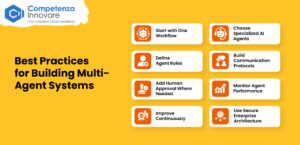
Best Practices for Building Multi-Agent Systems
Implementing proper multi-agent systems is not an easy task that can be achieved without a clear strategy, a clear definition of agent roles, and continuous optimization. Adhering to these best practices can aid organizations in attaining more confident and scalable AI workflow automation.
Start with One Workflow
Begin by automating one of the business processes, such as any of the customer support processes or invoice tracking processes. This will allow you to test, measure, and refine the system and then extend it to other workflows.
Choose Specialized AI Agents
Assign, in particular research, analysis, or implementation, each AI agent plan-wise. Special agents complete tasks more effectively and accurately.
Define Agent Roles
Specify exactly what individual AI agents are expected to do and their inter-agent interaction. Clear roles minimize the confusion and enhance the coordination of work.
Build Communication Protocols
Develop trustworthy communication principles so AI agents will be able to communicate and deliver updates and organize tasks without any delays or disagreements.
Add Human Approval Where Needed
To achieve accuracy of such high-value or sensitive decisions, compliance, and enhanced business control, include human review.
Monitor Agent Performance
Measure performance, response time, and accuracy on track work. Monitoring helps in identification of issues early in the workflow and improving the reliability of a system.
Improve Continuously
Evaluate the outcomes of the workflow, get feedback, and educate AI agents on a schedule to enhance efficiency and fit new business requirements.
Use Secure Enterprise Architecture
To permit long-term business expansion, create your multi-agent system on a distributed, secure, scaled structure with solid access controls, data protection, and tracking of systems.
Future of Multi-Agent AI in Business
The future of the autonomous AI agents will be based on creating smarter, faster, and more interconnected AI business workflows. As AI continues to grow, businesses are going to seek agentic AI solutions to automate some of their more intricate processes and increase productivity.
- Self-programmable AI agents: AI agents will simply get better and more refined as time goes by due to the data and feedback collected about them and previous data.
- Agent-to-agent marketplaces: Companies will have access to and be able to connect specialized AI agents, which cooperate to complete complex tasks across platforms.
- Enterprise digital workforces: Businesses will develop digital workforces of AI agents that collaborate with the employees to automate business processes that are routine and repetitive.
- AI native organizations: More companies will leverage AI to influence their business, and smart automation is part of all business processes.
- Autonomous business processes: AI agents will movingly operate end-to-end processes with minimal human support, making it faster, more agile, and efficient.
- Cross-platform AI partnership: AI agents will communicate with the CRM, ERP, and cloud applications, among other enterprise applications, without a suture, and after that, the business process will be streamlined.
- Industry-specific AI agents: To address the industry-specific dynamics of operations, businesses will use industry-specific AI agents in healthcare, finance, manufacturing, retail, and logistics.
As such innovations keep advancing, agentic AI solutions will assist businesses in creating scalable, secure, and intelligent AI ecosystems that contribute to long-term growth and digital transformation.
Why Businesses Need Agentic AI Solutions
Today businesses require not just general chatbots but intelligent systems capable of automating entire business processes. The agentic AI solutions will assist organizations in creating teams of business AI agents, which collaborate to perform their business functions, including planning, analysis, decision-making, and execution. This enhances efficiency, is less labor-intensive, and automates AI workflows faster.
The agentic AI solutions created by Competenza are used by businesses to develop, implement, and operate enterprise AI agents to integrate with existing systems and facilitate complex business processes. With the secure and scalable AI solutions, organizations will be able to automate their operations, enhance their productivity, and promote long-term business growth.
Conclusion
The multi-agent systems are changing the method by which companies automate and deal with complex workflows. When organizations enable autonomous AI agents to work together, organizations will be able to enhance their efficiency and accuracy and automate AI workflows more efficiently than using a single AI agent.
With the ongoing evolution of AI, any business that goes the route of multi-agent systems will be better-positioned to scale its operations, increase productivity, and make better decisions. It is time to start experimenting with agentic AI solutions and create secure and enterprise-grade multi-agent workflows, which will underpin the long-term business growth and innovation.
FAQs
What are multi-agent systems?
Multi-agent systems are AI systems in which two or more specialized AI agents collaborate towards a common objective. Agents do a certain task, including planning, analyzing, and implementing, which simplifies the process of making complex business workflows more effective.
What is the collaboration of autonomous AI agents?
The AI agents are independent agents that have the ability to share information, coordinate, and check each other in real-time. This type of interaction allows automation of business processes more rapidly and accurately.
What is the difference between a multi-agent system and a single AI agent?
A uniquely defined agent (in one instance of many AI agents) would be defined as a unique agent in a many-agent system, hosting a population of agents, specialized and cooperating groups. It is a multi-user model that enhances the scalability of workflows, their performance, and the ensuing decisions made on complex workflows.
What do you do to automate business with AI agents?
Through the application of AI agents, workflows can be automated by dividing various tasks such as data collection, analysis, decision-making, and execution into specialized agents. This saves the man hours, promotes efficiency, and allows end-to-end automation.
Why is AI agent collaboration beneficial?
Working with AI agents provides a quicker execution of operations, accuracy, smart decision-making, ongoing workflow automation, less manual labor, and greater scalability to scale up a business.
What industries employ multi-agent AI?
The use of multi-agent AI is common in healthcare, financial, retail, manufacturing, logistics, insurance, customer services, and IT operations to automate business operations that are complex.
Can multi-agent systems be safe for enterprises?
Yes, multi-agent systems can be secure when organizations establish high access controls, data encryption, data monitoring, and governance policies to guard business and customer data.
What can businesses do with agentic AI solutions?
The first steps that businesses can take to automate their workflow are to identify a workflow to automate, pick specific AI agents, integrate them with the existing systems, and monitor the performance. Such a strategy enables constructing safe, scalable, and productive AI-agile business processes.