

The successful software product starts with an idea, but in order to make your idea into a product to launch, you need to go through a process of validation and planning. Most of the companies jump into the development without ascertaining whether their idea is technically attainable or places a response to a genuine market requirement. This usually causes unwarranted expenses, delays, and non-adoption of the products. Systematic POC to MVP can be used to mitigate such threats. A Proof of Concept (POC) is created to see how workable an idea is and prove the key assumptions through testing prior to serious development. After validating the idea, the process of developing a minimum viable product (MVP) with the essential functionality, which can undergo testing by actual users, is necessary. This approach can assist the businesses in obtaining feedback, in building on their solution, and in making the decisions driven by data in the development process.
Using the help of professional POC software development services, organizations are able to validate ideas more quickly, recognize technical aspects of obstacles early, and form a proper course of successful product development. A clear roadmap would enable companies to go through the method of exploring the idea, creating an MVP, and eventually launching a product that satisfies their users and business goals.
This blog will touch on the most crucial processes that are helpful in the transformation of a tested idea into a market-ready product, beginning with how the idea is preserved and features are planned and extending to development, testing, and launch preparations.
Understanding the Product Validation Journey
An ideal idea on its own cannot be used to make a successful software product. It is important that businesses first prove their idea to be technically viable and one that fulfills real user requirements before investing in a full-scale development. This will reduce threats, avoid very costly mistakes, and maximize success.
Most software projects fail due to basing them on assumptions and not on actual data. Premature idea testing will help businesses know what issues they will have to deal with, and also they can decide on what they will expect if the product or service is used and reveal this and make decisions before going any further.
In this instance POC software development services and MVP development are needed. A POC (Proof of Concept) can be used to confirm the feasibility of an idea, and an MVP (Minimum Viable Product) can be used to test the idea in real life with users and to collect useful feedback.
Product Validation Flow
Idea → POC → MVP → User Feedback → Product Improvement → Product Launch
Adhering to this product development roadmap assists businesses in transforming proved ideas into products ready to launch with a lot of confidence and reduced risk.
What Is a Proof of Concept (POC)?
A Proof of Concept (POC) is a concept development process that attempts to determine the viability of an idea at a preliminary stage prior to the complete development being done. During the proof-of-concept software development, emphasis lies on testing out the main idea, testing technologies, and ensuring that the suggested solution can operate as required.
The aim of a POC is to help minimize uncertainty and conduct software product validation prior to many resources being spent. Relevant features, integrations, and technical testing help companies to achieve insight into business challenges by knowing the possibility of their business challenges and making sensible decisions in the course of business development.
Goals of a POC
- Validate technical feasibility.
- Test key technologies and integrations.
- Identify potential development challenges.
- Reduce project risks and costs.
- Support stakeholder decision-making.
To determine whether an AI-driven system could analyze patient records according to its purpose, a healthcare startup can test a POC to see whether an artificial intelligence (AI) system can analyze patient records correctly before it reduces its resources to the overall product development. Once the idea has proven to be successful, then the company can proceed with the development of an MVP.
Bypassing the complex processes of desktop testing, POC development services allow companies to trial their ideas with ease and minimize risks, as well as build a larger base of successful software products.
What Is an MVP?
A Minimum Viable Product (MVP) is the simplest prototype of a product that has only essential features to address a given user problem. Rather than creating a full-fledged solution upfront, businesses leverage an MVP to work to validate their idea on the market and derive what actual users think of their concept.
The MVP development process involves releasing at a very fast rate with bare minimum functionality for businesses to make certain that their assumptions are correct and to continuously improve on the actual user feedback. This will help in reducing unwarranted development expenses, and it directs the resources towards features that contribute towards the highest value.
Goals of an MVP
- Test market demand.
- Collect real user feedback.
- Validate product-market fit.
- Attract potential investors.
- Reduce development waste.
Under MVP software development, businesspeople can learn more about user behavior, refine areas of improvement, and make informed decisions (needing the data) and scale the product up. Because it is a cheaper and faster approach to release, minimizes risks, and develops a product that fulfills the needs of the market, an MVP is a common trend among most organizations, especially within the startup MVP development industry.
POC vs MVP: Key Differences
Proof of Concept (POC) and Minimum Viable Product (MVP) are handy in the process of product development but are intended to be used differently. A POC is used to test the technical feasibility of a concept, and an MVP is created to test whether the product will be used by real beneficiaries and whether the market will need the product. The difference allows businesses to select the approach that is appropriate at the appropriate development phase.
| POC | MVP |
| Validates technical feasibility | Validates market demand |
| Internal testing | Real-user testing |
| Technical focus | Customer focus |
| Not customer-facing | Customer-facing |
| Reduces technical risk | Reduces market risk |
Step 1 – Validate Your Idea Through a POC
The first POC-to-MVP thing is to have the capability to prove the concept of the software you are creating. At this point, the business outlines its objectives, enumerates technical specifications, tests key attributes, weighs up the technology stack, and assesses the viability of the solution. This preliminary stage of a software product validation life cycle helps in the limitation of risk, and if any idea is thoroughly supported, then it only moves on.
Benefits:
- Early validation
- Lower development risk
- Better planning and decision-making
Step 2 – Analyze POC Results and Define MVP Scope
After the POC has been completed, read the results to realize what was successful and what needs adjustments. These insights will help figure out what ideas worked, cut down the unnecessary elements, and explain the fundamental functionality to reach the MVP. They are supposed to be focused on solving critical user problems and must be aligned to business goals and technical capabilities.
Focus Areas:
- User pain points
- Business objectives
- Technical limitations
Step 3 – Prioritize Core MVP Features
Only items that are useful to the users should be included in the MVP. The feature focus helps it to stay on track of the development, is cheaper to maintain, and launches at a more rapid pace.
| Priority | Description |
| Must Have | Core functionality needed for the MVP |
| Should Have | Important enhancements that add value |
| Could Have | Features that can be added later |
| Won’t Have | Features planned for future releases |
Benefits:
- Faster development
- Reduced costs
- Better product focus
Step 4 – Design the MVP User Experience
Prior to the development, craft a feel of simplicity for the customers through user journeys, wireframes, UX, and customer workflows. The ideal MVP will launch the product and enable the users to engage with it and provide valuable feedback.
Why It Matters:
A positive user experience increases adoption and engagement and helps to gather valuable insights to become improved in the future.
Step 5 – Build the MVP
The team will be able to start the MVP development process, as the scope and design are already final. The stage comprises backend development, frontend development, API integration, security implementation, and optimization of performance. MVP software development intends to target the development of a working product, which can be validated by the real users within the shortest time possible.
Development Activities:
- Backend development
- Frontend development
- API integration
- Security implementation
- Performance optimization
Step 6 – Launch and Collect User Feedback
After the development, release the MVP and obtain the feedback of actual users. It assists companies to know the interaction of the customers with the product and where they can improve it before launching it on a large scale.
Focus on:
- User behavior
- Feature usage
- Customer satisfaction
- Performance metrics
Key Metrics:
- User retention
- Daily active users
- Conversion rates
- Customer feedback scores
Step 7 – Improve and Prepare for Full Product Launch
The last process involves perfecting the product according to the feedback. This may involve problem solving, usability, application of features requested, scaling infrastructure, and establishment of a marketing plan. Following this product development roadmap, the companies have an easy time going through the transition phase, which is a proof of concept before they introduce a product to the market.
Activities:
- Fix issues and bugs
- Improve usability
- Add requested features
- Scale infrastructure
- Prepare marketing efforts
Goal: Transform the MVP into a scalable, launch-ready software product development that meets user needs and business objectives.
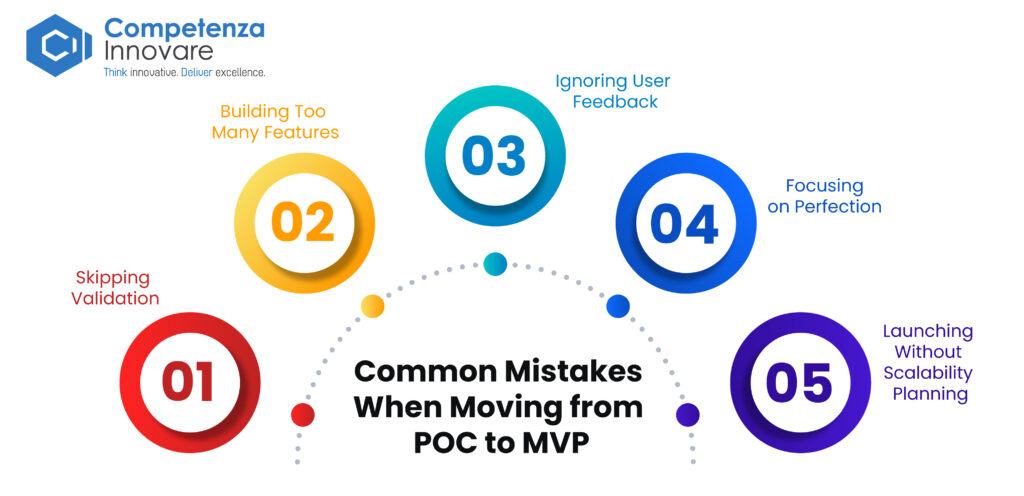
Common Mistakes When Moving from POC to MVP
A POC upgrade to the MVP is a massive slip in the product development cycle. However, many businesses make mistakes, and this could slacken the process, increase costs, and affect the success of the products. These hurdles need to be known in order to make choices that are more productive in the context of developing MVPs.
1. Skipping Validation
This can lead to technical issues and poor-quality products that will fail to fit the market; hence, a hasty move into creating a product without proper software product validation is simply not a brilliant thought. Key assumptions should always be prevaricated by utilizing a POC before going forward.
2. Building Too Many Features
MVP ought to be geared towards solving a deeper problem. Its complexity must be as minimal as possible and the number of features must be minimized because it may likely increase time and costs to develop it and complicate its release shortly and the feedback on it.
3. Ignoring User Feedback
The opinions of the users can provide effective information on what works and what needs improvement. Failure to consider this feedback can result in the creation of a product that is not pleased with by the customers.
4. Focusing on Perfection
The majority of the teams spend a lot of time trying to work out all features before launching. MVP will test the product on real users, and lessons will be learned based on the users and will be enhanced as time goes by.
5. Launching Without Scalability Planning
An MVP that has been successful can draw a higher number of users than anticipated. Lack of scalable architecture and developmental planning can lead to performance headaches on user experience and limit future growth.
By preventing the following pitfalls, businesses can go seamlessly through the transition between the proof-of-concept software development and a successful MVP and minimize the risks involved in the process, establishing a higher base to relocate the products to the market and subsequent expansion.
How POC Development Services Help Reduce Risk
Professional POC development services are an assurance that businesses legitimize concepts before investing in the full-sized development. Early technical feasibility testing enables businesses to discover early the potential difficulty, besides lessening uncertainty and making decisions about developing their product more decisively.
Working with an experienced team implies the availability of experienced technical support and architecture planning and structured validation. This will not only avert costly mistakes but also provide a more concrete foundation to make in the future.
Ready to turn your validated idea into an MVP? Let’s build your launch-ready product together.
Benefits of POC Development Services
- Faster idea validation
- Expert technical guidance
- Better architecture and technology planning
- Lower development costs
- Reduced project risks
- Smoother MVP development process
By using POC software development, companies would be assured that they have the opportunity to go through the stage of idea verification, move into MVP development, and then launch an effective product. Through this method, investment of time and resources is made towards solutions that are technically viable as well as in line with business objectives.
Conclusion
The process of creating a successful software product goes through testing the idea and, subsequently, full-scale development. A Proof of Concept (POC) is used to confirm the technical viability, and an MVP aims at testing the market demand and gathering valuable feedback. Combined, these phases minimize risks, enhance decision-making, and offer a greater base of products to succeed.
Any business can use a POC-to-MVP roadmap to focus on whatever solution will meet the needs of the user and the business needs. Through the assistance of professional POC software development services of The Competenza, companies are able to test ideas more quickly, simplify development, and have confidence in getting an idea out into a launch-ready product.
FAQs
Which is developed first, POC or MVP?
A Proof of Concept (POC) comes before an MVP. A POC is carried out to guarantee that the idea is technically implementable. As soon as the concept has been validated, companies might go to the next phase of developing MVPs to test them with real users and estimate the extent of the demand in the market.
What is the importance of a POC in the development of software products?
The POC will help the businesses test the assumption and ensure the technical feasibility is verified as well as identify potential challenges early in the process of development. This minimizes risk and enhances planning, and the resources are used in ideas that stand high chances of succeeding.
What is the general aim of MVP?
The main aim of an MVP is to launch a product with a few primitive features and get the feedback from the real users. This helps the business to understand the needs of the customers, validate product-market fit and proceed to improve it further by creating a fully functioning solution.
What is the time frame between POC and MVP?
This will be based on the level of the project, guaranteed capabilities, and technical requirements. This is one of the reasons why the overall time can be only a number of weeks or months to get businesses out of a valid POC to MVP.
Can we skip the POC phase in a startup?
Some straightforward products can be simply taken to the next step of developing an MVP, but when it comes to the development of innovative or technologically advanced solutions, startups use a POC. It minimizes uncertainty, and the idea will be proven to be usable before a considerable investment is made into it.
What MVP will feature?
An MVP should be in a position to include the essential features needed to form the solution to the significant user issue. By creating a core functionality, startups are able to build faster, reduce the cost of development, and receive valuable feedback on the use earlier.
How does user feedback improve an MVP?
User responses will provide details on what the customers have been interacting with in the product, what the customers are keen on in the product, and what areas it needs to be improved upon. This data assists teams to refine the product and make decisions based on data to develop it.
What is the benefit of POC software development services?
Professional POC software development services can assist businesses in validating the ideas, testing technologies, and mitigating risks of the technical problems as well as developing a clear roadmap as to what to do next. They also enable faster decision-making and an efficient way of allocating resources.
What is the difference between a POC and an MVP?
A POC will assist in analyzing the potential of an idea development under both technical considerations, and an MVP is a prototype that would be useful to test the market demand and get feedback. These two phases are very essential in mitigating a risk, in addition to improving product outcomes.
What is the advantage of a POC-to-MVP roadmap to improve product success?
A formal POC-to-MVP roadmap can assist companies in checking the validity of ideas and the priority of the correct features and in optimizing development processes and minimizing costly errors. It offers a well-defined channel of verification of the concept and launching of the product, which raises the chances of developing a successful software product.