

Artificial Intelligence is altering the development method of modern software products and can help the companies create wiser, faster, and more personal online interfaces. All companies are investing in AI-Powered Software Product Development to help organizations improve efficiency, innovation and customer interactions with AI-enabled SaaS solutions and AI-enabled chatbots, predictive analytics and business automation solutions.
Unlike the paper-cut applications, where the application is based on the rules stored in it, AI-driven software products can learn data, make choices of their own, recognize patterns and continuously optimize the tasks. Machine Learning, Generative AI, Natural Language Processing (NLP), and AI agents are some of the tools that enable developers to develop smart solutions to solve difficult business problems and provide end users with a more valuable experience.
With the ever-increasing need for AI Software Product Development, developers should know how to integrate AI technologies with scalable software architecture, high-quality data, and the contemporary development methods. It may be the development of recommendation engines, AI assistants, intelligent automation systems, or data-driven business applications, but the achievement of successful AI products does need a tactical and planned approach.
Our guide will cover how to create AI Software Products, the technologies used, how to create an AI-based software product, and the best practices that developers should use to develop an innovative, scalable, and future-proof software solution.
Understanding AI-Powered Software Products
AI is revolutionizing software product production and consumption. Unlike conventional applications, where one has to follow certain rules, AI-based software can also learn and draw conclusions, eliminate duplication, and develop more personalized experiences. Such capabilities enable businesses to be efficient and more customer-centered and create smarter digital solutions. Consequently, AI-Powered Software Solutions are taking over a significant role in contemporary Intelligent Software Product Development.
What Are AI-Powered Software Products?
AI-powered software solutions exploit technologies like Machine Learning (ML), Natural Language Processing (NLP), and Generative AI to process information, comprehend user behavior, and make intelligent decisions. Such applications can efficiently maximize their experience, relying on the data and user interaction.
Core Capabilities of AI-Powered Products
- Learning by Data: Discovers regularities and gets increasingly precise over time
- Predictive Decision-Making: Helps to make better decisions by predicting the outcomes.
- Smart Automation: Automation of business processes and routines.
- Personalization: Delivers personalized recommendations and experiences
- Natural Language Interactions: Powers virtual assistants, smart search and chatbots.
Why Businesses Are Investing in AI Software Product Development
Industrial companies are allocating AI Software Product Development so as to create smarter products, create more efficiency and serve customers with smarter experiences. AI technologies are increasingly evolved, and as companies adopt them, they are generating an increasing number of complex problems using them to streamline and remain competitive in an increasingly digital world.
- Improved Customer Experiences: AI can assist companies in providing more personalized and interactive customer experiences. Analyzing user behavior and preferences allows the AI-driven applications to recommend the relevant and personalized content and provide quicker assistance with the help of conversational AI tools, including chatbots and the virtual assistant.
- Operational Efficiency: A major Advantage of AI-Powered Software Products is efficiency. Robotization can help AI mechanize repetitive processes, decrease the amount of manual workload, and streamline work processes so that teams can work on more valuable business instead of spending on manual tasks.
- Improved Business Intelligence: AI-based solutions can process large volumes of data and transform it into meaningful information. There are predictive analytics and intelligent forecasting that are applied by organizations to help them in defining their trends and consumer behavior and can be employed to make more informed decisions.
- Competitive Advantage: AI enables organizations to become more innovative, expand their products at higher efficiency, and respond to market needs faster. With the help of Enterprise AI Software Product Development, businesses can build intelligent platforms that can help improve performance and customer interaction and build a stronger marketing position.
With AI becoming the main ingredient in the present-day software product, organizations that invest in intelligent technologies are in a better position to spur growth, increase efficiency, and provide long-term business value.
Key Building Blocks of an AI-Powered Software Product
The appropriate starting base will mean a winning AI Software Product Development. An AI-powered product should be built with a brief business objective, good data, and suitable AI technologies and scaled architecture, which can be extended in the future.
Defining the Right AI Use Case
The first step will be defining a business problem that can be solved with the help of AI. This may be improved customer service, automated processes or custom experiences, but the use case of AI must be focused on business goals and user needs.
Building a Strong Data Foundation
Information is a very important aspect of AI applications. The right, viable and efficiently managed data supports the learning process of AI models, developing plausible results, and delivering better results.
Choosing the Right AI Technologies
Machine Learning, Large Language Models (LLM), Deep Learning, and Generative AI are technologies that help software products run data analyses, make predictions, and automate tasks while also creating intelligent user experiences.
Designing a Scalable Software Architecture
Scalable architecture will make sure that the product is capable of serving the increasing users, data and business needs. Strong security practices, API integrations, and cloud-based infrastructure can be used to ensure that the performance, flexibility, and reliability are maintained.
Collectively, these building blocks establish the base to Build Intelligent Software Applications with AI and develop software products into innovative, scalable, and future-ready products.
Recommended to Read: How Much Does It Cost to Build a Software Product
Step-by-Step Process for Building AI-Powered Software Products
The comprehensive insights about How to Build AI-Powered Software Products can only be achieved in a structured manner, which entails a blend of software engineering, data management, and AI technologies. The clarity of the development process assists businesses in developing smart, scalable and reliable software.
Step 1: Define Product Vision and AI Strategy
Defining the clear business objectives and knowing what the users need, this process starts. The companies are supposed to establish the area where AI can add value, be it through automation, personalization, predictive analytics, or better decision-making. This will be achieved through developing a clear strategy that will facilitate the appropriateness of the product in terms of addressing real problems and delivering measurable outcomes.
Step 2: Prepare and Manage Data
Any AI-based application is founded on data. This process will consist of collecting relevant information, data cleaning, data categorization, marking information where it has to be marked, and data storage in a safe place. The AIs’ models rely on quality data to arrive at more accurate and reliable conclusions.
Step 3: Select the Right AI Technologies
The second step entails the choice of technologies that suit the purposes of the product. Machine learning (ML) may be used by developers to make predictions, Natural Language Processing(NLP) to add conversational features, Computer Vision to read and interpret images and Generative AI to generatively create content and automate certain tasks depending on the application.
Step 4: Design and Develop the Product
Having chosen the technology stack, development starts. This will involve achieving a barebones design, a scalable back-end, and integrating artificial intelligence into the application to provide intelligent and user-friendly user interfaces.
Step 5: Train, Test, and Optimize Models
Training AI models should rely on quality data, and this would need to be checked to ensure that all the models are correct and functioning correctly. Testers and optimization also help to increase the level of reliability, reduce possible mistakes, and guarantee the overall performance of the AI-based features.
Step 6: Deploy and Monitor
The Deployment is the final phase of the AI-Powered Software Product Development Method. Once launched, businesses need to continuously measure performance, get user feedback and retrain models where needed and keep accuracy up-to-date as business needs evolve.
This AI Software Product Development Lifecycle assists organizations in creating AI-driven products that are scalable, efficient and able to bring business value in the long run.
The Role of Generative AI in Modern Software Product Development
Generative AI is changing the way the current software products are developed, tested, and refined. Being a major component of generative AI software development, it assists development teams to operate more quickly, establish innovative features and provide better user experiences. Coding assistance and intelligent automation are just a couple of ways that Generative AI is turning into a key part of AI-Driven Software Development.
- Rapid Product Development: Generative AI can also enable a programmer to speed up the product development cycle by providing assistance with code generation, prototyping, and automatic documentation. This enables teams to create and test ideas faster, cutting down on time to develop and speeding up the production time.
- Improving Product Features: Virtual assistants, intelligent search, content generation and AI copilots are also examples of AI-powered features included in many modern applications. These features assist the user to find information quicker, automate it, and stage software more effectively, which provides a more interesting experience.
- Increasing Productivity of Developers: Generative AI decreases monotonous code generation and assists developers in the software lifecycle. It aids in the development, testing, and documentation of code and assists in raising the code quality, increasing productivity, and speeding up the development process.
Still getting better, Generative AI is currently helping companies to produce more intelligent software products as it enables development teams to work more efficiently and introduce new ideas to the market much faster.
Essential Technologies Developers Use to Build AI Applications
The right choice of technologies can define the successful operation of the products based on AI. They fixate on these tools to create extremely smart, high-performing, and scalable applications, be it with machine learning models or with cloud-based and artificial intelligence services. This knowledge of such technologies plays a significant role in How Developers Build AI Applications and provide new software systems.
| Technology | Purpose | Common Use Cases |
| Machine Learning & Deep Learning | Learns from data and identifies patterns | Predictive analytics, forecasting, recommendation engines |
| Natural Language Processing (NLP) | Understands and processes human language | Chatbots, sentiment analysis, voice assistants |
| Computer Vision | Analyzes visual information from images and videos | Image recognition, video analysis, object detection |
| AI Agents & Automation | Automates tasks and business processes | Intelligent workflows, task automation |
| Python | Popular programming language for AI development | AI model development and data processing |
| TensorFlow & PyTorch | Frameworks for building and training AI models | Machine learning and deep learning applications |
| OpenAI APIs | Adds advanced AI capabilities to applications | AI assistants, content generation, intelligent search |
| Cloud AI Services | Supports scalable AI deployment and management | AI Development Company for SaaS Products and enterprise solutions |
It is these technologies on which the modern AI-based application development services are founded that help businesses create more efficient applications, automate processes, and create a better user experience.
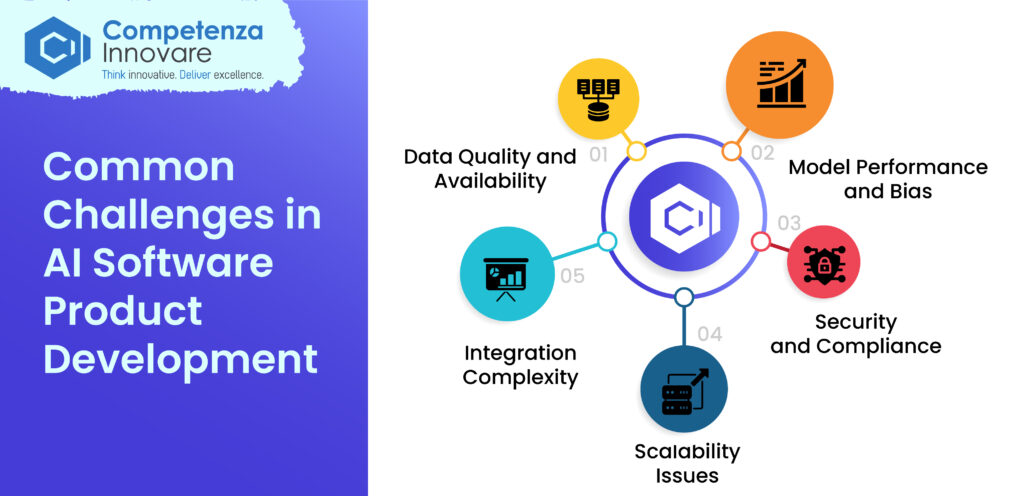
Common Challenges in AI Software Product Development
Despite the promising opportunities that AI has to offer, there are multiple challenges posed by the creation of intelligent applications, too. Such challenges in the development of AI Software Products can inform businesses and developers to come up with more reliable, secure and scalable AI-powered products.
Data Quality and Availability
AI models rely on information to make decisions and learn. Missing or unsuitable data or uneven data can negatively affect the models and produce unreliable outputs. The use of the AI requires quality data to be implemented successfully.
Model Performance and Bias
The AI models should be accurate, reliable, and continuously enhanced. Badly trained models may give biased or wrong results, which impact customer trust and commercial performance. Frequent testing, monitoring and retraining can help enhance performance with time.
Security and Compliance
Most AI-powered applications handle vast volumes of sensitive data. Priorities of businesses should be data privacy, data security and compliance with the industry regulations to ensure that the information of users is not jeopardized and endangers trust.
Integration Complexity
Most systems may be complicated in integrating AI with their existing systems, particularly when dealing with legacy systems or multiple third-party platforms. To achieve seamless integration, it must be well planned to be compatible and perform smoothly.
Scalability Issues
AI applications should be scalable as the amount of user demand and data grows. Successful Enterprise AI Software Product Development depends on infrastructure expansion, managing resources, and optimization of performance.
By focusing on the challenges early in the development cycle, the businesses will be able to create AI-based software products that are secure, reliable, and have the potential to deliver long-term value.
Best Practices for Developing Successful AI-Powered Software Products
Constructing an AI-powered software product goes beyond high-tech technologies. Businesses must observe appropriate development practices to achieve AI solutions that are valuable, scalable, and aligned to user expectations. Such best practices can help organizations to come up with reliable and effective AI Custom Software Development Solutions.
- Begin with Measurable Business Goals: Assign specific goals and performance indicators (KPIs) to make sure that AI activities and business applications move in the same direction as it is stated in the business requirements and performance that should be delivered.
- Bring AI Solutions to Real User Issues: Introduce capabilities that address real customer issues and create value to user experiences, but not AI capabilities without justification.
- Scalable and Flexible Architecture: Does it support applications to serve more users and data and then scale to AI without diminishing performance?
- Build the Best Data management practices: possess quality, safe and organized data to leverage the quality and accuracy of the AI models.
- Represent AI Governance and Security: It is an obligatory component, which will ensure the appropriate level of protection, data safety, and compliance requirements needed to protect confidential information and offer a reasonable degree of AI usage.
- Continuous Testing and optimization of AI Models: Continuous training and testing bring business requirements in line with the model.
- Make AI Knowledge and Software Engineering Best Practices: AI products should be integrated into AI knowledge, software knowledge, and product engineering knowledge.
- Develop with an Agile Approach: An agile process of development: Agile developmental processes are beneficial since they can react quicker, generate constant feedback and be responsive to business and user requirements.
When these best practices are followed, companies can develop intelligent, scalable and high-performance AI-driven software products. A partnership with an already existing AI Product Development Company might also help organizations accelerate the development process, avoid risks, and optimize AI investment.
Ready to build a scalable AI-powered software product? Partner with Competenza to turn your idea into reality.
Why Partner with Competenza for AI-Powered Software Product Development
Competenza helps businesses develop thoughtful, scalable, and even future-ready software products through its end-to-end Software Product Development Services. The pool of AI knowledge and existing development methodologies and cloud-native engineering create solutions that are in tandem with business needs and user requirements.
Being experts in custom software product development, Competenza will assist businesses in the process of developing the product strategy up to integrating and deploying AI. Its creativity, safety, magnitude and rapid delivery orientation will help businesses establish AI-powered software applications that result in growth and long-term benefit.
Conclusion
Artificial intelligence is quickly becoming a fundamental element of contemporary software applications, assisting companies in providing smarter user experiences, automating workflows and making superior decisions. The correct mix of good data, the scalable architecture, and the modern AI technologies is the key to successful AI-Powered Software Product Development.
With the ongoing development of AI, software engineers with a robust knowledge base of AI can create innovative and future-proof solutions. The Future of AI-Powered Software Development is in the development of intelligent applications to respond to the user needs, enhance efficiency, and generate business growth. Companies investing in AI-based software products today will be in a better place to expedite innovation and thrive in a more digitalized world.
FAQs
What is AI-based software product development?
AI-powered software is created by creating software applications via machine learning, generative artificial intelligence, natural language processing (NLP), and automation to automate intelligent behavior, quality decision-making, and user experiences.
How does the process of AI-powered software product development look?
The developers develop AI software products in the following ways: they formulate business goals, prepare quality data, choose appropriate AI technology, deal with the management of scalable architecture, incorporate AI functionality and maintain the products once implemented.
What technologies are available in parallel with the creation of AI software?
The common technologies are sometimes referred to as Machine Learning, Deep Learning, Natural Language Processing (NLP), Computer Vision, Large Language Models (LLMs), Generative AI, Python, TensorFlow, PyTorch, and cloud-based AI services.
What is the effect of generative AI on the software product development process?
Through promoting the growth of users with the help of code generation, prototyping in a fast manner, creating automatic documentation, effective search, virtual assistants, and content creation, generative AI allows teams to create products more productively than ever.
What are the major issues of AI software product development?
The large-scale problems such as data quality, model accuracy, security and compliance needs, interoperability with existing systems, scalability issues, and continuous management of AI models are some of the greatest.
What is the duration to create an AI-powered software product?
This schedule is based on the complexity of the product, features, AI needs and the availability of data. The simplest AI-based product can use a couple of months, and a solution on the enterprise level might take more time.
Why would a business collaborate with an AI product development company?
A seasoned AI product development firm contributes to know-how in AI management, software engineering, data management, and product development. This assists companies to mitigate development risk and speed to market and develop scalable AI-developed software that creates long-term value.