

Legacy applications still serve to support many critical business processes; however, it is likely to cause difficulties as technology is changing and customers are becoming more demanding. Obsolete systems may result in increased maintenance expenses, lack of scalability, security risks, and challenges in integrating with new platforms. Most organizations are modernizing their applications to enhance performance, agility, and future business value to keep up with competition and pursue digital transformation initiatives.
Nevertheless, a successful project of modernization requires more than choosing new technologies. Companies require a proven application modernization partner, one capable of analyzing current systems, designing an effective application modernization plan, and navigating the change process with a minimal amount of disruption. Be it cloud adoption, application re-architecture, better security, or better user experiences, the right partner is a key factor in getting desired results.
Application modernization consulting services and software modernization services are provided by many providers, which makes it difficult to select the most suitable one. Organizations have to take into account criteria like the technical skills, industry experience, cloud capabilities, modernization practices, and support. The guide discusses the choice of app modernization partner, which qualities to consider, and what questions need an answer to make the decision, helping a business develop a good basis to grow and innovate in the future.
What Is an Application Modernization Partner?
An application modernization partner is an expert technology firm that assists organizations to modernize old applications to suit current business and technology needs. With technical knowledge and strategic advice, these partners will evaluate the systems available, design an effective application modernization plan, and advise the path of change. It may be understanding how to move to cloud services, re-architect an application, scale it, or protect applications, but an experienced partner ensures that businesses reduce the certain amount of technical debt that they have, achieve greater scalability, and gain the most out of their modernization investments. Having the right app modernization partner also guarantees the implementation of an effective system of application modernization roadmap to assist in the long-term growth, innovation, and digital transformation objectives.
Why Choosing the Right Application Modernization Partner Matters
Identifying the appropriate application modernization partner is among the key choices in every modernization program. Modernization is usually a complicated process that should be carefully planned and implemented because legacy systems usually provide support to the most critical business processes. With an experienced partner, organizations may elaborate on an effective application modernization approach, match technological updates with business objectives, and create a more straightforward dynamic to newer platforms.
Reducing Modernization Risks
The application modernization projects may have technical issues and integration complications as well as issues related to data migration. An effective partner will minimize them to the early detection of possible problems, eliminating expensive project delays, cost management, and minimizing business interruption to day-to-day activity.
Accelerating Digital Transformation
The appropriate partner contributes with tested expertise, advanced technologies, and best practices in the industry to the project. This allows organizations to implement new technologies more promptly, enhance their work efficiency, and respond more timely to market needs. Due to this, companies will be able to speed up the pace of their digital transformation and become more agile in general.
Maximizing Long-Term ROI
In addition to the finalization of the modernization project, an appropriate enterprise application modernization organization is aimed at providing a long-term value. Modernized applications are more likely to be less maintenance-intensive, more effective in performance, and scale even better as the business grows. This assists organizations to save on operating expenses, enhance system reliability, and leverage investments made in modernization.
Define Your Application Modernization Goals Before Selecting a Partner
Businesses need to articulate their modernization goals and expectations before they do select the application modernization partner. There are also unique issues in every organization, and unless there is a direction, the modernization process might be expensive, time-consuming, and difficult to control. A clearly defined application modernization strategy will be used in order to make sure that the modernization efforts meet the business needs, technology needs, and growth plans.
Identify Business Objectives
The initial one is to have knowledge of what the business would like to accomplish under the modernization. The most common are enhancing customer experiences, raising operational efficiencies, lowering the cost of maintenance, supporting the performance of applications, enabling scalability, and hastening digital transformation. Setting out these objectives assists in organizations concentrating on the accomplishments that bring actual business value.
Assess Existing Legacy Systems
In any modernization approach, the first step is to assess all the current applications with the aim of identifying the ones that require modernization. Limits on technology, technical debt, security vulnerabilities, performance concerns, integration difficulties, and infrastructure dependencies should be assessed by organizations. Knowing the legacy system’s current condition assists in knowing which applications to address first and the modernization strategy that will be most beneficial.
Establish a Modernization Roadmap
A structured application modernization roadmap offers a distinct outline of modernization objectives. It ought to give brief gains in the short term, transformation goals in the long term, project priorities, resource needs, and anticipated results. Focusing their modernization efforts on the impact on business and technical requirements permits organizations to diminish risks, enhance decision-making, and have an easier changeover to modern, scalable, and future-ready applications.
Key Qualities to Look for in an Application Modernization Partner
The success of your modernization program can be largely defined by the selection of the appropriate app modernization partner. The perfect match is not only with someone who possesses the technical skills to modernize old applications but also can focus the modernization process on business interests. When comparing the providers, the organizations must consider experience, strategic abilities, technical expertise, and scalability skills to make sure that they choose a legacy application modernization partner that induces quantifiable outcomes.
Proven Legacy Modernization Experience
One of the greatest things to be considered is experience. An experienced modernization partner of a legacy application must demonstrate an effective history of modernization of complex applications in different sectors. Reading of case studies, client success stories, and previous projects may assist organizations in evaluating the capability of the partner to handle the contemporary modernization problems, minimize the risks, and achieve successful results.
Strategic Consulting Capabilities
The ultimate modernization begins with a proper plan. Major suppliers of application modernization consulting services offer detailed evaluation of current applications, determine modernization opportunities, and design a personalized modernization strategy of applications implemented depending on the business and technical needs. This business tactic assists organizations to prioritize activities, allocate resources efficiently, and get the most out of their modernization investments.
Strong Technical Expertise
An effective modernization initiative involves skill in the modern technologies and cloud applications along with enterprise development practices. The partner must have experience in cloud migration, refactoring of applications, re-architecture of applications, API integration, automation, and security improvements. High technical abilities aid in ensuring that the applications are modernized effectively and enhance performance, reliability, and scalability.
Scalability and Future-Readiness
Modernization must be in line with the present and future requirements of business. An established enterprise application modernization customer base deals with the development of flexible, scalable, and future-friendly solutions, which can be extended with new technologies and with the demand of the market. This can be achieved through companies concentrating on scalability and innovation such that they can reduce their technical debt, improve operational agility, and offer a strong foundation for future growth.
Evaluate Cloud and Technology Modernization Capabilities
Any modernization effort hinges on how well a partner can collaborate with the current cloud platforms, cloud architecture, and cloud development practices. In assessing an application modernization partner, businesses must check the ability of these partners to provide quality cloud application modernization services and software modernization services that enhance scalability, performance, and long-term business agility.
Cloud Migration Expertise
An experienced modernization partner must be able to demonstrate that they have worked on planning and executing cloud migration projects. Key capabilities include:
- Experience with AWS, Microsoft Azure, and Google Cloud.
- Migration plans and cloud preparedness.
- Protected and uninterrupted migration of the workload.
- Timely cloud infrastructure optimization and cost control.
- Skills in a multi-cloud and hybrid deployment.
Application Re-Architecture
Old applications usually need architectural transformations in order to accommodate new business needs. Find somebody who can:
- Rewrite monolithic applications into microservices-based applications.
- Enhance scalability and flexibility of the application.
- Facilitate quicker releases and updates of features.
- Support cloud-native development approaches.
- Increase the performance and reliability of applications.
Application Refactoring and Replatforming
All applications do not require being rebuilt. The experienced partner would be able to:
- Upgrade old code; do not break overall functionality.
- Enhance performance and maintainability of applications.
- Minimize technical and operational complexity.
- Prolong the life of business applications.
- Choose the most affordable way of modernization.
DevOps and Automation Practices
Modernization cannot be successful in the long run without practices of modern development. Assess the provision of:
- CI/CD pipeline implementation.
- Automated checking and quality control.
- Ability to perform infrastructure as code (IaC).
- Continuous supervision and performance monitoring.
- Faster and more reliable software delivery processes.
Through assessing these capabilities, the businesses can find an enterprise application modernization company that is capable of delivering an application modernization strategy, cloud adoption, and long-term value through modern, scalable, and future-ready applications
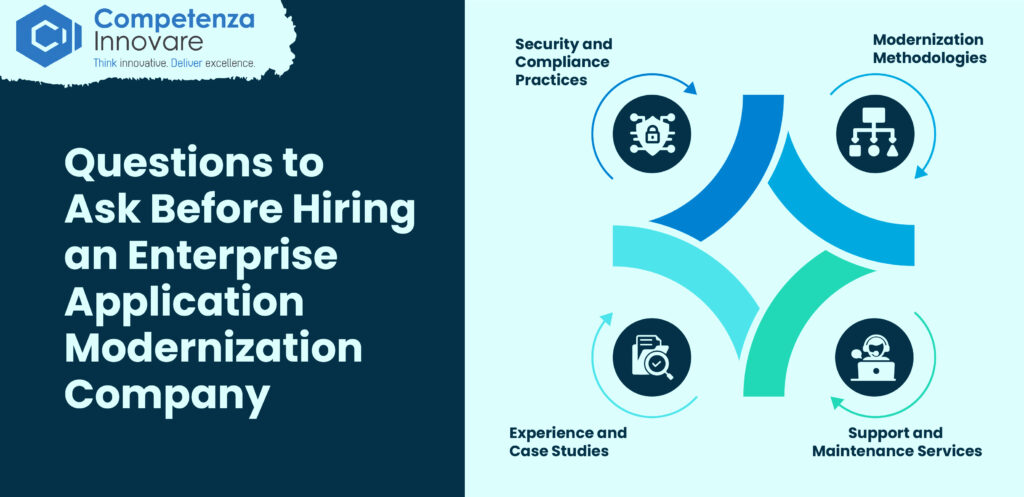
Questions to Ask Before Hiring an Enterprise Application Modernization Company
When it comes to deciding on an enterprise application modernization company, it is not just about service offerings and technical capabilities. By posing the right questions during the evaluation process, organizations can know about a partner who has experience, expertise, and support required to make the modernization journey successful. A provider is also likely to demonstrate suitability as to how well they can meet your business goals, technical needs, and long-term development strategies through these discussions.
Experience and Case Studies
The past history of a partner can give us a good idea about his or her ability. Consider asking:
- Have you completed similar application modernization projects?
- Do you have some case studies or stories about a successful client?
- What industries have you worked with?
- How do you handle complex legacy application environments?
Past projects can also be helpful in establishing whether a company possesses experience that will enable it to handle your individual modernization issues.
Modernization Methodologies
Each of the applications needs its approach to modernization. Ask potential partners:
- Which modernization strategies do you recommend and why?
- Do you offer rehosting, refactoring, replatforming, re-architecting, or rebuilding services?
- How do you determine the most suitable modernization path?
- How do you minimize risks during the modernization process?
- How to modernize a monolithic application with microservices?
Their responses can enable you to determine their strategic planning skills and technical prowess.
Security and Compliance Practices
Security will have to be a key element in any modernization project. Important questions include:
- What data protection measures do you implement?
- What do you do about application security risk?
- What are your compliance standards and regulatory requirements?
- What is your secure migration and modernization to the cloud?
A security focus will help in the securing of business-critical systems and sensitive information undergoing transformation.
Support and Maintenance Services
Modernization, and not after the deployment, takes care of it. Ask about:
- Post-modernization maintenance and support schemes.
- Monitoring of applications and performance optimization.
- Continuous security improvements and polishes.
- Future scalability and upgrade support.
The partner in modernization must also offer long-term respite to make sure that applications are safe, productive, and aligned to the changing business requirements.
Common Red Flags to Avoid When Choosing a Modernization Partner
The selection of an application modernization partner is a paramount step that can either influence or not influence the ultimate success of your modernization project. Although several providers advertise full-service legacy system modernization offerings, not everyone possesses the skills, procedures, or resources to achieve effective outcomes. Prompt identification of the possible red flags will also help organizations reduce threats, avoid the expensive losses, and keep their application modernization strategy on track.
- Absence of Modernization Framework: A reputable enterprise application modernization firm ought to have a transparent and well-organized process of modernization. The inability of a provider to describe processes of how they evaluate applications, prioritize loads, create an application modernization roadmap, and handle implementation may reflect low experience or application of inconsistent practices in the delivery process.
- Poor Cloud Expertise: Cloud adoption and modernization frequently coincide. An unexperienced partner who has not worked with AWS, Microsoft Azure, or Google Cloud or cloud application modernization services would be inept at designing scaled solutions and future-ready ones. The organizations seek to find established experience of cloud migration and cloud-native modernization.
- No Security-First Approach: Security is supposed to be incorporated in all areas of the modernization process. Providers who ignore the concept of secure code and compliance measures, safeguarding data, and risk control can leave essential applications and sensitive data at the mercy of unwarranted risks.
- Lack of Communication and Transparency: There should be a modernization process that is in collaboration and transparency. Partners are bound to provide timelines, periodic progress reports, realistic expectations, and reports. Successful communication can lead to confusion, delays, and escalation of costs as well as project guesses.
- None of the Long-Term Support Strategy: It is not enough to stop being modernized once it is deployed. Utilizations need to be monitored, optimized, maintained, and updated with security. An effective software modernization partner must also provide sustained support in a bid to enable companies to obtain the best out of their modernization investment and address the subsequent changes in technology.
By steering clear of such red flags, organizations will be able to select a partner to help them modernize that is more prepared to provide secure, scalable, and sustainable modernization results.
Benefits of Working with the Right Application Modernization Partner
The collaboration with a seasoned application modernization vendor can also make a substantial contribution to the success of your modernization strategy. In addition to modernizing old systems, the appropriate partner assists organizations to match technology investments to business objectives, mitigate project risks, and accelerate digitalization initiatives. Businesses can gain quicker outcomes by engaging professional consulting services for the modernization of applications and software with the ability to have a better base for future expansion.
Faster Modernization Timelines
A professional partner introduces well-tested methodologies, techniques, and organization into modernization projects. This assists in minimizing delays in implementation, enhances the efficiency of projects, and increases the rate of the transition of the legacy systems to the modern application.
Improved Application Performance
The applications are modernized to provide improved speed, reliability, and user experiences. Organizations can optimize their system’s overall performance and efficiency of operation through optimization of application, architecture, and development practices that are more recent.
Enhanced Security and Compliance
The right modernization partner incorporates security best practices throughout the modernization process. These involve enhancing security of data, improving vulnerabilities, deploying secure architectures, and assisting organizations in complying with requirements based on industry-specific compliance.
Reduced Technical Debt
The legacy applications tend to add technical debt as time goes by, thus becoming hard and expensive to maintain. Modernization assists in getting rid of outdated technology, eases the administration of applications, and minimizes persistent maintenance issues, enabling a team to concentrate on innovation as opposed to the continuous needs of maintaining a system.
Greater Scalability and Agility
One of the major benefits of modernization is the possibility to facilitate the development of business in the future. The development of modern applications is oriented at this concept of scalability and flexibility that enables organizations to respond faster and adapt to the current market demands, introduce new technologies, and respond more effectively to new customer demands.
The presence of an established modernization partner can offer businesses an opportunity to optimize the value of their modernization investment and improve their performance, security, and scalability, as well as sustainable operation.
Future Trends Shaping Application Modernization in 2026 and Beyond
Businesses need to embrace a progressive application modernization strategy in order to stay competitive and enable future expansion due to the current technological development. Recent and new technologies are transforming the modernization of legacy systems by organizations as well as enhancing their operational efficiency and increasing the pace of digital transformation. These are the trends that are likely to influence the future of application modernization.
- AI-Assisted Application Modernization: AI-based applications can be employed to analyze the legacy applications, automate modernization, trace failures within the code, and accelerate the decision-making process, making the decision-making process more efficient and compatible with each other.
- Cloud-Native Development: Cloud-native architecture, microservices, and containers are becoming increasingly popular with companies in order to scale, flex, and perform better in applications with services demanded by organizations adapting services to the cloud rapidly.
- Platform Engineering: Businesses are investing in platform engineering to integrate the process of developing software across teams, deepen their collaboration, and accelerate the pace of a software delivery process.
- Intelligent Automation: Automation is helping businesses automate testing and deployment and monitor and manage infrastructure, eliminate manual effort, and improve operational efficiency.
- Composable Architectures: Modular and reusable software systems assist businesses in better responding more swiftly to shifting needs, unleashing technology, and thus bringing about new innovations.
Using these tendencies, the organizations will be able to develop modern, scalable, and future-oriented applications that are able to leverage long-term business success.
Why Businesses Need a Strategic Application Modernization Roadmap
A detailed application modernization roadmap is used to modernize legacy systems in a methodical and effective manner. Businesses, rather than changing things massively, can do it step by step to minimize risks and costs, as well as operational disruptions.
An efficient application modernization plan also helps to make sure that the modernization projects are aligned with business objectives, whether the idea is to improve performance, to increase security, to make it more scalable, or to enable the digital transformation. Having the priorities and the objectives that are being measured, the organizations will be able to track progression and assess the success of the modernization efforts.
Through collaboration with a proven provider, such as Competenza, companies would be able to create a strategic roadmap that allows them to grow in the long term and optimize the value of their investments in modernization.
Conclusion
Modernization of the applications is not the upgrade of the technology but rather a plan towards the future of your business. Selecting an appropriate application modernization partner guarantees a legacy system is transformed effectively, safely, and with the least amount of disturbance. Through experience assessment, modernization skills, cloud skills, and long-term support, organizations will be able to make sound decisions that will enhance their business goals. An intensive application modernization plan, along with a definable roadmap, assists the enterprises to enhance operations, become more scalable, cut knowledge of technical debt, and remain afloat in the changing digital environment. The appropriate partner will be able to transform the modernization challenges as a long-term growth and innovation opportunity.
FAQs
What does a business want in an application modernization partner?
An offering of recent experience, high technical expertise, capabilities to execute cloud migrations, awareness of security, and systematic modernization strategy should be sought by businesses. The appropriate partner must be knowledgeable of business goals and offer structural assistance to meet successful modernization effects too.
What is the importance of application modernization in organizations?
Application modernization assists organizations to enhance the performance of applications, improve security, decrease technical debt, improve scalability, and promote digital transformation initiatives. Modernized applications can be more likely to fulfill the changing demands of business and customers.
What do I consider in an enterprise application modernization firm?
Enterprise application modernization companies that an organization needs to evaluate include its project portfolio, industry experience, modernization methodologies, cloud capability, and security practices, as well as post-modernization support services. Cases and client references can also be reviewed as a means of ability assessment.
What are the most used ways of application modernization?
Rehosting, refactoring, replatforming, re-architecting, and rebuilding applications are some of the typical modernization strategies. Strategy would be the most suitable and depends on the business objectives, complexity of application, budget, and long-term technology needs.
What is cloud knowledge, and why is it important when choosing a modernization partner?
Expertise in the cloud is needed, as some of the modernization projects may entail transferring the applications to the cloud. When having an experienced partner in the spheres of AWS, Microsoft Azure, and Google Cloud, one will be able to optimize scaled-out, flexible, secure, or efficient operations.
How does an application modernization strategy contribute to project success?
An application modernization strategy provides an effective change direction and creates goals, priorities, time frames, and results to be achieved. It helps organizations to reduce risk and align technology investment with business goals and achieve better modernization results.
How does modernization of applications help reduce technical debt?
Modernization replaces the outdated technologies and improves the simple codebase and architecture of the applications themselves, rendering them easier to maintain and upgrade. This lessens technical debt, lowers the maintenance expenses, and guarantees higher reliability of the systems.
What are the advantages of an experienced application modernization partner?
A proper app modernization partner can help to reduce the timeline of a project and simplify it. applications, streamlining applications, strengthening the risk of security, supporting cloud migration, reducing modernization risks, and helping organizations achieve the optimum ROI on their modernization investment.
How long is the average time of application modernization?
The timeline is based on the complexity of the applications, the extent of modernization, and the technological requirements as well as the approach to modernization adopted. Larger projects can also require many years, and smaller ones can be resolved within several months.
What are the measures of success of application modernization in businesses?
The key performance indicators that can be used to measure success include better application performance, less maintenance of the application, enhanced application security, shorter lifecycle deployment times, enhanced scalability, better user experience, and efficiency of the entire business.