


Software development is not cheap, and to most companies, it is increasing at an alarming rate. The salaries of developers are increasing in all the major markets. The expenses in the cloud infrastructure grow quicker than anticipated by the finance team. The fact that in many projects the budgets are overrun with a certain regularity has turned into some sort of a norm. The pressure to reduce custom software development costs is real and persistent for startups that attempt to stretch a seed round, as well as enterprises that manage multi-million dollar technology portfolios in both cases.
The good news is that the majority of software projects do not get into the red since the cost of development is always unaffordable. They spent more money due to an unnecessary decision scope that was not well defined, testing that was not done until it became costly, technical debt that kept on multiplying over the years, and needlessly larger teams than the work actually needed. The initial step in software development cost optimization and reducing development cost without the quality compromises that make short-term savings worth long-term liabilities is to understand where the costs originate.
Understanding What Drives Software Development Costs
To optimize a software development budget, you must have a clue as to what is actually driving the spend. The roots of most of the cost overruns can be attributed to the same six factors.
Project Complexity
The harder such a system is with regard to integrations, data structuring, data security requirements, and business logic, the greater the time and cost of building the system. It is a cost of doing business to introduce complexity that is actually required. The cost that ought to have been avoided is complexity that arises due to the lack of someone questioning the need for a given feature or an integration.
Feature Scope
The largest driver of software development cost in most projects is feature scope. Each element included in a backlog reflects the development time, testing time, documentation, and maintenance. Scope increase not based on commercial reasons, often referred to as “scope creep,” is the cause of an out-of-sport proportion of cost increases throughout the industry.
Team Size and Expertise
Smaller teams are not necessarily cheaper than larger teams; they might simply require more time to deliver at the same quality, pushing the overall cost more. The correct team size on your project and the correct seniority makeup are software cost management decisions that can be paid back in the entire development life cycle.
Choice of Technology Stack
The implications of technology options extend past the hourly programmers’ costs far out into the long term. A technology stack that has a low talent pool is costly to recruit as well as maintain. The rate of technical debt of legacy technologies exceeds the rate of modern alternatives. Early decisions made in regard to cloud infrastructure may result in cost architecture that is challenging to modify afterwards.
Infrastructure Costs
One cost line that is most underestimated during the software project budget planning is cloud infrastructure. Storage, compute, egress, third-party API, and monitoring all add up, and they increase with usage in a way rarely well-captured by initial cost estimates.
Maintenance and Support
The software is not the only expense at launch. Maintenance and security patch development can cost 15–25 percent more than the initial build annually, plus performance monitoring and an increase in continuing development. One of the best payback cost-cutting strategies is building it long-term with an in-mind maintenance cost in the form of clean architecture, good documentation, and automated testing.
Recommended to Read: How Much Does It Cost to Build a Software Product
12 Proven Ways to Reduce Software Development Costs Without Cutting Quality
1. Define Scope Rigorously Before Development Begins
The optimal software development cost optimization strategy is not the most exciting one; the least exciting is defining what you are building before you start building it. A thoroughly examined, reviewed, and signed scope document does away with the most usually encountered source of budget overrun work that was not defined in the initial estimate.
Delay the coding to at least a requirements analysis, user story mapping, and stakeholder alignment. Each hour of this phase would save several hours of costly waste of time later.
2. Build an MVP First
The MVP approach is among the most potent low-cost software development strategies that can be used when dealing with new products and major new features. Instead of creating the entire vision initially and possibly getting it false, create the bare minimum that enables you to test your major assumptions on actual users.
The savings in the development cost of the MVP are achieved on two fronts at the same time: you pay less to create the first version, and you save money by not wasting time creating a feature that proves to be non-essential. The experience with an MVP nearly always leads to improvement of the end product at much less total cost than developing the full vision first.
3. Choose the Right Engagement Model
The choice of a fixed-price or time-and-material contract has a major implication on the optimization of a software development budget. A fixed price is used to hedge against vendor overruns in well-defined projects. Time and materials provides flexibility against changing requirements but does not incur the risk buffer that vendors include in fixed-price bids due to uncertain scope. The wrong model of your type of project is the usual and preventable cost driver.
4. Right-Size Your Development Team
Optimization of the cost of development teams begins with you being straightforward with what is required by your project. A large team imposes a coordination overhead and inefficient communication, slowing down delivery and making it more expensive. A small team has bottlenecks that expand timelines. The correctly sized team with a suitable seniority profile is nearly always less expensive on a total basis than the team that was formed on the basis of availability, not necessity.
5. Leverage Outsourcing and Nearshoring Strategically
Software outsourcing is also one of the most direct methods of reduce software project costs, especially to businesses located in markets that are high cost, such as the US, UK, Western Europe, and Australia. Eastern Europe, Southeast Asia, Latin America, or India can deliver considerably lower hourly rates, but not quality, without a commensurate decrease in quality so long as the vendors are chosen and managed appropriately.
The word is strategically. Cost optimization is not to outsource core product architecture or security-critical systems to the cheapest vendor possible but to create risks. The right outsourcing model is the alignment of the engagement model, the capability of the vendor, and the structure of communication to the type of work being outsourced.
6. Implement Automated Testing Early
One of the most dependably measurable cost savings within software development is QA automation savings. Manual tests are costly, time-consuming, and erratic. Automated test suites are faster and more frequent and detect regressions earlier when the cost to fix remains minimal. Initial investment in test automation infrastructure can usually pay back in three to six months in any project where there is significant ongoing development velocity.
Automation is not the end of the cost argument of early testing. Incidents encountered during development cost less than those encountered in the post-release stage. One of the most frequently used agile software development cost errors, delayed testing, always increases the overall project cost by focusing on qualitative issues at the most costly phase in the lifecycle.
7. Address Technical Debt Proactively
Technical debt refers to the discounted price of quick-hack code, architectural choices that were made based on less than complete information, and dependencies left uncleaned up. Technical debt increases when not managed. It features that will take one week to take three. Months are spent by the developer of new code that should have been self-documenting. The libraries are languishing with security vulnerabilities, which should have been patched several years ago.
Reducing technical debt is non-glamorous yet among the most beneficial returns in software management cost reduction. A 15-20 percent allocation of every sprint to reducing technical debt keeps the codebase in good health and avoids the cost explosion that code that fails to address technical debt brings.
8. Use Open-Source and Third-Party Components
Construction needs no more costs than doing it by hand. The available open-source libraries, third-party APIs, and SaaS components span a vast array of functionality that would require a lot of development effort to replicate. Authentication, payment processing, email delivery, search, analytics, and mapping are all mature, well-supported third-party services that can be incorporated in days, not weeks, to build.
These cost savings are a reality, but with strings attached to them; all third-party dependencies are maintenance commitments. Whether business-critical, select components with active communities, visibly licensed, and commercial support options.
9. Adopt Agile Development Practices
Agile software development cost benefits are also well-documented. Iterative delivery is the process of delivering working software at the conclusion of each sprint, which provides clients with the capability to do course correction prior to committing to a major budget to an erroneous direction. Misalignments are picked up at the earliest stage through Sprint reviews. Backlog prioritization makes sure that the richest work is accomplished first so that when the budget is depleted, the product can still provide its fundamental value.
Agile also generates more visibility of costs than waterfall. Burn rate, velocity, and backlog size provide clients with an ongoing, precise view of project stage finances instead of budget shock that waterfall projects generate upon review of the milestones.
10. Implement DevOps and CI/CD Pipelines
DevOps and continuous integration/continuous deployment processes lower software development costs in multiple ways at once. Automated build, test, and deployment pipelines minimize the amount of manual effort that is required in each release cycle. Quick release cycles imply quicker feedback, implying that issues are detected and addressed earlier. Infrastructure as code minimizes the provisioning time and error rate of environments and configuration management.
To businesses especially, DevOps investment is among the most commercially viable technology investments available, with continuous demonstration of cost reduction in release, defects, and time to market.
11. Manage Scope Changes Formally
No one factor in cost management of a software project has more often been seen to contribute to the budget overruns than scope creep. What seems little by little, a new field here, a new integration there, and a new revised workflow soon access an amassed flaw, as not seen in budgetary predictions often until too late.
Formal scope management does not imply refusal to change. It entails putting the cost of change into sight prior to its consent. Any change request must be estimated, documented, and approved by an individual who has the budget authority prior to development. This one discipline averts most unexpected cost development in complicated software projects.
12. Invest in the Right Architecture Upfront
The decisions in architecture during an early phase of a project are the hardest decisions to alter. A single architecture that is not scalable needs an expensive re-architecture as the load increases. Inadequate database design leads to performance issues, which cost to refactor. Retrofitted security architecture introduces vulnerabilities and compliance costs instead of being built with appropriate design.
Hiring skilled software architects at the outset of a project despite the temptation of a cost-constrained budget is actually shown to lead to a lower overall cost of the project by avoiding the structural issues that can be the cause of the most costly rework.
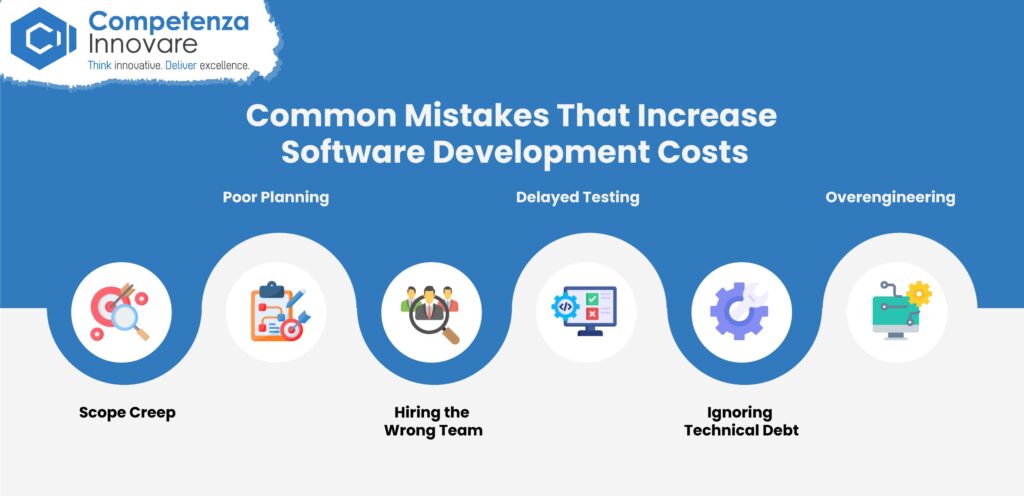
Common Mistakes That Increase Software Development Costs
Scope Creep
The fact of uncontrolled scope increase is the most frequent and fairly avoidable cost driver in software development. Functionalities that are implemented without formal change management, requirements that creep without budget reallocation, and requests by stakeholders that sideline the prioritization process all lead to projects that are delivered late and at higher costs.
Poor Planning
Poor requirements definition, rosy estimation, and lack of risk assessment at the start of the project generate cost surprises in the process of delivery. The planning phase is not overhead; it is the highest payoff investment in the project.
Hiring the Wrong Team
The wrong team is not cheaper than the right team; the wrong team is more expensive than the right team. Onboarding time, rework, and results in a slower delivery are all costs that would increase to an overall cost that is higher than what a more competent team could have quoted.
Delayed Testing
Moving quality assurance to the latter stage of the project focuses defects on the most costly stage to resolve them. Each week of delayed testing will increase expense to the ultimate delivery. It is always less expensive to do continuous testing during development than to do intensive testing at the end.
Ignoring Technical Debt
Technical debt, which is never fixed, does not remain fixed but increases. Teams slow down. Features take longer. It is even harder to onboard new developers. The cost of compounded technical debt is always higher than the cost of dealing with it in a systematic manner.
Overengineering
Scaling, complexity, or flexibility is not required by the product today; development cost is not matched by business value. YAGNI: You Aren’t Going to Need It is an actual cost management tenet and is not merely a developer preference. Design in terms of the current requirements of the product and design in such a manner that a complete rebuild is not necessary even to support future expansion.
Also Read: How to Estimate a Software Development Project: A Practical Guide
Cost Reduction vs Quality Reduction: Understanding the Difference
Costs are not equal cuts. Others end up saving money and not compromising quality. Others will economize at the expense of quality, which will generally result in greater downstream expenses.
Smart Cost Optimization
Smart optimization of software development addresses wasteful processes, features, staffing, and tooling options that increase costs yet create an equivalent amount of value. It is always safe to eliminate waste. It does not lower the quality of what has been delivered; it lowers the cost of delivery of the same.
Examples of smart cost optimization would be right-sizing staffing of teams, automating manual tests, proactively dealing with technical debt, selecting open-source components instead of custom-written code, and flexibly outsourcing.
Risky Cost-Cutting Practices
Risky cost cutting is an attack on the wrong things. Reduction in QA investment, reduction of experienced architects, postponement of security reviews, and omission of documentation are short-term low costs that result in downstream costs that are usually multiple of the initial savings.
Software development decisions that most often were considered the most costly include those that seemed a saving at the time: deferring testing, taking cheaper developers without appropriate skills, and not planning the architecture.
Long-Term Business Impact
The commercial measure of cost optimization is not what was spent on the project — it is the total cost over the lifetime of the software. A product built cheaply with poor architecture, inadequate testing, and accumulated technical debt will cost far more over three to five years than one built properly from the start. True software development budget optimization accounts for the full lifecycle, not just the initial build.
How Startups Can Reduce Development Costs
MVP Development Style: Create the bare bones that validates your fundamental assumption, and no more. The cost savings associated with MVP are along two fronts: you save on the initial cost, and you prevent development of features that will prove unnecessary. Permit to test scale.
Outsourcing Strategies: Most startups would not be commercially viable to build a complete in-house engineering team at the outset. Offshore or nearshore outsourcing provides senior development talent at half to two-thirds the cost of the same talent purchased on-premises in the US or UK, one of the most immediate cost reductions to undertaking the software project successfully.
Open-Source Technologies: Open-source stacks offer the benefit of no licensing cost as well as deliver production-grade, enterprise-scale tools. React, Node.js, PostgreSQL, or Kubernetes can be used at no cost and have large and active communities of users behind them, a simple, cost-effective software development option for any early-stage product.
Lean Product Development: Lean development removes work that is not directly delivering user value—work in progress is reduced, waste is minimized and eliminated, and outcomes are measured instead of output. In startups where a single dollar of runway is important, lean practices are both a cost optimization approach and a software development methodology.
Reduce Software Costs Without Compromising Quality — Talk to Our Experts Today.
How Enterprises Can Optimize Software Development Budgets
Process Automation: In enterprise environments, release management, environment provisioning, and compliance checks and reporting have considerable manual overhead. Automation of these processes saves costs per release, allows senior engineers to do more productive work, and decreases the error that is always introduced by manual execution.
DevOps and CI/CD: Enterprise DevOps and CI/CD investment provides quantifiable software development savings speeds, reduced release times, reduced production events, reduced manual testing expenses, and enhanced developer productivity. In the case of large engineering organizations, maturity of DevOps practices is one of the best returns that can be achieved.
Resource Allocation: Resource optimization of development team costs reviews and price levels necessitates proper management of engineering capacity allocation. Senior engineers should not be employed to do work that does not entail senior skills.
Vendor Management: The bargaining power of technology vendors is very high in most enterprises yet is not utilized. One of the least used levers of enterprise software development budget optimization is active software cost management, regular contract reviews, and renegotiating at renewal.
Long-Term Value of Smart Cost Optimization
Software development cost optimization is not aimed at reducing expenditure on software. It is to reap greater benefits by every pound or dollar invested. An architectural system that is well-designed, tested, and documented will be even a little more expensive to develop and will always give better commercial returns over the long term than a cheaper system that has developed technical debt, is always in need of fire suppression, and grows increasingly difficult to modify.
Efficiency in long-term investment is smart development cost reduction. The companies that know this and practice cost optimization disciplines always and never reactively build the type of software property that accumulates value over time as opposed to dissipating it.
Conclusion
Software development can be reduced in costs, not quality, though more effort is needed to focus on the right things. Write the definition of scope first. Begin with an MVP, when requirements are unclear. Right-size your team. Automate testing early. Control technical debt in a well-organized way. Control scope varies formally and takes lifecycle cost-conscious architecture decisions, rather than build costs.
The twelve software development cost management strategies with the competenza have no shortcuts. These are discipline practices that reliably result in software projects that are less expensive to build, that are more reliable as delivered, and cheaper to maintain compared to those avoided by the practices.
Frequently Asked Questions
How can software development costs be minimized most effectively?
The most effective cost reduction strategy is scope definition prior to the development. The majority of budget overruns can be traced to poorly documented requirements and uncontrolled scope that can be avoided through the use of strict upfront planning.
What can startups do to lower the cost of software development?
Priorities should be placed on the MVP approach, using open-source technologies, and nearshore outsourcing should be considered when it comes to development work. Creating just sufficient constructs to confirm central suppositions and outsourcing where appointing is untimely conveys the most significant value-cost ratio to companies at their initial phases.
Will outsourcing actually save on software development costs?
Of course, in a strategic manner. By moving activities nearer to the markets, such as Eastern Europe, Southeast Asia, or Latin America, it is possible to increase hourly rates by 40-70 percent lower than those in the US or UK in-house.
What is the cost of technical debt on software development?
Technical debt that cannot be managed makes each subsequent change more expensive; attributes are slower to develop, admitting new engineers is difficult, and security bugs are piled on. Reduction of technical debt must be a normal budgeted sprint task and not part of a crisis response.
What is the difference between cost reduction and cost optimization in software development?
Cost optimization will minimize wastage and enhance the quality of output. Smart optimization of software development aims at inefficiency, over-engineering, and bad team composition instead of investing in quality to avoid costly downstream problems.
What is the benefit of agile development in lowering software project costs?
Agile produces running software at each sprint conclusion, allowing corrective actions early in the course of the project before a huge budget has been allocated to a misguided approach. Iterative delivery, continuous testing, and the prioritization of the backlog make costs of change lower and increase predictability of the budget overall.
What are the most risky cost-saving measures in software development?
Shortening or eliminating QA investment, not conducting architecture planning, delaying or not conducting security reviews, and hiring underqualified developers to save on rates are all methods of saving on rates in the short term with downstream costs that usually outweigh the initial savings by severalfold.
What can enterprises do to streamline big software development budgets?
The enterprises are to be aimed at investing in DevOps and CI/CD, active management of vendors, discipline of resource allocation, and automation of the processes. The least frequent leveraged enterprise software budget optimization lever is deliberately distributing engineering capacity based on actual work requirements as opposed to seniority or availability and renewing contracts with vendors on a regular basis.