

Education has always been a highly human activity; however, the structures created around education have never kept in touch with the way people learn. Classroom layouts to suit the normal student. Education systems that place each person at a slow pace despite his or her pace. Bureaucratic processes that distract teachers. That is exactly what agentic AI in EdTech is doing—far beyond what the preceding waves of education technology have been able to accomplish.
The gap is real. The Digital Education Council indicates that 86% of students are already using AI in their education—although 80% believe their school is not doing well in integrating AI. In the meantime, 57 percent of institutions of higher education have AI on the strategic list. The most plausible way to bridge that gap is agentic AI in education—going beyond reactive tools that respond to queries when asked to anticipate doing what autonomous systems plan, act, monitor, and adapt precisely in the absence of human intervention at every step.
The difference between this moment and past EdTech cycles is that agentic AI use cases in education are no more hypothetical. These systems already personalize learning journeys, automate the delivery of assessment feedback and provide 24/7 support to students and run administrative processes that all used to consume much faculty and staff time and create an educational experience that adapts to every learner and an administrative system that can perform as well as it can work, better than rigid systems have ever permitted.
What Is Agentic AI in EdTech?
The agentic systems of AI act with set objectives, independently planning and executing actions and modifying them in response to outcomes. Edtech agentic AI waits not to be stimulated. They act.
That difference is important in an EdTech sense. An outdated AI tool will indicate that a student is not keeping up. The educational AI system creates an identification of the pattern, a tailored nudge is sent, suggested remediation content suggests and sets an adjustment in the learning pathway, and it notifies the instructor when things are not getting better, without the intervention of any person pressing each of the buttons.
This is what distinguishes edtech agentic AI solutions and conventional educational technology. Smart learning systems, which are agentic architecture-based, do not present information—rather, they respond to it. That is not only an actual operation difference in an environment where educators are overworked and learning outcomes are subject to stricter and stricter review.
How Agentic AI Differs from Traditional EdTech Automation
Conventional EdTech is set to fixed logic—an LMS gives out a reminder, a quiz system scores answers, and a dashboard disseminates attendance data. Useful, but static. Goal-oriented, rule-free AI-driven education software development built on agentic systems. Agents of an agentic system examine behavioral indicators, target students at risk, implement individualized interventions, assess effectiveness, and optimize their strategy—without a faculty member reading the data and choosing actions.
Why EdTech Institutions Are Investing in Agentic AI
There is an increasing workload on the faculty. Student demands of individualized, receptive care are increasing. The administrative overhead is an institutional type of resource that would otherwise be used in teaching and learning quality. The agentic architecture-based AI-powered learning platforms would tackle all three concurrently—personalizing at scale, automating the administrative layer, and computing the AI learning analytics the institutions would need to achieve better results and prove their value to accreditors and potential students.
Top Use Cases of Agentic AI in EdTech
Find out about the applications and uses of agentic AI in the education industry.
1. Agentic AI for Personalized Learning Pathways
The most valuable commercially and pedagogically influential agentic use of AI in EdTech is AI-personalized learning. All students attend a course with varying knowledge levels, speeds of learning, modes of learning, and timing. Conventional course delivery considers them equal. Should agentic AI not?
Adaptive Learning Systems
Adaptive learning agents based on agentic AI continuously monitor the performance of every student—in terms of formative assessment, interaction information, time-on-task information, and response frequency—and correct the learning trajectory on the fly. A learner who has mastered a given concept proceeds. The struggling student gets more practice, alternative explanations, or an alternate content modality and can move. The curriculum is learner-centered instead of making the learner fit into the curriculum.
Dynamic Content Sequencing
The course recommendation engines of agentic AI rank learning content in real time—showing the correct content at the correct time according to the current state of knowledge of each learner. Prerequisites are automatically recognized and handled. Instead of being retarded, the advanced students are challenged. The educational process does not seem to be provided to a group but to an individual in a purposely structured way.
AI-Personalized Learning Interventions
In cases where a student is no longer engageable or when the performance or engagement profile of a student is set to lead to a poor result, agentic AI steps into the situation—with personalized nudges, suggesting particular reading materials, or changing the workload—before the situation degenerates into failure. AI student retention is also effective because the intervention should occur when it is timely and not at the time the damage has occurred.
2. Intelligent Tutoring Systems With Agentic AI
One of the most thoroughly studied ways in which AI is used in online learning—and agentic AI is turning it significantly more effective than the original generation of intelligent tutoring systems—is through personalized feedback.
On-Demand Academic Support
AI tutoring assistants are agentic and do not merely respond to the FAQ but offer round-the-clock academic assistance. They are able to explain concepts at various levels of abstraction, give worked examples, determine what point in the reasoning of a particular student is confusing, and modify their explanations in response to the student. For students learning beyond the business hours, or in different time zones, or in other languages other than the primary course language, this access is revolutionary.
Socratic Questioning and Guided Discovery
Instead of just providing students with answers, sophisticated agentic AI tutoring systems employ Socratic methods of questioning—giving guiding questions that allow students to solve problems themselves. Through this method, real knowledge is created instead of reliance on the AI, and the long-term learning potential improves compared to the direct provision of answers.
Concept Mastery Tracking
AI tutoring assistants keep a record of what every learner has indeed learned and what they have simply guessed or temporarily memorized. The mastery model is also self-reinforcing—by making sure that learners with deficiencies in initial background knowledge are spotted and assisted before those deficiencies can hamper their further work on higher-level material.
3. Automated Assessment and AI Grading Automation
One of the most time-consuming areas of education is assessment—and one of the most automatable areas with no quality loss.
Agentic AI Assessment Automation for Objective Content
AI grading automation can tackle objective evaluation—multiple choice, short answer, coding exercises, and mathematical problems—directly and without error. The immediate feedback to the students instead of waiting days to get the results is proven to increase the retention and engagement in learning among the students.
AI-Assisted Subjective Assessment
In essays and long-form responses, agentic AI will give agentic feedback on the quality of the argument, the use of evidence, writing clarity, and alignment with assessment criteria, either as a zero-draft look previewed by an educator or as the main commenting engine on low-stakes formative assessment. The feedback produced through rubrics is both consistent and scalable and not quite as variable as when many human markers are involved and pressed for time.
Formative Assessment at Scale
The fact that agentic AI makes it possible to create continuous formative assessment is unattainable without such AI. Consistent low-stakes testing during a given module—and high-stakes testing at the end—enables students as well as the instructor to find areas of learning deficiency in time to rectify them. These evaluations are then analyzed through AI to inform individual learning pathway adjustments.
4. Agentic AI Education Chatbots and Student Support Agents
Student support agentic architecture-based AI education chatbots can answer the entire spectrum of student support queries—academic, administrative, and pastoral—on their own, allowing faculty and student services generally to engage more with valuable tasks.
24/7 Student Query Resolution
The agentic student support agents manage the queries of enrollment, course selection, assignment submission, technical support, and clarification of academic policies 24/7—and the answers do not change depending on the agent responding and the hour of the day.
Personalised Onboarding
As a new student, Agentic AI Solutions can direct the entire onboarding process—enrollment, course setup, technology access, introductory content, and integration with the community. Instead of bombarding new students with information, agentic onboarding systems move the experience in the proper order and pay attention at the critical moments to make sure that the students are oriented and ready to learn.
Proactive Well-Being and Engagement Monitoring
Advanced agentic AI academic support systems watch signs of a student in distress—frequency of logging in, deterioration of submission quality, missed deadlines, less frequent forum use—and trigger proactive supportive outreach measures. It is much more effective for a pastoral nudge to be sent before a student completely stops logging in and not when they are already doing so.
5. Curriculum Development and Content Creation With
Agents of AI curriculum development tools based on agentic architectures are increasingly saving time, cost, and effort in creating, updating, and maintaining high-quality educational content—a role that has traditionally played a critical role in EdTech operations.
Automated Content Generation
Agentic AI creates draft course content: explanations, examples, practice questions, case studies, and assessments based on specified learning outcomes and curriculum models. Teachers reread, update, and certify instead of writing anything fresh—vastly lowering the time for content development and still being able to regulate quality.
Course Content Localisation and Accessibility
The agentic systems do translation, localization, and accessibility formatting—closed captions, alt text, and reading level adaptation—automatically and make course content more accessible to a more diverse and wider student body without the manual labor previously requiring such adaptations to be a significant burden to scale.
Curriculum Gap Analysis
AI learning analytics agents track ongoing student performance relative to the curriculum learning goals—where the learning material is not beneficially contributing to these learning goals and where individual modules or exams are performing consistently poorly. The process of curriculum improvement turns into a continuous and data-driven practice, not a manual one periodically.
6. Student Engagement and Retention AI Agents
One of the most strategically significant applications of agentic AI to higher education and online learning platforms—where student completion rates and retention have a direct impact on institutional revenue and reputation—is AI student engagement.
Early Warning Systems
The agentic AI views a natural stream of interaction points—frequency of logins, completion of content, performance on assessments, and participation in discussions and activity in support tickets—to inform students at risk of disengagement or dropping out, weeks before it is too late. This is the time frame in which the intervention is most successful and is most cost-effective.
Personalised Re-Engagement Campaigns
Once engagement declines are recognized, agentic AI uses personalized re-engagement interventions—customized messages, resource suggestions, peer connection suggestions, or instructor referrals—depending on the pattern of disengagement as opposed to sending an all-students reminder.
Completion and Achievement Motivation
The agentic systems monitor the completion of milestones of a course and use motivational prompting at the most predictive moment, when a student is nearly finishing a module, when data on peer comparison is positive, or when an inactive student returns to the platform. Intervention can be small and timely to achieve quantifiable ratios in the completion rates at scale.
7. Agentic AI For Educational Workflow Automation
The problem of educational workflow automation based on agentic AI is that administrative overhead takes up an unproportional portion of the educator’s and institutional temporal resources and does not diminish the quality of the processes per se.
Automated Enrolment and Course Administration
The agentic AI autonomously handles the entire process of enrolling, applying, verifying prerequisites, assigning courses, and sending confirmation messages. Administrative mistakes are reduced, processing time is lessened, and employee capacity is liberated to attend to students.
Compliance and Accreditation Management
Compliance obligations are followed by agentic systems that monitor documentation requirements, reporting deadlines, and accreditation standards and automatically generate the evidence and reports necessary to be audited. This independent regulation is useful to institutions that work in various regulatory environments.
Faculty Administrative Support
Agentic AI agents can schedule, allocate resources, track attendance, and perform reporting independently of the administrative workload that distracts teachers from teaching and researching, reallocating useful time to the individuals most important to the institution: their academic and pedagogical knowledge.
8. AI Learning Analytics and Institutional Intelligence
AI learning analytics agents process raw data produced by educational systems into institutional intelligence that can be acted upon—an evidence-based decision at all levels, from the individual student support level on one end to the institutional strategy level on the other.
Real-Time Performance Dashboards
Agentic edtech analytics systems offer visibility to faculty and administration on student performance, engagement, and achievement of learning outcomes—at the individual, cohort, and program levels in real-time. Dashboards are dynamic, and as new data is added, they do not represent a picture of how it was the last reporting period.
Predictive Outcome Modelling
Predicts learning outcomes at individual student and cohort levels using the current performance trends—enabling institutions to proactively respond by providing support resources, instead of responding to them. Students who are thought to struggle are given specific attention prior to their performance, outlining the prediction.
Programme Effectiveness Analysis
AI learning analytics agents analyze program and course performance systematically—assessing whether learning goals are being met, where students are habitually problematic, and which teaching methods are delivering the best results. This institutional intelligence facilitates ongoing improvement of programs as opposed to the use of periodic review of accreditation to reveal quality problems.
9. Agentic AI for Teacher Assistance
They occupy a huge percentage of their week on activities that are not related to actual planning of their teaching time, finding materials, and administrative stuff. The support layer is managed by agentic AI in order to allow educators to do their best.
Lesson Planning Support
The agentic AI creates lesson plans that are aligned to curriculum standards and the specific performance profile of a class. Educators look through and polish instead of creating new lessons—hours are saved every week. The system will indicate an alternative way of doing things once the data on student performance indicates that a concept was not well mastered and propose the revised strategy to be used in the next session.
Content Recommendations
AI-based learning assistants observe the existing resources—articles, videos, exercises, and tests—and suggest the most applicable material to each of the topics and learner groups. As time goes on, the system will learn what types of content yield the best results in the case of different learner profiles and adapt their suggestions to that profile.
10. Agentic AI for Corporate Training and Upskilling
Corporate L&D has been plagued with the problem of generic content being introduced at a standard speed to a highly diverse workforce in terms of their skills and roles. The agentic AI makes corporate training more of a personalized, ongoing engine of upskilling rather than a one-size-fits-all program.
Personalised Employee Learning
Individual paths provided by AI-personalized learning are designed on the current skills, needs of the role, and performance gaps of the employees. Instead of admitting all to the same program, agentic AI gives each employee just the specific material they require—at the appropriate level, in the appropriate format, and at the appropriate time.
Skill Assessment
Continuous skills assessment of the workforce is a continuous process undertaken by Agentic AI—offering a real-time view of capability gaps at the individual, team, and organizational levels. Automated AI assessment not only shows what employees know but also where there are critical gaps against business strategy and emergent needs directly in the adjustments of the learning paths and investment choices of L&D.
Recommended to Read: Agentic AI in Ecommerce
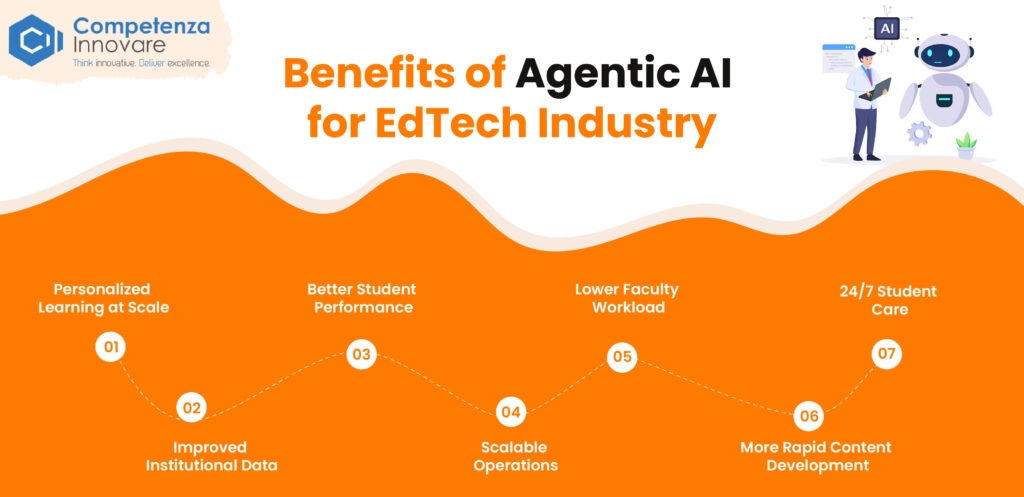
Benefits of Agentic AI for EdTech Industry
Personalized Learning at Scale: Agentic AI personalized learning provides individualized learning to all students at scale—a task (even at cohort scale) that human educators cannot execute at scale despite their expertise.
Better Student Performance: Adaptive learning systems, agentic AI tutoring, and proactive AI student retention interventions can all bring significant improvements in completion rates, in assessment performance, and in student satisfaction.
Lower Faculty Workload: AI grading, educational workflow, and agentic student support agents can save a lot of time for teachers—enabling them to concentrate on teaching, mentoring, and research instead of administration and handling routine queries.
24/7 Student Care: The AI education chatbots and intelligent learning systems are capable of delivering high-quality and consistent service even when no business is using the AI, better than the student expectations of instant and available real-time service despite time zones and time schedules.
Improved Institutional Data: AI learning analytics presents fine-grained, real-time knowledge of the institution, which can be used to capitalize on evidence-based curriculum design, resource-oriented selections, student services, and strategies.
Scalable Operations: Autonomous education systems can be expanded in size without increasing the number of personnel. Since it does not need to add headcount in the administrative team, agentic AI makes itself more operational as there is an increase in student enrollments.
More Rapid Content Development: AI curriculum development tools save by far the time between learning objectives and published course content—enabling institutions and EdTech platforms to build curriculum faster to the needs of the market and their students.
Roadmap for Implementing Agentic AI in EdTech
Phase 1 – Describe Learning and Operational Objectives: What outcomes do you desire agentic AI to achieve—completion rates, assessment performance, response time to support, and administrative efficiency? Hard targets come in handy to define the use cases to be focused on and success measurement.
Phase 2 – Determine Data Preparedness: Agentic AI requires clean, linked learner data, including the engagement indicators, history of previous performance, interaction with content, and support history. Leverage the data infrastructure you have and calculate timeframes to make fixed decisions about the time to implement the changes.
Phase 3 – Select the Right Platform: Select the priority of agentic AI solutions in your needs, current-use tech stack, data privacy needs, and regulatory needs. It will work both with and without integrating with your LMS, student information system, and communication tools, but it’s not an afterthought.
Phase 4 – Pilot with a Defined Cohort: Implement agentic AI on a pilot scale—course-wide, cohort-wide, or administrative—with a well-defined baseline and a comparator group. Practicing pilots will reveal the issues of implementation and user-adoption obstacles that cannot be observed in the demonstrations of the vendors.
Phase 5 – Govern and Scale: Decide on limits with respect to which agentic AI can operate independently—threshold limits, escalation limits, and human override policies—before scaling. Implement a continuous reviewing rhythm to evaluate performance, tweak parameters, and determine the following use cases to enable.
Ready to Transform Your EdTech Platform With Agentic AI? Let’s Build Smarter Learning Solutions Together.
The Future of Agentic AI in Education
- Full Autonomous Learning Partner: AI tutoring systems will become non-session-based longitudinal models of student knowledge, skills, and learning preferences and will adjust each interaction depending on a relationship that develops over months and years and not sessions.
- Independent Curriculum Design: AI curriculum development agents will embrace the entire process of creating learning outcomes to release courses—researching content, organizing the learning process, creating materials, and continually updating them as the field advances.
- Predictive Institutional Management: The autonomous educational systems will simulate the performance of institutions—enrollment, exposure to retention, program sustainability, and accreditation preparedness—and reveal the strategic decisions before they occur as an urgent operational issue.
- Hyper-Personalized Assessment: Assessment will shift to continuous adaptive evaluation, assessing the actual knowledge one has, as opposed to the standardized test, which will be agentic AI taking the whole process of assessment through to the abacus of feedback to adjustment of learning pathways.
- AI-Native Learning Environments: The future of Edtech agentic AI lies in learning environments where the agentic AI becomes not an element that is added to the existing activity but the scaffold around which the whole learning process is organized—personalizing content, pacing, assessment, and support.
Conclusion
The concept of agentic AI in EdTech is a real change in what education technology would produce—not only to the institutions that use it but also to learners whose achievements it affects. With the competenza, use cases cross all aspects of the educational experience: learning, assessment, support for students and curriculum development, and any aspect of institutional operations.
Current investments in agentic AI in education by the institutions and EdTech platforms are building capacity that increases with time. With an agentic AI engine, intelligent learning systems improve with each interaction with a student, each assessment score, and each support intervention, offering an increasing margin between the educational experience they provide and what cold and fixed platforms can provide.
Whether the EdTech agentic AI can deliver value is not the question to most EdTech organizations and educational institutions in 2026. The question here is where to begin, how to govern it responsibly, and how to scale upwards across the learning experience as swiftly as possible.
Frequently Asked Questions
What is an agentic AI in EdTech?
EdTech agentic AI systems that attempt to achieve set educational goals, such as improving student outcomes, customizing education procedures, and computerizing educational management through planning, executing, observing the consequences, and altering them without requiring human intervention on each step are referred to as agentic.
What is agentic AI contrary to traditional educational technology?
The traditional EdTech is a responsive one—it responds to cues or follows the rules. This is integral to agentic AI in education—identify the optimal actions to take and then perform them, learn, and evolve its strategy over time. It is adaptable to evolving needs of the learners rather than following an identical program.
What are the key agentic applications in education?
The main applications involve AI personalized learning, agentic AI tutoring systems, AI grading systems, AI student support chatbots, AI curriculum development, AI student engagement and retention, educational workflow automation, and AI student learning analytics.
How long does edtech agentic AI take to implement?
The timeframes between the data measurement and live operations will be eight to fourteen weeks, depending on the extent of automation that needs to be done in student support or personalized learning pathways based on the specific use case intended by the dedicated piloting pilot. Wider multi-use-case programs last between twelve and twenty-four months with complex integration and institutional data preparation.
Would agentic AI apply well to smaller EdTech platforms and institutions?
Yes, although larger organizations might start with small groups, the most common entry points to cloud-based edtech developer agentic AI tools are single or two high-impact application activities: AI tutoring support and AI student engagement monitoring, which can be configured to communicate with the existing LMS infrastructure without large technology capital.
What does agentic AI need to know to be useful in education?
EdTech agentic AI requires clean and integrative data in the shape of learner engagement, performance history, content engagement, and support history. Data quality and connectivity among them are the most important factors in assessing the degree to which autonomous educational systems can be personal and intervene.