

Another field where AI is getting into is a new wave of intelligent automation in the healthcare sector, surpassing data analysis and recommendations. The sector of agentic AI in healthcare is reinventing the industry by introducing autonomous systems capable of decision-making, executing tasks, and streamlining work processes with the least human participation.
Contrary to the classical AI systems, healthcare AI agents are able to proactively work on various tasks: provide appointment scheduling, monitor patients, automate workflows, facilitate diagnosis, and support real-time clinical decision-making. These sophisticated AI health agents are assisting healthcare providers to transcend the cause and effect of automation and geared to even smarter, intelligent healthcare operations.
The intelligent solutions that are required in healthcare are increasing at a high rate. The growing need of patients, shortages of personnel, growing costs of operations, and high demands of regulatory compliance efforts are pressuring healthcare organizations to modernize their systems. Therefore, AI healthcare automation is now necessary in order to achieve more economic efficiency and patient care.
Healthcare is revolutionizing with agentic AI that addresses critical clinical workflow issues and patient engagement, as well as predictive diagnostics and hospital resource allocation. It reduces administration, enhances better decision-making, results in better patient outcomes, and contributes to healthcare digital transformation.
In this blog, one is going to speak about the most appropriate agentic AI healthcare application, the greatest successes, practical applications, the largest barriers, and the future of AI-based healthcare in 2026 and further on.
What Is Agentic AI in Healthcare?
The advanced type of AI in healthcare called “agentic” can make decisions, take action, and control work with minimum human intervention. Unlike the conventional scenario of AI systems, which are mainly data processors or suggestive, agentic AI has the capability to improve the healthcare process in real time.
This is a big step in healthcare technology. The purpose of using AI agents in healthcare is to automatize complex tasks in healthcare, make it more efficient, and contribute to better decision-making in the area of patient care, diagnostics, and hospital management. Rather than replacing medical personnel, agentic AI helps to relieve administrative loads of the administrators and allows medical professionals to devote more attention to patients.
The most basic form of healthcare AI uses can be best expanded upon as the integration of the following powerful technologies:
- Machine learning (ML): allows AI systems to be trained on vast amounts of healthcare data, find patterns, and continuously optimize performance in the future. This helps to improve precision in diagnosing, predictive analytics, and patient monitoring.
- Large Language Models (LLMs): Use AI to read and understand medical information that is complex in nature. They will be in a position to read patient documentation and summarize the clinical notes and help in faster decision-making.
- Natural Language Processing (NLP): It allows AI to absorb, reason, and respond to human speech. It makes AI healthcare chatbots, virtual assistants, and intelligent patient communication systems.
- Knowledge Representation: Deepens clinical data, medical records, and healthcare and drives AI systems to make better decisions.
- Retrieval-Augmented Generation (RAG): Enhances reasoning in AI by translating systems to real-time healthcare data, medical knowledge bases, and updated patient records to ensure that the results become more relevant and accurate.
All these technologies enable intelligent healthcare systems to increase efficiency, better the outcomes of patient care, and shape the future of AI-powered healthcare.
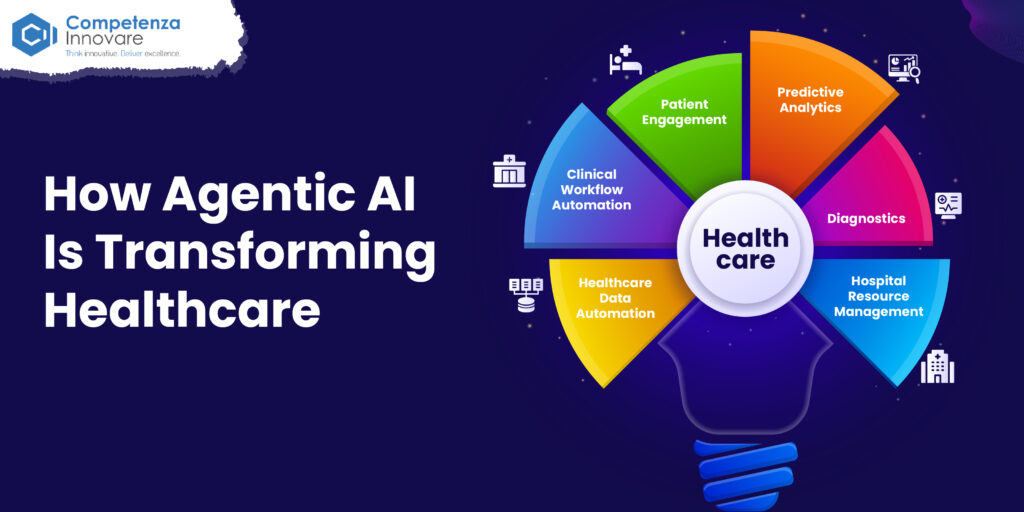
How Agentic AI Is Transforming Healthcare
Healthcare is a sector that will experience significant challenges in 2026, which include the cost of operation, workforce shortages, rising demand of patients, overworking requirements of administration, and convoluted compliance needs. These complications are compelling the healthcare organizations to implement more intelligent and effective solutions. Here, agentic AI development in healthcare is causing significant change. With the combination of smart automation and real-time decision-making, AI in healthcare could assist hospitals, clinics, and health organizations to develop their efficiencies, lessen workload, and improve patient care.
Clinical Workflow Automation
One of the biggest impacts of agentic AI is in clinical workflow automation. AI can help to automate such ordinary tasks as documentation, planning, billing, and administration employment, reducing the number of such operations and promoting organizational efficiency.
Patient Engagement
AI agents in healthcare are enhancing patient interaction through providing a personalized conversation, virtual assistance, appointment reminders, and expedited assistance. This assists in enhancing the patient satisfaction and experiences of care.
Predictive Analytics
Real-time and historical data in the healthcare industry are employed to detect patterns and anticipated health risks through agentic AI. This assists the healthcare professionals to make proactive decisions and enhance patient outcomes.
Diagnostics
Intelligent engines are now assisting in making diagnoses more precise through medical records and symptom and clinical data analyses, which are faster to carry out using AI. This helps to make faster and wiser medical decisions.
Hospital Resource Management
The optimization of resources in the hospital, including staff members, beds, and equipment, can be done through agentic AI. This maximizes the efficiency of the operation and reduces costs.
Healthcare Data Automation
Processing copious volumes of healthcare data is complex. With agentic AI, healthcare data automation becomes more straightforward by organizing, analyzing, and processing data more effectively to achieve improved decision-making.
In the future of healthcare systems, AI-based healthcare applications will play a critical role to ensure that the healthcare system is not only cheaper and efficient but also provides patients with improved care in 2026.
Top Agentic AI Use Cases in Healthcare
The integration of intelligent automation in healthcare has made agentic AI in healthcare one of the primary innovation sources as more healthcare organizations are adopting it. By making patients safer and hospitals more efficient, AI agents in healthcare have assisted healthcare providers to reduce the number of manual tasks, enhance efficiency, and achieve better patient outcomes. Such intelligent systems can also be used to analyze a large volume of healthcare data within a short time span, reduce unnecessary medical practices, and assist in making healthcare decisions faster, both in clinical and managerial practices.
1. AI-Powered Patient Triage Agents
The triage of patients is one of the most urgent processes in healthcare, mainly in emergency and high-need scenarios. The AI-driven patient triage agents assist in measuring symptoms, prioritizing urgent patients, and referring patients to the appropriate level of care according to severity and medical requirements.
Key use cases include:
- Symptom assessment
- Patient routing
- Emergency prioritization
These AI systems assist in minimizing the waiting time, enhancing the delivery of care, and enabling the patients to get access to medical care in time.
2. Clinical Documentation Agents
Healthcare professionals also spend a lot of time on clinical documentation. Healthcare AI agents help to streamline the process of documentation to allow healthcare workers to provide less and more care to victims.
Key use cases include:
- Automated note generation
- EHR updates
- Medical coding assistance
This makes documentation more accurate, work processes are simplified, and the general effectiveness improves.
3. Appointment & Scheduling Agents
Manual handling of appointments may lead to delays, late appointments, and scheduling inefficiency. The agentic AI will help with the automation of the scheduling and communication improvement process with patients.
Key use cases include:
- Appointment booking
- Rescheduling
- Follow-ups
- Patient reminders
This facilitates scheduling and minimizes the no-shows, and enhances patient satisfaction.
4. Revenue Cycle Management Agents
The management of the revenue cycle is critical towards maintaining the operations of health care. The agentic AI will assist in automating financial processes and streamlining administration complexity in billing and insurance.
Key use cases include:
- Claims processing
- Billing automation
- Insurance verification
This reduces the number of errors during the processing, increases the reimbursements, and enhances the management of revenues.
5. Clinical Decision Support Agents
Patient care involves provision of precise and timely information. Healthcare AI agents can assist service providers in making quicker and more knowledgeable choices based on extensive amounts of patient and clinical information.
Key use cases include:
- Treatment recommendations
- Drug interaction alerts
- Risk assessments
Such systems enhance the accuracy of diagnosis, facilitate treatment plan development, and patient safety.
6. Remote Patient Monitoring Agents
Remote monitoring has been gaining relevance in the management of chronic conditions as well as enhancing long-term care. The use of surveillance based on AI assists in monitoring the health of patients in real-time.
Key use cases include:
- Wearable device monitoring
- Alert generation
- Chronic disease management
This helps in proactive care and timely intervention and better patient outcomes.
7. Healthcare Contact Center Agents
Healthcare facilities receive numerous patient requests on a daily basis. Contact center AI agents enhance their establishment and quicker patient assistance.
Key use cases include:
- Patient support
- FAQ handling
- Care navigation
The systems enhance patient interactions and lower support workloads, as well as improve the quality of the entire service.
8. Hospital Operations Agents
Hospital operations are also vital in providing quality care. In healthcare, AI performs the role of an agent to maximize resources and improve the operations at healthcare facilities.
Key use cases include:
- Bed management
- Resource allocation
- Staff scheduling
This enhances efficiency in the hospital, lowers the cost of operations, and facilitates improved healthcare delivery.
These agentic AI healthcare applications continue to transform the future of healthcare as they continue to be adopted. Through intelligent automation coupled with real-time decision support, AI-powered healthcare solutions are enabling organizations to develop smarter, more rapid, and efficient healthcare systems.
Also Read: Agentic AI In Fintech
Benefits of Agentic AI in Healthcare
The benefits of agentic AI in healthcare are being realized and experienced clinically, operationally, and administratively as its adoption continues to increase. AI agents in healthcare are also assisting organizations to develop a smarter and efficient healthcare system since they are able to change the manner in which patients are addressed and eliminate inefficiencies.
Improved Patient Outcomes
A better patient outcome is one of the most potent benefits of AI agents in healthcare. The agentic AI assists medical practitioners to provide quality care by including individual treatment recommendations, proactive medicine, and fast diagnosis. Predictive insights and real-time monitoring also allow one to better recognize health risks in order to achieve better treatment outcomes.
Reduced Administrative Burden
The time spent on administrative work is very high in health facilities. Agent AIs can be used in the field of healthcare to mitigate this load by consequently automating hospitals, such as documentation, billing, scheduling, and communication with patients. This minimizes the time spent on manual work and enables healthcare staff to work more on providing quality care.
Enhanced Clinical Efficiency
Sometimes healthcare professionals are busy attending to operational chores. When AI is used in healthcare in a way of automation, routine activities can be made efficient, leading to an efficient system. This will allow the doctors, nurses, and other healthcare professionals to concentrate more on patient care and critical decisions about the medical cases.
Better Decision-Making
Decision-making is crucial and should be timely and accurate in the field of healthcare. AI agents in healthcare can deliver real-time information based on the analysis of patient records, medical histories, laboratory outcomes, and qualitative data. The AI-based insights will enable faster diagnosis, improved treatment planning, and improved clinical decisions.
Lower Operational Costs
Healthcare operations management is expensive and complicated. AI-assisted healthcare systems may reduce resource wastage, minimize errors, and reduce operational expenses by automating workflows and enhancing the allocation of resources to areas that need them. This will enable the healthcare organizations to enhance productivity and optimize resources.
Scalable Healthcare Delivery
The healthcare systems require solutions that are scalable, as the demand of the patients is ever-increasing. In healthcare, agentic AI assists organizations to effectively deal with increased numbers of patients by using automation, intelligent workflow, and resource utilization. This facilitates scalable, efficient, and future healthcare provision.
In sum, agentic AI has much more to offer health care than automation. AI is proving to be a technology of the future of the healthcare industry as it enhances patient outcomes, as well as operational efficiency.
Real-World Applications of Agentic AI in Healthcare
In the future, once research and practice have passed, a practical solution through Agentic AI in healthcare will be offered in hospitals, clinics, and healthcare systems by 2026. The healthcare sectors are actively implementing AI agents in healthcare to improve their work performance, treatment of patients, and digitalization.
Some of the most common applications in the real world are the following:
- AI-facilitated Patient Support Agents: CRM, office booking, follow-ups, medication reminders, and personal care assistants for patients.
- Automated Clinical Documentation: Automates the manual documents by use of technology to create clinical notes, summaries, and patient records.
- Intelligent Triage Systems: Page gives a chance to investigate the symptoms and medical history of the patients to define emergency cases and optimize care provision.
- AI Healthcare Chatbots: 24/7 capture patient support, frequently asked questions, and enhanced interaction with the patient.
- Predictive Analytics Platforms: Utilize health information to forecast dangers and futures and act in advance to treat.
- Smart Hospital Management Systems: Automate hospital functions such as bed availability, personnel schedules and resources.
The large healthcare providers begin to invest in the enterprise healthcare AI solutions to achieve efficiency, reduce costs, and develop smarter systems of healthcare. The future of healthcare delivery will be influenced by these AI-based medical applications as more and more people start adopting them.
Also Read: Agentic AI in EdTech
Challenges of Implementing Agentic AI in Healthcare
Even though the problem of Agentic AI in healthcare is linked to several benefits, certain challenges are related to the healthcare sector. Healthcare organizations must overcome technical, security, and operational obstacles in an attempt to achieve the success of AI-powered solutions.
Data Privacy and Security
Hospital systems handle personal details of the patients, and thus, privacy and security are major concerns. Considerable data security is required to assist in preventing the breaches and maintain patient trust.
Regulatory Compliance
Application of AI technologies within healthcare organizations must be in accordance with tough regulations.
Key regulations include the following:
- HIPAA
- GDPR
- Regional healthcare regulations
By fulfilling these demands, safe and compliant AI implementation is guaranteed.
Legacy System Integration
A lot of hospitals rely on the old systems and infrastructure. The implementation of AI agents in healthcare with the previously used software may become challenging and time-consuming.
Trust and Adoption
AI systems require that healthcare professionals have trust before embracing them. It is necessary to develop trust with proper understanding and performance that is guaranteed.
Nevertheless, with those obstacles, the organizations that are able to successfully implement AI healthcare agents can enhance the efficiency, increase patient care, and lead to long-term innovations.
Ready to Transform Healthcare with Agentic AI? Let’s Build Your AI Solution Today.
Future of Agentic AI in Healthcare
An agentic AI in healthcare has the highest potential in the future, as the healthcare system is shifting towards intelligent automation. With the development of AI technology, AI agents in healthcare will become increasingly influential to enhance efficiency, enhance patient care, and aid with smarter decision-making.
The key changes that in the few years ahead will be witnessed are the following:
- AI Medical Assistants will be smarter: AI medical assistants will be smarter and help medical specialists to diagnose, communicate, and offer medical assistance to patients faster.
- Full Autonomous Healthcare Workflows: Additional healthcare capabilities will be automated, including operational scheduling, documentation, billing, and workflow management, to become more efficient in their operations.
- Patient Care Agents: AI will provide more individualized care scenarios by analyzing patient data and can give personal recommendations, support, and monitoring.
- Adapted Predictive Healthcare Systems: It will also become possible to have AI in the future that is able to detect threats earlier, contribute to preventative healthcare, and more extensively plan the treatment process.
- Increased AI-Human Cooperation: AI will not be used to substitute healthcare professionals; instead, it will remain their assisting mechanism. The close cooperation between AI systems and medics will enhance the quality of care and decision-making.
Healthcare AI agents will be one of the primary sources of healthcare digital transformation as they will assist in the creation of smarter, faster, and more efficient healthcare systems as the adoption increases.
Conclusion
Healthcare agentic AI is changing the healthcare industry by ensuring efficiency, better patient care, and automating multifaceted workflows. AI agents in health care are assisting in creating more intelligent healthcare systems, both in terms of patient monitoring and diagnostics and clinical workflow automation. The further AI is employed, the more intelligent automation will position healthcare companies that invest in its employment in a more advantageous position to do things better, spend less, and be more innovative. At The Competenza, we help businesses develop AI-based solutions, which leads to digital transformation and further growth. The prospect of health care is intelligent, networked, and artificial.
FAQs
What does Agentic AI in healthcare mean?
Agency AI in healthcare refers to intelligent artificial intelligence systems that can identify decisions, implement actions, and manage healthcare activities with only a few human interactions. Unlike the old AI systems, which offer only recommendations or analyze information, agentic AI has the capability of automating the complicated healthcare processes. These AI-based tools can be used to enhance efficiency, decreasing the administrative load and improving patient care in hospitals, clinics, and any other healthcare institution.
What is the functioning of Agentic AI in healthcare?
The operation of AI agents within the healthcare sector is associated with the adoption of the latest technologies, such as machine learning (ML), artificial large language models (LLMs), natural language processing (NLP), and predictive analytics. Such technology allows AI systems to integrate with healthcare data, process medical data, automate work systems, and provide real-time decision-making. This aids healthcare providers in being more precise and effective and improves patient outcome.
What will be the role of Agentic AI in healthcare in 2026?
Right in 2026, healthcare is changing the face of healthcare, as agentic AI is enhancing clinical workflow and patient engagement and automating the clinical workflow as well as improving the functioning of the hospital. To cut expenses, enhance care delivery and efficiently tackle rising patient demands, healthcare providers are deploying AI to improve service delivery.
What are the best applications of Agentic AI in healthcare?
Artificial intelligence (AI) in the field of healthcare finds some of the most valuable agentic applications in AI-assisted patient care, clinical workflows, AI appointment scheduling, clinical decision support, medical diagnosis support, patient monitoring, predictive analytics, and resource optimization of hospitals. These applications are on the way to an even smarter healthcare system.
What are the advantages of Agentic AI in healthcare?
The critical advantages of healthcare AI agents are better patient outcomes, less administrative work, increased clinical efficiency, varied decision-making, lower healthcare delivery expenses, and scalability of healthcare delivery. The use of AI in healthcare can help organizations work more efficiently by automating repetition of work and optimizing workflow.
Will agentic AI help improve patient care?
Yes, AI agents in healthcare do make life easier in terms of providing better patient care, as they allow for providing personal assistance, real-time tracking, quicker diagnosis, and prompt treatment suggestions. AI-driven systems can remind patients of their medications, communicate with them, and even help them feel healthy, thus improving patient interaction and achieving better patient outcomes.
Will agentic AI replace doctors and medical professionals?
No, agentic AI in healthcare is not created to replace healthcare professionals but to assist them. AI facilitates the automation of other normal routine tasks, medical data processing, and decision support. In this way, doctors, nurses, and healthcare employees are able to pay more attention to critical clinical decisions and care of the patient.
What are the challenges of deploying Agentic AI in healthcare?
Use of AI-based healthcare solutions has been associated with problems of privacy and security of data, legal regulations, integration of old systems, and confidence in the system by health professionals. To achieve successful and safe AI implementation, organizations need to tackle such challenges.
Does Agentic AI offer security to healthcare systems?
Yes, AI agents related to healthcare can be safe under the condition of proper cybersecurity measures, secure infrastructure, encryption, and regulations, such as HIPAA and GDPR. Considerable attention could be drawn to effective security measures to protect sensitive information on patients and ensure the safe functioning of AI.
What does the future of agentic AI in healthcare hold?
The future of Agentic AI within healthcare is very promising. The future will bring more sophisticated AI systems, which will be independent and customized. Smarter AI medical assistance, proactive health services, self-service work, and even more active AI-human communication are some of the determinants of the future of healthcare services delivery.