

Projects are not because the models are ineffective but because organizations underestimate all the things that surround the model, such as data quality, governance, assessment, integration complexity, ownership of operations, and long-term cost management. The key to preventative actions against costly AI projects is first knowing why enterprise LLM projects fail and that they cannot get past the demo phase.
Generative AI has led to a wave of experimentation in businesses. But regardless of hundreds of successful proofs of concept, very few of them turn into production-grade systems producing a quantifiable business value. Based on a range of industry research, a sizable proportion of enterprise AI programs fail to reach production or fail to produce substantial ROI post-implementation. Exact numbers will vary across the definitions of failure, yet the trend is the same: a good portion of AI projects have potential but never get to become an actual asset of the business.
Whether the LLMs are powerful enough is no longer a question of concern to CTOs, CIOs, VPs of Engineering, or those in charge of digital transformation. The problem is how to actualize them safely, reliably, and profitably.
This article discusses why enterprise LLM projects fail in reality, and it offers a practical description of what can be done to get beyond the proof of concept successfully to production.
The State of Enterprise LLM Projects in 2026
The use of generative AI by enterprises is paying off. Almost all large organizations have introduced pilots, in-house experiments, or innovation programs using LLM Development Services. Nevertheless, there is a sizable chasm between experimentation and deployment.
This gap is reflected in various industry reports measuring the enterprise AI project failure rate. Studies generally indicate that, based on the approach applied, most AI projects end up dead or do not contribute to any quantifiable business results upon launch.
Noteworthy, these data are different since failure is defined differently by various analysts:
- Some measure projects that never reach production.
- Others measure projects that reach production but fail to deliver ROI.
- Some evaluate adoption rates among end users.
In spite of the variation, the summary is astonishingly similar: the challenge in adopting AI in businesses is often a result of a lack of capability of the models rather than almost anything else.
What Percentage of AI Projects Actually Reach Production?
A large percentage is also not universal in all studies and industries, though most analysts hold that a high number of AI initiatives take a back seat before production begins or do not result in the generation of business value. The question is not normally about the effectiveness of the model per se but whether the organization is able to operationalize, govern, and maintain the solution when at scale.
It is one of the significant transformations in the AI world. The question was five years ago:
“Will AI resolve this issue?
Today the question is
“Can the organization deploy, govern, and scale the solution?”
The bottleneck is no longer on model capability but on operational work.
Why Do LLM Demos Work but Production Fails? The Prototype Trap
The prototype trap is possibly one of the most famous explanations of the demo-to-production gap in AI, as explained by many practitioners.
An LLM proof of concept is commonly realized under idealistic conditions.
- The team selects a narrow use case.
- The data is carefully curated.
- The prompts are manually optimized.
- The inputs are clean and predictable.
- The results look impressive.
- Then reality arrives.
An assistant procurement employee who has done a perfect job on ten sample documents has to now do 50,000 vendor contracts of varying years, departments, formats, and jurisdictions.
A chatbot based on customer support that had been tested on a controlled set of data is now confronted with millions of actual customer requests with misspellings, lack of context, conflicting data, and emotional wording.
The disparity between demo and production is huge.
Consider the contrast:
Demo Environment
- One well-structured PDF
- Small dataset
- Hand-picked examples
- No latency constraints
- Limited user volume
Production Environment
- Thousands of inconsistent documents
- Legacy systems
- Messy spreadsheets
- Conflicting business rules
- High concurrency
- Strict compliance requirements
Many of the LLM proof of concept to production projects fall at this stage. The hallucinations commence, and the model boldly creates a policy that was never in place that, in either a financial or legal sense, can cost actual money. The latency spikes and two-second wait time of the demo are now forty-five seconds in the actual scenario and a total abandonment of the tool. The context window collapses, and the model loses the beginning of a lengthy discussion. There is no useful information in the retrieval step, and the system does not have a graceful way of responding to it. The API starts to hit a rate limit, and the entire thing throws an uncaught error before a customer.
- Hallucinations emerge on edge cases.
- Retrieval systems fail to find relevant information.
- Latency increases under load.
- Costs exceed expectations.
- Context windows become limitations.
- API outages occur.
- Fallback mechanisms are missing.
- Teams discover they built a demonstration—not a product.
Numerous organizations boast dozens of AI pilots but very few production deployments. It is not the problem that the demos were fake. The problem is that they never dealt with the facts of production worlds.
A demo is not a product. It is easy to wrap a user interface in an API key. Creating a reliable system that is secure yet accesses messy enterprise data and generates consistent responses with load is among the most difficult of the current decade’s engineering challenges. Days of considering the model to be the product are behind us. Integration around it is the hard and valuable work.
The 7 Real Reasons Enterprise LLM Projects Fail
To respond to the question of what makes AI projects implemented in enterprises fail, it is essential to look beyond the performance of models.
1. No Clear Business Goal or Success Metric
Most of the projects start out with enthusiasm instead of business strategy.
Companies are choosing to implement an AI initiative but have not found a specific workflow they think is enhancing. Consequently, teams create great demos without being able to clarify how they will gauge success. Questions such as whether or not the project worked are answered by no one since the executives have not defined any KPI.
The answer is basic yet neglected frequently: ensure that any project is anchored to a business result, performance indicator, or budget early on.
2. Poor Data Readiness
One of the largest LLM project challenges is data quality.
Production datasets are usually not as clean as development datasets. Structured documents are used to provide a test but are deployed into environments full of duplicates, out-of-date records, inconsistencies in formatting, and incomplete information.
Data problems keep reoccurring across the board as projects increase in scale. Companies cannot always realize how much work it took to prepare enterprise knowledge to be available, searchable, and reliable to AI systems.
Active AI programs do not consider data preparations as an outcome but as akin to readiness.
3. The Demo-to-Production Gap
The vast majority are written using just one API key and no consideration of what code is below. Production requires an operating layer with the ownership of cost, monitoring, and failure overhaul on all the models the company uses. In the event that that layer is absent, no one is aware who is to blame when the costs are out of control or the system collapses. The model is okay. There are no operations about it.
- There is no monitoring.
- No ownership structure.
- No cost controls.
- No failover strategy.
- No reliability engineering.
What happened is, as expected, the production of a promising prototype, which cannot be used as a business-dependent system. When eliminating experimentation and transitioning to production, it is necessary to develop the infrastructure around the model.
4. Missing Guardrails and Governance
An unclothed LLM in production is a liability. A validation layer is not present, and as such, there is nothing to intercept a fabricated answer until it is sent to a user. The absence of an audit trail and human control leads to no accountability. This can be quite dangerous in fields of law, medicine, and money, where a single sure misstep can have serious consequences. This is even not optional as it once was when the EU AI Act’s high-risk obligations take effect in 2026.
The risk of AI systems occurs when they are used without control in organizations. Organizations suffer reputational risks and compliance risks due to the absence of validation layers or human review processes, audit trails, or access control.
Governance is not dictatorship; it is a production need.
5. No Evaluation Framework
A core question that many teams are unable to address is:
“Is the system improving or getting worse?”
When you cannot quantify the workingness of the system, you are flying blind. It is amazing how many teams turn out product ships that have no evaluation in a closed loop that can tell them whether a change has made the things better or silently broken them. The knowledge base expands, and the answers begin to drift, with the knowledge base evolving without the user noticing any changes until a user confides. Evaluation is not a nice-to-have. It is the instrument panel. In the absence of constant analysis, organizations lose track of system quality. There must be continuous measurements in production AI, and not periodic testing.
6. Over-Engineering Through Fine-Tuning
Among the simplest international LLM implementation mistakes is the belief that all problems need specific model training to be addressed. When implementing retrieval-based solutions can solve the problem more quickly, economically, and with the smallest technical debt, organizations often go directly to the cycle of fine-tuning. Maintenance requirements, retraining cycles, version management, and complexity of operation are all added with fine-tuning. In a range of enterprise use cases, retrieval-augmented generation (RAG) with strong prompting is safer and yields improved results.
7. The Talent and Experience Gap
A significant distinction exists between an engineer who has created AIs with impressive demos and those who have deployed functioning AI systems in the field. Trained AI involves problem-solving experience, evaluations, on-hand architecture, cost-efficiency, and the failure modes that are unique to LLMs at scale. These skills are not represented in the majority of engineering curricula as yet. The team lacks such depth; it halts the project right at the demo to the production line. There are numerous engineering groups that are well-expert in software development but less trained in:
- LLM evaluation
- Prompt versioning
- RAG optimization
- Model governance
- AI observability
- Cost management
- Hallucination mitigation
The reason why AI pilots don’t reach production is this talent gap. Organizations require individuals that are knowledgeable on software engineering and production AI operations.
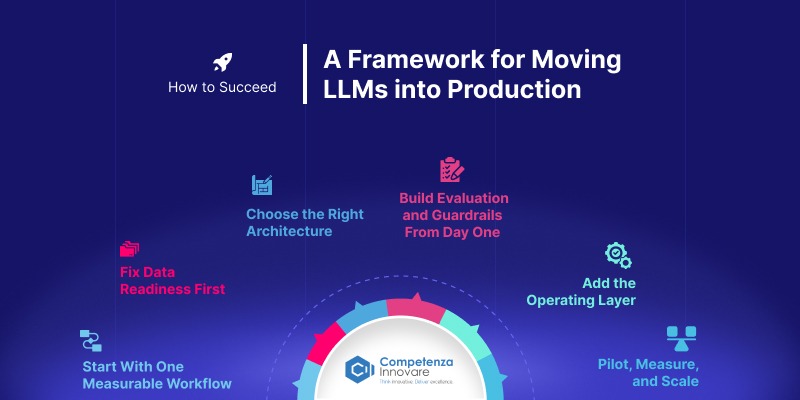
How to Succeed: A Framework for Moving LLMs into Production
The good news is that all those failures have a work-around solution. When teams close four or more of these gaps, they always get more shipments to the market faster and do not have to stall as frequently as those that close only one or two. The following is a staged model of the operation of taking LLMs to production, which directly corresponds to the 7 failures above. The order is significant, as you should go in order.
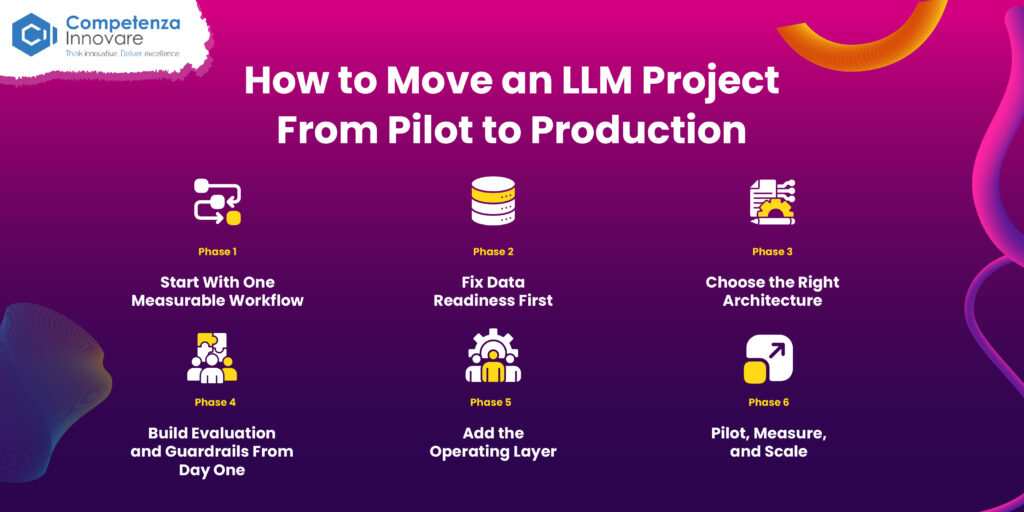
How to Move an LLM Project From Pilot to Production
A breakthrough model does not often result in success. It typically comes as a consequence of punished performance.
Phase 1: Start With One Measurable Workflow
Do not be tempted to develop a mass portfolio of pilots. Select one use case where there is a well-defined KPI associated with an actual profit and loss line. Determine beforehand what success will be in terms of numbers. Rather than trying to transform the organization on a large scale, they concentrate on one workflow and a specific KPI. This is the most significant AI project success factor.
Examples include:
- Reducing customer support handling time
- Accelerating contract review
- Improving proposal generation
- Increasing developer productivity
Any project must respond to the following three questions:
- What are the types of workflow automation every enterprise needs?
- How will improvement be measured?
- What business value does success create?
This focus brings about a congruency between the technical and business stakeholders.
Phase 2: Fix Data Readiness First
Before you write a line of orchestration code, invest in your data. Centralize it. Clean it. Establish a repeatable DataOps method to prevent decay of the foundation. At the beginning, assume that production data will be ugly, inconsistent, and incomplete, as it always is. Teams that consider clean data as a nice-to-have are blindsided. Manifold teams that assume messy data as the order-of-the-day construct systems that endure contact with the real world.
Invest in:
- Data cleaning
- Data standardization
- Metadata enrichment
- Knowledge management
- Data governance
The most powerful model is unable to make up untrustworthy information. Companies that invest in DataOps early save on deployment delays in the future.
Phase 3: Choose the Right Architecture
In the majority of enterprise applications, the initial point of departure is:
RAG + Prompt Engineering + Workflow Integration
This architecture offers a flexible system, transparency, and reduced maintenance costs.
Why Is RAG Better Than Fine-Tuning for Production?
Most enterprise applications have their starting point with retrieval-augmented generation with sound prompt engineering. This is why RAG is superior to fine-tuning in production and the response is feasible. RAG has your system up-to-date since you updated documents today as opposed to retraining next month. It provides you with traceability since you are able to know what source came up with an answer. Fine-tuning, by contrast, bakes out a snapshot that doesn’t change and retrains your debt each time your data changes.
This brings a number of benefits:
- Lower maintenance costs
- Faster updates
- Better traceability
- Source citations
- Reduced retraining requirements
Fine-tuning is still good, particularly in specialized behaviors and domain-specific tasks, though it is not the default option. In the case of many enterprises, a hybrid architecture may eventually turn out to be the best architecture.
Phase 4: Build Evaluation and Guardrails From Day One
Persevere not to screw them on afterwards. Establish a closed-loop evaluation system that uses automated scoring of the LLM as judges in addition to human spot checking of a subset of the results. Enclose all model calls with a run-time guardrail. Add graceful failures to the expected failures. What would you do upon receiving a rate limit error in the API? How do you handle zero results of retrieval? What will occur should the output fail on your schema? A production system responds to all these in a graceful manner. An exception is thrown in a demo.
Production AI requires:
- Automated evaluations
- Human review workflows
- Regression testing
- Performance benchmarks
- Safety monitoring
There must be guardrails to all model interactions. Outputs should be validated by validation layers before they are given to the users. Fallback should gracefully deal with failures. Organizational leaders who design governance in the architecture do not have to pay later to rectify it.
How to Reduce LLM Hallucinations in Production
Grounding, validation, and oversight help to reduce hallucinations.
RAG systems give verifiable source material that limits the responses of the model. Risk is also minimized through output validation, schema enforcement, confidence scoring, and human review. Human-in-the-loop processes are still needed in high-stakes areas in order to ensure reliability and compliance.
Phase 5: Add the Operating Layer
It is this layer that makes a demo a product. Make a decision as to who owns the cost, governance, and monitoring of all models in your stack. Calibrate it in a way that you can view latency, spend, and quality on display. Provide failover in such a way that when one model or provider experiences a bad day, the system does degrade in a graceful fashion rather than collapsing. And you do not have a production system without this layer. There is a demo that you have, which has a public URL.
To achieve production AI, there must be an operating layer including:
- Monitoring
- Logging
- Cost tracking
- Security controls
- Access management
- Incident response
- Model governance
The absence of such a layer means that organizations are unable to scale AI systems. The operating layer is the layer that converts a prototype into a business platform.
Phase 6: Pilot, Measure, and Scale
Test the worth of whatever you are going to expand on in the first place. Run the pilot. Compare with a number that you had defined in Phase 1. You tend to broaden the scope to new use cases only when the results are holding. That is the self-sufficient cycle that keeps programs that build up into real value and programs that indulge in costly folly.
Companies can only grow when they provide value as compared to the intended KPIs.
- Measure outcomes.
- Validate adoption.
- Confirm ROI.
- Then scale.
This disciplined practice advances dramatically the chances of success in the long term.
Ready to Move Your LLM Project From Pilot to Production? Let’s Build It Right.
How Long It Takes and What It Costs to Get to Production
A common executive question is:
How long does it take to deploy an LLM to production?
The straightforward response is that this is based on project scope, underlying data quality, and the complexity of the enterprise environment. In many cases a focused use case with clean and well-structured data could reach a state of production within a couple of weeks. Nevertheless, bigger implementations with several systems, compliance provisions, governance provisions, security audits, and intricate integrations might need months to implement in full and harden to be utilized in production.
Among the greatest misunderstandings is the fact that the choice of models sets the time. As a matter of fact, data readiness and operational complexity tend to be the largest variables. Organizations also need to make plans on how to remain the owner who would not be involved in the first deployment. Production AI is not a single implementation, as knowledge repositories evolve, embeddings require periodical updates, models evolve, guardrails must be continuously tuned, and evaluation datasets must grow over time. Effective AI programs in enterprises consider maintenance, monitoring, and optimization as needs of the long-term operating model and not an issue of post-launch.
How to Measure ROI on an Enterprise LLM Project
ROI needs to be treated by the executives just like any other strategic investment.
Focus on:
- Productivity gains
- Cost reductions
- Revenue improvements
- Risk reduction
- Employee efficiency
- Customer experience improvements
AI business cases with the highest strength are those that are directly linked to financial success. The project that impresses the stakeholders at a demo is not the successful one. A successful project will be one that will continually increase a KPI associated with business performance. This is where it is usually decided by organizations whether to recruit internally or employ external experts.
Build vs. Buy: When to Bring in a Partner
There are some decisions wherein every team may decide to build or to buy, and it does not require a sales pitch, but it should be given a decent framing. Making your own would be logical when the engineers have real-life production AI experience, and you have real capacity to own the system in the long run. The decision to bring in a partner makes sense to the business in case the talent and experience difference is what binds you and the speed to production is relevant.
The seventh cause of failure is the one most companies should not underestimate, and it is the one that its partners find the quickest solution for. When your demos perform and your production versions are giving patchy answers and your model builds are surging and none of the team has ever delivered reliable AI, then you need the experience with the operating layer. That is precisely what established LLM development services are designed to do. When that is where you are, it is worth a chat before you give the go-ahead to another pilot that will get lost in an obscure report.
It is reasonable to develop LLMs in-house when organizations have:
- Production AI expertise
- Data engineering maturity
- Operational ownership capabilities
- Sufficient implementation bandwidth
A partner is valuable to us when speed, experience, and minimization of risks are important.
Prompts and interfaces are not the only types of AI partners that are actually useful. They aid organizations in visualizing the experience gap by setting up assessment structures, administration procedures, execution architectures, observability practices, and generation operations.
Outsourcing innovation should never be an objective. Measurable business value should be a goal to accelerate the pilot-to-real business value journey.
Why Choose Competenza for Enterprise LLM Development?
A model alone is insufficient to ensure an LLM project can be moved successfully out of proof of concept and into production. The common challenges encountered in implementing AI can be addressed at The Competenza Innovare, where we provide organizations with a secure, scalable, and business-oriented solution with LLM.
What Makes Competenza Different?
- Production-First Approach: We are not engaged in the provision of AI prototypes but in actual business results.
- LLM & Generative AI Solutions expertise: RAG systems and AI assistants to enterprise-level automation.
- Powerful Data & Integration Services: Linking AI services to deployed enterprise systems and processes.
- Governance & Security Focus: Compliance, reliability, and responsible deployment of AI.
- End-to-End AI Development: Strategy, architecture, deployment, monitoring, and optimization.
- Introduced Systems to AI Success: Guide businesses to the transition between systems that pilot AI and production.
To make AI investments predictable, high-impact business solutions regardless of the scale of your first AI project or enterprise-wide deployments, Competenza can make an impact.
Conclusion
The reason why enterprise LLM projects fail is also shockingly consistent across industries: the technology is typically prepared, but the operational discipline around it is not.
Organizations are successful when they are concerned about the total system and not the model.
The winning structure is simple:
Begin with a single workflow → organize the data → select the appropriate architecture → construct evaluations and guardrails → construct the operating layer → quantify the outcomes => scale.
The success of enterprise AI is not often connected with a magical model. It has to do with developing trusted processes, governance, and working underpinnings surrounding potent technology.
The question to ask before rolling out your next AI initiative is whether your organization is indeed ready to produce. Structured LLM production-readiness evaluation, or a 7-question checklist to ask before building a custom LLM, can assist in uncovering latent risk, preventing expensive implementation errors, and meaningfully increasing your prospects of succeeding in AI investment into quantifiable business revenue.
Frequently Asked Questions
Why are the majority of enterprise AI projects failing?
Difficulties of most enterprise AI projects are caused by strategy, data, governance, and operational gaps and not by limitations of the model. Demos tend to work on clean datasets, but when it comes to production, messy data, compliance, evaluation, and business complexity challenge many teams.
What is the percentage of AI projects becoming production?
How success and failure are defined by the researchers varies the estimates. The industry surveys indicate that a larger proportion of the AI projects are not launched into production, or they do not deliver any business value with operationalization, which is a symptom of the still-existing disconnect between experimentation and operationalization.
Why is it that LLM demos work but production fails?
LLM demos are traditionally run in controlled environments, with clean datasets and specially crafted prompts. Production environments bring a sense of scale; latency demands; inconsistent information; and border cases, as well as governance and availability failures, which were never exercised in the proof of concept.
What do you do to pilot an LLM project to production?
Start with one quantifiable workflow, improve data readiness, adopt the proper design, develop evaluation processes and gates, promote ownership of processes, and scale when they could derive quantifiable business outcomes over the specified KPIs.
What is the time to deploy an LLM to production?
Niche applications can also be deployed to production in a few weeks, with a company-wide deployment taking several months. The timeframe is more reliant on data readiness, degrees of integration, governance imperatives, and organization maturity as opposed to model selection.
What is the measurement of ROI on an enterprise LLM project?
Assess ROI based on business performance and not on technical performance. Target productivity enhancement, cost savings, increment in revenue, reduction in risks, and customer service metrics that generate recorded financial effects and executive visibility.
Does Competenza develop tailor-made AI and LLM applications?
Yes, Competenza creates proprietary AI applications, such as AI assistants, enterprise chatbots, RAG systems, document intelligent platforms, workflow automation applications, and industry-specific LLM applications.